Understanding the concepts on Degrees of Freedom
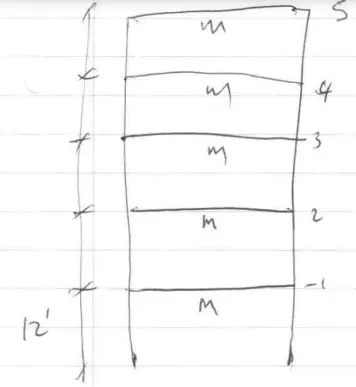
A five storey structure with 5 translational DOF is shown here. Each storey has mass ‘m’. The eigenvalue problem has been solved and the 5 periods of vibration Tn and their corresponding mode shapes, φn has been derived.
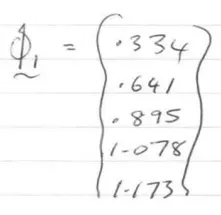
The fundamental period of vibration (T1 = 2 seconds) and its associated mode shape:
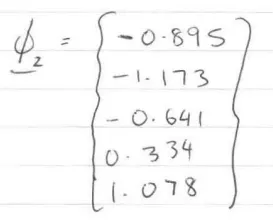
The second mode of vibration (T2 = 0.6852 seconds) and its associated mode shape:
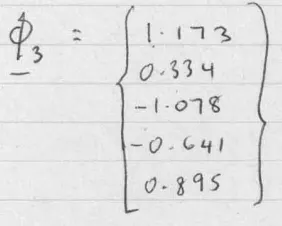
The third mode of vibration (T3 = 0.4346 seconds) and its associated mode shape:
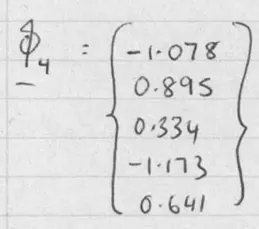
The fourth mode of vibration (T4 = 0.3383 seconds) and its associated mode shape:
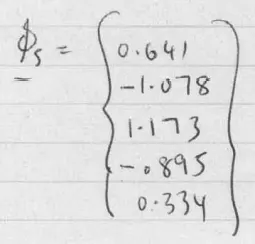
The fifth mode of vibration (T4 = 0.2966 seconds) and its associated mode shape:
Solution:
A five storey building building with their respective mode shapes and time period of vibration has been given and their repective base shear needs to be calculated.
- Ln , Mn and Γn for each of the five modes are to be computed.
- Also, calculate the effective modal mass Mn* and the modal mass participating ratio for the 5 modes. The mass matrix will be required to evaluate these parameters.
Mass matrix :
m= `[[m,0,0,0,0],[0,m,0,0,0],[0,0,m,0,0],[0,0,0,m,0],[0,0,0,0,m]]`
Modal mass matrix (M) = `Phi`nT * m * `Phi`n
For the first mode, Mode 1 (n=1)
= [ 0.334 0.641 0.895 1.078 1.173] `[[m,0,0,0,0],[0,m,0,0,0],[0,0,m,0,0],[0,0,0,m,0],[0,0,0,0,m]]``[[0.334],[0.641],[0.895],[1.078],[1.173]]`
By doing matrix multiplication
= [0.112m+0.410m+0.801m+1.162m+1.376m]
M1=3.861m
Similarly for other modes the modal mass matrix is calculated as '3.861m' as the mode shapes for all the storeys are similar to each other and as per the manual claculation the values are more or less close to 3.861m. So,
M2=3.861m, M3=3.861m, M4=3.861m, M5= 3.861m.
Modal Property Calculation:
Ln = `Phi`nT * m * `iota`
where `iota`= influence vector and assuming 100% uitilization of seismic force it is `[[1],[1],[1],[1],[1]]`
Mode 1:
= [0.334 0.641 0.895 1.078 1.173] `[[m,0,0,0,0],[0,m,0,0,0],[0,0,m,0,0],[0,0,0,m,0],[0,0,0,0,m]]``[[1],[1],[1],[1],[1]]`
By doing matrix multiplication
=[0.334m+0.641m+0.895m+1.078m+1.173m]
L1=4.121M
Mode 2:
=[-0.895 -1.173 -0.641 0.334 1.078] `[[m,0,0,0,0],[0,m,0,0,0],[0,0,m,0,0],[0,0,0,m,0],[0,0,0,0,m]]``[[1],[1],[1],[1],[1]]`
By doing matrix multiplication
=[-0.895m-1.173m-0.641m+0.334m+1.078m]
L2=-1.297M
Mode 3:
=[1.173 0.334 -1.078 -0.641 0.895] `[[m,0,0,0,0],[0,m,0,0,0],[0,0,m,0,0],[0,0,0,m,0],[0,0,0,0,m]]``[[1],[1],[1],[1],[1]]`
By doing matrix multiplication
=[1.173m+0.334m-1.078m-0.641m+0.895m]
L3=0.683M
Mode 4:
=[-1.078 0.895 0.334 -1.173 0.641] `[[m,0,0,0,0],[0,m,0,0,0],[0,0,m,0,0],[0,0,0,m,0],[0,0,0,0,m]]``[[1],[1],[1],[1],[1]]`
By doing matrix multiplication
=[-1.078m+0.895m+0.334m-1.173m+0.641m]
L4=-0.381M
Mode 5:
=[0.641 -1.078 1.173 -0.895 0.334] `[[m,0,0,0,0],[0,m,0,0,0],[0,0,m,0,0],[0,0,0,m,0],[0,0,0,0,m]]``[[1],[1],[1],[1],[1]]`
By doing matrix multiplication
=[0.641m-1.078m+1.173m-0.895m+0.334m]
L5= 0.175M
Modal participation factor calculation:
Γn = Ln/Mn
Mode 1:
=4.121/3.861
Γ1=1.067
Mode 2:
=-1.297/3.861
Γ2=-0.335
Mode 3:
=0.683/3.861
Γ3=0.176
Mode 4:
=-0.381/3.861
Γ4=-0.09
Mode 5:
=0.175/3.861
Γ5=0.04
Effective Modal mass (Mn*) calculation:
Mn*=(Ln)2/Mn
Mode 1:
=(4.121)2/3.861
M1*=4.39M
Mode 2:
=(-1.297)2/3.861
M2*=0.43M
Mode 3:
=(0.683)2/3.861
M3*=0.12M
Mode 4:
=(-0.381)2/3.861
M4*=0.03M
Mode 5:
=(0.175)2/3.861
M5*=0.007M
Modal mass participating ratio calculation:
=Mn*/Mj
where Mj=Total mass=M+M+M+M+M=5M
Mode 1:
=4.39M/5M=0.88=88%
Mode 2:
=0.43M/5M=0.086=8.6%
Mode 3:
=0.12M/5M=0.024=2.4%
Mode 4:
=0.03M/5M=0.006=0.6%
Mode 5:
=0.007M/5M=0.001=0.1%
Base shear (Vb) calculation:
Vb=Mn* x An
where An is the pseudo-acceleration which is obtained using the time acceleration graph and obtained using the time given
T1 = 2 seconds, A1= 0.27g
T2 = 0.6852 seconds,A2= 0.76g
T3= 0.4346 seconds,A3= 1.03g
T4 = 0.3383 seconds,A4= 1.03g
T5= 0.2966 seconds,A5= 0.76g
Mode 1:
=4.39m x 0.27g
V1=1.18 mg
Mode 2:
=0.43 x 0.76
V2=0.32 mg
Mode 3:
=0.12 x 1.03
V3= 0.12 mg
Mode 4:
=0.03 x 1.03
V4=0.03 mg
Mode 5:
=0.007 x 0.76
V5=0.005 mg
Total base shear calculation using SRSS rule
V= √(V1)2+(V2)2+(V3)2+(V4)2+(V5)2
= √(1.18)2+(0.32)2+(0.12)2+(0.03)2+(0.005)2
Total shear = 1.29 mg
Results:
- Ln , Mn and Γn for each of the five modes are computed.
- Effective modal mass Mn* is also computed for all the five modes.
- The modal mass participating ratio is also computed for all the modes and to achieve 90% of modal mass participating ratio the first two modes are enough.
- Base shear for each modes and total base shear using SRSS rule are computed.