Understanding the concepts on Degrees of Freedom
Question 1:
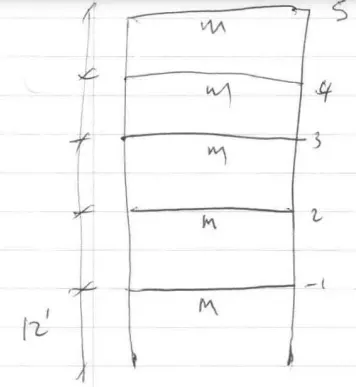
A five storey structure with 5 translational DOF is shown here. Each storey has mass ‘m’. The eigenvalue problem has been solved and the 5 periods of vibration Tn and their corresponding mode shapes, φn has been derived.
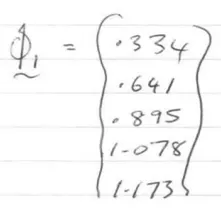
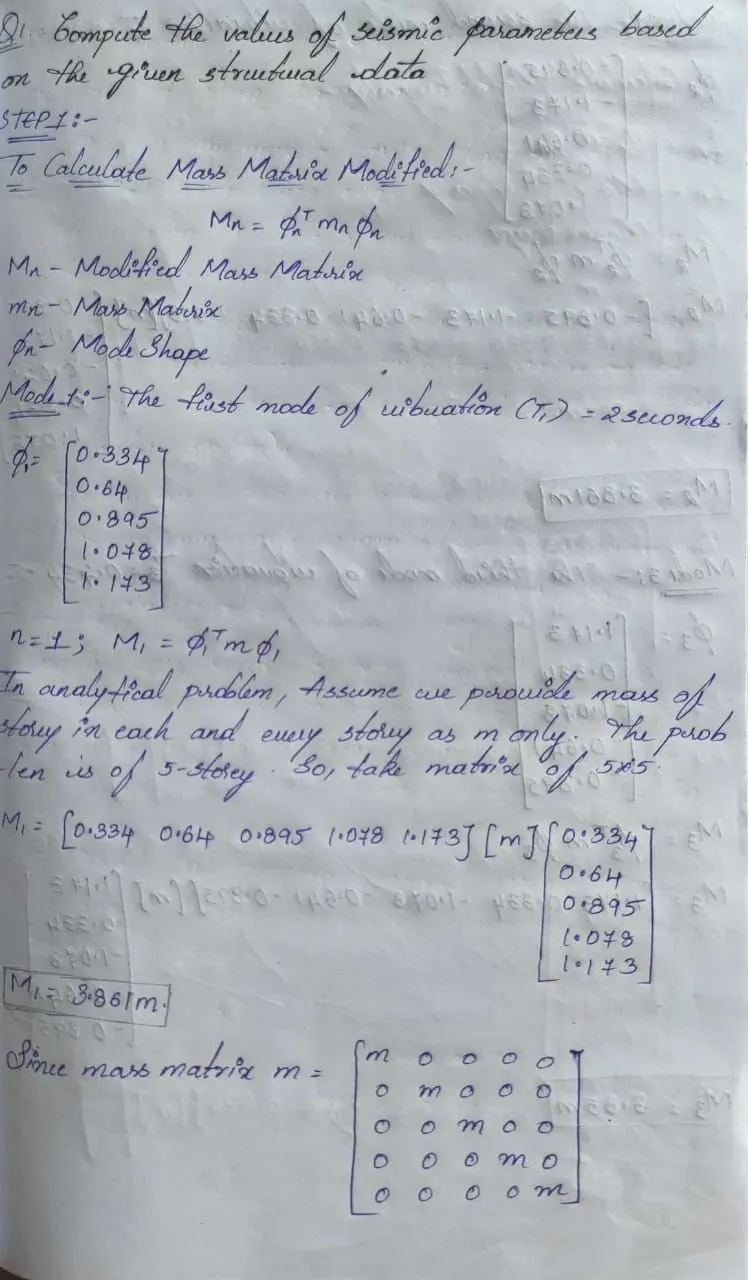
The fundamental period of vibration (T1 = 2 seconds) and its associated mode shape:
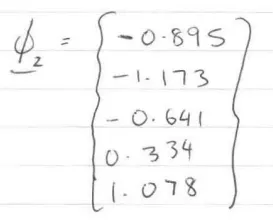
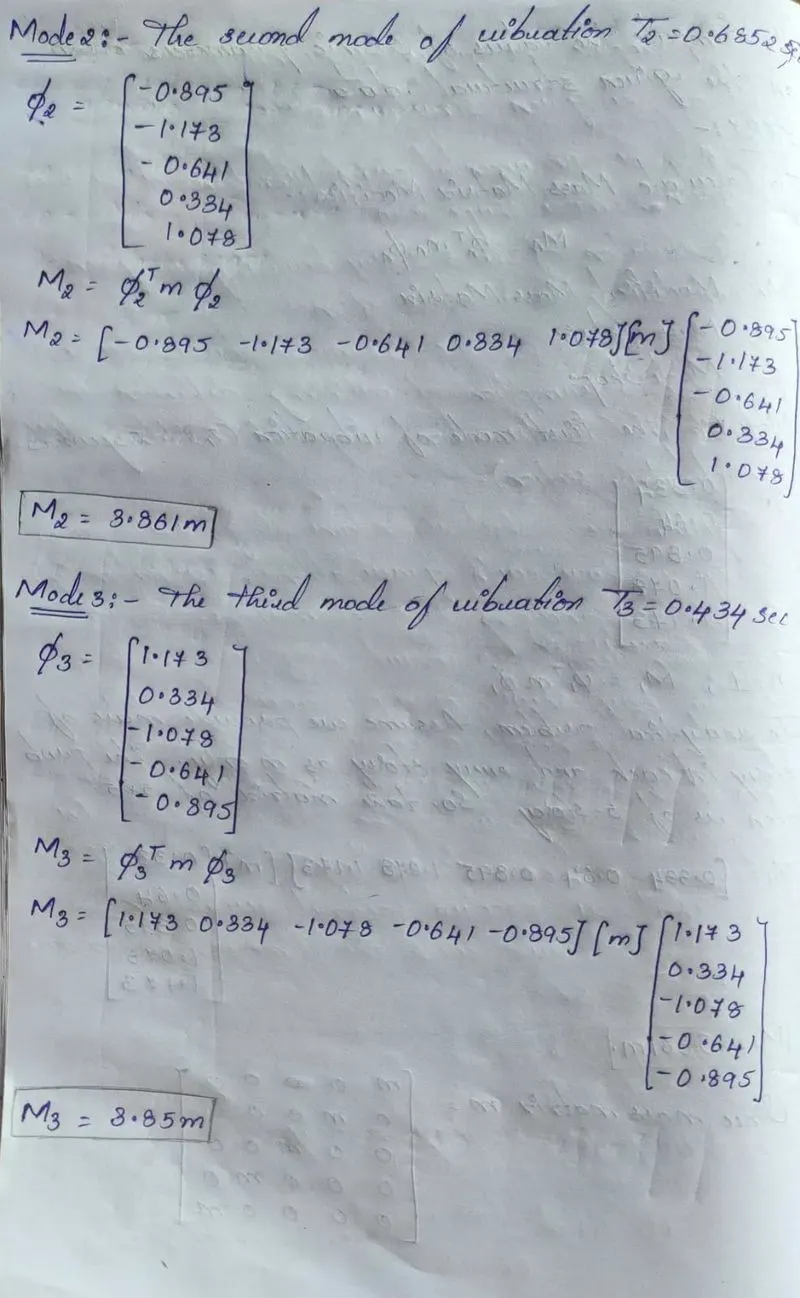
The second mode of vibration (T2 = 0.6852 seconds) and its associated mode shape:
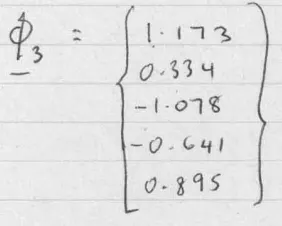
The third mode of vibration (T3 = 0.4346 seconds) and its associated mode shape:
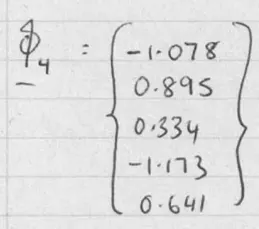
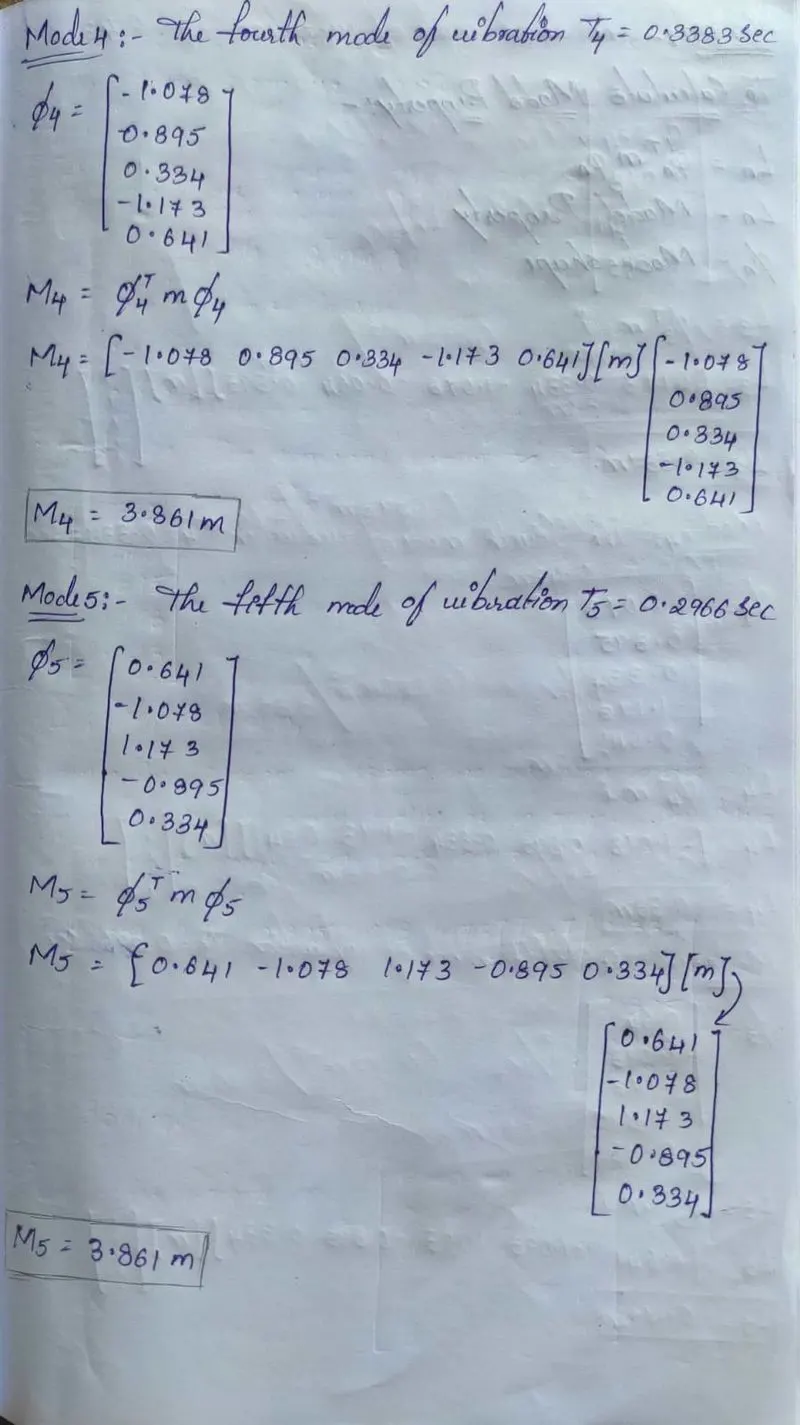
The fourth mode of vibration (T4 = 0.3383 seconds) and its associated mode shape:
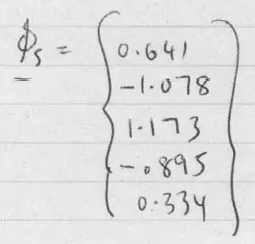
The fifth mode of vibration (T4 = 0.2966 seconds) and its associated mode shape:
- Ln , Mn and Γn for each of the five modes are to be computed from Equations below.
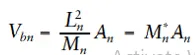
- Also, calculate the effective modal mass Mn* and the modal mass participating ratio for the 5 modes. The mass matrix will be required to evaluate these parameters.

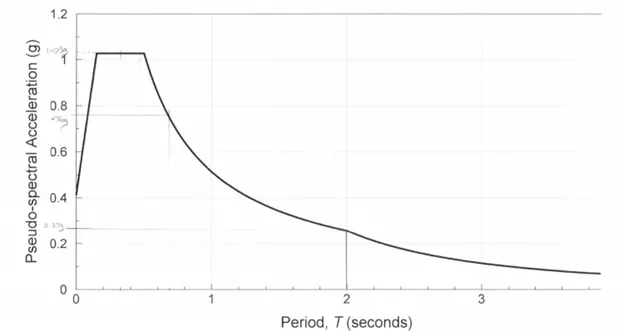
- Finally, obtain the base shear for each of the 5 modes of vibration and the combined base shear as per SRSS rule. The pseudo acceleration design spectrum to obtain the base shear for each mode is provided below.
- How many modes are to be considered such that a modal mass participating ratio of 90% is obtained?
AIM:-
- To calculate Ln, Mn and Tn for each of the five modes.
- To calculate the effective modal mass Mn* and the modal mass participationg ratio for the five modes and To calculate number of modes are to be considered such that a modal mass participationg ratio of 90% is obtained.
- To calculate the base shear for each of the five mode of vibration and the combined base shear as per SRSS rule. The pseudo acceleration design spectrum to obtain the base shear for each mode is provided.
OBJECTIVES:-
- To understand mode shapes of multi storey building.
- Manually calculate the base shear for multi storey buiding in modal analysis.
- Understand the terminologies involued in modal analysis.
PROCEDURE:-
1.1 To Calculate Modified Mass Matrix (Mn):-
Given data:-
- The fundamental period of vibration and mode shapes are given for 5-storey building.
- The elevation of the 5-storey building is given as 12'.
- Each storey as a mass of m.
- ϕ1, ϕ2, ϕ3, ϕ4 and ϕ5 are mode shapes given for a particular assumption of building's deflection for each storey.
- In analytical problem, Assume we provide mass of storey in each and every storey as m only. The problem is of 5-storey. So, take matrix of 5*5.
Mode1:-
Mode2 & Mode3:-
Mode4 & Mode5:-
RESULT:-
The seismic parameter Modified Mass Matrix is calculated based on the given structural data.
M1 = 3.861m
M2 = 3.861m
M3 = 3.85m
M4 = 3.861m
M5 = 3.861m
_____________________________________________________________________________________________________
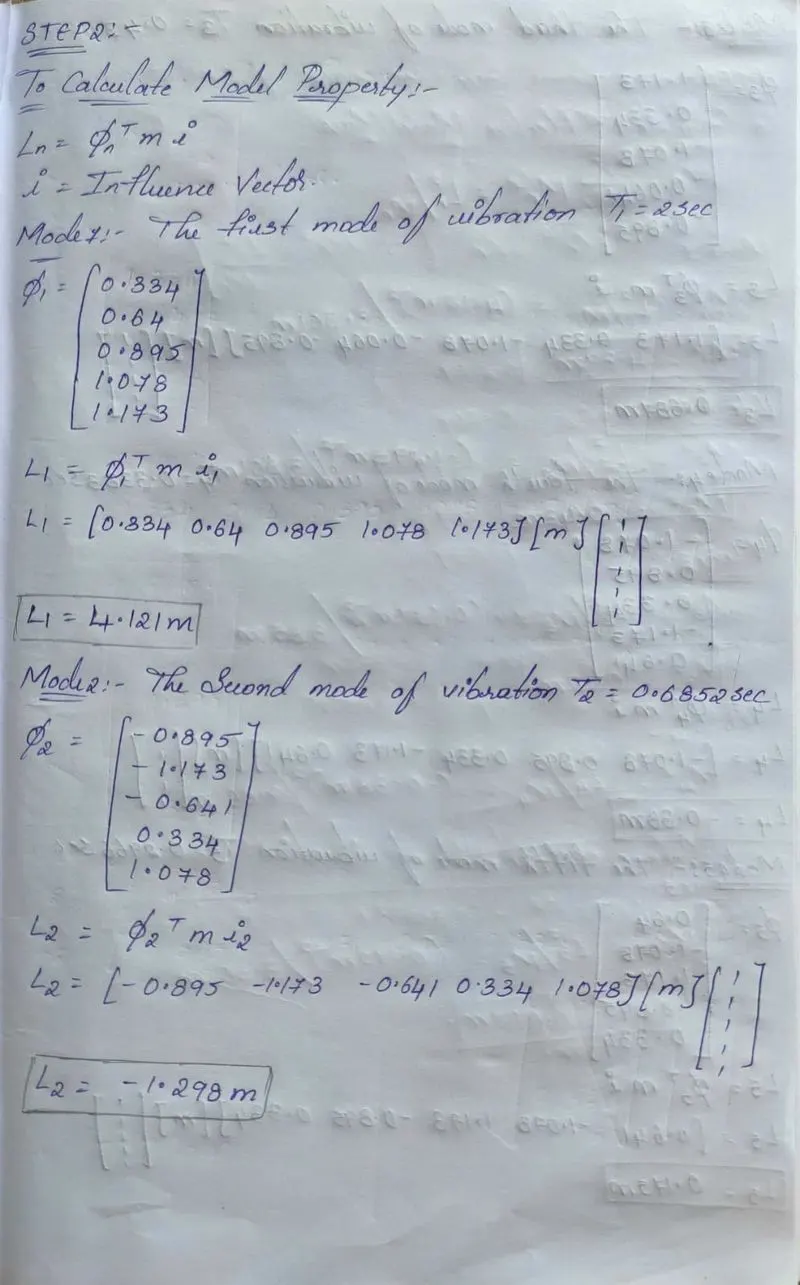
1.2 To Calculate Modal Property(Ln):-
Given data:-
- The fundamental period of vibration and mode shapes are given for 5-storey building.
- The elevation of the 5-storey building is given as 12'.
- Each storey as a mass of m.
- ϕ1, ϕ2, ϕ3, ϕ4 and ϕ5 are mode shapes given for a particular assumption of building's deflection for each storey.
- In analytical problem, Assume we provide mass of storey in each and every storey as m only. The problem is of 5-storey. So, take matrix of 5*5.
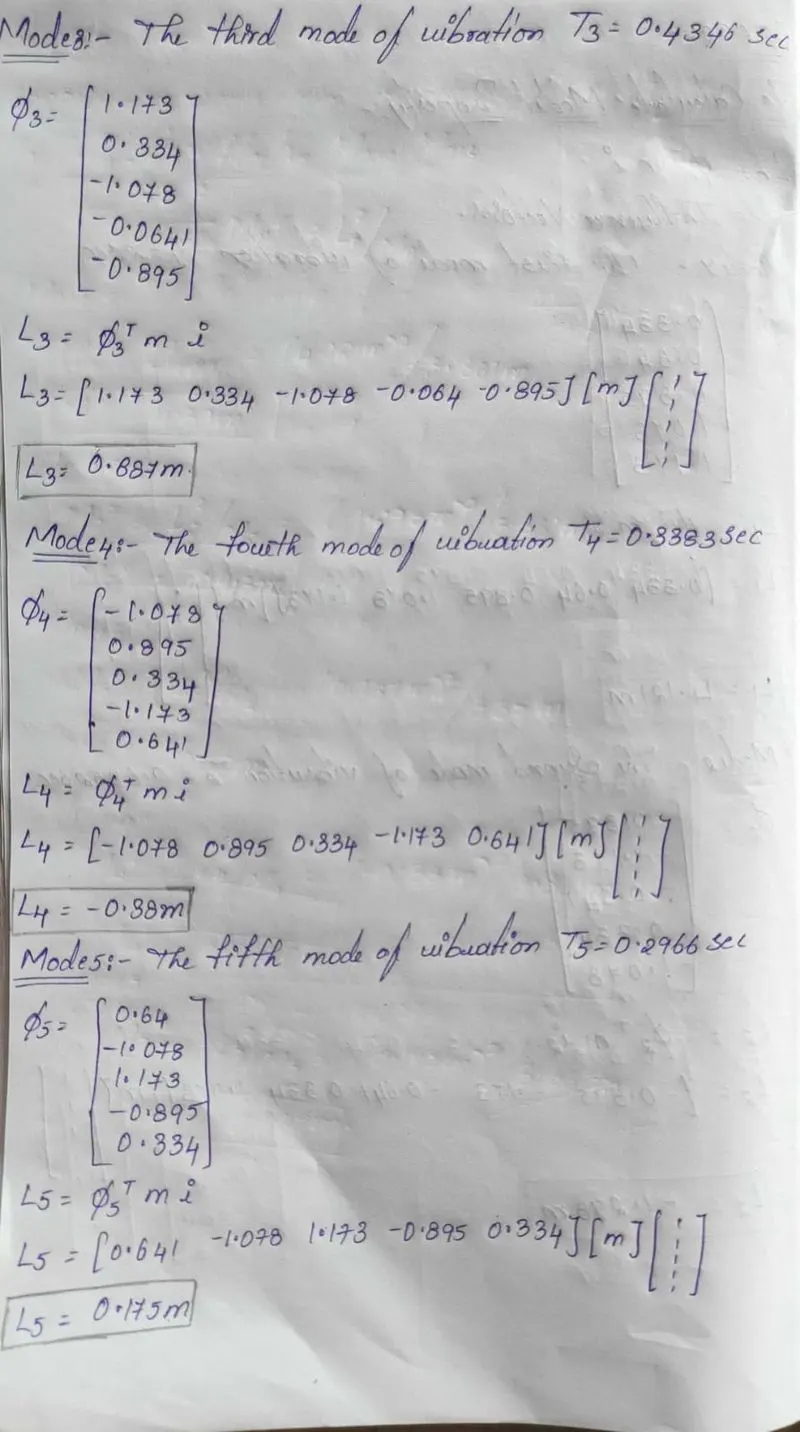
- Here, to calculate modal property, there is term called i, that is influence vector. For suppose if you apply force in x - direction, then how much force percentage is transferring in the same direction utilization of seisimic force. That is in fluence vector.
- Whatever be the case if the external load provided in the x - direction in a building 100% of load will transfer in the same direction..
- Asumme 100% utilization of sesimic force takes. Then there is a diversion takes place. Here, take influence factor as unit vector matrix.
Mode1 & Mode2:-
Mode3, Mode4 & Mode5:-
RESULT:-
The seismic parameter Modal Property is calculated based on the given structural data.
L1 = 4.121m
L2 = -1.298m
L3 = 0.687m
L4 = -0.38m
L5 = 0.175m
_____________________________________________________________________________________________________
1.3 To Calculate Modal Participation factor(Tn or Γn):-
Given data:-
- The fundamental period of vibration and mode shapes are given for 5-storey building.
- The elevation of the 5-storey building is given as 12'.
- Each storey as a mass of m.
- ϕ1, ϕ2, ϕ3, ϕ4 and ϕ5 are mode shapes given for a particular assumption of building's deflection for each storey.
- In analytical problem, Assume we provide mass of storey in each and every storey as m only. The problem is of 5-storey. So, take matrix of 5*5.
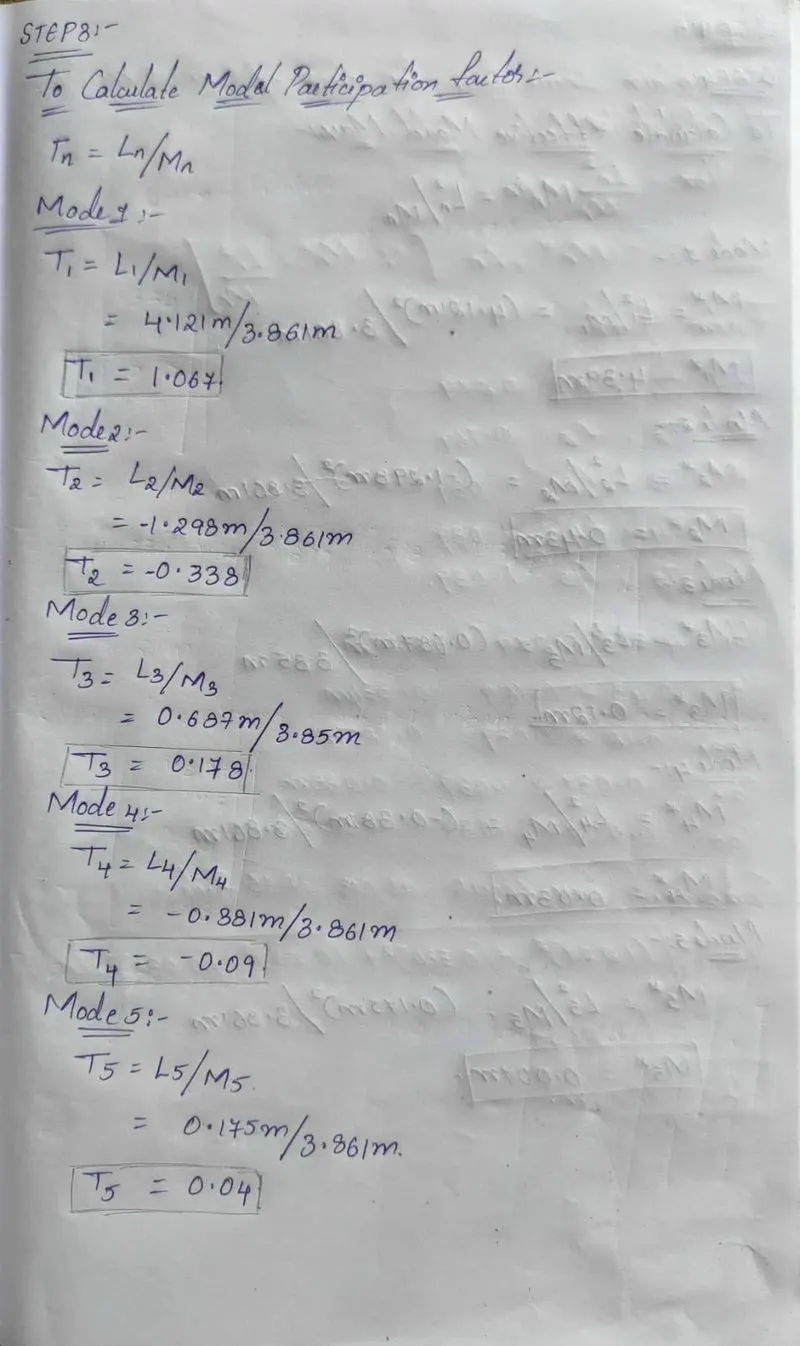
- Tn or Γn is a modal participation factor. It is a measure of the degree to which the nth mode participation in the response.
- The modal participation factor is a measure of how strongly a given mode contributes to the response of the structure when subjected to force/displacement excitation in a specific direction.
RESULT:-
The seismic parameter Modal Participation factor is calculated based on the given structural data.
T1 = 1.067m
T2 = -0.338m
T3 = 0.178m
T4 = -0.09m
T5 = 0.04m
_____________________________________________________________________________________________________
2.1 To Calculate Effective Modal Mass(M*):-
Given data:-
- The fundamental period of vibration and mode shapes are given for 5-storey building.
- The elevation of the 5-storey building is given as 12'.
- Each storey as a mass of m.
- ϕ1, ϕ2, ϕ3, ϕ4 and ϕ5 are mode shapes given for a particular assumption of building's deflection for each storey.
- In analytical problem, Assume we provide mass of storey in each and every storey as m only. The problem is of 5-storey. So, take matrix of 5*5.
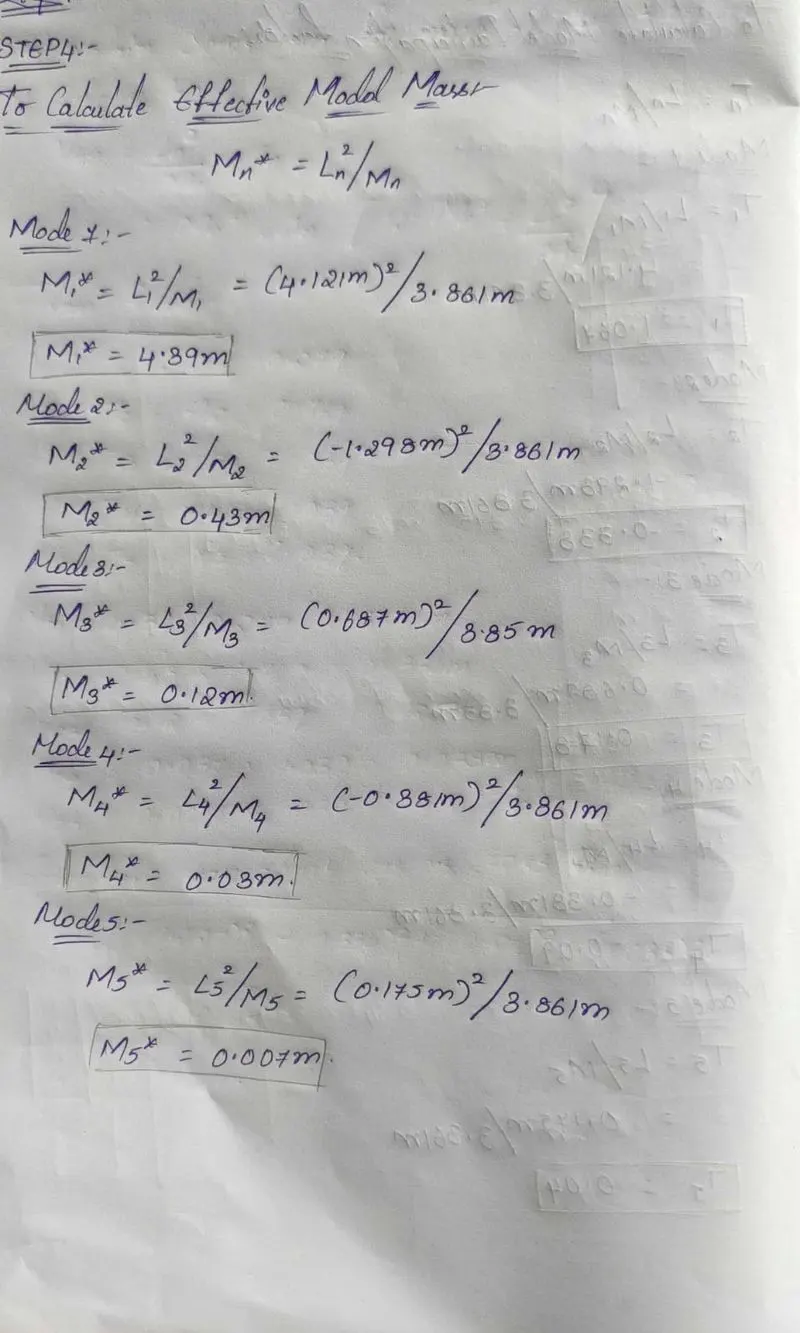
- The modal effective mass is a measure to classify the importance of a mode shape when a structure is excited by base acceleration (enforced acceleration)
- Effective modal mass is nothing but the total mass. For example 100kg of mass is there in the building then how much does it is participating in the mode1, 2 etc.
RESULT:-
The seismic parameter Modal Participation factor is calculated based on the given structural data.
M1* = 4.39m
M2* = 0.43m
M3* = 0.12m
M4* = 0.03m
M5* = 0.007m
_____________________________________________________________________________________________________
2.2 To Calculate Modal Participation Ratio(Mn*/Mj):-
Given data:-
- The fundamental period of vibration and mode shapes are given for 5-storey building.
- The elevation of the 5-storey building is given as 12'.
- Each storey as a mass of m.
- ϕ1, ϕ2, ϕ3, ϕ4 and ϕ5 are mode shapes given for a particular assumption of building's deflection for each storey.
- In analytical problem, Assume we provide mass of storey in each and every storey as m only. The problem is of 5-storey. So, take matrix of 5*5.
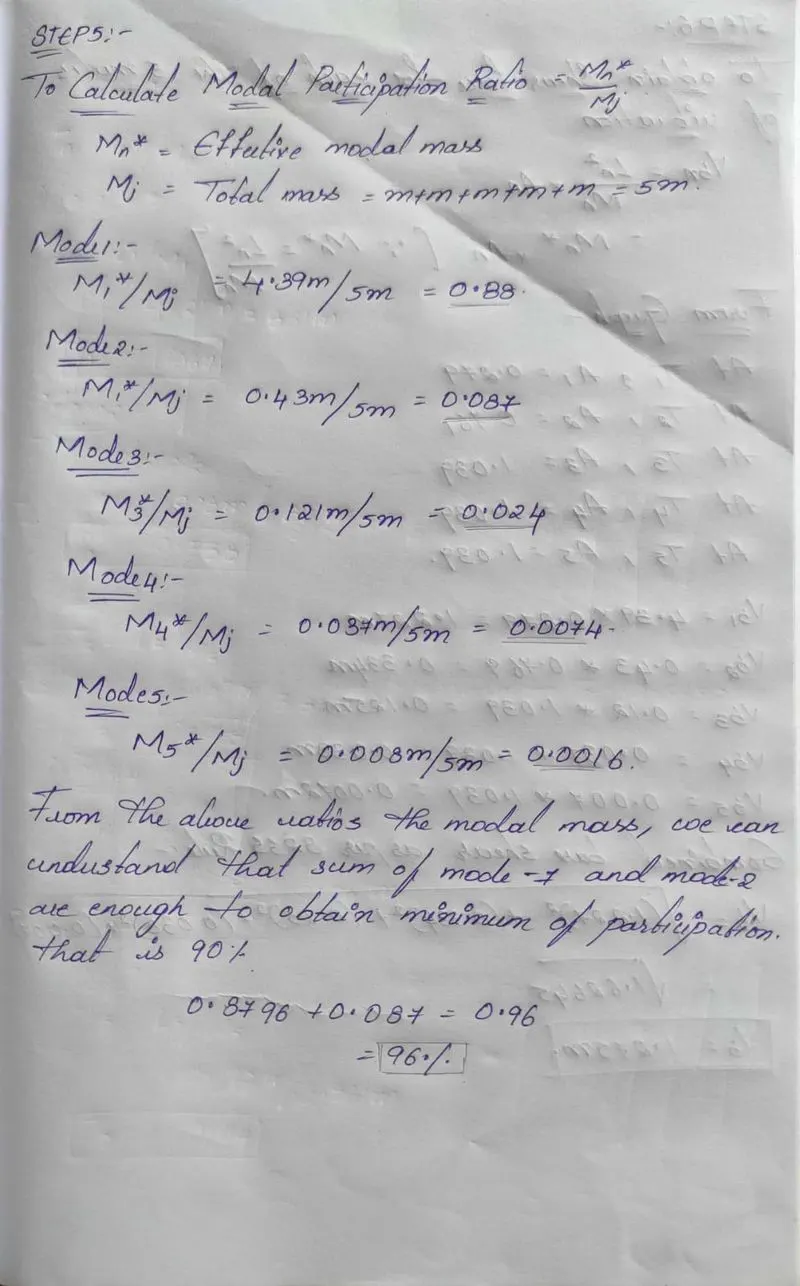
- Mj is the total mass of the building. For example we get 0.88 then it is 88% probability for the 1st mode to happen in building.
- From Modal Participation ratio it is clear that adding two mode mass participation ratios, we get 0.88+0.09=0.97.
- To achieve minimum 90% of modal mass participation ratio, The First two modes are enough.
RESULT:-
The seismic parameter Modal Participation factor is calculated based on the given structural data.
M1*/Mj = 0.08m
M2*/Mj = 0.087m
M3*/Mj = 0.024m
M4*/Mj = 0.0074m
M5*/Mj = 0.0016m
_____________________________________________________________________________________________________
3.0 To Calculate the shear force for each of the five modes of vibration and Calculate combined base shear as per SRSS Rule:-
Given data:-
- The fundamental period of vibration and mode shapes are given for 5-storey building.
- The elevation of the 5-storey building is given as 12'.
- Each storey as a mass of m.
- ϕ1, ϕ2, ϕ3, ϕ4 and ϕ5 are mode shapes given for a particular assumption of building's deflection for each storey.
- In analytical problem, Assume we provide mass of storey in each and every storey as m only. The problem is of 5-storey. So, take matrix of 5*5.
- Here, to calculate base shear for each of the 5 modes of vibration and combined combined base shear as per SRSS rule.
- Base shear is an estimate of the maximum expected lateral force that will occur due to seismic ground motion at the base of a structure. It depends upon thesoil conditions at the site.
- Here is the pseudo acceleration design spectrum to obtain the base shear for each mode as shown in the graph below.
- In general the Pseudo acceleration is in the terms of g. For vertical loadings we have earthquake qravitational acceleration (g). But we are analzing horizontal deformation. So, here the horizontal acceleration is required.
- To convert horizontal force in to a relative base shear for a paticular high rise building. We need to convert horizontal mass in to a force with relative acceleration on;y.
- It cannot be g which suppose to be downwatd direction. For horizontal mass we have to multiply it with a special acceleration. That is from pseduo spectral graph drawn with the time period in x-axis against PSA.
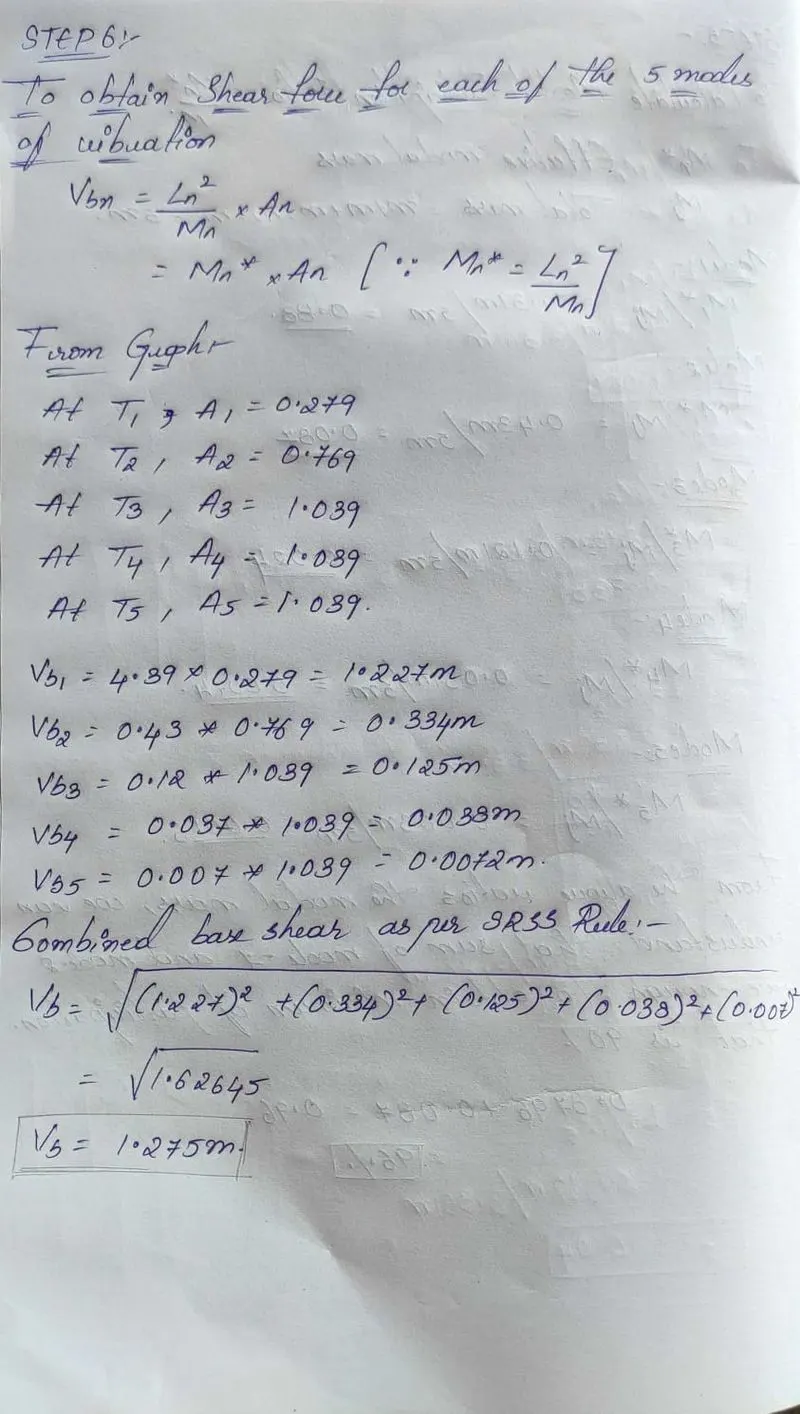
RESULT:-
The seismic parameter Base Shear is calculated based on the given structural data.
Vb1 = 1.227m
Vb2 = 0.334m
Vb3 = 0.125m
Vb4 = 0.038m
Vb5 = 0.0072m
The combined base shear as per SRSS Rule, Vb = 1.275m
___________________________________________***THE END**_____________________________________________