Understanding the concepts on Degrees of Freedom
Understanding the concepts on Degrees of Freedom
Question 1:
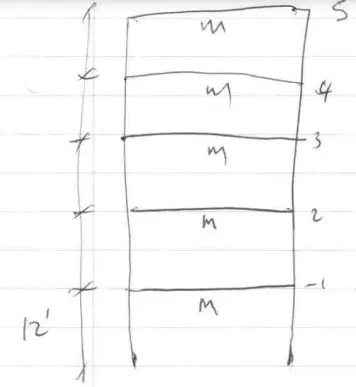
A five storey structure with 5 translational DOF is shown here. Each storey has mass ‘m’. The eigenvalue problem has been solved and the 5 periods of vibration Tn and their corresponding mode shapes, φn has been derived.
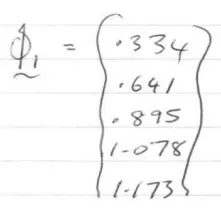
The fundamental period of vibration (T1 = 2 seconds) and its associated mode shape:
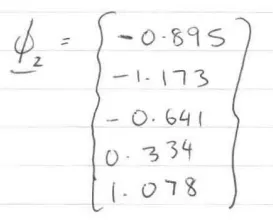
The second mode of vibration (T2 = 0.6852 seconds) and its associated mode shape:
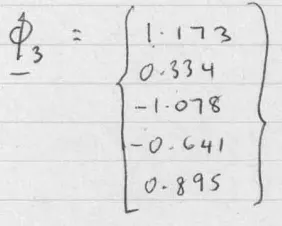
The third mode of vibration (T3 = 0.4346 seconds) and its associated mode shape:
The fourth mode of vibration (T4 = 0.3383 seconds) and its associated mode shape:
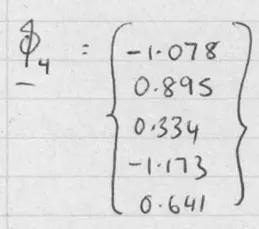
The fifth mode of vibration (T4 = 0.2966 seconds) and its associated mode shape:
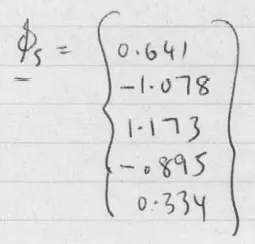
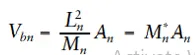
- Ln , Mn and Γn for each of the five modes are to be computed from Equations below.
- Also, calculate the effective modal mass Mn* and the modal mass participating ratio for the 5 modes. The mass matrix will be required to evaluate these parameters.

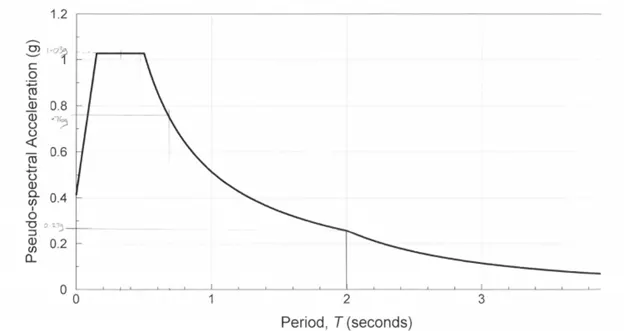
- Finally, obtain the base shear for each of the 5 modes of vibration and the combined base shear as per SRSS rule. The pseudo acceleration design spectrum to obtain the base shear for each mode is provided below.
- How many modes are to be considered such that a modal mass participating ratio of 90% is obtained?
Answer
AIM:- To obtain Ln, Mn and Γn for each of the five modes associated wih the model, calculate the effective modal mass M*n and the modal mass participating ratios for the five modes and also obtain the base shear as per SRSS rule.
INTRODUCTION- All the solutions are going to be explained with step by step procedure.
Mass matrix (m) = [ m 0 0 0 0
0 m 0 0 0
0 0 m 0 0
0 0 0 m 0
0 0 0 0 m ]
Modify mass matrix (M)= ΦT1 * m * Φn
for the first mode (n=1)
= [ 0.334 0.641 0.895 1.078 1.173 ] [ m 0 0 0 0 [ 0.334 ]
0 m 0 0 0 [ 0.641 ]
0 0 m 0 0 [ 0.895 ]
0 0 0 m 0 [ 1.078 ]
0 0 0 0 m ] [ 1.173 ]
M1 = 3.861 m
now,
modal property (L) = ΦT1 * m * l
where l = influence vector ( assuming 100% utiilization of seismic force )
for the first mode (n=1)
= [ 0.334 0.641 0.895 1.078 1.173 ] [ m 0 0 0 0 [ 1 ]
0 m 0 0 0 [ 1 ]
0 0 m 0 0 [ 1 ]
0 0 0 m 0 [ 1 ]
0 0 0 0 m ] [ 1 ]
L1 = 4.121 m
sol,
modal participation factor (l ) = L/M
for the first mode , l = L1/M1
l1 = 4.2121m / 3.861m
l= 1.067
similarly l2 = - 0.335
l3 = 0.177
l4 = -0.098
l5 = 0.045
&
Effective model mass ( M ) = Ln2 / Mn
for the first mode, M1 = L12/M1
M1 = ( 4.121 m )2 / 3.861m
M1= 4.389m
similarly M2 = 0.436m
m3 = 0.121m
m4 = 0.038m
m5 = 0.008m
now modal mass participation ratio = Mn / M1
where m1 = Total mass of the building = m+m+m+m+m = 5m
modal mass participation ratio of first mode (n=1) = 4.398m/5m = 0.88
similarly, second mode (n=2) = 0.09
third mode (n=3) = 0.02
fourth mode (n=4) = 0.01
fifth mode (n=5) = 0.02
Adding first two mode mass participation ratio, we get 0.88 + 0.09 = 0.97
To achive minimum 90% of modal mass participation ratio first two modes are enough
Base shear
base shear (Vb) = Mn . An
for the first mode Vb1 = 4.398m X 0.27g
Vb1 = 1.187 mg
similarly, Vb2= 0.327 mg
Vb3= 0.126 mg
Vb4= 0.039 mg
Vb5= 0.008 mg
Average base shear is calculate by the method of square root of sum of square
square root ( Vb12) + (Vb22) + (Vb32) + (Vb42) + (Vb52)
Vb = 1.15 mg
Step-3
ΓnΓn = LnMnLnMn
Mode-1:
Γ1=L1M1=4.121M3.861M=1.067Γ1=L1M1=4.121M3.861M=1.067
Mode-2
Γ2=L2M2=−1.298M3.861M=−0.33Γ2=L2M2=-1.298M3.861M=-0.33
Mode-3
Γ3=L3M3=0.687M3.85M=0.178Γ3=L3M3=0.687M3.85M=0.178
Mode-4
Γ4=L4M4=−0.381M3.861M=−0.09Γ4=L4M4=-0.381M3.861M=-0.09
Mode-5
Γ5=L5M5=0.175M3.861M=0.04Γ5=L5M5=0.175M3.861M=0.04
Step-4
M1⋅M1⋅=L12M1L12M1
L1=4.121M,M1=3.861ML1=4.121M,M1=3.861M
M1⋅=(4.121M)23.861MM1⋅=(4.121M)23.861M
M1⋅=4.39MM1⋅=4.39M
Mode-2
M2⋅=L22M2M2⋅=L22M2
L2=−0.298M,M2=3.861ML2=-0.298M,M2=3.861M
M2⋅=(−0.298M)23.861M=0.43MM2⋅=(-0.298M)23.861M=0.43M
Mode-3
M3⋅=L32M3=(0.687M)23.85M=0.12MM3⋅=L32M3=(0.687M)23.85M=0.12M
Mode-4
M4⋅=L42M4=(0.381M)23.861M=0.03MM4⋅=L42M4=(0.381M)23.861M=0.03M
Mode-5
M5⋅=L52M5=(0.175M)23.861M=0.007MM5⋅=L52M5=(0.175M)23.861M=0.007M
Step-5
Modal mass participating ratio= Mn⋅MjMn⋅Mj
Mn⋅=EffectivemodalmassMn⋅=Effectivemodalmass
Mj=Totalmass=M+M+M+M+M=5MMj=Totalmass=M+M+M+M+M=5M
Mode-1
M1⋅Mj=4.39M5M=0.88=88%M1⋅Mj=4.39M5M=0.88=88%
Mode-2
M2⋅Mj=0.43M5M=0.086=8.6%M2⋅Mj=0.43M5M=0.086=8.6%
Mode-3
M3⋅Mj=0.12M5M=0.024=2.4%M3⋅Mj=0.12M5M=0.024=2.4%
Mode-4
M4⋅Mj=0.03M5M=0.006=0.6%M4⋅Mj=0.03M5M=0.006=0.6%
Mode-5
M5⋅Mj=0.007M5M=0.001=0.1%M5⋅Mj=0.007M5M=0.001=0.1%
Step-6
Now we need to obtain the base shear for each of the 5 modes of vibration, as shown below
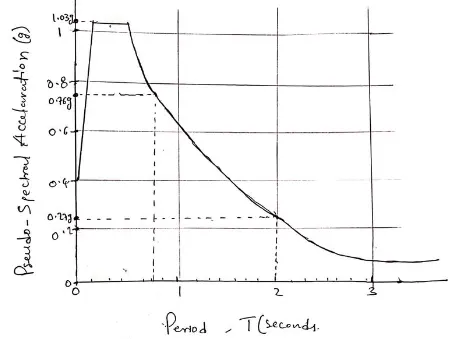
T1=2seconds,A1=0.27gT1=2seconds,A1=0.27g
T2=0.6852seconds,A2=0.76gT2=0.6852seconds,A2=0.76g
T3=0.4346seconds,A3=1.03gT3=0.4346seconds,A3=1.03g
T4=0.3383seconds,A4=1.03gT4=0.3383seconds,A4=1.03g
T5=0.2966seconds,A5=0.76gT5=0.2966seconds,A5=0.76g
Mode-1
Vb1=(M1⋅XA1)=(4.39MX0.27g)=2.619kipsVb1=(M1⋅XA1)=(4.39MX0.27g)=2.619kips
Mode-2
Vb2=(M2⋅XA2)=(0.43MX0.76g)=0.719kipsVb2=(M2⋅XA2)=(0.43MX0.76g)=0.719kips
Mode-3
Vb3=(M3⋅XA3)=(0.12MX1.03g)=0.272kipsVb3=(M3⋅XA3)=(0.12MX1.03g)=0.272kips
Mode-4
Vb4=(M4⋅XA4)=(0.03MX1.03g)=0.067kipsVb4=(M4⋅XA4)=(0.03MX1.03g)=0.067kips
Mode-5
Vb5=(M5⋅XA5)=(0.007MX0.76g)=0.011kipsVb5=(M5⋅XA5)=(0.007MX0.76g)=0.011kips
Step 7:
Combined base shear as per SRSS rule:
Vb=√Vb12+Vb22+Vb32+Vb42+Vb52Vb=Vb12+Vb22+Vb32+Vb42+Vb52
= √(2.613)2+(0.719)2+(0.272)2+(0.067)2+(0.011)2(2.613)2+(0.719)2+(0.272)2+(0.067)2+(0.011)2
=3.20kips
Step 8
The two modes are to be considered such that a modal mass participating ratio of 90% is obtained
M1⋅Mj+M2⋅Mj=88%+8.6%=96.6%M1⋅Mj+M2⋅Mj=88%+8.6%=96.6%
Result:
Calculated Ln,MnandΓnLn,MnandΓn for each of the five modes from the given equations
Calculated the effective modal mass Mn⋅Mn⋅and the modal mass participating ratio for the 5 modes
The base shear for each of the 5 modes of vibration are obtained
As per SRSS rule the combined base shear is obtained
The two modes are to be considered such that a modal mass participating ratio of 90% is obtained