Underbody Coating
UNDERBODY COATING
Underbody coating is usually a dense cladding (often based on rubber) applied uniformly to the undercarriage of the automobile. It is normally sprayed or painted on when the car is just out of the dealership and is clean. This is because it can prevent further damage to the undercarriage. Underbody coating provides long term protection from corrosion to car’s underbody. It also protects parts like internal body panels, frame rails and other inner cavities that are not physically accessible but are prone to corrosion.
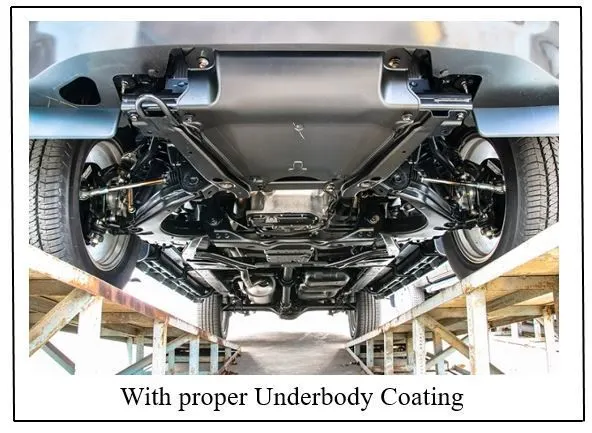
While you are sitting on the driving seat enjoying the smooth ride, the underbody of your car is always exposed to muddy water, stones, rugged roads, and potholes. This makes it prone to wear and tear, which is often not in plain sight but could lead to serious issues if not taken care of.
TYPES OF UNDERBODY COATING
1.Rubberized Underbody Coating
This is generally thought of as the best underbody coating for your car. It preserves the underbody well, protecting it from scratches. Applying this to the undercarriage is not much of a hassle either.
2.Wax Based Underbody Coating
This – more or less – ephemeral undercoating will wear away in a few months’ time. On the upside, wax-based undercoating puts up a big fight against moisture. It is also the most affordable option out there.
3. Asphalt Based Automotive Undercoating
Best suited for lorries, trucks and large vehicles this provides a greater degree of protection compared to rubber-based coatings. However, asphalt-based coatings contain little amounts of rubber for sound-insulation purposes. The process of applying this coating is a bit time-consuming though.
4 Polyurethane Underbody Coating
This coating closes up splits and fractures on the underbody of the vehicle. It offers up good protection against corrosion and also bonds with the metal. Unlike in the case of asphalt-based coating, you can paint over the polyurethane coating.
THE UNDERCOATING PROCESS
1.CLEAN
Prior to applying a rust-repelling undercoating, you will need to remove as much corrosion build-up, caked-on road grime, and any other form of “crap tastic” contaminant from the underside of the vehicle. Here are a few of the core steps to completing this process.
1.BLAST
2.DEGREASE
3.GRIND
4.SAND
2. Prime Time
Most DIY undercoating products require a primer of some sort to serve as a basecoat. We’ve found that the best primers are those with high zinc levels, as this provides an additional corrosion resistance. Just be sure to follow the manufacturer’s instructions, for many primers have their own unique prep requirements and curing times.
3. Undercoat
The final step in the undercoating process is the application of the undercoating itself. Most of these products involve a two-stage or dual-layer spray-on procedure.
While the first round of undercoating should be relatively thin, know that it is not there to be the first line of defense, but to serve as a basecoat for the thicker outer coating. An hour or two of downtime on a warm day should provide ample cure time for this first layer. Once it becomes tacky to the touch, it’s time to move on to the final outer coating.
These final layers should be applied liberally, and in smooth, slow movements. Rushing will only cause uneven coverage and drips to form, so take your time. Once fully coated, it’s time to sit back and let your undercoating cure, which depending upon temps and the product used, may take anywhere from a few hours to a few days.
PROS :-
- FIGHTS RUST
It plays an important role in keeping corrosion at bay
- ABSORBS NOISE
Very thick undercoating can soften the noises that reach the cabin. Since the undercoating is often made up of rubber it absorbs some of the rackets
- REINFORCEMENT
If your car comes with stock underbody coating, using another coating on top of it, is not going to hurt. It will offer additional reinforcement, protecting the underbody from water, road debris, gravel and small pebbles.
- PROLONG CARS LIFE
Good undercoating not only defends the underbody from corrosion but also protects the engine and transmission as well.Less rusting coupled with slower wear and tear can surely add years to the lifespan of your vehicle.
CONS :-
- costly process.
- Applying underbody coating will not have any effect to the already corroded part.