Underbody Coating
UNDER-BODY COATING
Underbody coating is a coating that is applied over a topcoat to wheel wells, the inside of door panels or fenders, the underside of a trunk or hood, or the underside of motor vehicles or mobile equipment for the purposes of protection or noise reduction. This offers the potential to significantly improve surface durability while adding additional functionalities or properties like self-healing, super-hydrophobicity, self-stratifying, self-sensing, soundproofing, anticorrosion, & vibration damping.
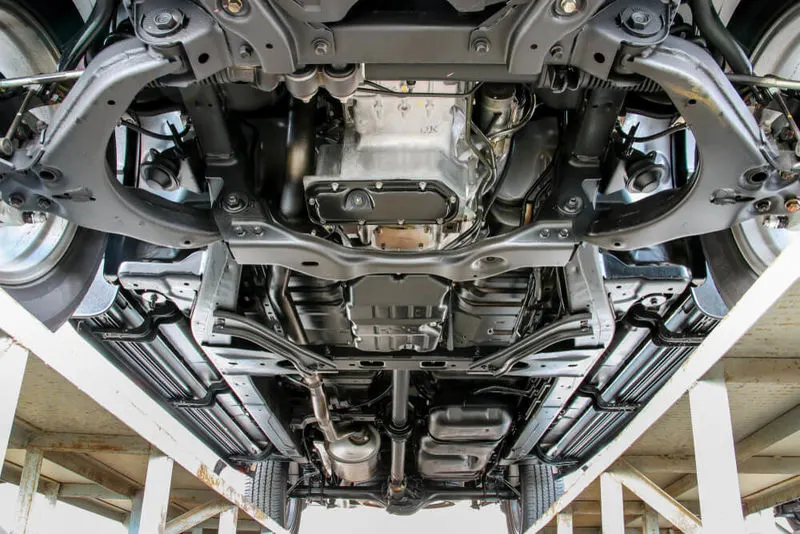
During the underbody coating PVC is used to coat the undercarriage and seal the seams. The figure below depicts the lower door sections and rocker panel places where anti-chipping PVC or urethanes are applied, as well as the cross-section of this layer in respect to the other body coatings.
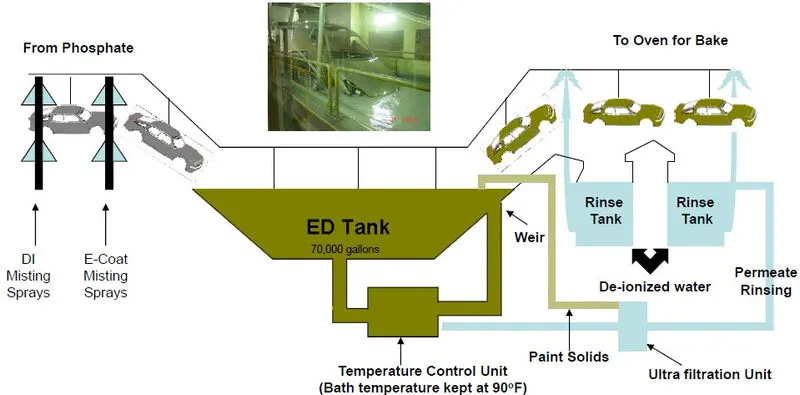
A soft tip primer coat is typically applied during this process to improve chipping resistance. Using a high elastic resin that rests between the electrodeposition and primer layers, this layer is placed to the front edge of the hood, which is prone to chipping shock. The radiator supports, wheel housing, and under rear portions of the body are also covered with a quite dull black pigment called a blackout coating during the third step.
TYPES OF UNDERBODY COATING
The underbody coating for automobiles is broadly classified into 4 types. They include the following:
1. Rubberised underbody coating
Rubberized undercoating is simple to apply and provides sound insulation as well as protection from dust, moisture, and dents.
Rubberized undercoating is safe to apply on wheel wells and quarter panels, as well as your undercarriage, and dries to a soft rubbery texture that avoids further rust, damage, or moisture leaks. The coating can be painted over and quickly removed with an undercoating remover spray if necessary for bodywork.
Overall, Rubberized Undercoating is the greatest option for safeguarding your vehicle's undercarriage, since it offers the most straightforward and effective protection against rust and moisture.
2. Wax-based underbody coating
A paraffin-based undercoating will be the most cost-effective and time-efficient way to protect your vehicle's undercarriage. Keep in mind, however, that it will wear off faster than other undercoatings and will need to be removed and redone at least once a year.
Undercoatings made of wax never really harden. They drip or run into seams and cracks during application to give protective characteristics. They come in spray gun containers or aerosol cans and provide at least a base level of protection in fairly humid climates.
3. Polyurethane Underbody Coating
A polyurethane-based sealer is another choice for undercoating your vehicle. This kind of undercoating for vehicles is a little faster and easier to apply.
Polyurethane undercoating is frequently preloaded into a spraying gun in the form of a canister. This form of sealant bonds with and protects the unoxidized metal by seeping into all cracks and seams, displacing salt and moisture, and flowing around rusty regions. It also sands fast in the event that bodywork is required, and it may be painted over.
On the other hand, this sort of automotive undercoating usually necessitates a little more surface preparatory work before application, such as sanding and applying an etching primer to exposed metals.
4. Asphalt-Based Undercoating
Any of the of which of undercoating will provide adequate protection for basic automobiles. Asphalt-based undercoating adds a layer of protection against pebbles, chips, and moisture for large trucks and heavy machines.
A small amount of rubberized material is usually included in asphalt-based undercoatings to help them form up firmly and soften noise. This type of undercoating, which is often available in five-gallon containers, requires more cure time than the other three and is not paintable, thus it's best used for undercarriages only.
Pros-
- Fights against rust: It has a crucial role in preventing corrosion. Underbody coating is especially useful if you live near the coast, where there is a lot of humidity and corrosion is a common occurrence. If you live somewhere where it snows in the winter, you should seriously consider undercoating.
- Absorbs noise: Very thick undercoating, believe it or not, can soften noises that reach the cabin. The undercoating, which is frequently made of rubber, absorbs some of the rackets. The car's occupants could avoid the road noises — at least to some extent.
- Reinforcement: It will add support to the underbody, protecting it against water, road debris, gravel, and small pebbles. The factory coat would also have a lower risk of flaking away.
- Prolong car’s life: A good undercoat protects not just the underbody from corrosion, but also the engine and transmission! Less rusting, along with slower wear and tear, can extend the life of your car by many years. On the undercarriage, there would be fewer dents, dings, and scratches to worry about.
Cons-
- Applying an underbody coating to a corroded part will have no effect.
- Undercoating is quite expensive.
- Because corrosion begins after a few years, underbody coating is not a good idea for people who change their cars every few years.