Underbody Coating
Underbody coating is usually a dense cladding (often based on rubber) applied uniformly to the undercarriage of the automobile. It is normally sprayed or painted on when the car is just out of the dealership and is clean. But even if you are getting the undercoating applied after a couple of years, it’s fine too. This is because it can prevent further damage to the undercarriage.
Now let us look at the various kinds of automotive underbody coating you can go for, for your vehicle.
-
Rubberized Underbody Coating
This is generally thought of as the best underbody coating for your car. It preserves the underbody well, protecting it from scratches. Applying this to the undercarriage is not much of a hassle either.
-
Wax Based Underbody Coating
This – more or less – ephemeral undercoating will wear away in a few months’ time. On the upside, wax-based undercoating puts up a big fight against moisture. It is also the most affordable option out there.
-
Asphalt Based Automotive Undercoating
Best suited for lorries, trucks and large vehicles this provides a greater degree of protection compared to rubber-based coatings. However, asphalt-based coatings contain little amounts of rubber for sound-insulation purposes. The process of applying this coating is a bit time-consuming though.
-
Polyurethane Underbody Coating
This coating closes up splits and fractures on the underbody of the vehicle. It offers up good protection against corrosion and also bonds with the metal. Unlike in the case of asphalt-based coating, you can paint over the polyurethane coating.
Download the GoMechanic App Now!
Advantages of Undercoating
Now we will tell you why you should consider investing in a vehicle underbody coating.
-
Fights Rust
It plays an important role in keeping corrosion at bay. Underbody coating can come in handy especially if you live near the sea, where there is too much humidity, and rusting is just one of those everyday things. You should also seriously consider undercoating if you reside in a place where it snows in winter.
-
Absorbs Noise
Believe it or not, very thick undercoating can soften the noises that reach the cabin. Since the undercoating is often made up of rubber it absorbs some of the rackets. The occupants of the car could spare themselves of the road noises – at least up to a certain extend.
-
Reinforcement
If your car comes with stock underbody coating, using another coating on top of it, is not going to hurt. It will offer additional reinforcement, protecting the underbody from water, road debris, gravel and small pebbles. There would also be a lesser chance for the factory coat to flake away.
-
Prolong Car’s Life
Good undercoating not only defends the underbody from corrosion but also protects the engine and transmission as well! Less rusting coupled with slower wear and tear can surely add years to the lifespan of your vehicle. There would be fewer dents, dings and scratches on the undercarriage for you to fret about.
The underbody coating that is most commonly used on cars in India and supplied by companies such as 3M is a thick, rubberized paint that forms a 2-3 mm thick coating all along the underside of the car when sprayed on. You also get a thinner clear coat underbody coating which is like a lacquer that coats the entire underside of the car. Some even inject rust-preventive coating material into crevices such as the bottom of doors and door sills, to protect them from rust.
Some car manufacturers already offer some underbody coating straight out of the factory which is usually sprayed inside the wheel arches and under the floor board of the car.
Here are some benefits of underbody coating
Rust Prevention
Ideally any additional underbody coating should be applied when the car is brand new and clean. Car manufacturers use thick paints and sealants for the underbody, but adding an underbody coat especially in coastal cities is useful. Salt water tends to corrode cars really badly.
On bad roads, flying stones and pebbles can chip off the original underbody coating and leave the metal exposed. Using an aftermarket underbody coating offer extra protection.
Sound insulation
The thicker underbody coatings used on cars also act as effective sound dampeners. They can reduce road noise and tyre noise and make the cabin seem quieter – due to the sound absorptive nature of rubberized paints.
Easy maintenance
A uniform black underbody coating gives a car a clean look. It also makes the car easier to maintain by just hosing the underside down. You can be confident that slush build up won’t lead to rusting easily. Most underbody coats these days come with a five-year warranty, which is the lifetime of such a coating.
Here are some of the downsides to underbody coating:
High cost
Cost of underbody coating has come down, but is still expensive. This is because underbody coating offered by a car dealer is one way in which they make money off the customer.
Risk of damage during application
Care must be taken while applying underbody coating. This thick rubberized paint if not applied properly, can get into moving mechanical parts and cause premature failure – such as into the U-joint or CV joints in a cars propeller shaft or drive shafts. They can also hinder smooth movement of suspension components, if applied incorrectly. And there’s also the risk of overspray on to the car’s paint finish on the lower edges of the car.
. Modern Automotive Coating Processes
-
Pretreatment: removes and cleans excess metal and forms an appropriate surface structure enabling bonding of a corrosion protection layer.
-
The next step is electrodeposition (ED) of the anti-corrosion or rust prevention layer.
-
A sealer like Poly Vinyl Chloride (PVC) is applied for anti-corrosion, elimination of water leaks, and minimization of chipping and vibrational noise.
-
A primer is then applied to promote adhesion between the surface and the basecoat; it also imparts a smoother surface for subsequent layers and has anti-chipping properties.
-
Finally, the topcoats that include a basecoat and clearcoat are applied; they provide surface properties that are sought after, including color, appearance, gloss, smoothness, and weather resistance.For the external surfaces of an automobile to be easily visualized, the five main steps of coating produce a layered structure depicted in Figure 2. These coatings are applied in a particular order and have different material and protection or finishing functionalities; also, each layer relates to the others and imparts a desired balance of properties [23].
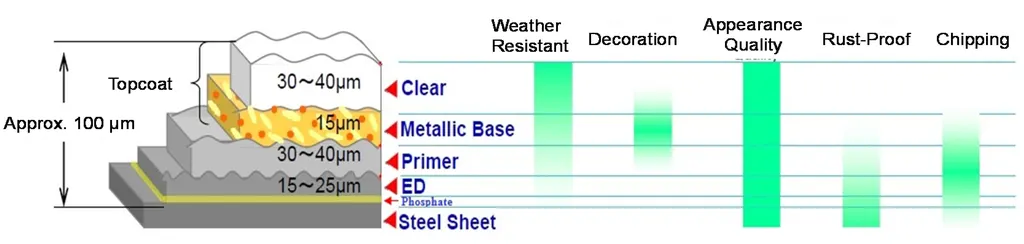 Figure 2. Automotive coating layers, their thicknesses and purposes for an exterior surface.
2.1. Pretreatment
When the automobile body sheet metal components are welded together, the resulting structure is referred to as the body-in-white (BIW). The first sequence in preparing the BIW for subsequent coating is pretreatment—see Figure 3. Pretreatment consists of cleaning the body surface to remove remaining oils from the stamping process and welding residues through three primary liquid dip processes of degreasing, conditioning, and phosphating [24]. An additional pretreatment cleaning that employs ~pH 9 hot water can also be used. Pretreatment helps the primer to bond onto the metal. A phosphate treatment applies an inert layer of metal phosphate, providing resistance to corrosion spread [25]. The degreasing solution is composed of alkaline salts and surfactants and can include caustic soda, trisodium phosphate, and sodium carbonate. The surfactants are types of detergents for emulsifying oils and lubricants on the BIW. The degreasing zone typically consists of at least two sequences, including a spray stage known as knock-off-degrease (KOD) and a dip sequence. The advantage of using these two is that a significant portion of the oil and dirt will be removed by the high-pressure spray, thereby leaving a relatively lower load for the dip sequence to clean.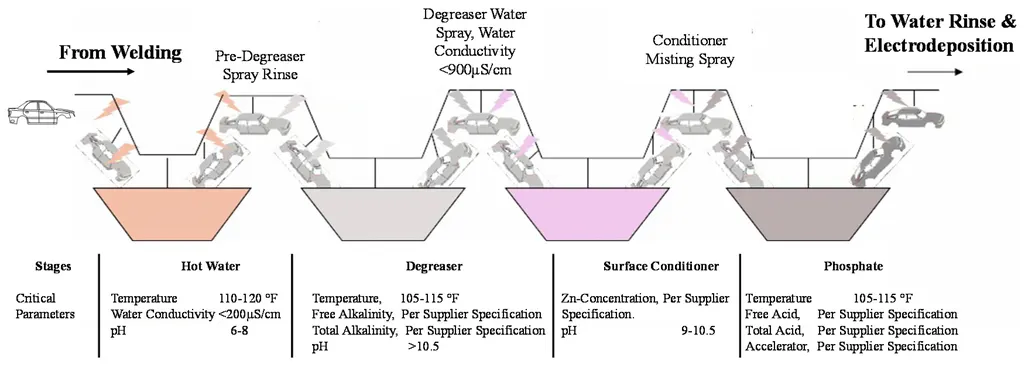 Figure 3. Pretreatment sequences for the body-in-white.The next sequence is surface conditioning (also called activation), which creates nucleation sites for phosphate crystal growth. It increases the number of crystallization nuclei on the metal surface that enhance bonding mechanisms for the subsequent phosphate sequence [26]. In conditioning, an aqueous dispersion of titanium orthophosphate with pH between 8 and 10 is typically used. Finally, the liquid dip phosphate solution is composed of phosphoric acid, phosphate ions, nitrate ions, zinc and other divalent metal ions, hydrogen ions, and an accelerating compound. The free acid etches the steel surface, causing hydrogen to be released while metal phosphate ions are precipitated onto the surface in a crystalline form. The primary objective during phosphating is to deposit a thin, dense and uniform conversion layer on the cleaned and prepared metal surface [27].
2.2. Electrodeposition (ED)
The metal underbody and frames of automobiles are coated to prevent corrosion, whereas other areas like the roof are not rust-proofed. When not coated to prevent corrosion, the structural metals (or other materials) are primed before applying additional coatings. Figure 4 displays types of corrosion protection coatings for cold rolled steel.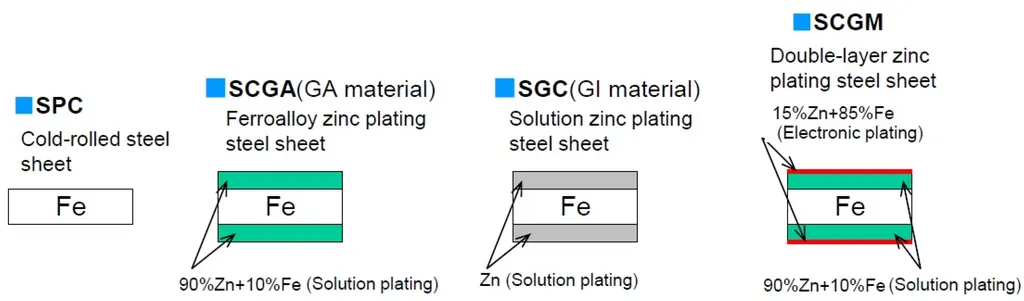 Figure 4. Various types of steel sheets for car body.An SCGA electrodeposition solution having a 90% Zn–10% Fe composition (GA material) is the primary coating used in modern automobiles to prevent corrosion. In comparison to the SGC solution, i.e., GI material, with 100% Zn during electrodeposition, the GA material minimizes ED gas pin (paint quality defects) and maximizes spot welding performance; however, the SGC process is still used in Europe. The SCGM corrosion protection method was used in previous decades, and it did enable minimization of ED gas pin. However, its cost was higher than the GA material coating.The electrodeposition coat or E-coat provides rust and corrosion protection and was first introduced in the 1960s. Since then the use of E-coat has grown at a rapid pace. By 1970, 10% of all cars were electrocoated and by 1990, 90% of all cars were electrocoated. Today, it is the most conventional coating process used in vehicle manufacturing.The E-coat process has not only grown at a rapid rate but has changed significantly since it was first introduced. From 1964 to 1972 an anodic E-coat process was used, and from 1976 to the present, a cathodic E-coat has been used. The E-coat film thickness has also varied during this time frame. Thicknesses started at 25 µm and remain.As shown in Figure 5, E-coating involves dipping automobile bodies into the coating solution and passing an electric current through the body and the liquid ED paint solution. Because of the charged nature of this coating process, the ED paint penetrates into places a spray would not reach. The ED paint is promoted to bond with the metal substrate, and a uniform coating thickness is produced. The result is an insoluble, deposited layer with a very high solids content and firm adherence to the pretreated body [25].
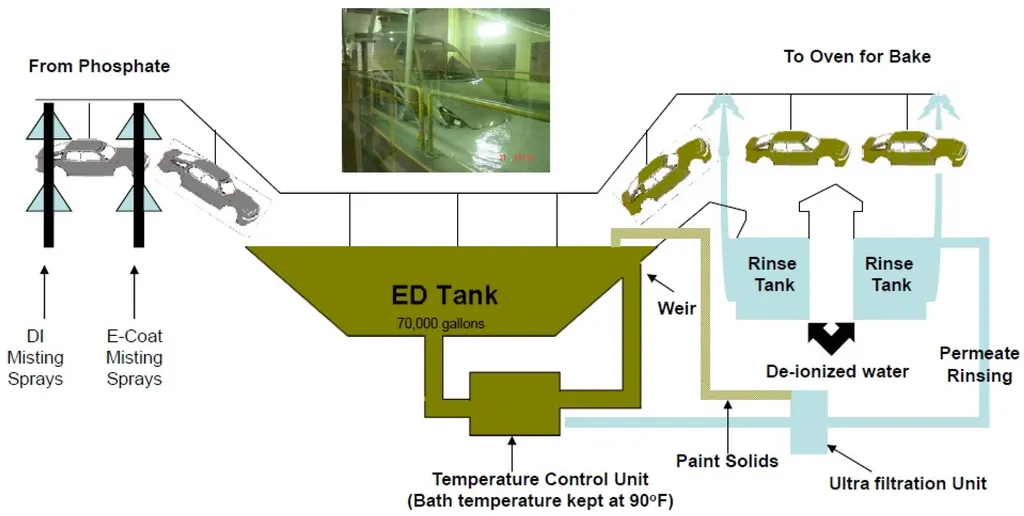 Figure 5. Electrocoating process.During operation, a mixture of resin, binder, and a paste containing the pigments is fed into the electrodeposition tank. The automobile body is lowered into the tank, and an electric current applied; the solution in the tank consists of 80%–90% deionized water and 10%–20% paint solids (consisting of resin, binder, and pigment). The deionized water acts as a carrier for the paint solids, which are under constant agitation. The resin is the backbone of the final paint film and provides corrosion protection, durability, and toughness. Pigments are used to provide color and gloss. To control paint performance during cathodic E-coating, purging of the paint and regulating the amount of applied voltage are essential. As the coating grows in thickness, it becomes more and more insulating, thereby causing the deposition process to slow. As an automobile body exits the tank, paint solids adhering to the surface but not bound to the surface are rinsed off to recover the ED solids via an ultrafiltration unit to ensure surface smoothness [28].After the E-coat, the automobile body enters a bake oven, in which heating and keeping at a temperature of 160 °C for 10 min causes film curing to promote maximum performance properties. The oven temperature and heating time primarily enhance chip resistance and film adhesion to the body; corrosion protection is affected less by these conditions. Because surface roughness influences the smoothness and brilliance of the topcoat, some sanding of the surface is usually performed to remove or eliminate defects before the body enters the next application step.A common challenge in the current E-coating process is that of water spots that contaminate coated surfaces. These spots can appear on the air-dried surface if water droplets from the conveyor or other sources fall on the body, especially if the water in the tanks is not deionized properly and has high conductivity; the water spots are usually a remnant of unwanted ions in the water and will cause problems in subsequent coating applications and their adherence and appearance. If water spots are present, they have to be removed by sanding. Hence, it is necessary to use well-deionized water and routinely monitor its conductivity. Alternately, operators also add surfactants or ultrafiltrates to the water rinse zone to eliminate or manage water spots.
2.3. Rust-Proof Materials: Sealer/PVC
The third step is underbody coating (UBC) and seam sealing using PVC (Polyvinyl Chloride) and urethane. This sealing has multiple purposes, as shown in Table 1.Table 1. Purposes and types of sealants used in automobiles. The sealant is applied around and inside the doors, hood, trunk, and front dash, and onto the exterior and interior of metal joints and outer area of the back wheel well; application of the sealant is accomplished either manually or with robots and prevents air and water ingress and inhibits rust formation. Recently, PVC and acryl/urethane sealants have also been used in the underbody areas, a process called the Dampening Coat (DC), to impart noise-proofing and vibration-deadening. The noise and vibration are transferred from the engine, drive train, suspension system, road noise of the tires, and flowing air, and the underbody sealants reduce noise transfer into the passenger compartment of the automobile [29]. The underbody coating also provides anti-corrosion and chipping protection; typically, it is accomplished using robots equipped with airless sprayers. Figure 6 displays the lower door sections and rocker panel locations where PVC or urethanes are applied as an anti-chipping protection, and shows the cross section of this layer with respect to the other coatings on the body parts.
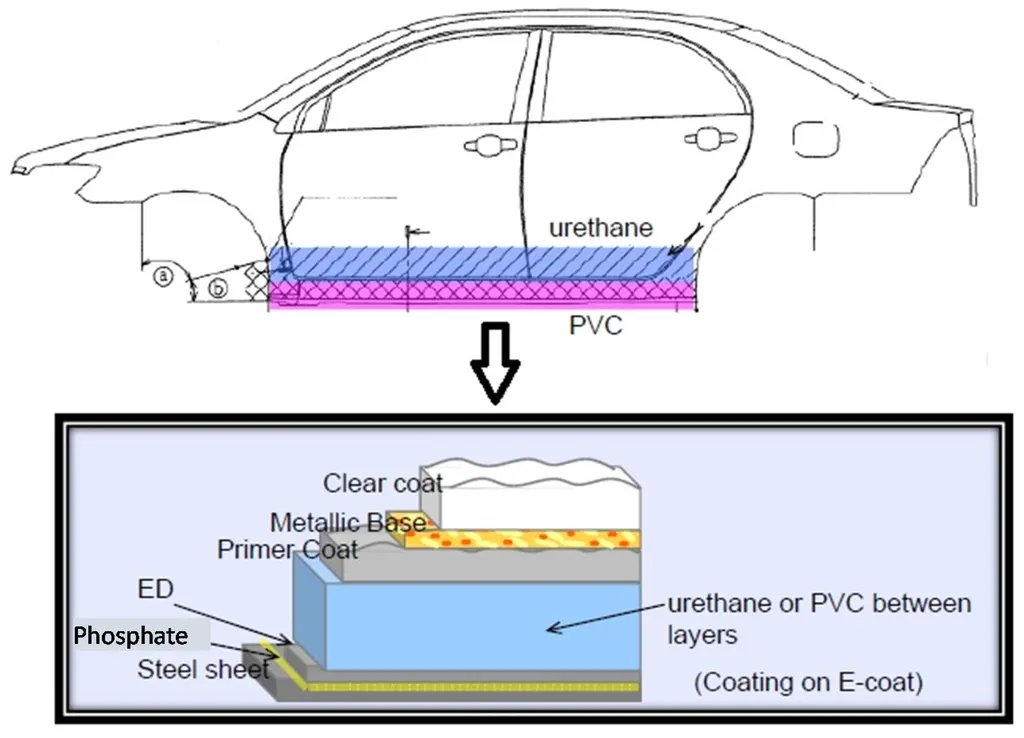 Figure 6. The anti-chipping material coating on lower doors and rocker panels.During this third step, it is also typical to apply a soft tip primer coat that improves the chipping resistance (resistance against chipping by flying stones or debris). This layer is applied to the front edge of the hood, which is an area prone to chipping shock, using a high elastic resin that resides between the ED and primer coats. Also, during the third step, the radiator supports, wheel housing, and under rear areas of the body are coated with a relatively dull black pigment called a blackout coating.