Section Modulus calculation and optimization
Section Modulus calculation and optimization :
Aim:
The given below diagram shows the Methods of calculation the Section Modulus and optimization .To find the section moudulus for the give Hood design and calculate it's moment of inertia and it' s strength modulus .
Expalation:
Section modulus is a geometric property for a given cross-section used in the design of beams or flexural members. Other geometric properties used in design include area for tension and shear, radius of gyration for compression, and moment of inertia and polar moment of inertia for stiffness. Any relationship between these properties is highly dependent on the shape in question. Equations for the section moduli of common shapes are given below. There are two types of section moduli, the elastic section modulus and the plastic section modulus. The section moduli of different profiles can also be found as numerical values for common profiles in tables listing properties of such as
Elastic section modulus
For general design, the elastic section modulus is used, applying up to the yield point for most metals and other common materials.
The elastic section modulus is defined as S = I / y, where I is the second moment of area (or area moment of inertia, not to be confused with moment of inertia) and y is the distance from the neutral axis to any given fibre. It is often reported using y = c, where c is the distance from the neutral axis to the most extreme fibre, as seen in the table below. It is also often used to determine the yield moment (My) such that My = S ⋅ σy, where σy is the yield strength of the material.
| Cross-sectional shape | Figure | Equation | Comment |
|---|---|---|---|
| Rectangle | {\displaystyle S={\cfrac {bh^{2}}{6}}} |
Solid arrow represents neutral axis | |
| doubly symmetric I-section (major axis) | {\displaystyle Sx={\cfrac {BH^{2}}{6}}-{\cfrac {bh^{3}}{6H}}}
{\displaystyle Sx={\tfrac {Ix}{y}}} with {\displaystyle y={\cfrac {H}{2}}} |
NA indicates neutral axis | |
| doubly symmetric I-section (minor axis) | {\displaystyle Sy={\cfrac {B^{2}(H-h)}{6}}+{\cfrac {(B-b)^{3}h}{6B}}} [4] [4] |
NA indicates neutral axis | |
| Circle | {\displaystyle S={\cfrac {\pi d^{3}}{32}}} [3] [3] |
Solid arrow represents neutral axis | |
| Circular hollow section | {\displaystyle S={\cfrac {\pi \left(r_{2}^{4}-r_{1}^{4}\right)}{4r_{2}}}={\cfrac {\pi (d_{2}^{4}-d_{1}^{4})}{32d_{2}}}} |
Solid arrow represents neutral axis | |
| Rectangular hollow section | {\displaystyle S={\cfrac {BH^{2}}{6}}-{\cfrac {bh^{3}}{6H}}} |
NA indicates neutral axis | |
| Diamond | {\displaystyle S={\cfrac {BH^{2}}{24}}} |
NA indicates neutral axis | |
| C-channel | {\displaystyle S={\cfrac {BH^{2}}{6}}-{\cfrac {bh^{3}}{6H}}} |
NA indicates neutral axis |
 ,
,
Plastic section modulus:
The plastic section modulus is used for materials where elastic yielding is acceptable and plastic behavior is assumed to be an acceptable limit. Designs generally strive to ultimately remain below the plastic limit to avoid permanent deformations, often comparing the plastic capacity against amplified forces or stresses.
The plastic section modulus depends on the location of the plastic neutral axis (PNA).The PNA is defined as the axis that splits the cross section such that the compression force from the area in compression equals the tension force from the area in tension. So, for sections with constant yielding stress, the area above and below the PNA will be equal, but for composite sections, this is not necessarily the case.
The plastic section modulus is the sum of the areas of the cross section on each side of the PNA (which may or may not be equal) multiplied by the distance from the local centroids of the two areas to the PNA:
{\displaystyle Z_{P}=A_{C}y_{C}+A_{T}y_{T}}
The Plastic Section Modulus is not the 'First moment of area'. Both relate to the calculation of the centroid, but Plastic Section Modulus is the Sum of all areas on both sides of PNA (Plastic Neutral Axis) and multiplied with the distances from the centroid of the corresponding areas to the centroid of the cross section, while the First moment of area is calculated based on either side of the "considering point" of the cross section and it is different along the cross section and depends on the point of consideration.
| Description | Figure | Equation | Comment |
|---|---|---|---|
| Rectangular section | {\displaystyle Z_{P}={\cfrac {bh^{2}}{4}}} [5][6] [5][6] |
{\displaystyle A_{C}=A_{T}={\cfrac {bh}{2}}} , {\displaystyle y_{C}=y_{T}={\cfrac {h}{4}}} , {\displaystyle y_{C}=y_{T}={\cfrac {h}{4}}} |
|
| Rectangular hollow section | {\displaystyle Z_{P}={\cfrac {bh^{2}}{4}}-(b-2t)\left({\cfrac {h}{2}}-t\right)^{2}} |
where: b = width, h = height, t = wall thickness | |
| For the two flanges of an I-beam with the web excluded[7] | {\displaystyle Z_{P}=b_{1}t_{1}y_{1}+b_{2}t_{2}y_{2}\,} |
where:
{\displaystyle b_{1},b_{2}} |
|
| For an I Beam including the web | {\displaystyle Z_{P}=bt_{f}(d-t_{f})+0.25t_{w}(d-2t_{f})^{2}} |
||
| For an I Beam (weak axis) | {\displaystyle Z_{P}=(b^{2}t_{f})/2+0.25t_{w}^{2}(d-2t_{f})} |
d = full height of the I beam | |
| Solid Circle | {\displaystyle Z_{P}={\cfrac {d^{3}}{6}}} |
||
| Circular hollow section | {\displaystyle Z_{P}={\cfrac {d_{2}^{3}-d_{1}^{3}}{6}}} |
 =width, {\displaystyle t_{1},t_{2}}
 =thickness, {\displaystyle y_{1},y_{2}}
 are the distances from the neutral axis to the centroids of the flanges respectively.
The plastic section modulus is used to calculate the plastic moment, Mp, or full capacity of a cross-section. The two terms are related by the yield strength of the material in question, Fy, by Mp = Fy ⋅ Z. Plastic section modulus and elastic section modulus are related by a shape factor which can be denoted by k, used for an indication of capacity beyond elastic limit of material. This could be shown mathematically with the formula :-
{\displaystyle k={\cfrac {Z}{S}}}
Shape factor for a rectangular section on modulus, the following formula applies:
where I = moment of inertia, y = distance from centroid to top or bottom edge of the rectangle
For symmetrical sections the value of Z is the same above or below the centroid.
For asymmetrical sections, two values are found: Z max and Z min.
To calculate the value of Z for a simple symmetrical shape such as a rectangle:
where
and y =
This gives the formula for Z as: .
Section Modulus of an HOOD:
- Section moudulus is a direct measurment of any section area of an object about an reference or neutral axis .
- Strength is nothing but, capable of supporting grater laods , so higher that strength it has a capable of a Supporting grater loads .
- This Strength can Measure driectly from Section modulus formula, and defined by below formula .
Section modulsrepresented with a symbol is ' S'.
Formula :
S= I/Y
where 'I' is moment of inertia .
'Y' is diffrence between the referance line or nutral axis to one of the extream end of object.
* moment of interia is nothing but offering resistance against of moment , bending or twisting , that if we applied any external load on the body , how much resistance its offering to tend to deform.
* SO , higher the value of moment of inertia , have higher resistance to deform under certain load , hence we can say that moment of interia directly proportional to the material , and strength of the material cn be calculated with the help of section modulus .
* If we vary the neutral axis towards postive or negative side the strength of the body will decrease , becauese that neutral axis line lies middle of the section only have higher strength at particular point, so, here Y value is intersely proportional to section Modulus .
S= I/Y.
By using the same formula & principle it's calculate the Strength of hood panel.
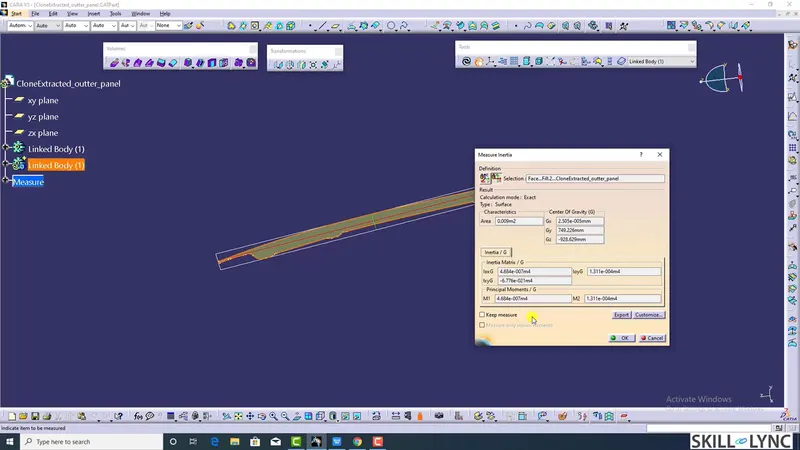
Here the moment of inertia was calculated by using nx 12 software abotained value are
- Imax : 8.485481X 10^5 mm^4
Imax :3.18672X10^3 mm^4
'Y' is diffrence between the referance line or nutral axis to one of the extream end of object.
* moment of interia is nothing but offering resistance against of moment , bending or twisting , that if we applied any external load on the body , how much resistance its offering to tend to deform.
* SO , higher the value of moment of inertia , have higher resistance to deform under certain load , hence we can say that moment of interia directly proportional to the material , and strength of the material cn be calculated with the help of section modulus .
* If we vary the neutral axis towards postive or negative side the strength of the body will decrease , becauese that neutral axis line lies middle of the section only have higher strength at particular point, so, here Y value is intersely proportional to section Modulus .
S= I/Y.
By using the same formula & principle it's calculate the Strength of hood panel.
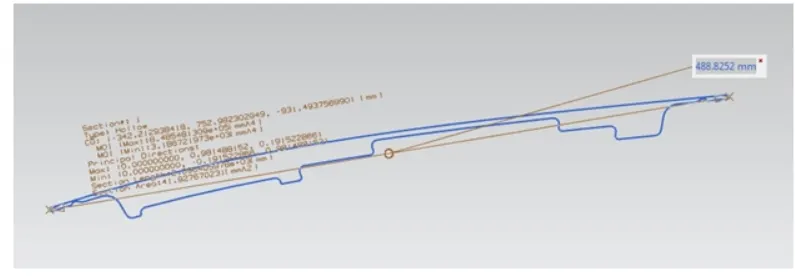
Here the moment of inertia was calculated by using nx 12 software abotained value are
- Imax : 8.485481X 10^5 mm^4
Imax :3.18672X10^3 mm^4
Total length of ' Y' value was 488.8252mm
So at neutral axis we need y value : y/2 =488.825/2=244.412 mm
* Section of modulus (S) :I/Y = 8.485481x10^5mm^4 /244.412mm
=3.471x10^3mm^3(Maximum Strength).
* Section of modulus (S) : I/Y = 3.18672x10^3mm/244.412mm
=0.013x10^3mm^3 (Maximum Strength).
So the strength of an hood varies from 0.013x10^3mm^3 to 3.471x10^3mm^3:
Now , one more trail is that ,here the inner panel curve offsetting outside by 1 mm that increasing in cross sectional
area, the results shown below.
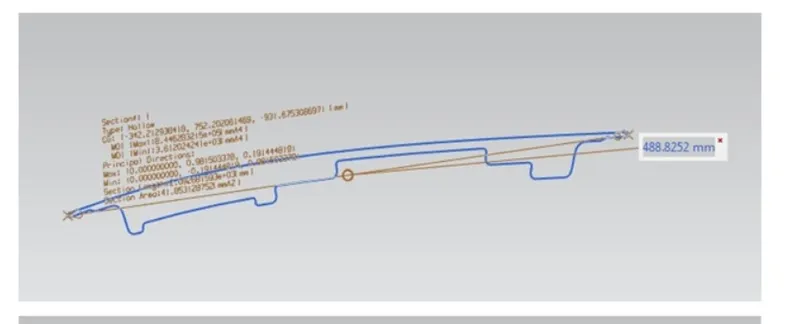
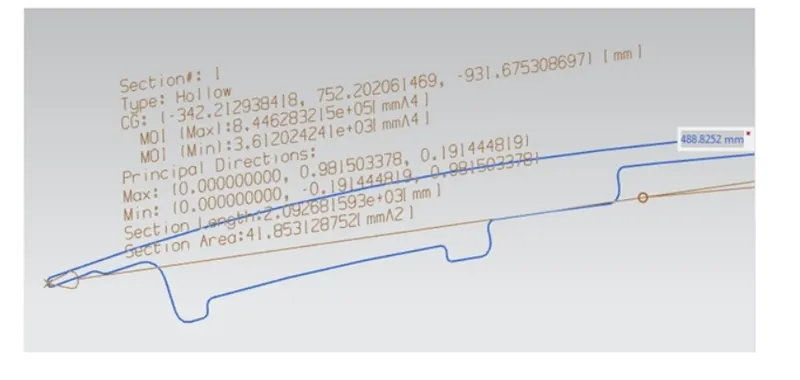
I obtained the value of
Imax :8.4462x10^5mm^4
Imax : 3.61202x10^3mm^4
Total length of Y value was 488.8252mm
So,at neutral axis we need ' Y'value :y/2=488.8252/2=244.412mm
1) Section modulus (s) :I/y=8.4462x10^5 mm^4 /244.412mm
=3.455x10^3mm^3(maxium strenght).
2) Section modulus (s) :I/y=3.61202x10^3mm^4/244.412mm
=0.014x10^3mm^3(minium Strength).
So the strength of an hood varies from 0.014x10^3mm^3 to 3.455x10^3mm^3:
* So here when comparing both the hoos there is changes in both MAX and MIN strength values ,what I came to know that when I increased section area by 1mm the value of minimum strength was increased
from 0.013x10^3mm^3 to 0.014x10^3 mm^3 , Hence with increase in cross sectional area results in increase in strength .
* But ,when we seen the value of maximum strength decrease from 3.471x10^3mm to 3.455x10^3mm^3, I think this due to design of hood ,here what we want to known that when increase in cross
sectional area there will be increase in minimum strength or maximum strength or increase both .
* So Newton's first law also explains that, if higher the mass, the force required to move the object is also
high due to offering more resistance in oder to move the object, This resistance we called it also a MOMENT OF INERTIA.
* In case of hood also same principle will work, that when increase in cross sectional area by 1mm the minimum load carrying capacity or
strength was increased by 8% what we observed from the above discussion .
* The strength of the material also depends upon the composition of material , Thickness and cross sectional area of an object .
CONCLUSION:
The Strength of material is directly proportional to the moment of inertia , Hence increase in sectional area there is have increase in overall mass of an object.
Hence have increase in Strength .