Underbody Coating
UNDERBODY COATING
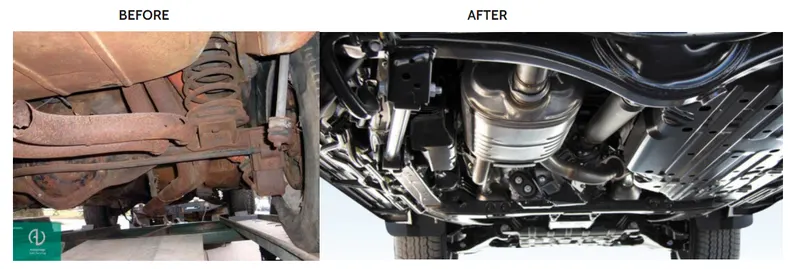
Underbody coating provides long term protection from corrosion to car's underbody. It also protects parts like internal body panels, frame rails & other inner cavities that are not physically accessible but are prone to corrosion.
- Car body is made up of several metals such as Iron, Steel, Aluminium, Copper etc. Rusting is the common term for corrosion of iron & its alloys.
- It is a must to make sure the underbody is given a layer of protection from all grime & grit & annual clean up & touch up is necessary.
- Corrosion is the reaction of iron & oxygen, as may present in water or air moisture.
- Because it is not in plain sight, we often do not see the damage. Underbody coating or treatment offers a long term solution for issues related to corrosion & rust.
- The underbody of the car is exposed to most wear & tear caused by dirt grimes, bad roads, stones & muddy water. Since it is not visible in plain sight, we often do not see the damage. This treatment makes a corrosion resistant protection film on the underbody surface that protects it from rust & abrasives & covers under chasis & wheel arches.
ELECTRO COATING
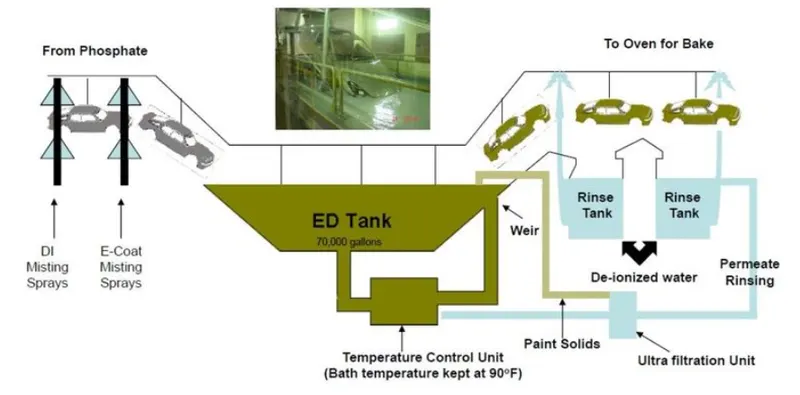
E-coating is an immersion wet paint finishing process that uses electrical current to attract the paint product to a metal surface. This process is also referred to as paint deposition.
TYPES OF UNDERBODY COATING
RUBBERIZED UNDERCOATING
Rubberized vehicle undercoating is easy to apply & offers sound-cushioning as well as protection from dust, moisture & dings or dents. In addition to your undercarriage, rubberized undercoating is also safe to use on wheel wells & quarter panels, & dries to a soft rubbery finish that prevents further rust, damage or moisture seeps. The coating can be painted over & if necessary for bodywork, can be easily removed with an undercoating removal spray. Overall, rubberized coating is generally the best option for protecting your vehicle's undercarriage, as it provides the simplest & best protective measures against rust & moisture.
POLYURETHANE UNDERCOATING
The other option for undercoating your vehicle is to use a polyurethane-based sealant. This type of vehicle undercoating is a little bit quicker & easier to apply. Oftentimes, polyurethane undercoating will come in canisters ready to preload into an application gun. This type of sealant works by seeping into all cracks & seams, displacing salt & moisture & oozing around rusty areas to bond with & protect unoxidized metal. It also sands quickly in case you will need to perform bodywork & can be painted over. On the flipside, this type of car undercoating generally requires a little bit more surface prep work before applying--sanding & applying an etching primer to bare metals before using are generally recommended.
WAX OR PARAFFIN-BASED UNDERCOATINGS
A paraffin-based undercoating will be the cheapest & quickest option available with which to protect the undercarriage of your vehicle. However, keep in mind that it will wear off quicker than other types of undercoating & will need to be stripped & reapplied at least once every year. Wax-based undercoatings never truly harden. During application, they drip or flow into seams & cracks to provide protective properties. They are usually available in a spray gun canister or in an aerosol can & offer at least a base protection in moderately humid climates.
ASPHALT-BASED UNDERCOATING
For standard vehicles, any of the aforementioned types of undercoating will provide sufficient protection. For large trucks & heavy machinery, asphalt-based undercoating provides a bit of extra durability against rocks, chips & moisture. Asphalt-based undercoating generally contains a little bit of rubberized material that sets up firmly and also helps soften noise.
ADVANTAGES
- Undercoating gives an extra layer of protection against rust & corrosion, protecting your car.
- Undercoating will eventually wear out, but you can get years of protection from it. Even vehicles in warmer climates gain protection as debris is repelled & kept away from eating at the vehicle.
- It can be self-applied.
- It minimizes the sound from underneath the car.
- The coating does not chip away when hit by stones.
DISADVANTAGES
- It adds weight to the vehicle.
- It must be reapplied every 3 to 5 years for the best results.
- Undercoating will not help you if corrosion already exists & the corrosion needs to be removed first before it can be applied, which can be expensive for you.