Underbody Coating
AIM:
Underbody Coating and How It Protects Your Car
- Underbody coating is usually a dense cladding (often based on rubber) applied uniformly to the undercarriage of the automobile.
- It is normally sprayed or painted on when the car is just out of the dealership and is clean. But even if you are getting the undercoating applied after a couple of years, it’s fine too. This is because it can prevent further damage to the undercarriage.
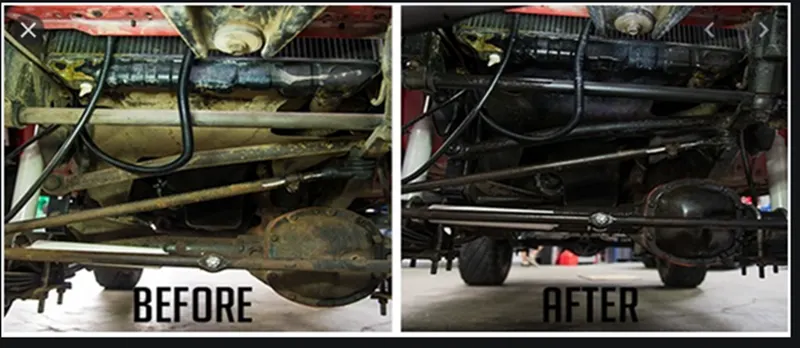
The main purpose of undercoating is to check rust especially in the body components like frame rails along with other exposed metal parts. Underbody coating can also reduce wear and tear.
1. Modern Automotive Coating Processes
Modern automotive coating methods consist of five main steps. They include the following:
- Pretreatment: removes and cleans excess metal and forms an appropriate surface structure enabling bonding of a corrosion protection layer.
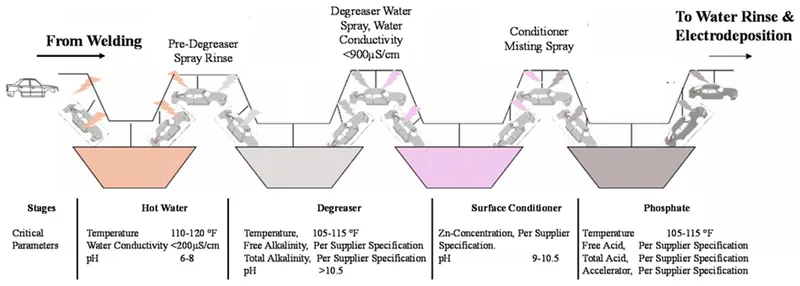
Figure . Pretreatment sequences for the body-in-white.
- The next step is electrodeposition (ED) of the anti-corrosion or rust prevention layer.
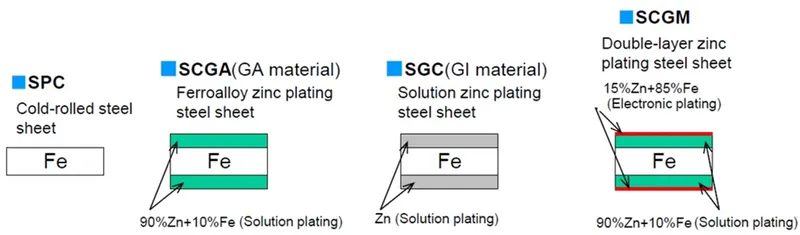
Figure . Various types of steel sheets for car body.
- A sealer like Poly Vinyl Chloride (PVC) is applied for anti-corrosion, elimination of water leaks, and minimization of chipping and vibrational noise.
- The sealant is applied around and inside the doors, hood, trunk, and front dash, and onto the exterior and interior of metal joints and outer area of the back wheel well.
Application of the sealant is accomplished either manually or with robots and prevents air and water ingress and inhibits rust formation.
- Recently, PVC and acryl/urethane sealants have also been used in the underbody areas, a process called the Dampening Coat (DC), to impart noise-proofing and vibration-deadening. The noise and vibration are transferred from the engine, drive train, suspension system, road noise of the tires, and flowing air, and the underbody sealants reduce noise transfer into the passenger compartment of the automobile .
The underbody coating also provides anti-corrosion and chipping protection; typically, it is accomplished using robots equipped with airless sprayers. The lower door sections and rocker panel locations where PVC or urethanes are applied as an anti-chipping protection, and shows the cross section of this layer with respect to the other coatings on the body parts.
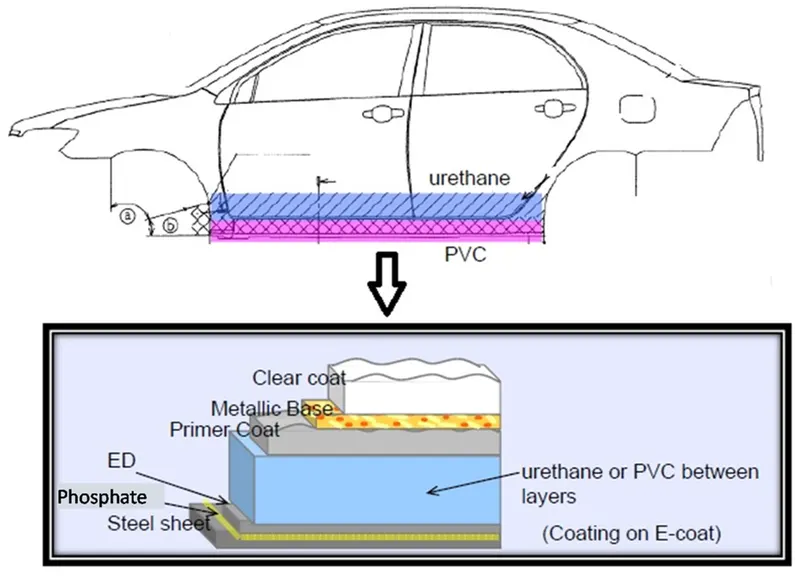
- A primer is then applied to promote adhesion between the surface and the basecoat; it also imparts a smoother surface for subsequent layers and has anti-chipping properties.
- Finally, the topcoats that include a basecoat and clearcoat are applied; they provide surface properties that are sought after, including colour, appearance, gloss, smoothness, and weather resistance.
The areas of an automobile depicted where these five steps of coating and other additional coatings are used. As can be realized when examining this figure, a significant number of specific coatings and materials are needed in addition to the above-listed steps to manufacture a salable automobile.
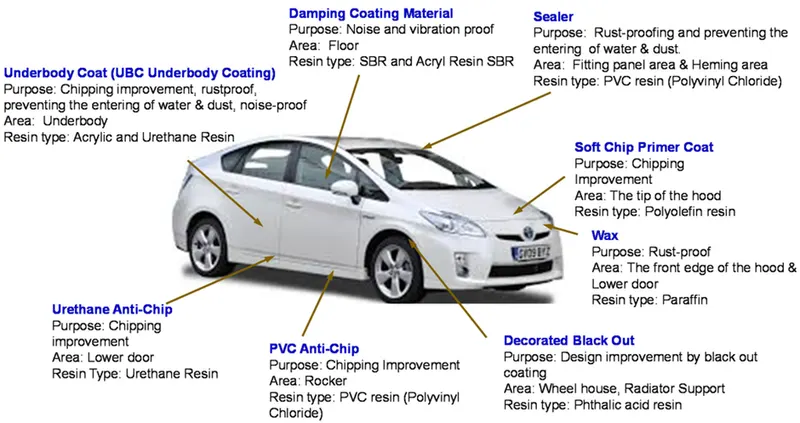
Figure . Summary of coating tasks for specific areas.
2. Automotive Coating Performance
- The performance of an automotive coating can be assessed from different views, e.g., the durability of the exterior and interior paint finishes or the aesthetic features. However, limitations exist on the paint properties, process capabilities, and, most importantly, the amount of money that can be spent to improve the finish.
- Consequently, each automotive company defines its color and appearance standards, which are to meet or exceed the levels reached by competitors and customer expectations.
- Particularly important is the uniformity—or harmony—among all components. In the case of the exterior finish, it is necessary that add-on parts such as bumpers, spoilers, mirror housings, and other decorative trim parts match the neighbouring body panels.
- Differences in color and appearance are especially obvious on automobile models with panels having very tight fits to each other.
2.1. Coating Quality
Coating qualities can be judged on three main criteria:
- Protection against harsh environments
- Durability
- Appearance quality.
A. Protection against harsh environments
A harsh environment refers to damage caused by falling objects (fall out), ultraviolet (UV) rays, hot (above 80 °C) or cold (below −20 °C), scratches, rock hits (chipping), and the rust from salt or road de-icers.
B. Durability
A measure of durability is to have an automobile with rust proofing for over 20 years and good colour/gloss appearance for over a decade.
C. Appearance quality
The three parameters for determining appearance quality are colour, paint smoothness, and gloss
2.2. Corrosion Protection
Automobile coatings are subjected to a number of different environments and situations during their service life.
Degradation of the coating depends on three main factors:
- Coating formula
- The intensities of the environment or situation
- Duration.
Exposure to UV from the sun, heat, and humidity has a long-term deleterious effect with different degrees of intensity depending on the climate and weather conditions. However, these three factors can be simulated in controlled, laboratory weathering tests to assess the lifespan of the coatings.
Often, automobile coatings are also subjected to corrosive gasses and microorganisms.
To suppress or eliminate corrosion, it is necessary to gain a solid understanding of it. All metals after production or shaping have a tendency to seek their lower energy, a natural state which originally was that in the ore from which it originated. This tendency is caused by the Law of Entropy, i.e., the lower energy state is that of an oxidized, corroded state.
In automobiles, corrosion usually results from electrochemical reactions in which the steel is immersed in a suitable electrolyte, like water and road salt, and will create some localized anodes and cathodes.
Anodic oxidation and cathodic reduction are occurring, during which electrons flow from the anodes to cathodes. As a result of the anodic dissolution, a perforation in the metal will happen eventually.
Furthermore, corrosion can occur when two different metals are in contact in the presence of an electrolyte. Called bimetallic corrosion or the galvanic effect, the metal with the lower potential will become the anode with the production of electrons and associated metallic ions, and the other metal will act as the cathode.
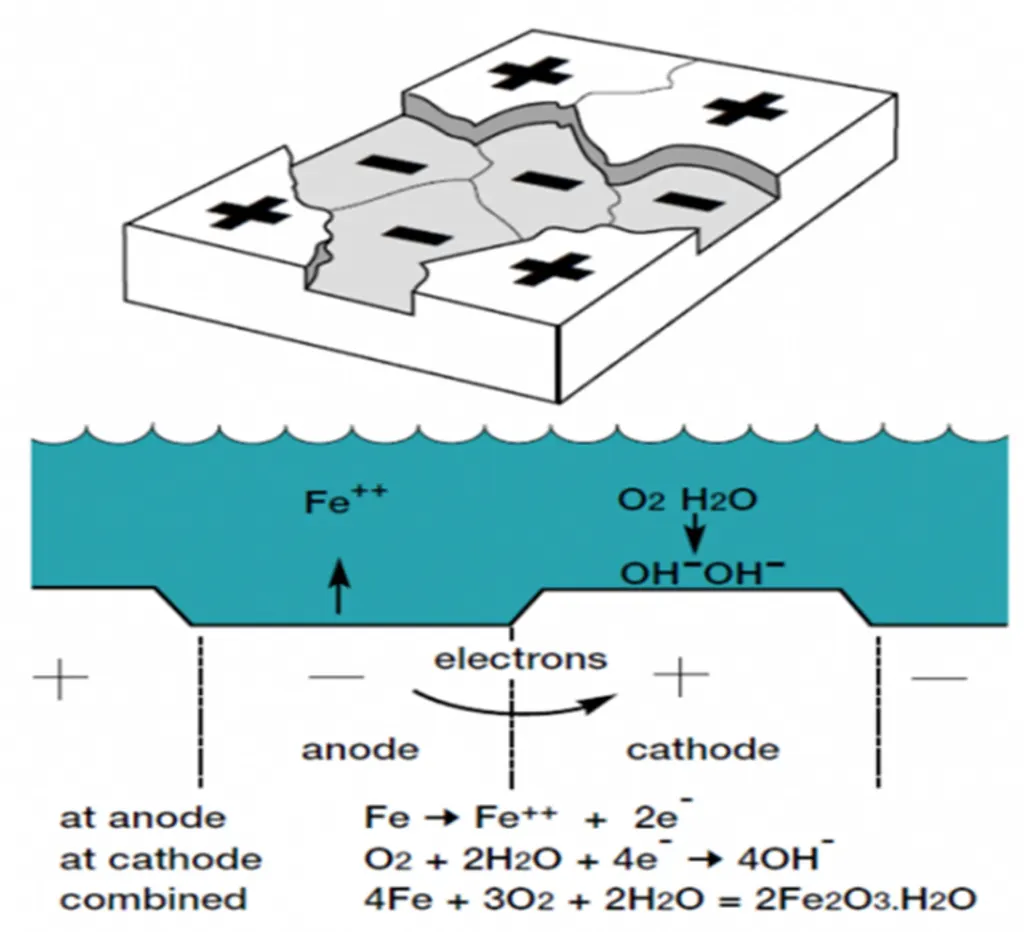
Figure. Corrosion of an automotive body structure.
Factors that affect corrosion include humidity, temperature, a variety of air pollutants such as chlorine, sulphur oxides, and nitrogen oxides, and winter road de-icing salts. These factors can lead to several forms of corrosion.
In addition to zinc coatings, effective design principles of automobile bodies, in addition to providing aesthetic and aerodynamic qualities, can decrease the accumulation and ingress of debris and minimize the prominence of features prone to stone chipping.
Aspects of design that influence corrosion resistance can be divided into the following:-
Styling features: it is at the external “clay” modeling stage of an automobile body that the major panel split can be decided, i.e., when the actual panel configuration is planned that determines the number of joints and associated seams, all of which are potential sites for crevice corrosion.
Subassembly: in subassembly design it is important to avoid complexity because complexity inevitably impairs adequate coverage of panels by paint and waxes. The real danger areas are touching surfaces that promote crevice corrosion and cause decreased coating thicknesses.
Panel and Design: individual panel design features should include drain holes located at the lowest extremity of the section in subsequent parent subassemblies.
3. TRENDS IN AUTOMOTIVE COATING PROCESS
As described in the above, current trends in automotive coating process are motivated by lowering manufacturing costs, delivering customer satisfaction via aesthetic features and corrosion protection, and mitigating environmental concerns.
A tremendous amount of consideration has been put into current automotive coating systems, and they have a level of sophistication that satisfies most customers around the world.
Compared to 30 years ago, the problem of corrosion is almost alleviated, and the durability and appearance of the topcoats have become acceptable for the lifetime of a car.
Hence, a closer look at recent trends in automotive coatings is presented in the following.
3.1. Powder Coating
- One solution to the emission of VOCs has been the replacement of liquid coatings with coatings in the form of dry, particulate solids, commonly called “powder” coatings.
- Their compositions contain very low concentrations of volatile solvents, on the order of 2%, substantially less than any other paint system.
- Currently, the automotive industry uses powder coating on wheels, bumpers, hubcaps, door handles, decorative trim and accent parts, truck beds, radiators, filters, and numerous engine parts.
- A clear powder topcoat has also been developed; BMW and Volvo are using it on their new model cars, and GM, Ford, and Chrysler have formed a consortium to test it on their production lines.
- Powder coatings are an advanced method to apply a decorative and protective finish to almost any type of metal and can be used both by industry and consumers.
The powder used is a mixture of fine particles of pigment and resin that is electrostatically sprayed onto the surface to be coated. The charged powder particles adhere to the electrically grounded surfaces until the powder is heated and fused into a smooth coating in the curing oven. The result is a uniform, durable, high-quality, and attractive finish.
Powder coating is the fastest growing finishing technology in North America, representing over 10% of all industrial finishing applications.
Powder coatings emit zero or near-zero VOCs, and can be used to produce much thicker coatings than conventional liquid coatings without running or sagging. Over-spray can be recycled, thereby meaning it may be possible to achieve nearly 100% TE of the coating.
Capital equipment and operating costs for a powder line are less than for conventional liquid lines. Items that are powder coated have fewer differences in appearance between horizontally and vertically coated surfaces than liquid coated items.
3.2. 3-Wet Paint
- The automobile industry seeks to eliminate or minimize the extent of spray application processes, space, and baking ovens because of the significant savings in material and energy. One approach has already been successfully established—a wet-on-wet-on-wet-system (3-wet) that mostly eliminates the primer oven in the coating process.
- An additional step has also been taken—to remove primer surfacer application—with its function preserved by the application of the first basecoat layer.
Waterborne, 3-wet paint systems have been developed to reduce VOCs and CO2 emissions. These systems apply the primer coat, then basecoat and finally the clearcoat, after which curing is accomplished in only one oven.
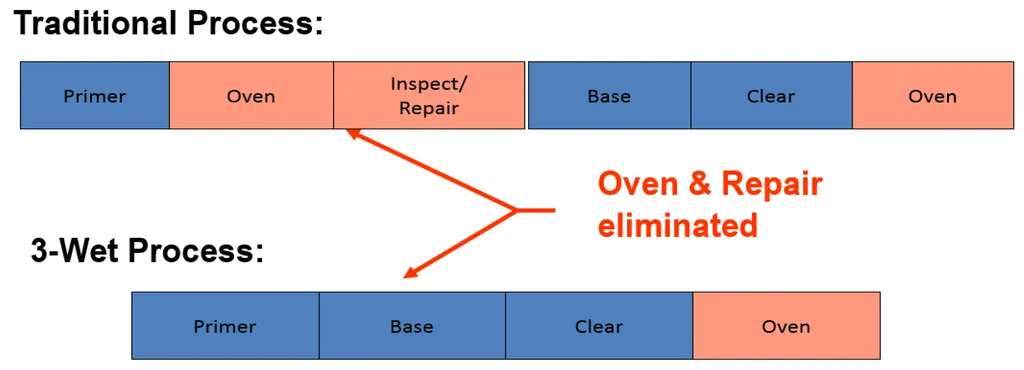
Figure . Existing and 3-wet processes of the primer coat.
The 3-wet paint technology has the potential to be cost-efficient and environmentally rigorous, and produce durable, high-quality painted vehicles.
Types of Undercoating
- Rubberized Underbody Coating
- Wax Based Underbody Coating
- Asphalt Based Automotive Undercoating
- Polyurethane Underbody Coating
1.Rubberized Underbody Coating
This is generally thought of as the best underbody coating for your car. It preserves the underbody well, protecting it from scratches. Applying this to the undercarriage is not much of a hassle either.
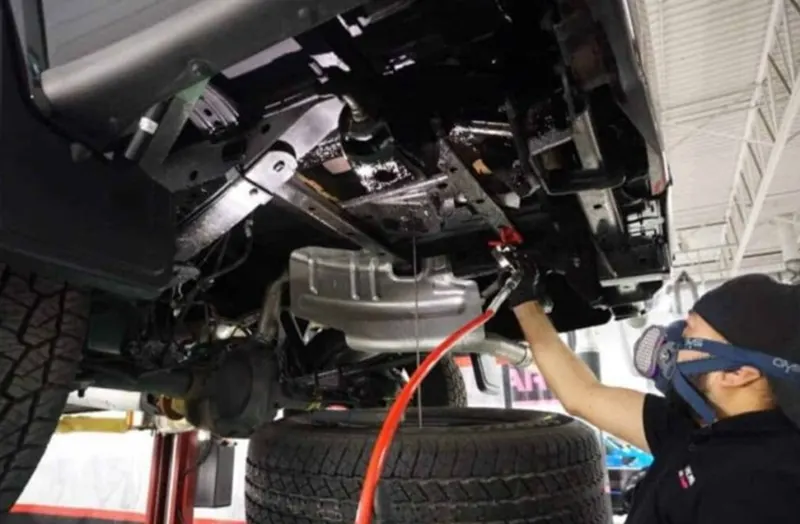
2. Wax Based Underbody Coating
This – more or less – ephemeral undercoating will wear away in a few months’ time. On the upside, wax-based undercoating puts up a big fight against moisture. It is also the most affordable option out there.
3.Asphalt Based Automotive Undercoating
Best suited for lorries, trucks and large vehicles this provides a greater degree of protection compared to rubber-based coatings. However, asphalt-based coatings contain little amounts of rubber for sound-insulation purposes. The process of applying this coating is a bit time-consuming though.
4.Polyurethane Underbody Coating
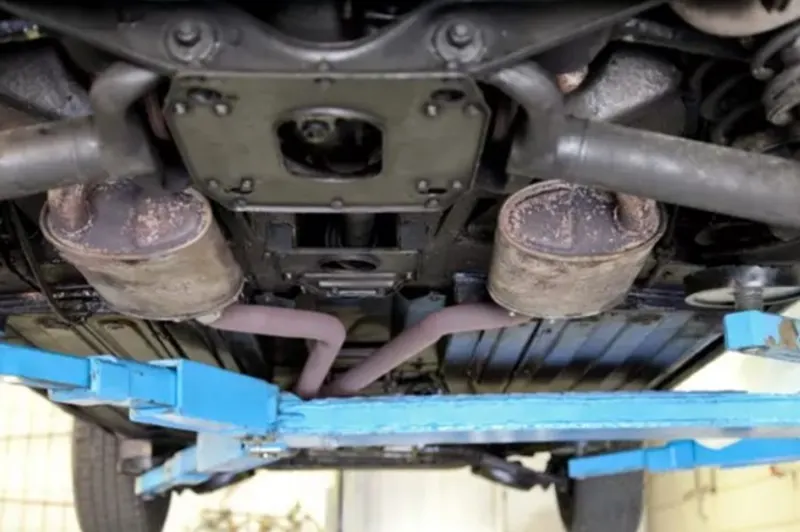
This coating closes up splits and fractures on the underbody of the vehicle. It offers up good protection against corrosion and also bonds with the metal. Unlike in the case of asphalt-based coating, you can paint over the polyurethane coating.
ADVANTAGE OF UNDERBODY COATING:-
Now we will tell you why you should consider investing in a vehicle underbody coating.
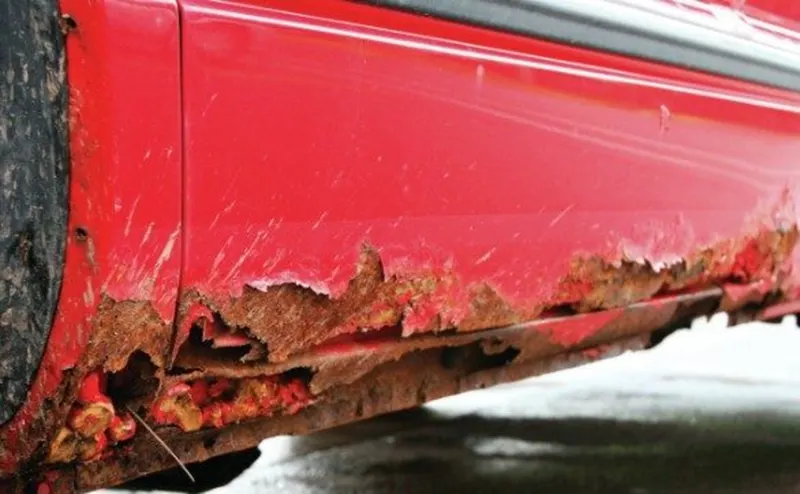
1. Fights Rust
It plays an important role in keeping corrosion at bay. Underbody coating can come in handy especially if you live near the sea, where there is too much humidity, and rusting is just one of those everyday things. You should also seriously consider undercoating if you reside in a place where it snows in winter.
2. Absorbs Noise
Believe it or not, very thick undercoating can soften the noises that reach the cabin. Since the undercoating is often made up of rubber it absorbs some of the rackets. The occupants of the car could spare themselves of the road noises – at least up to a certain extend.
3. Reinforcement
If your car comes with stock underbody coating, using another coating on top of it, is not going to hurt. It will offer additional reinforcement, protecting the underbody from water, road debris, gravel and small pebbles. There would also be a lesser chance for the factory coat to flake away.
4. Prolong Car’s Life
Good undercoating not only defends the underbody from corrosion but also protects the engine and transmission as well! Less rusting coupled with slower wear and tear can surely add years to the lifespan of your vehicle. There would be fewer dents, dings and scratches on the undercarriage for you to fret about.

5. The service might help with the cost of your insurance.
Vehicular insurance is based on risk. If you reduce the risks of a claim by giving your vehicle a proactive service, of which an undercoating applies, then it may lower your overall premiums. States which see high levels of corrosiveness, such as Hawaii, typically see the steepest discounts with this advantage. Northern and coastal states in the U.S. might also see this benefit.
Although the premium decrease won't offset the cost of the service, a discount of 3% to 7% may be available for some owners.
DISADVANTAGE OF UNDERBODY COATING:-
1. It won't do anything about the corrosion which is already present.
For an undercoating to be effective, it must be in place before the underbelly of your car begins to rust. If you apply it over corrosion, you won't be making an improvement. It will look better„. until the rust breaks its way through the layer of undercoating you've applied. If you have rust present, then it must be removed, with the metal repaired, before the undercoating is applied for best results.
2. It works best on new cars.
If you've purchased a used vehicle, then the cost of preparing the underbelly for an undercoating might be more than the value of the car. You must remove all the residue from the bottom before it can be applied. Failing to do so will seal in the debris that is present already, which can lead to more problems. The best time to have an undercoating applied is when a vehicle is purchased new because it offers a superior level of protection then.
3. Most vehicles make it five years before corrosion begins to show.
For vehicle owners who purchase something new every 3 to 5 years, then rustproofing may not be a good use of your cash. Although an undercoating does add value to a used car, that only applies when the rustproofing product used provides a transferrable lifetime warranty. Most vehicles that are on the road today are able to make it five years before any corrosion begins to show. It may be 7 to 10 years before the functionality of the vehicle is negatively impacted by the lack of an undercoating.
If you wash your vehicle regularly, especially during the winter months, then you might be able to save the time and money required for this service.
4. A third-party undercoating service might void your vehicle's warranty.
Some new cars no longer need the undercoating service provided because the structure of the vehicle has it built-in already. If you hire a third-party provider to apply an undercoating, you could void the corrosion perforation warranty that is factory provided. Most vehicles today that leave the factory floor are all provided with included rust proofing.
If you are purchasing a used vehicle, an undercoating to a clean underbelly could extend the life of the vehicle and give it more value. For new vehicle purchases, you should ask the dealer what rustproofing options are included before paying for a separate undercoating option. Ask for documentation of what is provided instead of taking the word of the salesperson or the service personnel.
Many dealers have language in their terms and conditions that only written agreements are binding.
5. It adds weight to the vehicle.
Although the amount of weight added to a vehicle with an undercoating is minimal (between 10 to 20 pounds for most vehicles), there is an element of fuel economy to consider. When your vehicle weighs more, the distance you can travel on a single tank of fuel is reduced. The undercoating might reduce your efficiency by up to one mile per gallon, which creates an additional fuel cost over time that is worth considering.
APPLICATION PROCEDURE OF UNDERBODY COATING:-
- Lift up the vehicle, take off the wheel and plastic wheel covering.
- Thoroughly clean the under body of the vehicle by high pressure water.
- Blasting with compressed air could accelerate the drying.
- Mask off the adjacent areas and parts with paper where not allowed to spray, such as exhausting pipe, brake system, engine, paint surface and etc.
- Shake the can approx. 40 times before use, connect the can with spray gun.
- Spray at room temperature and from a distance of approx. 25 cm in an X motion to build up a continuous coat Do not spray on parts of the brake, engine or exhaust system.
- Apply this product until the desired layer thickness is reached. If a thick layer is required, let layers dry in between.
- After each use, clean the spray by flushing with suitable solvent.
- After tough free, remove all the mask paper, re install all the parts.
- In case the under-body coating is sprayed to unwanted areas, clean it before drying.