Underbody Coating
AUTOMOTIVE UNDERBODY COATING
1) INTRODUCTION :-
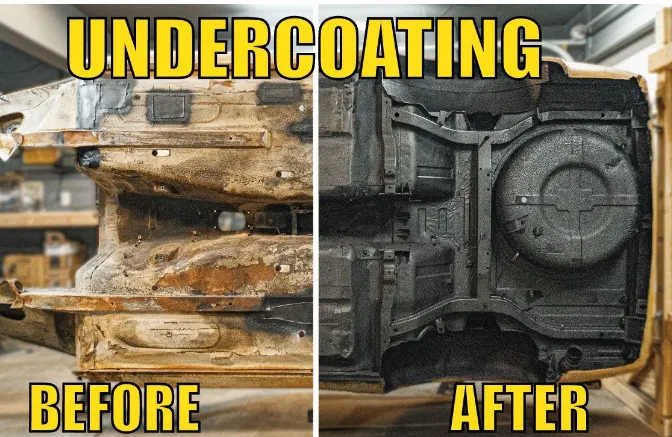
A car’s underbody is exposed to the most wear and tear caused by muddy water, potholed roads, stones and other obstacles on the road. Because it’s not in plain sight, we often do not see the damage.
2) UNDERBODY :-
This method involves spraying a tar-based substance on the exposed parts of a vehicle's underbody. The tar-like undercoating acts as a barrier once it hardens, keeping out moisture, salt, and other substances. This undercoating works best when applied to the undercarriage of a new vehicle.
Rustproofing and undercoating your vehicle can protect it from corrosion and rust. This is especially important for the undercarriage of your vehicle, which commonly comes into contact with substances such as water, chemicals such as salt, and other dirt and debris from the road. Without some sort of protection, the bottom of your vehicle can rust and corrode, leading to part failure.
3) UNDERBODY COATINGS :–
A coating composition which adheres to the underbody of an automobile and protects the underbody from the environment. The coating composition includes a polymeric composition which, when coated onto an automobile underbody, allows small road debris to embed into the coated composition while traveling to provide further protection to the underbody. An acceptable level of weight gain of sand in the coating is at least about five to forty weight percent based on the weight of the coated composition. Another embodiment is a coating composition having a viscosity of at most about 1000 centipoise at 150 °C and includes a styrene-rubber diblock copolymer, a styrene-rubber-styrene triblock copolymer, and a polar-functionalized polymeric material. The rubber portions of the diblock and triblock copolymers are individually selected from the group consisting of ethylene-butylene, ethylene-propylene, and mixtures thereof.
4) DESCRIPTION :-
available in both thin film and foaming types are designed to provide a critical protective barrier between the road and vulnerable underbody surfaces. In addition to protecting from moisture and impact, the foaming‐type products provide excellent sound dampening properties.
Before rustproofing or undercoating your undercarriage, you need to consider a few things.
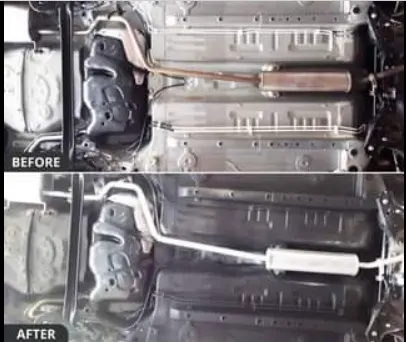
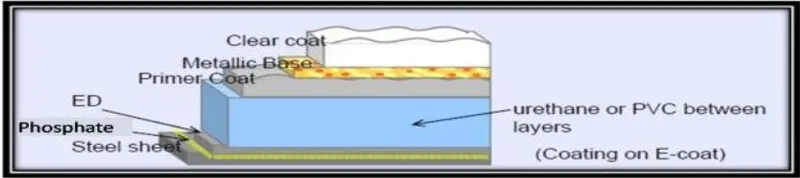
The advantages and disadvantages of rustproofing/undercoating your vehicle :-
- The best time to rustproof or apply undercoating protection is when you buy a brand new vehicle that hasn't been driven yet. In essence, ask the dealership to apply the protection before you even drive off the lot. For used vehicles, rustproofing could just be a waste of time, as all you are really doing is covering up dirt and grime that already exists on the vehicle.
- Apply protection while at the dealership. Many dealerships offer rustproofing or undercoating as an add-on when buying a new car.
- This represents the best time to have an undercoating applied, as the underbody of the vehicle is probably the cleanest it will ever be.
- If you only plan on keeping the vehicle for a few years, you might consider sparing the expense and foregoing getting an undercoating applied.
- Applying an undercoating on a used vehicle. Another option to having an undercoating applied at the dealership is to have one applied at a later time.
- This applies most commonly to used vehicles. While the underside of the vehicle has already been exposed to water, dirt, and other debris from the road at this point, applying an undercoating now can protect it from further exposure.
5) MODERN AUTOMOTIVE COATING PROCESS :-
Modern automotive coating methods consist of five main steps. They include the
following:
➢ Pretreatment: removes and cleans excess metal and forms an appropriate surface structure enabling bonding of a corrosion protection layer.
➢ The next step is electrodeposition (ED) of the anti-corrosion or rust prevention layer.
➢ A sealer like Poly Vinyl Chloride (PVC) is applied for anti-corrosion, elimination of water leaks, and minimization of chipping and vibrational noise.
➢ A primer is then applied to promote adhesion between the surface and the basecoat it also imparts a smoother surface for subsequent layers and has anti-chipping properties.
➢ Finally, the topcoats that include a basecoat and clearcoat are applied; they provide surface properties that are sought after, including color, appearance, gloss, smoothness, and weather resistance.The areas of an automobile depicted in Figure1show where these five steps of coating and other additional coatings are used. As can be realized when examining this figure, a significant number of specific coatings and materials are needed in addition to the above-listed steps to manufacture a salable automobile.
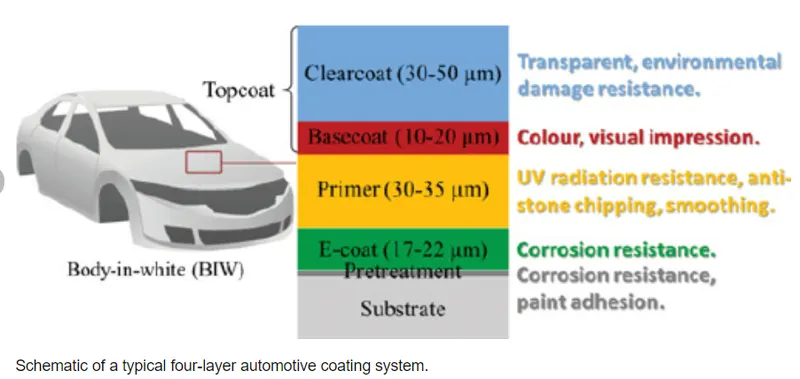
Pretreatment
When the automobile body sheet metal components are welded together, the resulting structure is referred to as the body-in-white (BIW). The first sequence in preparing the BIW for subsequent coating is pretreatment . Pretreatment consists of cleaning the body surface to remove remaining oils from the stamping process and welding residues through three primary liquid dip processes of degreasing, conditioning, and phosphating. An additional pretreatment cleaning that employs ~pH 9 hot water can also be used. Pretreatment helps the primer to bond onto the metal. A phosphate treatment applies an inert layer of metal phosphate, providing resistance to corrosion spread . The degreasing solution is composed of alkaline salts and surfactants and can include caustic soda, trisodium phosphate, and sodium carbonate. The surfactants are types of detergents for emulsifying oils and lubricants on the BIW. The degreasing zone typically consists of at least two sequences, including a spray stage known as knock-off-degrease (KOD) and a dip sequence. The advantage of using these two is that a significant portion of the oil and dirt will be removed by the high-pressure spray, thereby leaving a relatively lower load for the
dip sequence to clean. The next sequence is surface conditioning (also called activation), which creates nucleation sites for phosphate crystal growth. It increases the number of crystallization nuclei on the metal surface that enhance bonding mechanisms for the subsequent phosphate sequence. In conditioning, an aqueous dispersion of titanium orthophosphate with pH between 8 and 10 is typically used. Finally, the liquid dip phosphate solution is composed of phosphoric acid, phosphate ions, nitrate ions, zinc and other divalent metal ions, hydrogen ions, and an accelerating compound. The free acid etches the steel surface, causing hydrogen to be released while metal phosphate ions are precipitated onto the surface in a crystalline form. The primary objective during phosphating is to deposit a thin, dense and
uniform conversion layer on the cleaned and prepared metal surface.
Electrodeposition (ED)
The metal underbody and frames of automobiles are coated to prevent corrosion, whereas other areas like the roof are not rust-proofed. When not coated to prevent corrosion, the structural metals (or other materials) are primed before applying additional coatings. Figure displays types of corrosion protection coatings for cold rolled steel.
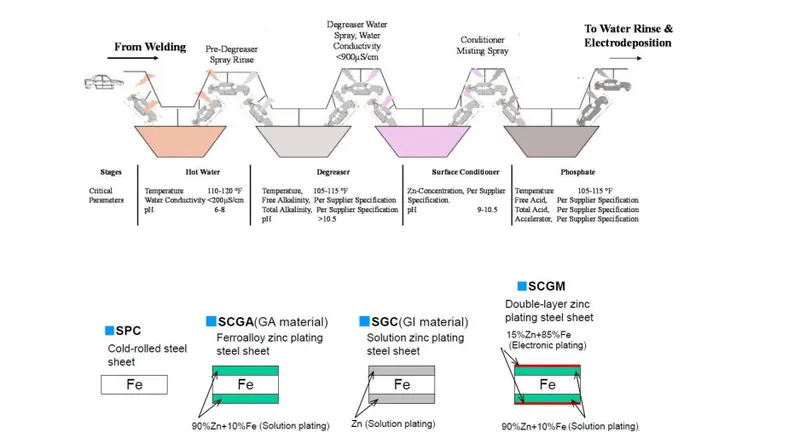
An SCGA electrodeposition solution having a 90% Zn–10% Fe composition (GAmaterial) is the primary coating used in modern automobiles to prevent corrosion. In comparison to the SGC solution, i.e., GI material, with 100% Zn during electrodeposition, the GA material minimizes ED gas pin (paint quality defects) and maximizes spot welding performance; however, the SGC process is still used in Europe. The SCGM corrosion protection method was used in previous decades, and it did enable minimization of ED gas pin. However, its cost was higher than the GA material coating. The electrodeposition coat or E-coat provides rust and corrosion protection and was first introduced in the 1960s. Since then the use of E-coat has grown at a rapid pace. By 1970, 10% of all cars were electrocoated and by 1990, 90% of all cars were electrocoated. Today, it is the most conventional coating process used in vehicle manufacturing. The E-coat process has not only grown at a rapid rate but has changed significantly since it was first introduced. From 1964 to 1972 an anodic E-coat process was used, and from 1976 to the present, a cathodic E-coat has been used. The E-coat film thickness has also varied during this time frame. Thicknesses started at 25 µm and remained that way until 1976 when the cathodic process was adopted, and an 18 µm thickness was established; it remained at this value until 1984, when the film thickness was increased to 35 µm. This relatively thick film was used until 1992 when E-coat film thicknesses were decreased to the current value of 20 µm.The E-coat solution consists of a mixture of resin, binder, a paste containing the
pigments, and a solvent. During anodic electrodeposition, metal parts are positively charged while the paint is negatively charged; because small amounts of metal ions migrate into the
paint film, it limits the performance properties of the coating. Hence, anodic coatings are mainly used for interiors and offer excellent color and gloss control. In cathodic electrodeposition, the metal part is negatively charged while the paint is positively charged. In contrast to the anodic process, the cathodic process reduces the amount of iron that can enter into the paint film. Hence, cathodic coatings offer high performance and excellent corrosion resistance and have mostly replaced anodic coatings in North America. The Ecoat process is considered to be relatively environmentally friendly; it uses only a 0.5%
solvent solution.
The pH of the solvent in the ED tank is a measure of the balance of acidic and caustic components in the tank. The balance is dominated by the functional groups in the resin and the neutralizing agents. A decreased pH in the cathodic ED tank lowers film thickness so that higher voltage needs to be applied with the danger of rupture effects. The pH can be influenced by the pretreatment chemicals in a detrimental way. In such a case, conductivity and pH drift to values outside of the specification and corrections have to be made by replenishing ultrafiltrate with deionized water (D.I.) water.
E-coating involves dipping automobile bodies into the coating solution and passing an electric current through the body and the liquid ED paint solution. Because of the charged nature of this coating process, the ED paint penetrates into places a spray would not reach. The ED paint is promoted to bond with the metal substrate, and a uniform coating thickness is produced. The result is an insoluble, deposited layer with a very high solids content and firm adherence to the pretreated body .
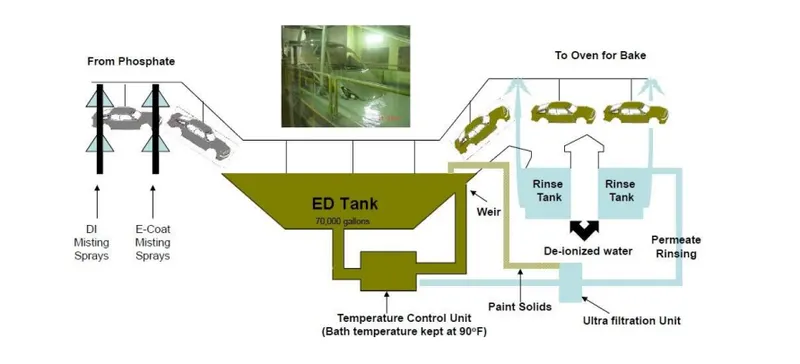
During operation, a mixture of resin, binder, and a paste containing the pigments is fed into the electrodeposition tank. The automobile body is lowered into the tank, and an electric current applied; the solution in the tank consists of 80%–90% deionized water and 10%–20% paint solids (consisting of resin, binder, and pigment). The deionized water acts as a carrier for the paint solids, which are under constant agitation. The resin is the backbone of the final paint film and provides corrosion protection, durability, and toughness. Pigments are used to provide color and gloss. To control paint performance during cathodic E-coating, purging of the paint and regulating the amount of applied voltage are essential. As the coating grows in thickness, it becomes more and more insulating, thereby causing the deposition process to
slow. As an automobile body exits the tank, paint solids adhering to the surface but not bound to the surface are rinsed off to recover the ED solids via an ultra filtration unit to ensure surface smoothness.
After the E-coat, the automobile body enters a bake oven, in which heating and keeping at a temperature of 160 ˝C for 10 min causes film curing to promote maximum performance properties. The oven temperature and heating time primarily enhance chip resistance and film adhesion to the body; corrosion protection is affected less by these conditions. Because surface roughness influences the smoothness and brilliance of the topcoat, some sanding of the surface is usually performed to remove or eliminate defects
before the body enters the next application step.
A common challenge in the current E-coating process is that of water spots that contaminate coated surfaces. These spots can appear on the air-dried surface if water droplets from the conveyor or other sources fall on the body, especially if the water in the tanks is not deionized properly and has high conductivity; the water spots are usually a remnant of unwanted ions in the water and will cause problems in subsequent coating applications and their adherence and appearance. If water spots are present, they have to be removed by sanding. Hence, it is necessary to use well-deionized water and routinely monitor its conductivity. Alternately, operators also add surfactants or ultrafiltrates to the water rinse zone to eliminate or manage water spots.
The Difference Between Rust Protection and Undercoating
Undercoating and rust protection often go hand-in-hand, but they are actually two different things. Rust protection generally goes inside your vehicle, while undercoating is used for protection outside of the vehicle, and there are a variety of coatings available. Depending on the level of damage and how much protection you want for your vehicle will determine which type of automotive undercoating you choose.
6) DIFFERENT TYPES OF UNDERCOATINGS :-
Having undercoating professionally applied to your vehicle can be expensive, but fortunately, if your budget is tight, you can do it yourself for a fraction of the price. Here are some of the various types of undercoating available.
Now let us look at the various kinds of automotive underbody coating you can go for, for your vehicle.
A) RUBBERIZED UNDERCOATING :-
Rubberized Vehicle undercoating is easy to apply and offers sound-cushioning as well as protection from dust, moisture, and dings or dents.
In addition to your undercarriage, rubberized undercoating is also safe to use on wheel wells and quarter panels, and dries to a soft rubbery finish that prevents further rust, damage, or moisture seeps. The coating can be painted over and, if necessary for bodywork, can be easily removed with an undercoating removal spray.
Overall, rubberized undercoating is generally the best option for protecting your vehicle's undercarriage, as it provides the simplest and best protective measures against rust and moisture.
This is generally thought of as the best underbody coating for your car. It preserves the underbody well, protecting it from scratches. Applying this to the undercarriage is not much of a hassle either.
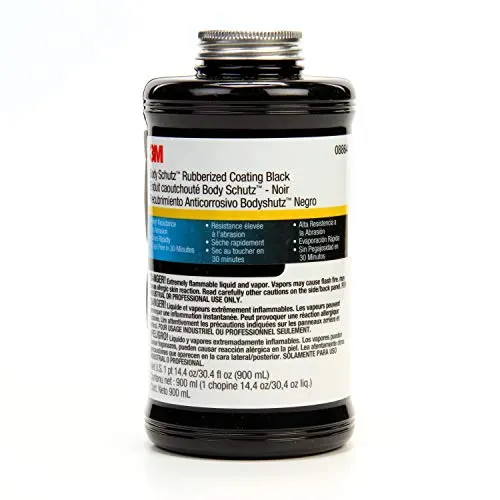
Ideal for cars driven in rough terrain, as its name suggests, this undercarriage coating involves applying a rubber agent to the underbelly to protect and cushion it against dents, dust, and moisture.
Advantages:
- Easy to apply
- Quickly applied with no fuss
- Undercoat can be painted for a neat finish
- Provides satisfactory protection
- The simplest way to undercoat your car
- Safe to apply
- Truly dries to a soft rubbery finish that prevents further rust, damage, or moisture seepage
B) WAX OR PARAFFIN-BASED UNDERCOATINGS :-
A paraffin-based undercoating will be the cheapest and quickest option available with which to protect the undercarriage of your vehicle. However, keep in mind that it will wear off quicker than other types of undercoating and will need to be stripped and reapplied at least once every year.
Wax-based undercoatings never truly harden. During application, they drip or flow into seams and cracks to provide protective properties. They are usually available in a spray gun canister or in an aerosol can and offer at least a base protection in moderately humid climates.
This – more or less – ephemeral undercoating will wear away in a few months’ time. On the upside, wax-based undercoating puts up a big fight against moisture. It is also the most affordable option out there.
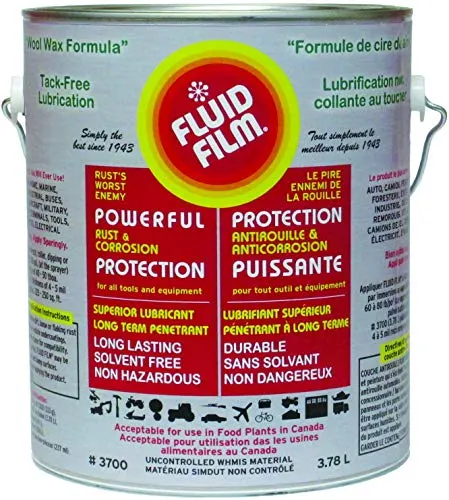
It is the preferred undercarriage coating for cars often driven on highways and normal roads. Sometimes referred to as wax-based undercoating, it provides sufficient guard for cars in fairly moist regions.
Advantages:
- Readily flows into seams to guarantee any exposed and prone surfaces are protected
- The most inexpensive undercoating option
- Conveniently available in spray guy canisters or aerosol cans
An example of a Wax/ Paraffin Undercoat is Fluid Film 1, a rust inhibitor, anti-corrosion, and anti-rust undercoat.
Disadvantages:
- Wears off quicker in comparison to other types
- Unlike the rubberized type, it does not really dry
Needs to be stripped and reapplied at least once a year as soon as signs of wear and tear start to show.
C) ASPHALT BASED AUTOMOTIVE UNDER COATING :-
For standard vehicles, any of the aforementioned types of undercoating will provide sufficient protection. For large trucks and heavy machinery, asphalt-based undercoating provides a bit of extra durability against rocks, chips, and moisture.
Asphalt-based undercoating generally contains a little bit of rubberized material that sets up firmly and also helps soften noise. Generally sold in five gallon containers, this type of undercoating also needs more cure time than the other three, and is NOT paintable, making it best to use only for undercarriages.
Best suited for lorries, trucks and large vehicles this provides a greater degree of protection compared to rubber-based coatings. However, asphalt-based coatings contain little amounts of rubber for sound-insulation purposes. The process of applying this coating is a bit time-consuming though.
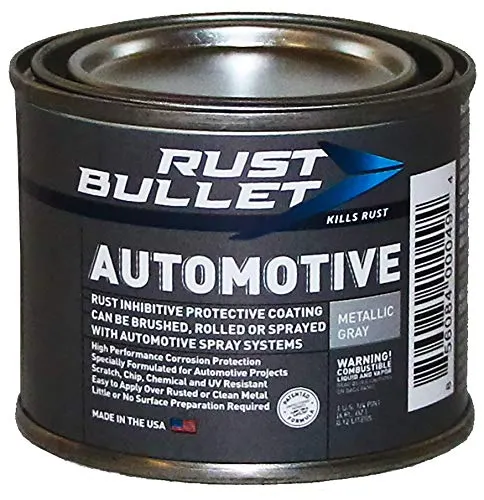
Unlike the rubberized, wax/paraffin-based, and Polyutherane undercoatings, this type is made of asphalt and generally also contains some rubberized material that sets up firmly and helps soften noise from the engine.
It reportedly has the most damage-resistant properties. Although asphalt-based undercoating is ideal for trucks, military, and all-terrain vehicles, it will also help protect your car, truck, motorcycle, and heavy machinery from the elements.
It last long and is best for endurance vehicles that have to undergo heavy road use.
When it comes to large trucks, heavy machinery, military, and all-terrain vehicles, asphalt-based undercoating provides added durability against rocks, chips, and moisture. It’s usually available from professional service shops.
Advantages:
- Formulated to protect from dirt, rust, and corrosion, it normally has a shelf life of up to two years. Sold in five-gallon containers
- Provides extra durability as it is the strongest and thickest undercoating available
Examples of asphalt-based undercoats are Rust Bullet, an automotive inhibitor paint for rust preventive and protective coating. As well as Skyco-Ospho protective coating.
Disadvantages:
- It takes time to harden and so requires more cure time than the other three types
- Unlike the other three, it is also, not paintable as such, not very aesthetically suitable for standard vehicles
- For best used only for the undercarriages of utility vehicles and trucks
The only type of undercoating with a limited warranty
D) POLYURETHANE UNDERBODY COATING :-
The other option for undercoating your vehicle is to use a polyurethane based sealent. This type of vehicle undercoating is a little bit quicker and easier to apply.
Oftentimes, polyurethane undercoating will come in canisters ready to preload into an application gun. This type of sealant works by seeping into all cracks and seams, displacing salt and moisture and oozing around rusty areas to bond with and protect unoxidized metal. It also sands quickly in case you'll need to perform bodywork and can be painted over.
On the flipside, this type of car undercoating generally requires a little bit more surface prep work before applying -- sanding and applying an etching primer to bare metals before using are generally recommended.
This coating closes up splits and fractures on the underbody of the vehicle. It offers up good protection against corrosion and also bonds with the metal. Unlike in the case of asphalt-based coating, you can paint over the polyurethane coating.
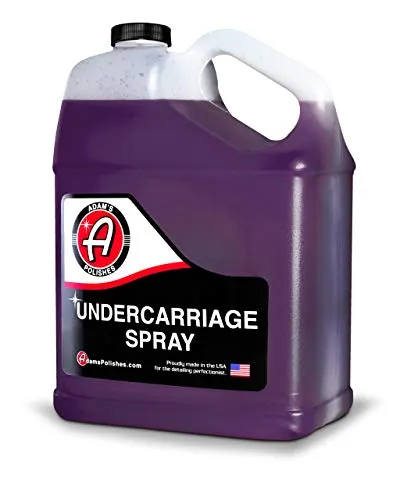
The polyurethane used in this product is a high-quality and durable material that is perfect for any weather condition. It is ideal for standard vehicles.
Advantages:
- It has a long lifespan and is resistant to wear and tear
- Easily and quickly applicable
- Trickles into cracks and rusty spots already present on the underbelly of your car and fills them, hence protecting the underlying metal
- Quick and simple to remove, as it sands easily
- Dislodges salt, moisture, and oozing around rusty areas to bond with and protect unoxidised metal
- Can be painted over
Disadvantages:
- For better adherence, needs undercarriage preparation before application
- Requires time-consuming etching with primer to bare metals
E) WATER-BASED UNDERCOATING :-
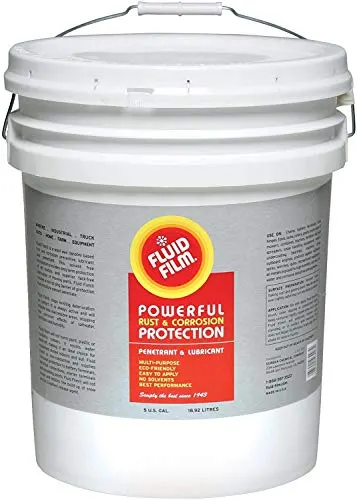
Water-based undercoating is a protective layer that helps your car stay protected from harsh weather conditions. It is made from an advanced polymer that is non-toxic and environmentally friendly.
The product can be applied to any surface, including metal, plastic, rubber, and glass. It will keep your car protected from rust, salt, and moisture. This undercoating provides a protective barrier that lasts for only a year-depending on where you drive your car.
When it comes to DIY (Do it Yourself) undercoating, this type is the most popular. Coming in an aerosol can, it can be purchased from most automotive shops. This product is easy to apply and can be done in a single day.
Advantages:
- Thin-set, it takes a short time to dry
- Can be done at home
Examples of Water-based undercoats are Total Coat Automotive Sprayable Undercoating, Corroseal Water-Based Rust Converter Metal Primer, CRC SP-300 Corrosion Inhibitor, and the Evapo-Rust-Block Water-Based Rust Inhibitor.
Disadvantages:
- It requires frequent repetition as it’s not very durable
- It cannot repel ice and water like petroleum-based undercoating
F) PETROLIUM-BASED UNDERCOATING :-
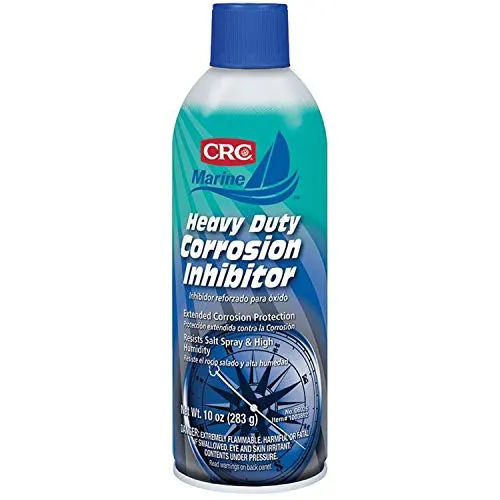
Petroleum-based undercoating is a heavy, viscous oil-based liquid product that provides an effective barrier against moisture and corrosion.
The liquid dries and hardens to provide tough, durable, and long-lasting protection against moisture and corrosion. This product is typically applied to the undercarriage of automobiles, trucks, and other vehicles.
Petroleum-based undercoating can be purchased from your professional vehicle servicing shops.
Advantages:
- Has greater deflective abilities for road salts and grime
- Repels ice and water because of its petroleum base
Examples of Petroleum-Based undercoating are CRC Heavy Duty Corrosion Inhibitor and the Fluid Film Rust Inhibitor for rust prevention and anti-corrosion.
Disadvantages:
- Requires annual replacement
7) ADVANTAGES OF UNDERCOATING :-
Now we will tell you why you should consider investing in a vehicle underbody coating.
-
FIGHTS RUST
It plays an important role in keeping corrosion at bay. Underbody coating can come in handy especially if you live near the sea, where there is too much humidity, and rusting is just one of those everyday things. You should also seriously consider undercoating if you reside in a place where it snows in winter.
-
ABSORB NOISE
Believe it or not, very thick undercoating can soften the noises that reach the cabin. Since the undercoating is often made up of rubber it absorbs some of the rackets. The occupants of the car could spare themselves of the road noises – at least up to a certain extend.
-
REINFORCEMENT
If your car comes with stock underbody coating, using another coating on top of it, is not going to hurt. It will offer additional reinforcement, protecting the underbody from water, road debris, gravel and small pebbles. There would also be a lesser chance for the factory coat to flake away.
-
PROLONG CAR'S LIFE
Good undercoating not only defends the underbody from corrosion but also protects the engine and transmission as well! Less rusting coupled with slower wear and tear can surely add years to the lifespan of your vehicle. There would be fewer dents, dings and scratches on the undercarriage for you to fret about.
- Warranty and Other Perks
Underbody coatings can also make it easier for you to clean the car. Besides these, the coating provides a bit of thermal insulation making travelling by road easier even during summers.
Undercoating can be applied as a liquid, typically sprayed or brushed on, then allowed to dry. It helps to protect the axle, engine, brake system, transmission, exhaust and fuel systems, suspension parts, gas tank, floorboards.
Undercoating can be sprayed on any type of car, truck, or SUV. The type one chooses to use is often determined by the level of damage your car has sustained and/or the extent to which you would like to protect its underbelly.
There are several types of undercoating and their specific brand examples currently available on the market.
8) DIFFERENT TYPES OF RUSTPROOFING/UNDERCOATING METHODS :-
When having your vehicle rustproofed or an undercoating applied, you have a few options to choose from. Whether you prefer the latest technology or a more tried and true method, knowing what the different options are should allow you to choose the best one for your vehicle.
A) SPARY METHOD :-
- The spray is the most common method used by dealers. The spray consists of a tar-like substance that is applied to the undercarriage. It functions as a barrier for salt, moisture, and oxygen, which causes corrosion.
- You can also purchase it as a DIY product, but the whole magic lies behind the method of application, so it’s better to do the job with a dealer, especially if you have a new vehicle.
B) ELECTRONIC METHOD :-
- Using a weak electric current, this small device can stop the corroding effects of rust.
- You can have these electronic devices installed at the dealership, or save some money and buy them from a source outside of the dealership.
- The reviews on these devices are mixed, as this is a virtually new technology.
C) DRIPLESS OIL SPARY METHOD :-
- A wax-like substance applied to the entire body of the vehicle, it hardens once it has dried.
- One of the downsides of dripless oil sprays is that you need to have holes drilled into the body of the car at specific points to make it effective.
- The spray also has a high viscosity, meaning that it does not always get into all of the nooks and crannies of your vehicle.
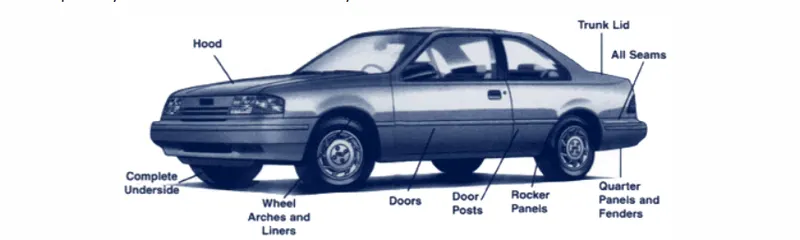
D) DRIP OIL SPRAY METHOD :-
- This is the most commonly recommended rust protection.
- Drip oil sprays tend to continue to drip once applied until they dry. This dripping can last anywhere up to 48 hours after application.
- Unlike the dripless varieties, the more watery nature of drip oil sprays means it gets into more areas on your vehicle, though you still need to have holes drilled in your vehicle's fenders, doors, and other areas to make sure that it gets to all the areas it needs to.
9) HOW TO APPLY AND REMOVE UNDERCOATING :-
A– CLEANING THE UNDERBODY :-
You have to remove all debris and contaminants from the chassis to start with the undercoating process. It is another way to maintain your car in routine. You will need a hydraulic hoist or lift to complete this step in the right manner.Here is how you can clean the underbody.
-
Degreaser:
A high-quality commercial-grade degreaser would be helpful in removing oil and grime from the undercarriage. Follow the exact steps listed on the cover or recommended by the manufacturer. Spray the degreaser, then allow it to soak for a moment, then wipe it off with a microfiber towel or shop rag.
-
Grinding:
Now, grind the existing hard contaminants and rust from the undercarriage and other components that you want to treat. You can use a mild grinding pad to remove the debris easily, but remember to wear eye protection while doing it.
-
Sanding:
After degreasing and grinding, remove those scratches and other stubborn contaminants using a 200 to 400 grit.
Use a Tack Rag or IPA solution:
To wind up the cleaning process, wipe down the area with a tack rag or IPA solution.
B – APPLYING PRIMING :-
You will need a primer for applying DIY consumers. Primers serve as a basecoat. You need to follow the instructions listed by the manufacturer for expected results. The recommended primers usually contain a high level of zinc. Zinc helps in reducing rusting, even if the protective layer is penetrated.
C – APPLYING UNDERCOATING :-
This is the final step. The undercoating sprays are similar to bed liners. Most products are applied in two steps as dual layers. The first layer should be thin, covering the entire surface. Allow it to rest at least for an hour, especially if you are applying a rubberized undercoating.
After this layer has been dried, you can apply the second coat generously. Don’t forget to apply it as per the instructions given by the manufacturer. It will take a few hours to days for curing.
When you are done with the process, you need to look after the undercarriage to protect it from saltwater, road grime, or mag chloride as these contaminants are corrosive and result in oxidation and rusting.
Materials Needed
- Degreaser
- Grinder
- Microfiber towels
- Paint (black automotive paint)
- Paint Brush
- Primer
- Safety Glasses
- Sandpaper (at least 220 grit or larger)
- Scraper
- Undercoating
- Undercoating removal spray
- Vehicle hoist
While you could pay someone to apply an undercoating to your vehicle, you can also save money by doing it yourself. Before beginning, make sure you have the right equipment to successfully complete the task and enough space to complete the task safely.
- Clean the underbody. Start by cleaning the underbody of the vehicle.
- This requires you to put the vehicle up on a hoist.
- Using a degreaser, clean the underside of the vehicle.
- Next, remove all rust from the undercarriage using a grinder. Make sure to wear eye protection when doing so.
- Sand any remaining rust using sandpaper designed for metal. You need a sandpaper with a grit of at least 220 or larger.
- Wipe away all of the dust created from grinding and sanding.
- Paint and prime the underbody. After removing any rust, it is time to prime and paint the underside of the vehicle.
- Start by priming all of the areas you cleaned of rust. One of the best primer types to use is a high zinc primer. Allow the primer to dry.
- Your next step is to paint over the primer with black automotive paint. Allow the paint to dry.
- Undercoat the underbody. The last step in the process requires you to apply an undercoating to the underbody of your vehicle.
- Apply the undercoating liberally to the underbody of your vehicle. Make sure to apply it to every part that you expect to be exposed to the road. Allow this coat to dry for at least an hour, or longer if the instructions call for it.
- Apply a second coat of undercoating to the bottom of your vehicle. Allow this coat to dry overnight before driving on the road.
Tip: Use a rubberized undercoating for best results. A rubberized undercoating is more durable and seals better, protecting the metal from exposure to water.
- Removing an undercoating. Removing an undercoating is a simple process.
- Spray the undercoating with an undercoating removal spray.
- Once the undercoating has been softened enough, use a scraper to remove the undercoating.
10) CONCLUSION :-
Using an aftermarket underbody coating offer extra protection. The thicker underbody coatings used on cars also act as effective sound dampeners. They can reduce road noise and tyre noise and make the cabin seem quieter due to the sound absorptive nature of rubberized paints.