Underbody Coating
what is underbody coating?
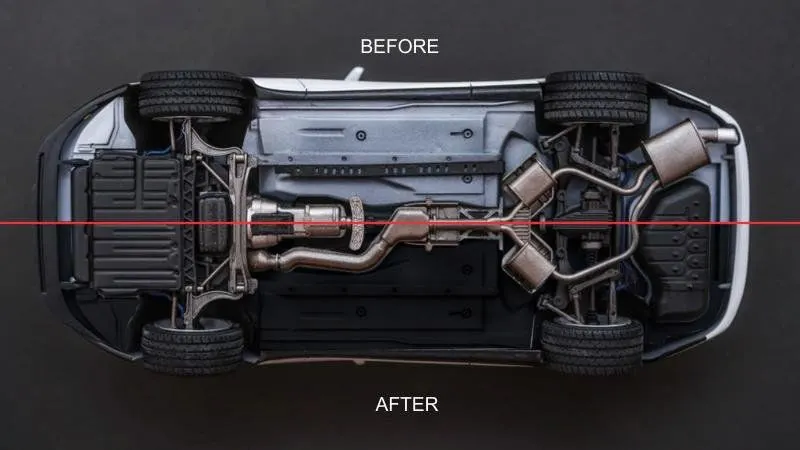
Ans:- Underbody coating provides long term protection from corrosion to car’s underbody. It also protects parts like internal body panels, frame rails and other inner cavities that are not physically accessible but are prone to corrosion.
Purpose of underbody coating
The main purpose of undercoating is to check rust especially in the body components like frame rails along with other exposed metal parts. Underbody coating can also reduce wear and tear.
Benefits
• Minimizes Sound: It minimizes the sound from underneath the car resulting a noiseless, smooth driving experience.
• Heat Insulation: It insulates the interior of the car from extreme temperatures from beneath the vehicle providing a comfortable cabin experience.
• Anti-chipping property: If any stone hits the coating it does not get chipped away hence protects the underbody from exposure to water.
Underbody coating types
1) PRETREATMENT:
The first sequence in preparing the BIW forsub sequent coating is pretreatment. Preatrament removes & clean excess metal & forms an appropriate surface structure enabling bonding of a corrosion protectionlayer. It consists of cleaning the body surface to removeremaining oils from the staming process & welding residues through three primary liquid dip processes of degreasing, conditioning, & phosphating.
Pretreament helps the primer to bond onto the metal. A phosphate treatment applies an inert layer of metal phosphate, providing resistance to corrosion spread.
2) ELETRODEPOSITION:
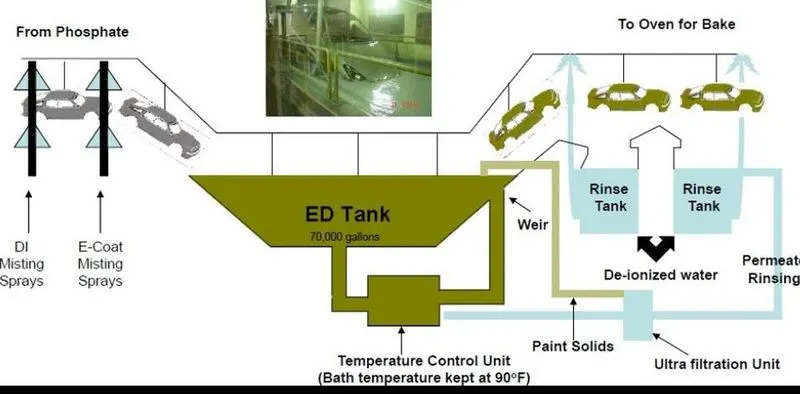
E-coating involves dipping automobile bodies into the coating solution & passing an electric current through the body & the liquid ED paint solution. Because of the charged nature of this coating process, the ED paint penetrates into places a spray would not reach.
During operation, a mixture of resin, binder, & a paste containing the pigments is fed into the ED tank. The automobile body is lowered into the tank, & an electric current applied; the solution in the tank consists of 80-90% deionised water & 10-20% paint solids.The resin is the backbone of the final paint film & provides corrosion protection, durability, & toughness. Pigments are used to provide color & gloss.
3) RUST-PROOF MATERIALS: SEALER/PVC:
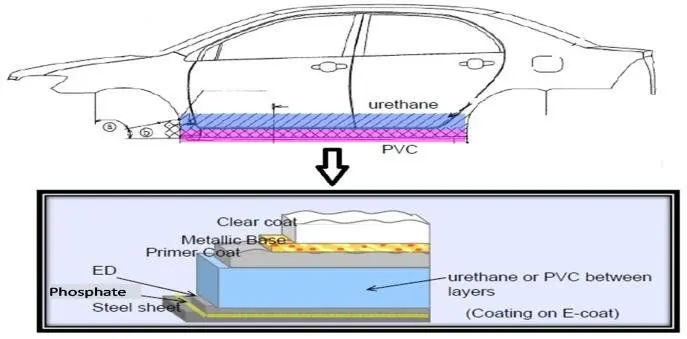
The third step is underbody coating & seam sealing using PVC. displays the lower door sections & rocker panel locations where PVC or urethanes are applied as an anti-chipping protection, & shows the cross section of this layer with respect to the other coatings on the body parts.
- Undercoating Pros:
Let’s look at some of the vehicle undercoating pros.
1) Protection Against Corrosion And Rust
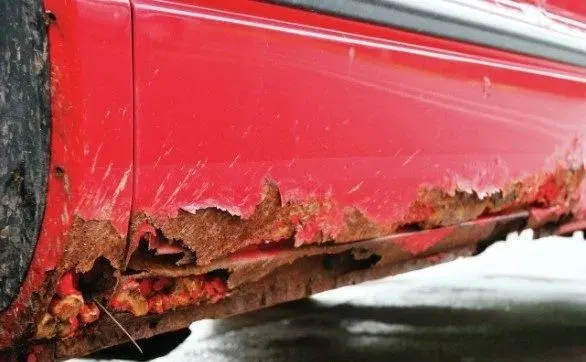
Undercoating offers a layer of protection against corrosion and rust. Any debris will be repelled by the undercoating.
You can expect years of protection from undercoating although it wears out in the end. This is the reason why the process is popular.
A car is a large investment so it pays to take the best care of it you can.
2) Extend The Life Of Your Vehicle

It will extend the life of your car. Undercoating stops rust.
Corrosion isn’t just about causing an issue with the metal under your car but it can also get into cables and wires – in fact anything made of aluminum or steel can be affected including the engine and transmission.
3) Cover Small Damages
You can undercoat damaged parts of the car such as scratches, chips and nicks caused by debris flying up as you drive.
Modern undercoating can cover small areas of damage.
4) You Can Do It Yourself
You have the choice of undercoating your own vehicle or getting it done professionally.
It is perhaps best to get the professionals to do it if you have the budget. It can cost more than 1,24,149₹ at the shop depending on the type of car you have.
Doing it yourself can reduce this cost by some 90% although it can be messy to do.
5) Many Options
There are different methods to choose from. One is electronic which is used to stop the corrosion of rust already present.
Then you have standard undercoating which applies a thick, tar-like substance.
Another option is dripless oil spray with fills the body of the vehicle with something wax-like and then sets hard.
Finally there is the drip-oil way which can drip for up to 2 days after application and this is the most common method used by car dealerships.
6) Reduce Noise Inside Your Car
Undercoating your vehicle can reduce noise inside the car while you’re driving.
The coating creates a sound barrier meaning the interior of the car will be quieter.
- Undercoating Cons:
And here are some cons of vehicle undercoating:
1) It’s Not Effective On Cars With Corrosion
If your vehicle already has some corrosion it isn’t as effective.
Applying undercoat over rust means that although you’re stopping more moisture and airflow to the rusted area, the rusting process will still keep happening.
An undercoat will slow down the corrosion rather than reverse or stop it. You should attempt to remove the rust before applying an undercoat.
This isn’t always easy though, since rust can penetrate deeply into the metal, so encapsulating the rust and then applying an undercoat could be a waste of money.
2) Doesn’t Work So Well On Old Cars
Undercoating doesn’t work so well on old cars because the residue from under the car has to be removed before the undercoating is applied.
If you don’t remove the debris first, the already-present debris will be sealed in.
3) It’s Useless On New Cars
Undercoating might not be wise if you tend to change cars every few years, since it takes between 3 and 5 years before rust starts to show.
In fact it might be 10 years before your car is affected in any way at all by corrosion.
This means if you get a new car every few years then undercoating it would be a waste of money because it simply isn’t required.
4) Your Vehicle’s Warranty Might Be Voided
Your vehicle’s warranty might be voided if you opt for a third-party undercoating treatment.
Some new cars already come with undercoating so adding anything else risks your warranty.
5) It Makes Your Vehicle Heavier
It makes the vehicle 10 to 20 pounds heavier which affects fuel economy (how far you can travel on one tank of gas).
This is negligible in terms of fuel costs but still something to bear in mind.
6) It Can Be Damaged
Undercoating can be damaged.
Although you can expect a hard layer of protection against debris, driving on dirty or gravel roads often means the protective layer’s integrity will be reduced over time.
7) It Can Be Expensive
Reapply it every 3 to 5 years. This is the only way to ensure your vehicle is protected properly.