Underbody Coating
AUTOMOTIVE COATING
Automotive coating is a process used to coat automobile surfaces with the avant grade of technologies that are capable of producing durable surfaces, exceeding customer expectations of appearance, maximizing efficiency, and meeting environmental regulations .these accomplishments are rooted in trial and error approaches, techniques,s and technology approaches, and theoretical assessment. The development of new technologies in paint chemistries a comprehensive and up-to-date review of automobile coating and coating technologies were considered to be valuable to industrial practitioners and researchers.
UNDERBODY COATING
Underbody coating is usually a black, thick liquid that is sprayed on the underside or undercarriage of the car. It is used to protect the metal from rust and corrosion.it is most commonly applied to a vehicle that is used in wet or salty environments since it absorbs most of the moisture, grime, salt, and other chemicals which your motor vehicle comes into contact with on the road undercoating can be applied as a liquid typically sprayed or brushed on then allowed to dry it helps to protect the axle, engine, brake system, transmission, exhaust, and fuel system, suspension parts, gas tanks, floorboard. undercoating can be sprayed on any type of car, truck, SUV, etc .teh type one chooses to use is often determined by the level of damage of your car has sustained and or to an extent .there are several types of undercoating and the specific brand examples currently available on the market they are.
1 WAX OR PARAFFIN-BASED UNDERCOATING
Fluid film 1 gallon can rust inhibitor rust prevention anti-rust corrosion anti rust coating underbody rust proofing corrosion protection for truck snow blower mower car semi-tractor bus. it is the preferred undercarriage coating for cars often driven on highways and normal roads Sometimes referred to as wax-based undercoating, it provides sufficient guard for cars in fairly moist regions
2 RUBBERIZED UNDERCOATING
3M Body Schutz rubberized coating black,08864,1quart ideal for cars driven in rough terrain, as its name suggests, this undercarriage coating involves applying a rubber agent to the underbelly to protect and cushion it to prevent dents dust, and moisture. it can also be applied around wheel wells and quarter panels considered the best option for standard vehicles when it comes to the different types of undercoating.
3 POLYURETHANE UNDERCOATING
Adams SiO2 infused invisible undercarriage dressing spray for detailing, silica-infused for premium results, quick and easy to use, work on tires trim wheel wells, black satin finish (1 gallon) uses a polyurethane based sealant that comes in canisters ready to be loaded into a spray gun and sprayed to guard the undercarriage of your vehicle. Poly urethane used in this product is a highly quality and durable material that is perfect for any weather condition. It is ideal for standard vehicles
4 ASPHALT-BASED UNDERCOATING
Unlike the rubberized, wax paraffin-based, and polyuthereane undercoatings this type is made of asphalt and generally also contains some rubberized material that's set up firmly and helps soften noise from engines although asphalt-based undercoating is ideal for trucks military, and all-terrain vehicle. It last long and is best for endurance vehicles that have undergone heavy road use . When it comes to large trucks heavy machinery , military, and all-terrain vehicles asphalt-based undercoating provided added durability against rocks, chips, and moisture .
5 WATER-BASED UNDERCOATING
Water-based undercoating is a protective layer that helps your car stay protected from harsh weather conditions . It is made from an advanced polymer that is nontoxic and environmentally friendly . The product can be applied to any surface, including metal, plastic, rubber, and glass. It will keep your car protected from rust, salt, and moisture
6 PETROLEUM-BASED UNDERCOATING
Petroleum-based undercoating is a heavy, viscous oil-based liquid product that provides an effective barrier against moisture and corrosion. The liquid dries and hardens to provides tough, durable, and long-lasting protection against moisture and corrosion . This product is typically applied to the undercarriage of automobiles, trucks, and the other vehicle
TRENDS IN AUTOMOTIVE COATING
The current trends in the automotive coating process are motivated by lowering manufacturing costs, delivering customer satisfaction via aesthetic features and corrosion protection, and mitigating environmental concerns In fact, with the worldwide emergence of two-layer topcoats, the color, gloss, & chip resistance of automobile coating remain in relatively excellent condition during the first 7-10
years of an automobile's use
1. POWDER COATING
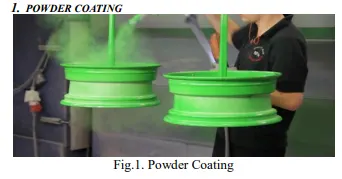
One solution to the emission of VOCs has been the placement of liquid coatings with coatings in the form of dry, particulate solids, commonly called ‘powder coatings’.Their compositions contain very low concentrations of volatile solvents, on the order of 2% substantially less than any other paint system. Currently, the automotive industry uses powder coating on wheels, bumpers, hubcaps, door handles, decorative trim & accent parts, truck beds, radiators, & numerous engine parts. A clear powder topcoat has been developed; BMW & Volvo are using it on their new model cars, & GM, Ford, & Chrysler have formed a consortium to test it on their production lines
MODERN AUTOMOTIVE COATING
1) PRETREATMENT
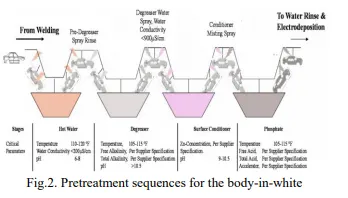
The first sequence in preparing the BIW for subsequent coating is pretreatment sees Fig.2. Preatramentremoves & cleans excess metal & forms an appropriate surface structure enabling the bonding of a corrosion protection layer. It consists of cleaning the body surface to remove remaining oils from the steaming process & welding residues through three primary liquid dip processes of degreasing,
conditioning, & phosphating
2 ELETRODEPOSITION
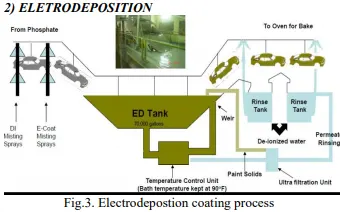
E-coating involves dipping automobile bodies into the coating solution & passing an electric current through the body & the liquid ED paint solution. Because of the charged nature of this coating process, the ED paint penetrates into places a spray would not reach
3) RUST-PROOF MATERIALS: SEALER/PVC
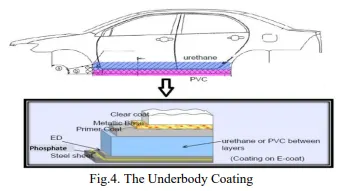
The third step is underbody coating & seam sealing using PVC. Fig.4 displays the lower door sections &rocker panel locations where PVC or urethanes are applied anti-chipping protection, & shows the cross-section of this layer with respect to the other coatings on the body part
4) PRIMER
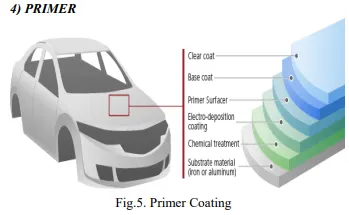
The fourth coating step is the primer. It can be water-borne, solvent-borne, or powder. The primer fills &smoothes minor imperfections & scratches that may be created during prior steps & by the intermediate sanding or grinding used to remove small imperfections. It also provides additional protection against corrosion & maximizes adhesion between it & the E-coat & basecoat; thereby, the primer increases paint durability
5 TOP COAT
It provides color to the top or final coating. In the widely used basecoat/clearcoat two-step automotive painting process, the base coat, which can be dull or flat, is the color coat for the vehicle. The glossy finish comes from the clear coat applied over the base coat.