Hood design-Week 2
HOOD
It is a hinged thin sheet that covers and protects the main parts of the car like the engine's main function is to direct access to the engine, battery, and other crucial parts of the car for repair and maintenance and to protect these parts from direct sunlight and dust.

It also gives good looks and, helps to design a car aerodynamically stable.

Sometimes it is required to supply pure air so the filter is provided on the bonnet to supply filtered inlet air. Hoods are provided with different vent designs for the cooling purposes of an engine and carburetor at high speed. scoops on the hood have another function of the supply of air for superchargers in case of supercharged engines.

And last function of the hood to handle this type of heavy engine with a supercharger outside
The sub-system hood
It consists of a hood, striker, opening system, latch, and in some cases pedestrian safety system. The main functions of the hood are to protect the under-hood system and work for pedestrian safety. The system should allow inspection of the engine and service of the under-hood systems, for example filling fluids. Together with the latch system and opening system, the hood should fulfill the demands in ergonomics concerning opening-closing forces and opening geometry. It should be robust enough to not be damaged by normal daily usage of the car.
Hood Complete
The hood is a design element and is part of the body that borders the front fenders, front lights, bumper, and plenum cover. The complete hood consists of an inner and an outer plate joined together by hemming around the edges of the hood. Rubber-based glue is used in the flange joint as the glue between the outer and inner hood and on points as well as in the inner plate pattern as anti-flutter. Today a certain pattern is used in order to fulfill the requirements for pedestrian safety and total stiffness in the hood. Front reinforcement (=lock striker reinforcement) and hinge reinforcements (steel) are clinched to the inner plate. Spot welding is used in the part assembly of front reinforcement. 2
The hood weight is about 10 kg. This is considered too high and a po[1]tential for improvement by weight reduction is to be worked towards. The greatest potential areas for weight reduction are material changes and redesign of the inner hood.
Hood Geometry
The hood geometry has a huge influence on the pedestrian safety of the hood. The different shapes like bends and roundings make the hood stiffer and harder in some places, a head impact in these areas can lead to large damage. Then the more flat areas of the hood are softer and more gentle for a pedestrian head impact. The inner hood has a complex design and geometry, this is necessary because it helps to distribute the stresses throughout the hood. It also consists of different holes for manufacturing and assembly. Figure 6 shows an example of the complex geometry of the inner hood. It is important to optimize the hood to the new material in order to utilize all the opportunities to integrate and optimize shape to a new process, Today the hood i optimized to the sheet metal stamping and sheet metal composition. Usually, only two bump stops are used, these are to be placed as far forward in the front as possible. In larger cars, two additional bump stops is necessary for the front due to the size and weight of the hood. The hood is mounted in the body factory (A-shop). It then passes through the paint shop

- Hood outer panel or skin of the hood.
- Hood inner panel.
- Hinge assembly.
- Striker.
Basic Vehicle Parts of Hood
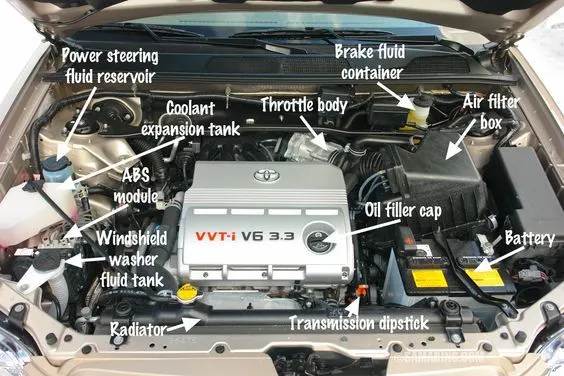
- Engine. Let's start with one we hope you know. ...
- Alternator. If your car won't start, it's important to determine if it's an issue with the battery or alternator. ...
- Battery. ...
- Belts. ...
- Cylinders and Spark Plug Wires. ...
- Piston and Crankshaft. ...
- Oil Fill Cap and Dipstick. ...
- Radiator
LATCH TRAJECTORY
The latch trajectory is the path that the striker will follow when the hood is open/closed while pivoting on the hinge axis. The latch trajectory is taken as a circle with the hinge axis as the center of the circle. The striker is placed 90 degrees such that it is tangent to the circle.