Underbody Coating
UNDERBODY COATING
Purpose :
Underbody Coating is a sprayable coating, which protects the under surface of the vehicle from corrosion.
INTRODUCTION: Modern-day cars are made of various materials combined but the main chassis of the car body is made of carbon steel or aluminum alloys to reduce weight while also giving the required strength to the body.But even after many layers of an added frameworks on the main body, it is still exposed from the bottom when a car is manufactured, and hence even after a certain time period rust starts to happen due to various climatic changes and terrains faced by the vehicle during its lifetime, hence it starts to corrode/rust which in short de-strengths the body resulting in a reduced life span of the vehicle.
To overcome this situation usually, an underbody coating is done on the body at the time of assembling.
Underbody Coating is a sprayable coating, which protects the under surface of the vehicle from corrosion.
Underbody coating provides long term protection from corrosion to car's underbody. It also protects parts like internal body panels, frame rails and other inner cavities that are not physically accessible but are prone to corrosion.
Protecting the underbelly of the car should be our top priority. Especially during monsoon when heavy precipitation causes the roads to become mini-rivers and our cars are left stranded there. This makes them prone to heavy corrosion in the underbody region.
It protects the underbody substrates from:
-
Environmental conditions
-
Impacts
-
Dampens sound and vibration
-
Insulates against cold and heat
-
Protects against Corrosion
-
Seals off seams
-
Hides welds, repairs & bodywork with spray
Modern automotive coating process:
The modern automotive coating consists of five steps:
- Pre-treatment: removes and cleans excess metal and forms an appropriate surface structure enabling bonding of a corrosion protection layer.
- The next step is electrodeposition (ED) of the anti-corrosion or rust prevention layer.
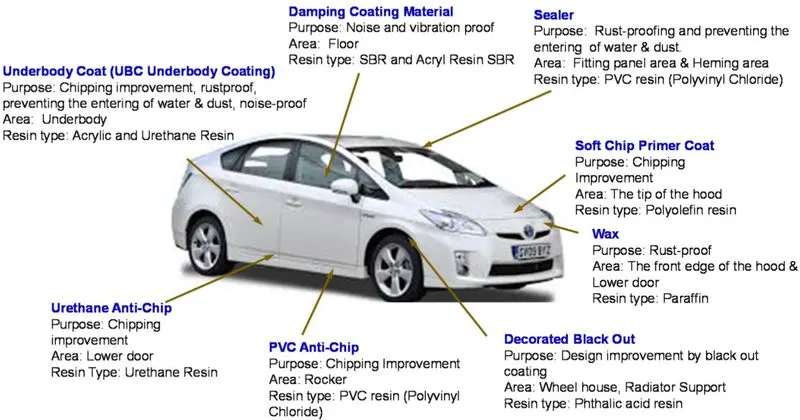
- A sealer like Poly Vinyl Chloride (PVC) is applied for anti-corrosion, elimination of water leaks, and minimization of chipping and vibrational noise.
- A primer is then applied to promote adhesion between the surface and the basecoat; it also imparts a smoother surface for subsequent layers and has anti-chipping properties.
- Finally, the topcoats that include a basecoat and clear coat are applied; they provide surface properties that are sought after, including colour, appearance, gloss, smoothness, and weather resistance.
Pre-treatment:
The first step in preparing BIW for subsequent coating is the pre-treatment process. Pre-treatment consists of cleaning the body surface to remove remaining oils from the stamping process and welding residues through three primary liquid dip processes of degreasing, conditioning and phosphating. The degreasing solution is composed of alkaline salts and surfactants and can include caustic soda, tri-sodium phosphate, and sodium carbonate. The surfactants are types of detergents for emulsifying oils and lubricants on the BIW.
Electrodeposition (ED):
The metal underbody and frames of automobiles are coated to prevent corrosion, whereas other areas like the roof are not rust-proofed. When not coated to prevent corrosion, the structural metals (or other materials) are primed before applying additional coatings. The ED processes are modified as per the BIW material property. This ED coating provides rust and corrosion protection.
Rust-proof materials: Sealer/PVC
The third step is underbody coating (UBC) and seam sealing using PVC and urethane. The sealant is applied around and inside the doors, hood, trunk, and front dash and onto the exterior and interior of metal joints and outer area of the back wheel well.
Primer:
The fourth coating step is the application of a primer surface or simply primer. It can be water-borne, solvent-borne or a powder. These primers are used to improve adhesion between the E-coat and topcoat, provide chipping protection, enhance paint appearance and also be environmentally compatible with emission regulations.
Top-coat:
The final step in the body coating process is to apply the topcoat, which consists of two layers—the basecoat and clear coat. The basecoat contains the primary colouring pigment and the clear coat provides a protective coating against environmental effects, corrosion, and UV light degradation promotes unmatched colour retention and provides a smooth unblemished even finish.
Significance:
- Undercoating helps to provide an additional layer of insulation and protection to the undercarriage of your vehicle.
- Manufacturers may apply car undercoating at the factory.
- The undercoating covers most of the car’s underside, including floor boards, frame, gas tank, pans, wheel wells and mufflers, suspension parts and exhaust pipes. This effect can be likened to black coating parking lot or a road.
- Undercoating materials adhere to metal, even if it is painted. Most of them come in pressurized cans for easy spray-on application, while an even spread may be tough to achieve without professional applicators.
- Ingredients used in the manufacturing of undercoating include fiberglass, ceramics, rubber, asphalt and silicone. Each has different properties in terms of heat resistance and retention, but all gives protection against the elements and damage.
- Auto undercoating protects the undercarriage, a vehicle’s most vulnerable area. Unlike the visible portions of your vehicle, the undercarriage doesn’t get washed frequently but it absorbs most of the moisture, grime, salt and other substances when you come in contact with those, as you drive.
- In addition to protecting your vehicle from elemental damage, good undercoating can also reduce engine noise, leaving you quieter than ever before.
- Even though if you buy a new car with undercoating from the dealer, remember that undercoating wears off typically within a short period of 1 year. Worn, patchy car undercoating can get damaged when water and other elements then get trapped under the coat, further eroding metal.
Type of Underbodycoa
1. Ceramic coating
2. Zinc - Rich Coating
3. Acrylic coating
4. Alkyd Coating
5. Polyurethane Underbody Coating
6. Rubberized underbody coating
7. Asphalt Based Undercoating
8. Oil and Drip OilSpray for Undercoating
-
Ceramic coating
Ceramic coating is a process that coats a car's surface with a solid ceramic material.
Advantage:-
ceramic coating are that it protects the car from weathering, corrosion and oxidation. It also provides a glossy finish that is tough and resistant to scratches. Ceramic coatings are applied on vehicles to provide protection against corrosion, abrasion, UV rays, and other environmental factors.
Disadvantage:-
The main drawback to ceramic coating is that it can be difficult to apply and requires special care in order to achieve a consistent finish.
-
Zinc - Rich Coating
These high performance coatings use zinc dust as a rust and corrosion preventative pigment. Organic zinc coatings are often made with epoxy or polyurethane resin binders, since high performance pigments justify high performance polymers.
Zinc coatings are particularly effective when used on steel, and provide dual function corrosion protection; both a galvanic and a polymeric barrier. Zinc-rich coatings are durable and resist abrasion.
-
Acrylic coating : Acrylic coatings have many advantages, including quick-drying and high gloss capability. They make great adhesion-promoting primers. Acrylics often require fewer ingredients and can increase the coated product’s corrosion resistance.
-
Alkyd Coating
Alkyd resins are vegetable oil or fatty acid-modified low molecular weight polyesters derived by the condensation reaction of polyhydric alcohols, monobasic and polybasic acids, vegetable oils, and fatty acids
Alkyds are used in paints, varnishes and in moulds for casting.
Advantages of Alkyd :-
Easy to apply (brush or spray), they provide a tight, properly finished result without streaks. Alkyd paints are water resistant and easy to keep clean using water. They are environmentally friendly and less toxic.
-
Polyurethane Underbody Coating
This covering seals breaks and fractures in the vehicle’s underbody. It provides strong corrosion resistance and also binds to the metal. Unlike an asphalt-based coating, the polyurethane coating may be painted over
-
Rubberized Underbody Coating
Rubberized coating is generally the best option for protecting your vehicle's undercarriage, as it provides the simplest and best protective measures against rust and moisture.
-
Asphalt Based Undercoating
Best suited for lorries, trucks, and large vehicles this provides a greater degree of protection compared to rubber-based coatings. However, asphalt-based coatings contain little amount of rubber for sound-insulation purposes. The process of applying this coating is a bit time-consuming though. Products commonly used are Tectyl 6430 | Water-Based Asphalt Undercoating, etc.
- Oil and Drip OilSpray for Undercoating
Even where rust is present, our oil undercoating will stop the oxidation and create a barrier to protect against the elements. Oil-based undercoating is key to protecting your car or truck and extend its life for many years.
Drip Oil Spray
This procedure is the most common and most recommended method of rust proofing, as it's able to fully rust proof your vehicle by penetrating all the small nooks and crannies.
Cons-
-
Apllying underbody coating will not have any effect to the already corroded part.
-
Undercoating is costly.
-
Since the corrosion itself starts after few year, underbody coating is not preferable to ower who change their car after few year.
Pros-
-
Minimizes Sound: It minimizes the sound from underneath the car resulting a noiseless, smooth driving experience.
-
Heat Insulation: It insulates the interior of the car from extreme temperatures from beneath the vehicle providing a comfortable cabin experience.
-
Anti-chipping property: If any stone hits the coating it does not get chipped away hence protects the underbody from exposure to water.