Underbody Coating
STUDY ON UNDERBODY COATING
Underbody coating protects the car's underbody from corrosion over time. It also protects elements that are not physically accessible but are prone to corrosion, such as internal body panels, frame rails, and other inner cavities.
In the past Cars were initially coated with a varnish-like solution that was brushed onto the vehicle surfaces, this coating was then sanded and smoothed, and the varnish was reapplied and refinished to establish numerous layers of the coating. Vehicles were polished to generate shiny surfaces after many layers of varnish were applied.
All of these coating procedures were done by hand, and it was not uncommon for the time between the start of the coating process and the conclusion, when the coating was dry and the car was ready to sell, to be quite long.
Current trends in the automotive coating process are driven by the desire to reduce manufacturing costs, provide consumer satisfaction through aesthetic features and corrosion protection, and alleviate environmental concerns.
METHODS FOR COATING CARS ARE:
PRETREATMENT
Pretreatment is the first step in getting the BIW ready to be coated. Preatrament removes and cleans any extra metal and creates the right surface structure so that a corrosion protection layer can stick to it.
ELECTRO-DEPOSITION
E-coating entails immersing automotive bodies in a coating solution & transmitting an electric current through the body and the liquid ED paint solution. Because of the charged nature of this coating procedure, the ED paint can reach locations that a spray cannot. Following E-coat, the automotive body is placed in a bakeoven, where it is heated and kept at a temperature of 160ºC for 10 minutes to encourage film curing and maximum performance attributes. The oven temperature and heating duration primarily improve chip resistance and film adhesion to the body; corrosion resistance is less affected by these circumstances.
PVC
The third step is PVC underbody coating & seam sealing. Urethanes are being used as anti-chipping protection, and the cross section of this layer in respect to the other coatings on the bodyparts.
PRIMER
The primer is the fourth coating phase. It can be water-based, solvent-based, or powder-based. The primer fills and smooth minor defects and scratches caused by previous stages and the intermediate sanding or grinding used to remove small imperfections.
TOP COATING
Final coating consists of two types base coating and clear-out coating, where base coating used to give the final colour and clear out coating done to protect from UV rays and corrosion.
TYPES OF COATING
- Rubberized coating
Rubberized undercoating forms a protective layer that keeps dust, filth, and moisture from corroding the metal components. This additional protection is a low-cost measure that can potentially increase a vehicle's service life.
- Polyuthrane coating.
A polyurethane coating is a polyurethane layer that is placed to the surface of a substrate to protect it. These coatings aid in the protection of substrates against a variety of flaws such as corrosion, weathering, abrasion, and other deteriorating processes.
- Wax or paraffin-based coating.
Paraffin is also utilized as a solvent and lubricant in industry. Paraffin can be used to preserve certain metals against corrosion. Paraffin can be used as a starting material to make solvent or water-based corrosion prevention chemicals.
- Asphalt based coating.
Asphalt-based undercoating has some benefits over wax-based undercoating. They both adhere well to most surfaces and perform well in terms of sealing out moisture, road chemicals, and oxygen. However, the biggest advantage to asphalt undercoating is it is less expensive. They last five years and dry to a Firm to Hard coating.
ADVANTAGES
- It acts as a layer of corrosion prevention.
- It will increase the lifespan of your automobile.
- It may aid in the reduction of interior noise.
DISADVANTAGES
- If corrosion is already present, it is less effective.
- It adds to the vehicle's weight.
- An undercoating is not resistant to damage.
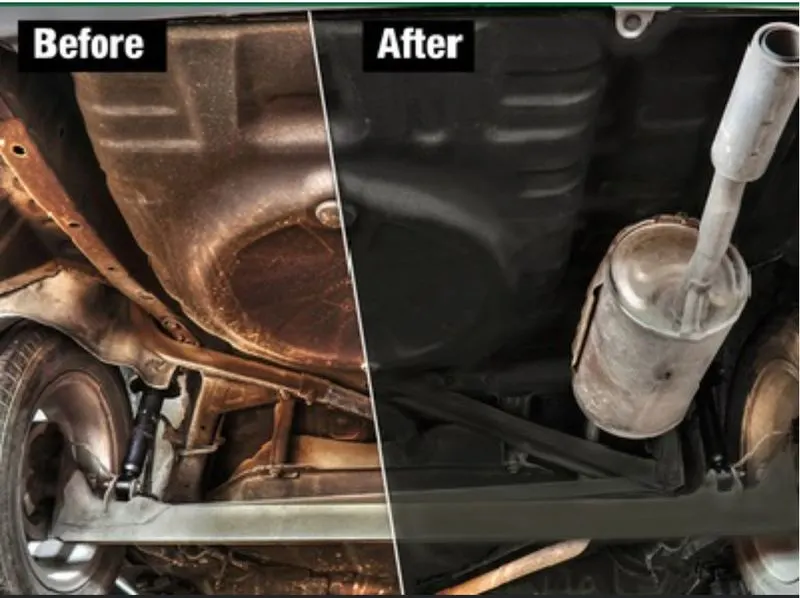
Image 1: Before and After Undercoating.
The Comparison image is attached above.