Underbody Coating
UNDERBODY COATING:
Underbody coating is usually a dense cladding (often based on rubber) applied uniformly to undercarriage of the automobile, it provides long term protection from corrosion to car's underboady.
It also protects parts like internal body panels, frame rails and other inner cavities that are not physically accessible but are prone to corrosion.
Process of Underbody Coating:
The underbody painting consists of 5 main processess.
- Pretreatment.
- Electrodeposition.
- Rust-Proof materials.
- Primer.
- Topcoat.
Pretreatment.
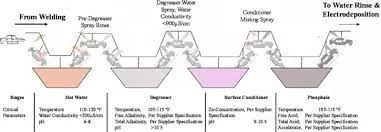
Pretreatment removes & clean excess metal & forms an appropriate surface structure enabling bonding of a corrosion protection layer. It consists of cleaning the body surface to remove remaining oils from the staming process & welding residues through three primary liquid dip processes of degreasing, conditioning & phosphating. The pretreatment helps the primer to bond onto the metal.
Electrodeposition.
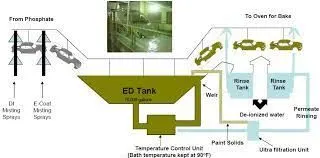
Electrodeposition coating process involves dipping automobile bodies into the coating solution & passing an electric current through the body & the liquid ED paint solution. Because of the charged nature of this coating process, the ED paint penetrates into places a spray would not reach. During operation, a mixture of resin,binder & a paste containing the pigments is fed into the ED tank. the automobile body is lowered into the tank, & an electric current applied. The solution in the tank consists of 80-90% deionised water & 10-20% paint solids. The resin is the back bone of the final paint film & provides corrosion protection, durability & toughness. Pigments are used to provide colour & gloss. After E-Coat the automobile body heated at the temperature of 160_C to 10 min in a chamber for causes film curing to promote maximum performance properties.
Rust-Proof Material: Sealer/PVC.
Rust-Proof material is a process which is typical to apply a soft tip primer coar that improves the chipping resistance . This layer is applied to the front edge of the hood, which is an area prone to chipping shock, using a high elastic resin that resides beteen the ED & primer coats, And also in this process the radiator supports, wheel housing & under rar areas of the body are coated with a relatively dull black pigment called a blackout coating.
Primer.
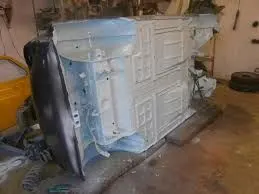
Primer can be water-borne, solvent-borne or a powder. The primer fills & smoothes minor imperfectionns & scratches that may be created during prior steps & by the intermediate sanding or grinding used to remove small imperfections. It also provides additional protection against corrosion & maximizes adhesion between it & the E-coat & basecoat there by the primer increases paint durability. This coating operations in an automobile assembly plant are usually implemented in three stages:
- Interior coating.
- Exterior coating.
- Cutting in an oven.
Manual spray painting is used for the the interior coating of the doors, engine compartment, & luggauge or trunk space. Some of the areas are not sprayed with basecoat. It is important that are primer colour matches the basecoat to be able to impart uniform coating appearances between interior & exterior coats.
Topcoat.
The topcoat is consists of two layers :
- Basecoat.
- Clearcoat.
Basecoat.
It contains the primary coloring pigments. It imparts the automobiles colour roughly 40,000 base coat colour are known today & approximately 1000 new colours are added to this list each year. three different types of basecoats are used for automobiles, including solvent-borne medium solids (MS), solvent-borne high solids(HS) & water-borne.
Clearcoat.
It is the final coating on the automobile surface, it provides durability, environmental etch & scratch resistance to the over all coating . It protects against damage such as fading that is caused by UV rays from the sun & imparts a gloss & depth that otherwise are not as vivid. The physical damage resulting from etching is associated with a localized loss of material & deformation or pitting of the clearcoat surface.
Types of underbody coating.
- Rubberized underbody coating.
- Wax Based underbody coating.
- Asphalt based automotive underbody coating.
- Polyurethane underbody coating.
Pros of undercoating.
- The protection it provides to the carriage of vehicle.
- It is an extra layer of protection against rust and corrosion.
- Gain protection even in warmer climates.
Cons of undercoating.
- It will not help if corrosion already exists.