Underbody Coating
AUTOMOTIVE UNDERBODY COATING
1.INTRODUCTION
at the beginning of the automotive industry about 100 years ago, companies were using paint color and varnish products to make shiny and smooth surface of the vehicle. But this days Automotive companies are using different type of the coating which have multiple layers and each layer work is different. A Coating is applied on surfaces and cover the object and make beautiful product. The reason behind of using the coating may be functional and decorative. Coating may be applies as liquid, gases or solid.
Today, we have many coating which is using according to their application, material type and etc. we have found some coating like underbody coat (UBC underbody coating), damping coating material, sealer, soft chip primer coat, wax, decorated black out, PVC anti chip, urethane Anti chip. These coating are used by the automotive industry. These coatings are used in the automotive body and every coating has different work.
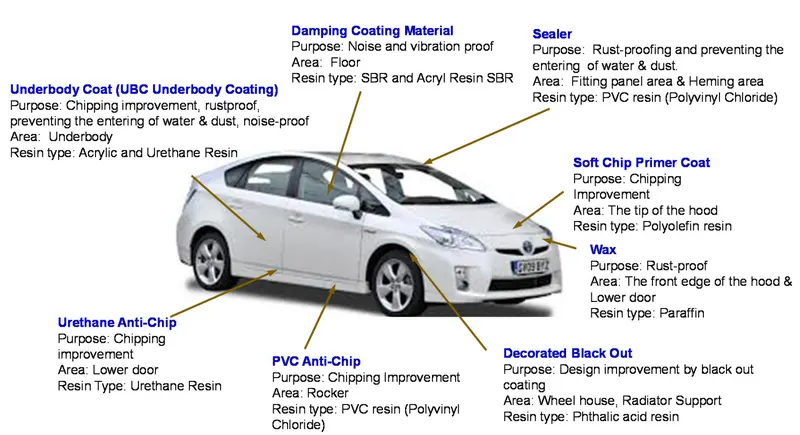
Underbody coating:- it is use to protect vehicle bodies from rust and corrosion. This coating helps in protection from dust and moisture as well as it protect from some other factors like poor road condition, stone hitted on car body when we are driving and during a rainy season which is not damage body from water.
Damping coating:- it is use on floor of car body which is decrease noise and vibration.
Sealer- it provide help to prevent from water and dust on the surface. Also it crate rust proof body. It coating apply on the harming area and fitting panel.
soft chip primer coat – this coating can prevent from chipping and cracks.
wax – it protects car bodies from the rust. Wax apply on the edge of the door and hood.
decorated black out – it is black type of coat which is use on the wheel house, support panel (radiator support)
PVC anti chip - it is prevent from the crack and chipping.
urethane Anti chip - it is prevent from the crack and chipping.
In this paper, we are focusing on the underbody coating, their types, processes and advantages. Underbody coating is most important part automotive which is focusing on life automotive body. When sheet metal is joined and crated frame body, it is call body in white (BIW). BIW will pass from the coating processes. This coating helps to protect BIW from the rust, dust, stone, water, cracks and screeches.
2.Modern Automotive Coating Processes
Modern automotive coating methods consist of five main steps.
- Pre-treatment
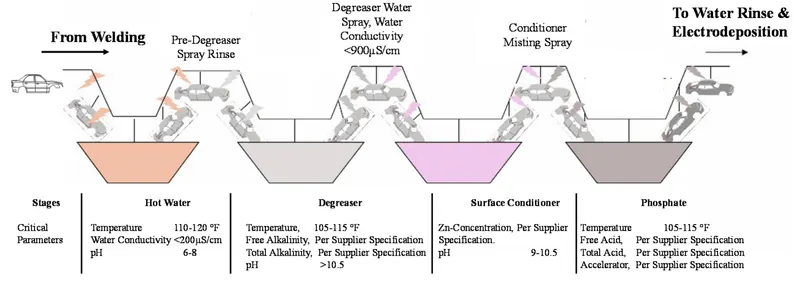
Automotive sheet metal parts are welded together, this structure called body in white(BIW). Pre- treatment include of cleaning surface from the oil and dust. This process contain 3 sub- process (degreasing, conditioning and phosphating) which help to clean BIW metal plate. Additional one process is added for the clean surface by the hot water. Degreaser solution is removed oil and lubricant on the BIW. Degreaser water is spray on BIW and clean the oil and dirt. Next solution is surface conditioner which creates nucleation sites for phosphate crystal growth. It increase crystal on the BIW that increase bonding mechanisms. Finally BIM will put in the phosphate solution and it is released metal iron, hydrogen. The primary objective during phosphating is to deposit a thin, dense and uniform conversion layer on the cleaned and prepared metal surface.
2.Electrodeposition
The next step is electrodeposition (ED) of the anti-corrosion or rust prevention layer. E-coating involves dipping automobile bodies into the coating solution and passing an electric current through the body and the liquid ED paint solution. Because of the charged nature of this coating process, the ED paint penetrates into places a spray would not reach. The ED paint is promoted to bond with the metal substrate, and a uniform coating thickness is produced. The result is an insoluble, deposited layer with a very high solids content and firm adherence to the pre-treated body.
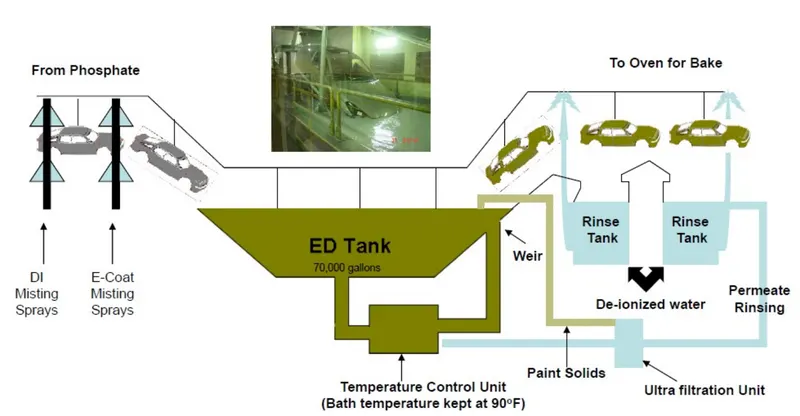
During operation, a mixture of resin, binder, and a paste containing the pigments is fed into the electrodeposition tank. The automobile body is lowered into the tank, and an electric current applied; the solution in the tank consists of 80%–90% deionized water and 10%–20% paint solids (consisting of resin, binder, and pigment). The deionized water acts as a carrier for the paint solids, which are under constant agitation. The resin is the backbone of the final paint film and provides corrosion protection, durability, and toughness. Pigments are used to provide color and gloss. To control paint performance during cathodic E-coating, purging of the paint and regulating the amount of applied voltage are essential. As the coating grows in thickness, it becomes more and more insulating, thereby causing the deposition process to slow. As an automobile body exits the tank, paint solids adhering to the surface but not bound to the surface are rinsed off to recover the ED solids via an ultrafiltration unit to ensure surface smoothness.
After the E-coat, the automobile body enters a bake oven, in which heating and keeping at a temperature of 160 ˝C for 10 min causes film curing to promote maximum performance properties. The oven temperature and heating time primarily enhance chip resistance and film adhesion to the body; corrosion protection is affected less by these conditions. Because surface roughness influences the smoothness and brilliance of the topcoat, some sanding of the surface is usually performed to remove or eliminate defects before the body enters the next application step. A common challenge in the current E-coating process is that of water spots that contaminate coated surfaces. These spots can appear on the air-dried surface if water droplets from the conveyor or other sources fall on the body, especially if the water in the tanks is not deionized properly and has high conductivity; the water spots are usually a remnant of unwanted ions in the water and will cause problems in subsequent coating applications and their adherence and appearance. If water spots are present, they have to be removed by sanding. Hence, it is necessary to use well-deionized water and routinely monitor its conductivity. Alternately, operators also add surfactants or ultrafiltrates to the water rinse zone to eliminate or manage water spots.
3. Rust-Proof Materials: Sealer/PVC
A sealer like Poly Vinyl Chloride (PVC) is applied for anti-corrosion, elimination of water leaks, and minimization of chipping and vibrational noise.The third step is underbody coating (UBC) and seam sealing using PVC (Polyvinyl Chloride) and urethane. The sealant is applied around and inside the doors, hood, trunk, and front dash, and onto the exterior and interior of metal joints and outer area of the back wheel well; application of the sealant is accomplished either manually or with robots and prevents air and water ingress and inhibits rust formation. Recently, PVC and acryl/urethane sealants have also been used in the underbody areas, a process called the Dampening Coat (DC), to impart noise-proofing and vibration-deadening. The noise and vibration are transferred from the engine, drive train, suspension system, road noise of the tires, and flowing air, and the underbody sealants reduce noise transfer into the passenger compartment of the automobile. The underbody coating also provides anti-corrosion and chipping protection; typically, it is accomplished using robots equipped with airless sprayers. Figure 6 displays the lower door sections and rocker panel locations where PVC or urethanes are applied as an anti-chipping protection, and shows the cross section of this layer with respect to the other coatings on the body parts.
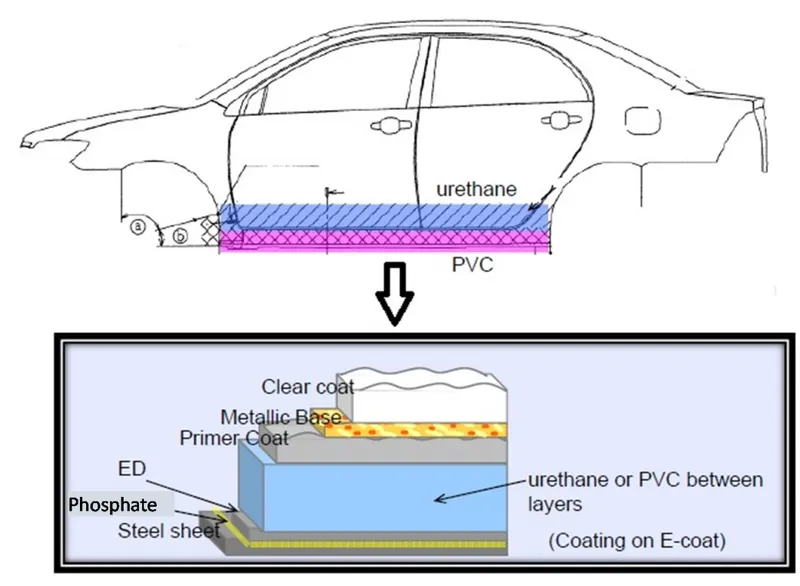
During this third step, it is also typical to apply a soft tip primer coat that improves the chipping resistance (resistance against chipping by flying stones or debris). This layer is applied to the front edge of the hood, which is an area prone to chipping shock, using a high elastic resin that resides between the ED and primer coats. Also, during the third step, the radiator supports, wheel housing, and under rear areas of the body are coated with a relatively dull black pigment called a blackout coating.
4. Primer
A primer is then applied to promote adhesion between the surface and the basecoat; it also imparts a smoother surface for subsequent layers and has anti-chipping properties. The cause behind using primer is to improve weather resistance, appearance and chipping resistance. Today’s primers have to improve adhesion between the E-coat and topcoat, provide chipping protection, enhance paint appearance and, also, be environmentally compatible with emission regulations.
The primer fills and smooths minor imperfections and scratches that may be created during prior steps and by the intermediate sanding or grinding used to remove small imperfections. Additionally, most automobile bodies have surface imperfections that arise from the pressing, stamping, and welding operations, and these defects are typically accentuated during the ED step. Hence, although the main purpose of the primer has been to act as a leveler that produces a smoother finished surface [30], it also provides additional protection against corrosion and maximizes adhesion between it and the E-coat and basecoat; thereby, the primer increases paint durability.
5. Topcoat
Finally, the topcoats that include a basecoat and clearcoat are applied; they provide surface properties that are sought after, including color, appearance, gloss, smoothness, and weather resistance.
Base coat
the basecoat is the third layer added to the car after the primer and before the clearcoat. Value, lightness or darkness, along with hue and chroma, are standard terms used in the color industry to describe the three-dimensional nature of the color created by using pigments in an automobile’s basecoat.
Three different types of basecoats are used for automobiles, including solvent-borne medium solids (MS), solvent-borne high solids (HS), and water-borne. The MS basecoats contain 15%–20% solid levels and have a spray viscosity of 100 mPa.s at 1000 rpm. The HS basecoats were developed from MS basecoats in response to the U.S. Environmental Protection Agency (EPA) requesting that the solid levels in solvent-borne spray paints be increased, and the organic solvents decreased to minimize VOC emissions. Waterborne basecoats have become the primary basecoat used throughout the U.S. automobile manufacturing industry since 2000 due to their environmental benefits.
Clearcoat
The final coating on an automobile’s surface is the clearcoat; it provides durability, environmental etch, and scratch resistance to the overall coating. It protects against damage such as fading that is caused by UV rays from the sun and imparts a gloss and depth that otherwise are not as vivid. The clearcoat also makes repairs and maintenance easier.
Spray Coating
The anti-chip coating, primer surface, basecoat, and clearcoat are typically applied by spraying, thereby requiring the use of atomizers. The quality of atomization influences the quality of the sprayed coating. Also, other factors such as the chemistry and material composition of the coatings influence the quality of the finished surfaces. A spray is considered as a system of droplets immersed in a continuous gaseous phase [45]; spray phenomena are common in power and propulsion applications, industrial applications, and nature [46]. Sprays are produced as a result of atomization, which is defined as the disintegration of liquid into droplets [45,47] by diverse mechanisms including aerodynamic, mechanical, ultrasonic, or electrostatic forces. For example, the breakup of liquid into droplets can be achieved by impingement on a liquid with gas in two-fluid atomization, by centrifugal forces in rotary atomization, by rapid vibrations established by a piezoelectric transducer in ultrasonic atomization, or by electrostatic/electromagnetic fields in electrostatic/electromagnetic atomization.
3. Types of underbody coating
- Rubberized underbody coating:- it protects the underbody of car from the scratches.
Ideal for cars driven in rough terrain, as its name suggests, this undercarriage coating involves applying a rubber agent to the underbelly to protect and cushion it against dents, dust, and moisture.
It can also be applied around wheel wells and quarter panels. Considered the best option for standard vehicles when it comes to the different types of undercoating.
Advantages:
- Easy to apply
- Quickly applied with no fuss
- Undercoat can be painted for a neat finish
- Provides satisfactory protection
- The simplest way to undercoat your car
- Safe to apply
- Truly dries to a soft rubbery finish that prevents further rust, damage, or moisture seepage
- Wax based underbody coating:- it protect from the moisture on the surface.
It is the preferred undercarriage coating for cars often driven on highways and normal roads. Sometimes referred to as wax-based undercoating, it provides sufficient guard for cars in fairly moist regions.
Advantages:
- Readily flows into seams to guarantee any exposed and prone surfaces are protected
- The most inexpensive undercoating option
- Conveniently available in spray guy canisters or aerosol cans
Disadvantages:
- Wears off quicker in comparison to other types
- Unlike the rubberized type, it does not really dry
- Needs to be stripped and reapplied at least once a year as soon as signs of wear and tear start to show
- Asphalt based automotive undercoating:- it provides sound insulation.
Unlike the rubberized, wax/paraffin-based, and Polyutherane undercoatings, this type is made of asphalt and generally also contains some rubberized material that sets up firmly and helps soften noise from the engine.
It reportedly has the most damage-resistant properties. Although asphalt-based undercoating is ideal for trucks, military, and all-terrain vehicles, it will also help protect your car, truck, motorcycle, and heavy machinery from the elements.
It last long and is best for endurance vehicles that have to undergo heavy road use.
Advantages:
- Formulated to protect from dirt, rust, and corrosion, it normally has a shelf life of up to two years. Sold in five-gallon containers
- Provides extra durability as it is the strongest and thickest undercoating available
Disadvantages:
- It takes time to harden and so requires more cure time than the other three types
- Unlike the other three, it is also, not paintable as such, not very aesthetically suitable for standard vehicles
- For best used only for the undercarriages of utility vehicles and trucks
- The only type of undercoating with a limited warranty
- Polyurethane underbody coating – it offers up good protection against corrosion and also bonds with the metal.
Uses a polyurethane-based sealant that comes in canisters ready to be loaded into a spray gun and sprayed to guard the undercarriage of your vehicle.
The polyurethane used in this product is a high-quality and durable material that is perfect for any weather condition. It is ideal for standard vehicles.
Advantages:
- It has a long lifespan and is resistant to wear and tear
- Easily and quickly applicable
- Trickles into cracks and rusty spots already present on the underbelly of your car and fills them, hence protecting the underlying metal
- Quick and simple to remove, as it sands easily
- Dislodges salt, moisture, and oozing around rusty areas to bond with and protect unoxidised metal
- Can be painted over
Disadvantages:
- For better adherence, needs undercarriage preparation before application
- Requires time-consuming etching with primer to bare metals
- Water based undercoating
Water-based undercoating is a protective layer that helps your car stay protected from harsh weather conditions. It is made from an advanced polymer that is non-toxic and environmentally friendly.
The product can be applied to any surface, including metal, plastic, rubber, and glass. It will keep your car protected from rust, salt, and moisture. This undercoating provides a protective barrier that lasts for only a year-depending on where you drive your car.
When it comes to DIY (Do it Yourself) undercoating, this type is the most popular. Coming in an aerosol can, it can be purchased from most automotive shops. This product is easy to apply and can be done in a single day.
Advantages:
- Thin-set, it takes a short time to dry
- Can be done at home
Examples of Water-based undercoats are Total Coat Automotive Sprayable Undercoating, Corroseal Water-Based Rust Converter Metal Primer, CRC SP-300 Corrosion Inhibitor, and the Evapo-Rust-Block Water-Based Rust Inhibitor.
Disadvantages:
- It requires frequent repetition as it’s not very durable
- It cannot repel ice and water like petroleum-based undercoating
- Petroleum based undercoating
Petroleum-based undercoating is a heavy, viscous oil-based liquid product that provides an effective barrier against moisture and corrosion.
The liquid dries and hardens to provide tough, durable, and long-lasting protection against moisture and corrosion. This product is typically applied to the undercarriage of automobiles, trucks, and other vehicles.
Petroleum-based undercoating can be purchased from your professional vehicle servicing shops.
Advantages:
- Has greater deflective abilities for road salts and grime
- Repels ice and water because of its petroleum base
Examples of Petroleum-Based undercoating are CRC Heavy Duty Corrosion Inhibitor and the Fluid Film Rust Inhibitor for rust prevention and anti-corrosion.
Disadvantages:
- Requires annual replacement
If you want to roll out in style and without sacrificing performance, then you should consider getting a modern classic.