Underbody Coating
UNDERBODY COATING
To go with off-road (Driving over slush,big rocks,snow area and Loose gravel) our car body need extra protection to experience a lovely ride,Also driveway scarp is generate in underbody,So it’s better to get car under body treated if you will be offroading your vehicle.
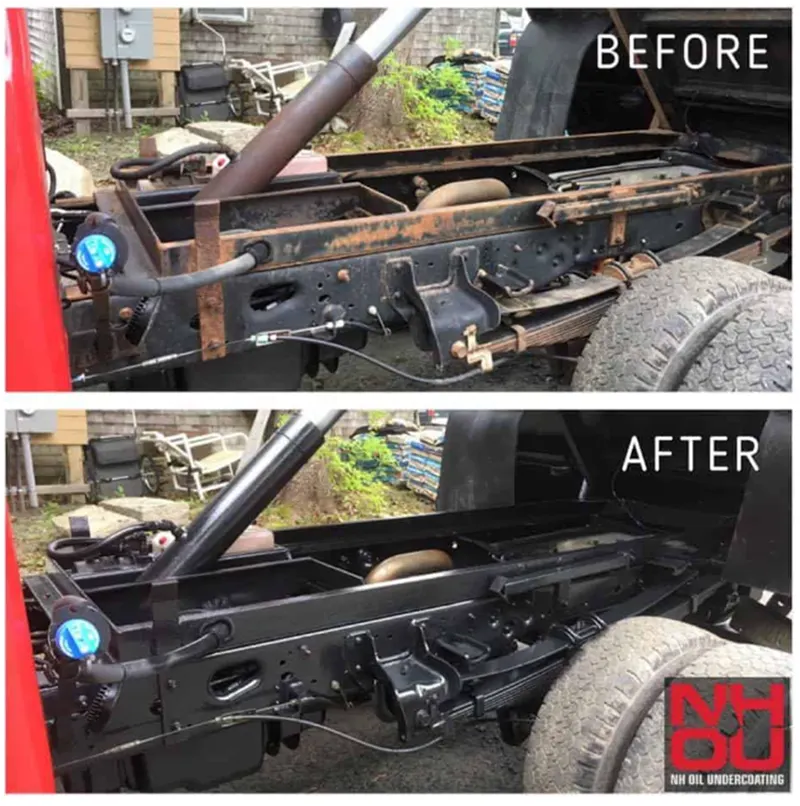
Pros(Benefits)
-Minimizes Sound: It minimizes the sound from underneath the car resulting a noiseless, smooth driving experience.
-Protect against Rust& Corrosion:The primary objective of getting underbody coating done is preventing metal components that are exposed on the bottom side of the car to damage from corrosion.
- Heat Insulation: It insulates the interior of the car from extreme temperatures from beneath the vehicle providing a comfortable cabin experience.
- Anti-chipping property: If any stone hits the coating it does not get chipped away hence protects the underbody from exposure to water.
-Reduces (NVH,Noise Vibration Harness)Level: Our country is fill with roads having uneven patches also pebbles hits the car underbody,a thick layer coating is absorb all the unpleasent noise and vibrations.
-Protect Vital Components: Underneath car some vital componets are left exposed like Engine,Silencer etc.Hence keep safe these parts we go for underbody treatment.Also improves resale value and save repair-bills.
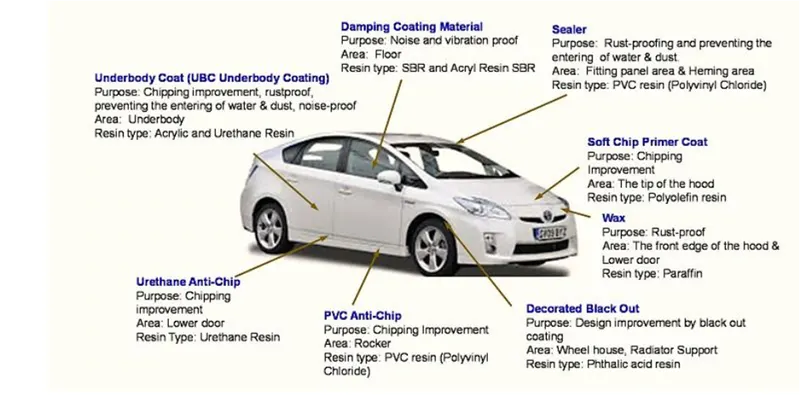
Modern Automotive Coating Process-
1.Electrodeposition(ED) Process.
2.Poly Vinyl Cloride (PVC) Process.
Electrodeposition(ED) Process.
-After body sheet metal components are welded together the first sequence in preparing the BIW for subsequent coating is pretreatment.
-Pretreatment consists of cleaning the body surface to remove remaining oils from the stamping process and welding residues through three primary liquid dip processes of degreasing, conditioning, and phosphating. An additional pretreatment cleaning that employs ~pH 9 hot water can also be used. Pretreatment helps the primer to bond onto the metal.
- A phosphate treatment applies an inert layer of metal phosphate, providing resistance to corrosion spread. The degreasing solution is composed of alkaline salts and surfactants and can include caustic soda, trisodium phosphate, and sodium carbonate. The surfactants are types of detergents for emulsifying oils and lubricants on the BIW.
-The degreasing zone typically consists of at least two sequences, including a spray stage known as knock-off-degrease (KOD) and a dip sequence. The advantage of using these two is that a significant portion of the oil and dirt will be removed by the high-pressure spray, thereby leaving a relatively lower load for the dip sequence to clean.
-The next sequence is surface conditioning (also called activation), which creates nucleation sites for phosphate crystal growth. It increases the number of crystallization nuclei on the metal surface that enhance bonding mechanisms for the subsequent phosphate sequence.
-In conditioning, an aqueous dispersion of titanium orthophosphate with pH between 8 and 10 is typically used. Finally, the liquid dip phosphate solution is composed of phosphoric acid, phosphate ions, nitrate ions, zinc, and other divalent metal ions, hydrogen ions, and an accelerating compound.
-The free acid etches the steel surface, causing hydrogen to be released while metal phosphate ions are precipitated onto the surface in a crystalline form. The primary objective during phosphating is to deposit a thin, dense and uniform conversion layer on the cleaned and prepared metal surface. 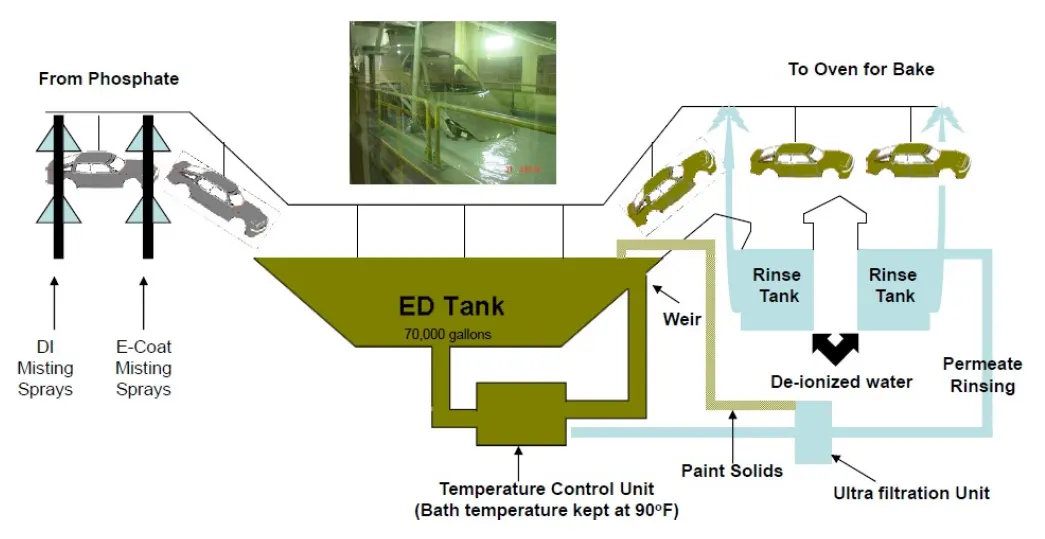
-Electro-deposition solution having a 90% Zn–10% Fe composition (GA material) is the primary coating used in modern automobiles to prevent corrosion.
-The E-coat solution consists of a mixture of resin, binder, a paste containing the pigments, and a solvent. During anodic electrodeposition, metal parts are positively charged while the paint is negatively charged; because small amounts of metal ions migrate into the paint film, it limits the performance properties of the coating. Hence, anodic coatings are mainly used for interiors and offer excellent color and gloss control.
-In cathodic electrodeposition, the metal part is negatively charged while the paint is positively charged. In contrast to the anodic process, the cathodic process reduces the amount of iron that can enter into the paint film. Hence, cathodic coatings offer high performance and excellent corrosion resistance and have mostly replaced anodic coatings in North America. The E-coat process is considered to be relatively environmentally friendly; it uses only a 0.5% solvent solution.
Poly Vinyl Cloride (PVC) Process.
-Poly Vinyl Chloride (PVC) is applied for anti-corrosion, elimination of water leaks, and minimization of chipping and vibrational noise.
-The sealant is applied around and inside the doors, hood, trunk, and front dash, and onto the exterior and interior of metal joints and outer area of the back wheel well; application of the sealant is accomplished either manually or with robots and prevents air and water ingress and inhibits rust formation.
-Recently, PVC and acryl/urethane sealants have also been used in the underbody areas, a process called the Dampening Coat (DC), to impart noise-proofing and vibration-deadening. The noise and vibration are transferred from the engine, drive train, suspension system, road noise of the tires, and flowing air, and the underbody sealants reduce noise transfer into the passenger compartment of the automobile.
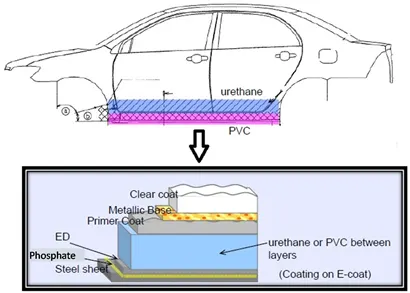
-The underbody coating also provides anti-corrosion and chipping protection; typically, it is accomplished using robots equipped with airless sprayers. show in Figure displays the lower door sections and rocker panel locations where PVC or urethanes are applied as anti-chipping protection and shows the cross-section of this layer with respect to the other coatings on the body parts.
-it is also typical to apply a soft tip primer coat that improves the chipping resistance (resistance against chipping by flying stones or debris). This layer is applied to the front edge of the hood, which is an area prone to chipping shock, using a high elastic resin that resides between the ED and primer coats. Also, during the third step, the radiator supports, wheel housing, and under rear areas of the body are coated with a relatively dull black pigment called a blackout coating.
THE UNDERBODY COATING MANUAL PROCESS FOR OLD CAR:
Clean
Prior to applying a rust-repelling undercoating, you will need to remove as much corrosion build-up, caked-on road grime, and any other form of "crap-tastic" contaminant from the underside of the vehicle.
-Clean the Metal Surface with Drgreaser.
-Remove all rust from the undercarriage using a grinder.Remove sand any remaining rust using sandpaper designed for metal. You need a sandpaper with a grit of at least 220 or larger. Make sure to wear eye protection when doing.
Prime-Time
-Spraying a primer is a crucial step in the undercoating process. Make sure to wear eye protection when doing.
-Most DIY undercoating products require a primer of some sort to serve as a basecoat. We've found that the best primers are those with high zinc levels, as this provides an additional corrosion resistance. Just be sure to follow the manufacturer's instructions, for many primers have their own unique prep requirements and curing times.
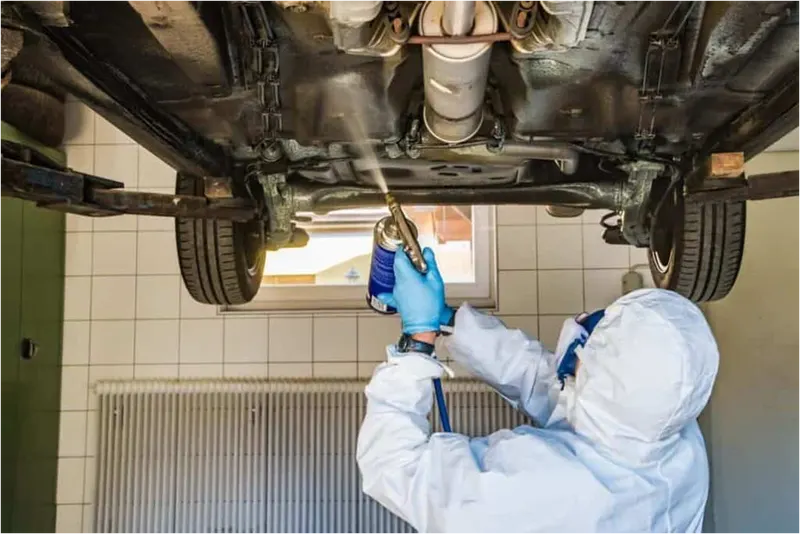
Under Coat
-The final step in the undercoating process is the application of the undercoating itself. Most of these products involve a two-stage or dual-layer spray-on procedure.
-While the first round of undercoating should be relatively thin, know that it is not there to be the first line of defense, but to serve as a basecoat for the thicker outer coating. An hour or two of downtime on a warm day should provide ample cure time for this first layer. Once it becomes tacky to the touch, it's time to move on to the final outer coating.
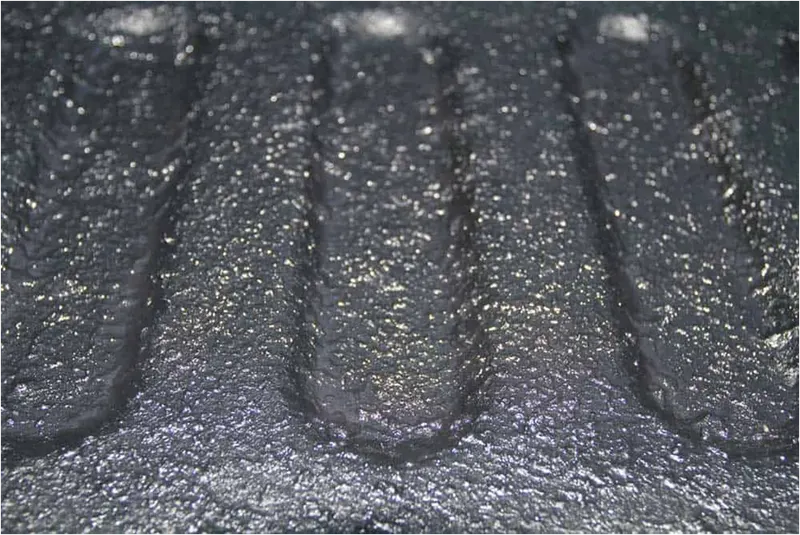
Concern:
-Now spraying on permanent coating without cleaning metal surface means that corrosive elements gets trapped between the undercoating layer and continue to eat metal. The worst part is that you’d think the vehicle is protected but your vehicle will be rusted beneath the coating.
-Use Rust Reformer as primer to coat hard to reach rusty areas before spraying undercoat over it.
-Clean the Metal surface with Degreaser.
-Use Face mask and Googles for safety.
- Inspecting and touching up the undercoating every year is a good idea.