Underbody Coating
UNDER BODY COATING PROCESS
- Underbody coating provides long term protection from corrosion to car’s underbody.
- It also protects parts like internal body panels, frame rails and other inner cavities that are not physically accessible but are prone to corrosion.
- Underbody coating can also reduce wear and tear.
Let us see the process briefly,

From Body Assembly
- As the body moves from the isolated weld area of the assembly line, subsequent body components including fully assembled doors, deck lids, hood panel, fenders, trunk lid, and bumper reinforcements are installed.
- Robots help workers place these components onto the body shell, the workers provide the proper fit for most of the bolt-on functional parts using pneumatically assisted tools
- Prior to painting, the body must pass through a rigorous inspection process, BIW the body in white operation.
Pre-Treatment and ED
- The vehicle bodies, which are by large made of light-weight steel, experience surface planning and pre-treatment.
- This arrangement includes through washing and wipe-cleaning.
- The pre-treatment process makes a compound crystallization happen on the vehicle surface that gives enhanced paint attachment and anticorrosion assurance.
ED Sanding
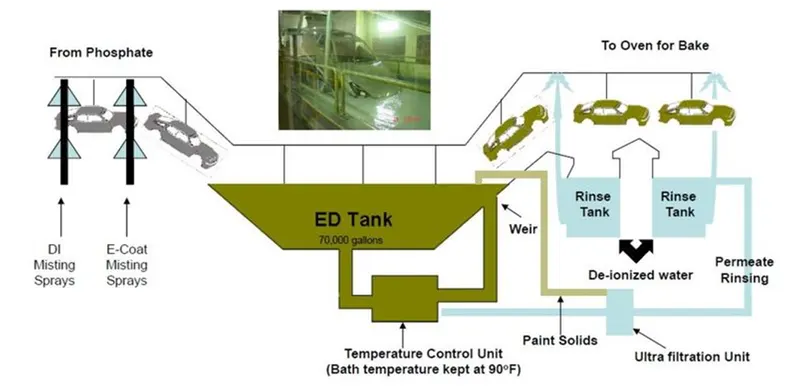
- Electro Deposition is most advanced and environment friendly Water based coating to be done on metal components.
- ED is chemically resistant, mechanically durable, and pleasant in appearance having very Good Salt Spray life.
- Every BIW body will carry out by rails and dip inside the tank in inclined angle a combination of 360 degree rotation ensures to fill each surface and depends on facilities available on OEM manufactures.
- After ED it moves to the heat unit to dry the wetted areas before primer.
Primer
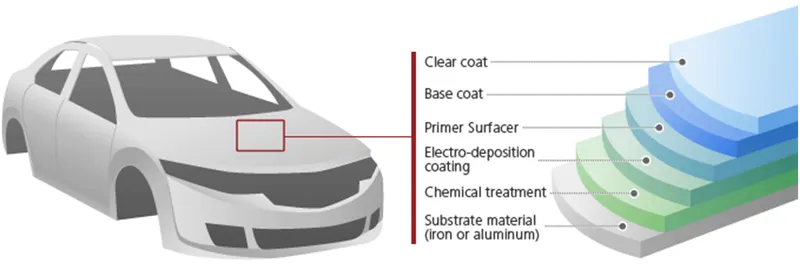
- The fourth coating step is the primer. It can be water-borne, solvent-borne, or a powder.
- The primer fills & smoothes minor imperfections & scratches that may be created during prior steps
- It also provides additional protection against corrosion & maximizes adhesion between it & the ED-coat & basecoat; thereby, the primer increases paint durability.
- Primer coating operations in an automobile assembly plant are usually implemented in three stages:
Interior coating, Exterior coating, & then cutting in an oven.
- Manual spray painting is used for the interior coating of the doors, engine compartment, & luggage or trunk space. Some of the areas are not sprayed with basecoat.
- It is important that are primer color matches the basecoat to be able to impart uniform coating appearances between interior & exterior coats.
Top coat(End painting process)
The final step in the body coating process is to apply the topcoat, which consists of two layers
Base coat & clear coat.
Base coat:
- It contains the primary coloring pigments.
- As part of the topcoat, the basecoat is third layer added to the car after the primer & before the clear coat.
Clear coat:
- The final coating on an automobile surface is the clear coat it provides durability, environmental etch, & scratch resistance to the overall coating.
- In most automobile assembly plants today, vehicle bodies are spray-painted by robots that have been programmed to apply the exact amounts of paint to just the right areas for just the right length of time.
- Considerable research and programming has gone into the dynamics of robotic painting in order to ensure the fine "wet" finishes for premium cars.
Types of Undercoating
Now let us look at the various kinds of automotive underbody coating for vehicle.
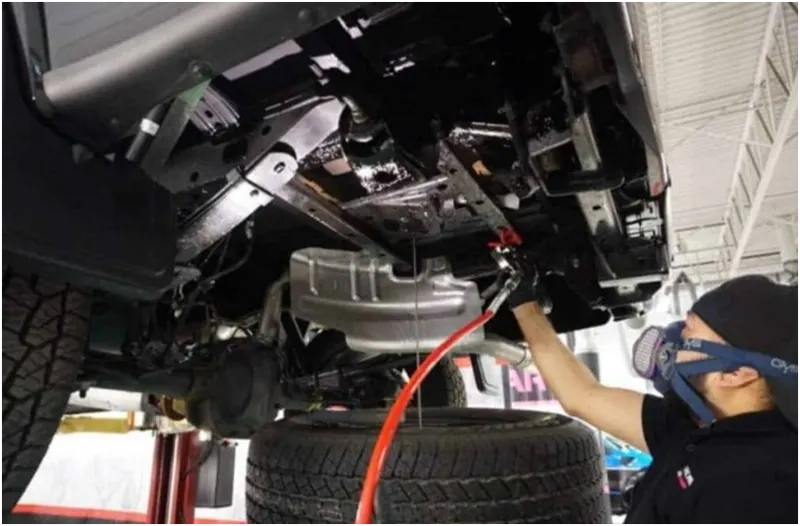
1.Rubberized Underbody Coating
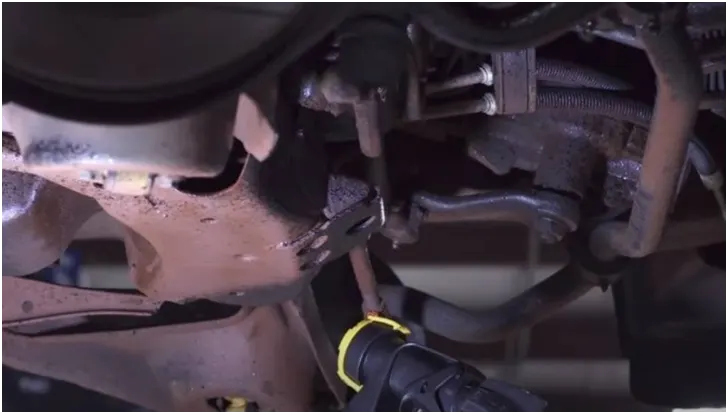
- This is generally thought of as the best underbody coating for your car.
- It preserves the underbody well, protecting it from scratches.
- Applying this to the undercarriage is not much of a hassle either.
2.Wax Based Underbody Coating
This – more or less – ephemeral undercoating will wear away in a few months’ time.
On the upside, wax-based undercoating puts up a big fight against moisture. It is also the most affordable option out there
3.Asphalt Based Automotive Undercoating
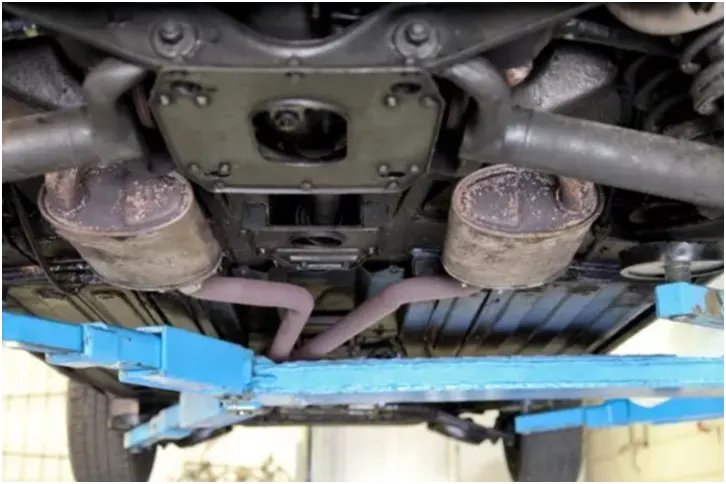
- Best suited for lorries, trucks and large vehicles this provides a greater degree of protection compared to rubber-based coatings.
- However, asphalt-based coatings contain little amounts of rubber for sound-insulation purposes.
- The process of applying this coating is a bit time-consuming though.
4.Polyurethane Underbody Coating
- This coating closes up splits and fractures on the underbody of the vehicle.
- It offers up good protection against corrosion and also bonds with the metal.
- Unlike in the case of asphalt-based coating, you can paint over the polyurethane coating.
Advantages of underbody coating
Fights rust
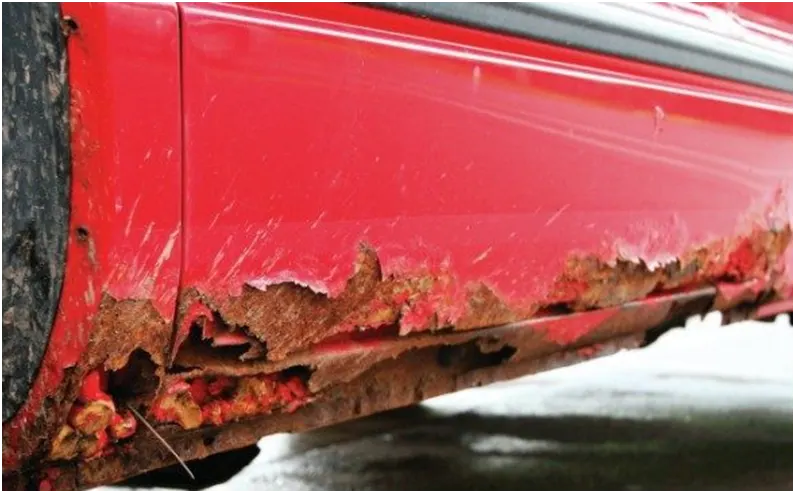
- It plays an important role in keeping corrosion at bay.
- Underbody coating can come in handy especially if you live near the sea, where there is too much humidity, and rusting is just one of those everyday things.
- You should also seriously consider undercoating if you reside in a place where it snows in winter.
Absorbs Noise
- Very thick undercoating can soften the noises that reach the cabin.
- Since the undercoating is often made up of rubber it absorbs some of the rackets.
- The occupants of the car could spare themselves of the road noises – at least up to a certain extend.
prolong cars life

- Good undercoating not only defends the underbody from corrosion but also protects the engine and transmission as well!
- There would be fewer dents, dings and scratches on the undercarriage
- Less rusting coupled with slower wear and tear can surely add years to the lifespan of the vehicle.
Disadvantages of undercoating
It adds weight to the vehicle.
It must be reapplied every 3 to 5 years for the best results.
It is less helpful if corrosion is already present.
Maintanence cost will be expensive.