Hood design-Week 2
Design of Car hood assembly by NX cad
Objective:
The aim of this project is to construct a well defined hood assembly by modeling the different parts needed in creation of our hood assembly that parts are hood inner & outer panel, hinge assembly, striker, etc.
Introduction:
Definition of Hood :
- The Hood is an opening body panel that covers the engine in a front-engine vehicle.
- The Hood is also known as Bonnet is some countries.
- The hood consists of an outer panel and inner panel.
- The inner panel provides strength while the outer panel functions as the metal cover and give an aesthetic look to the vehicle.
- Hoods also play a major role in the aerodynamics of the car, thereby reducing the drag and increasing the down force of the car.
- Hood also helps to direct impact of the any head-on collisions away from the passenger cabin there-by reducing the damages to the passengers.
- These Hoods are designed in such ways that less damages are caused to the pedestrians during accident.
Car Hood main components
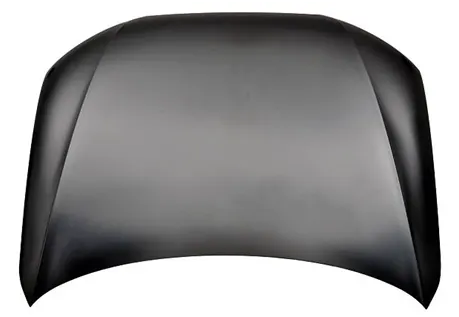
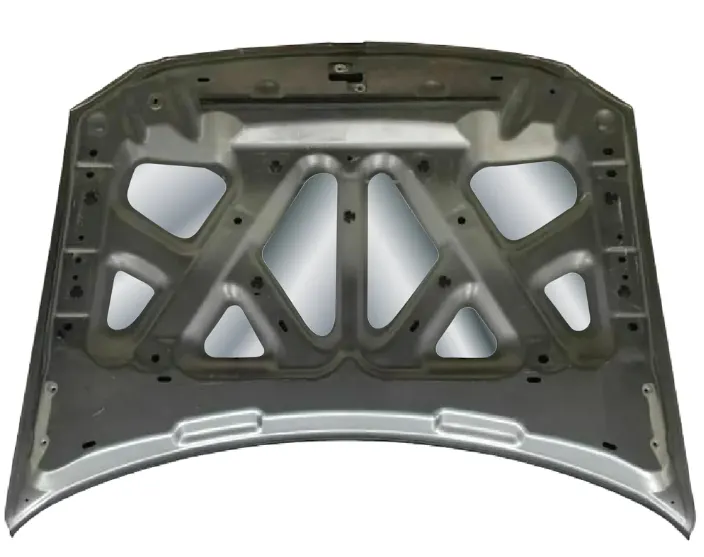
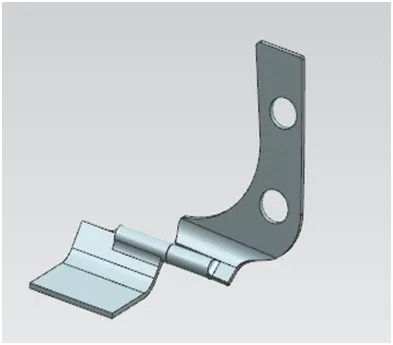
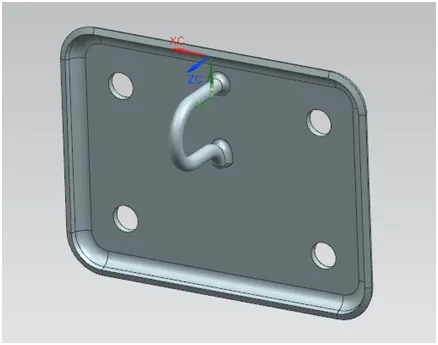
Outer panel Inner panel Hinge Stricker
- Car hoods are typically constructed from steel and sometimes from aluminum.. The hood design may vary from one make and model to another.
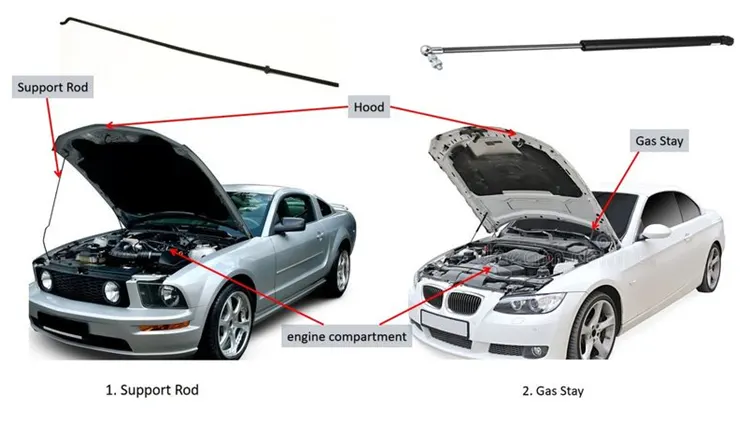
- While access for repairs and maintenance Hood can fix by two methods
- Support Rod
- Gas Stay
Design Considerations in Hood
While designing a hood several design parameters are to consider such as
- Passengers safety
- Pedestrian safety
- The opening angle of the hood
- Support system for the hood
- Manufacturing Feasibility
Passengers Safety
- Whenever the frontal crash takes place in a car the first part which will get affected will be hood.
- So, hood must be designed in such a way that it should not come off from the body of the car and must absorb the energy as far as possible and diverting the force towards the side panel of the car.
- so that the amount of force which is sent to the cabin is lesser since the force is lesser the passengers will experience less amount of force so that passenger safety is achieved.
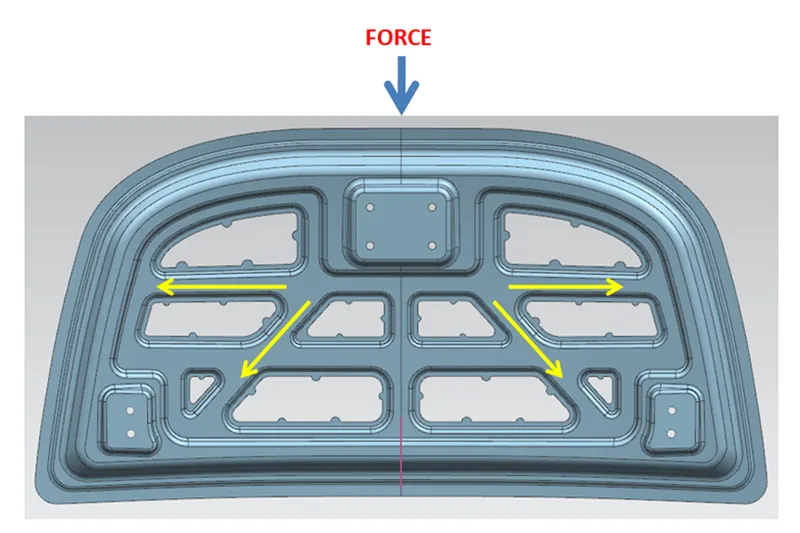
- Hood inner panel plays major role in dissipating the force away from the passengers.
- It is completely depending upon the emboss which is created in the inner panel.
A typical emboss is shown below. The force will completely move along the direction shown below minimising the force exerted towards the cabin
Pedestrian safety
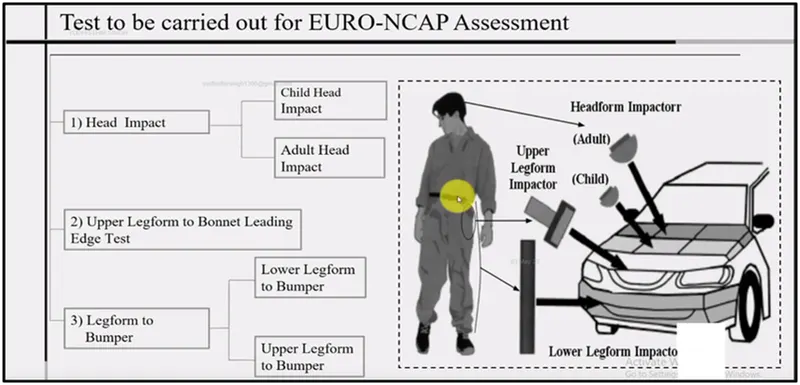
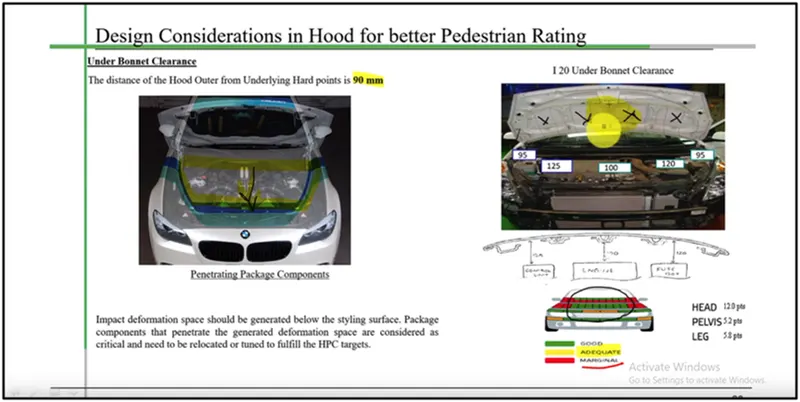
- The European New Car Assessment Programmed (Euro NCAP) is a European car safety performance assessment program which has developed test specifications & rating systems for assessing pedestrian injuries during impacts with the front of vehicles such test include a series of tests using impacts designed to bio-mimic a collision at speed of 40 km/h.
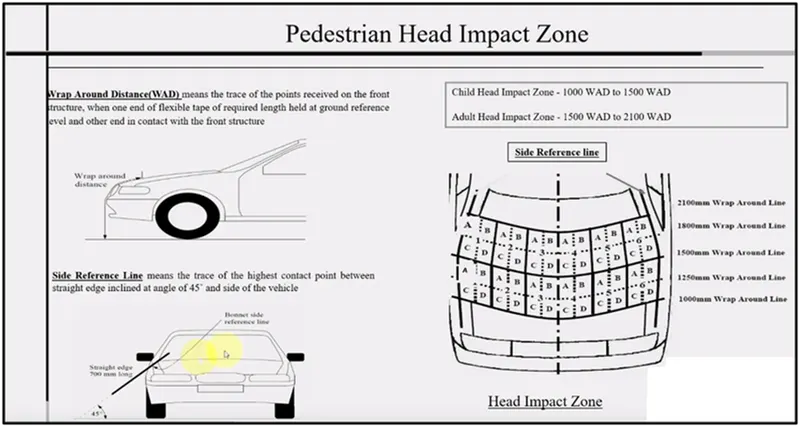
- So here in Hood we separate the whole area of hood into several small part / region during frontal crash. Hood is the major portion a person is going to come in contact with.
- So Euro NCAP specified some guidelines under which we distribute hood region into several parts and try to get greener region.
- Here below I have pasted an image to get an overview.
CAR HOOD DESIGN
AIM: To design the Hood of the front driving car by using the master section and standard procedure used in the OEM Manufacturer’s.
GIVEN MASTER SECTION:
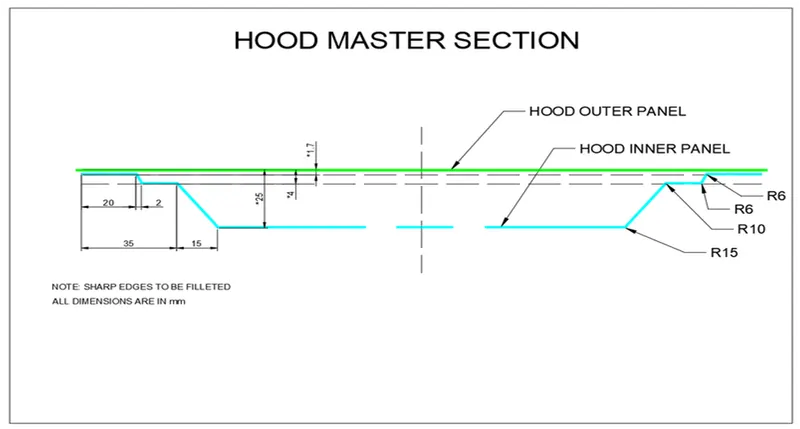
Hood thickness:-
Outer panel thickness:- 0.75mm
Inner panel thickness:- 0.75mm
Reinforcement thickness:- 1.5mm
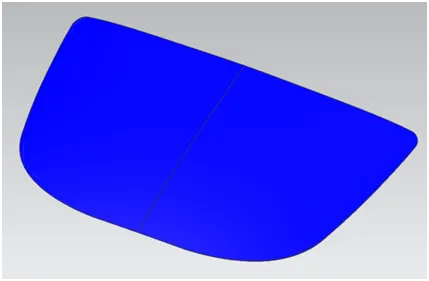
Hood outer panel
- Outer panels are the aesthetic elements of a car.
- It is the styling team who provides the skin for the outer panel.
- The shape, position and size of the hood should satisfy the safety norms. So while designing the hood we should give more importance to pedestrian safety.
- The outer panel is attached to the inner panel by hemming. So, it is necessary to provide required hemming flange and reliefs for the hemming operation.
- We also provide mastic sealants between outer panel and inner panel to reduce vibration.
Outer Panel
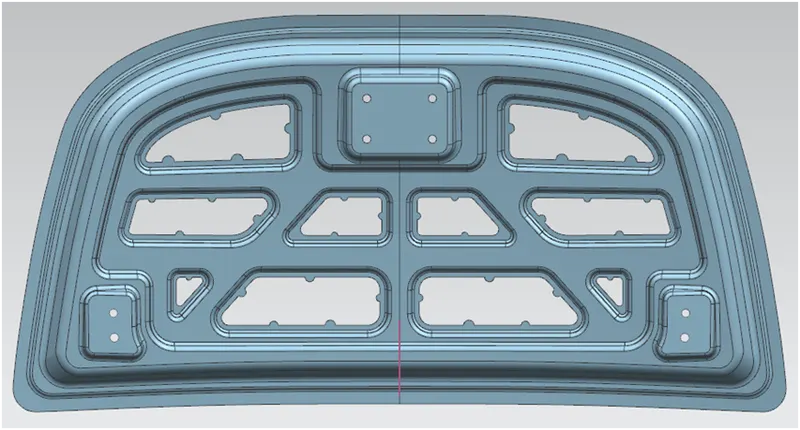
Hood inner panel
- Inner panel is the part that gives strength and rigidity to the outer panel.
- The master section represents the initial emboss shape and size. Then we provide the emboss for the latch and hinge elements after fixing the location.
Inner Panel
Hinge and striker Assembly
- It is used to fix the hood to the engine compartment.
- For any component has to be open and close with an axis, then hinge plays a major role.
- It has two simple parts (one is hood side hinge, another one is engine compartment side hinge) and assembled with the single axis.
- Hinge Assembly is attached at the each Outwards end of the hood and the engine compartment.
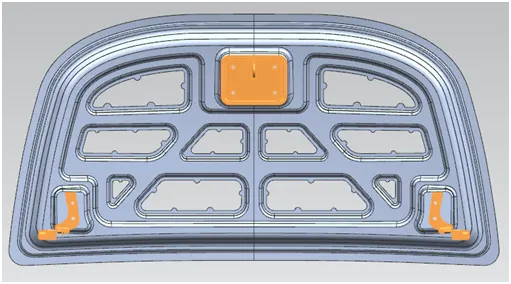
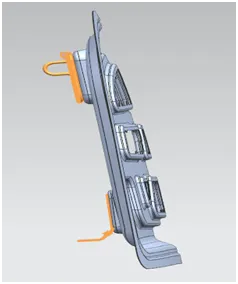
Hinge and striker assembly
Latch & Stricker
Latch & striker is used for locking the hood with the car. it's usually placed on the space provided on the inner panel.
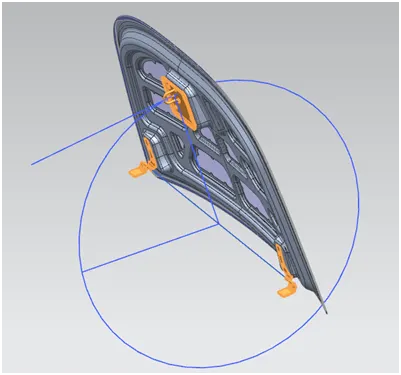
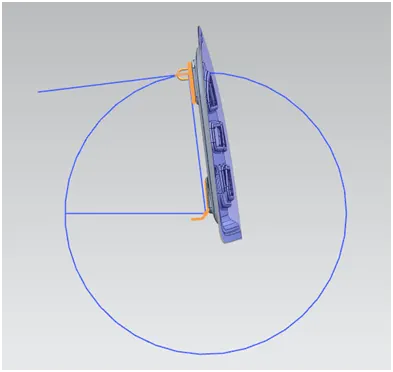
Positioning the striker along the Trajectory of the Centre of Hinge axis:
While opening or closing the hood, the latch must be perfectly aligned to the striker point. For that, the latches trajectory must be perpendicular to the hinge axis.
Reinforcement:
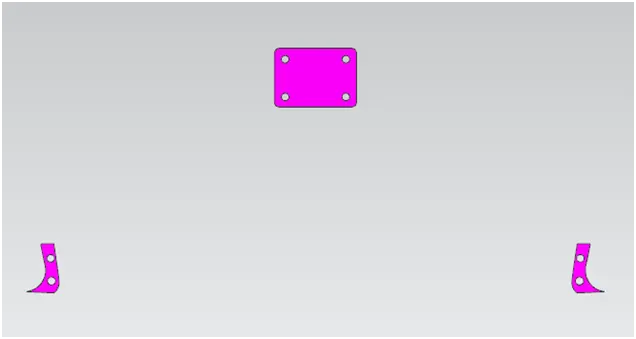
- Reinforcements are provided according to the design requirements.
- Mainly it is provided at the hinge and latch regions to improve the strength locally.
- Usually thickness of reinforcements will be higher than that of the inner panels and the value varies according to cost and requirement.
- According to the design requirement here it is given 1.5mm thickness to both hinge and latch reinforcements.
Reinforcement
Mastic data
- Mastic sealants used between the outer and inner panel.
- Mastic sealants are the rubber like elastic compound which connects the outer and inner panels of car hood at specified points.
- Mastic sealants are used in the region between the inner and outer panel because other joining process like welding or riveting are not good for car aesthetic design. It also helps in improving NVH (Noise, vibration, and harshness) characteristics.
- Mastic sealant points are effective around a circular region of 80mm diameter.
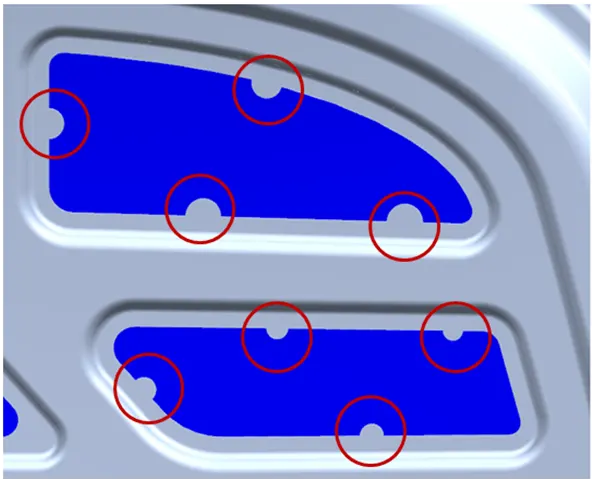
Highlighted red color circle are the Mastic points
Emboss definitions
- Embosses are provided to increase the strength of inner panel.
- Shape of embosses also determines the direction of collision force distribution.
- The shape of the embosses should be designed in such a way that, the collision forces should be directed towards outward side of the car (towards hinge side).
Manufacturing Process used in hood
Deep Drawing
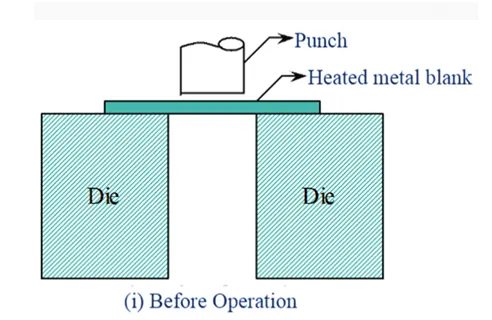
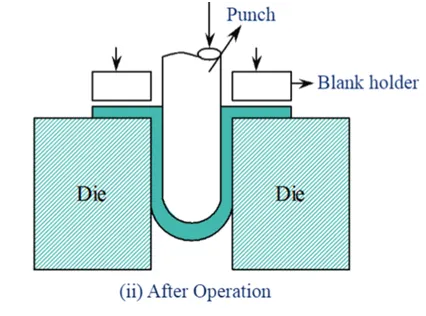
- Deep drawing is a process in sheet metal forming by the mechanical action of a punch and Die. A flat sheet metal blank is formed over a single, rigid, shape defining tool half by a flexible rubber diaphragm under uniform hydrostatic pressure.
- The process results in scratch-free parts regardless of the sheet thickness or complexity of the tool, including undercuts. High forming pressure ensures close tolerance parts direct from the press with little or no secondary hand work required.
- The process is considered deep when the depth of the drawn part exceeds its diameter. This is achieved by redrawing the part through a series of dies.
- The flange region, the sheet metal in the die shoulder area, experiences a radial drawing stress and a tangential compressive stress due to the material retention property. These compressive stresses, hoop stresses, result in flange wrinkles. These wrinkles can be prevented by using a blank holder, the function of which is to facilitate controlled material flow into the die radius.
Hemming and Corner Relief
- Hemming is a sheet metal forming process in which sheets are joined by bending it usually to 180°. Automotive body panels and automotive parts..
- This assembly method is widely used in the final stages of production of automobile hoods, doors, or other closures for aesthetic purposes.
- It is a metalworking process that involves rolling the edge of sheet metal over and onto itself, essentially creating an area of two layers.
- During this process, the edge of sheet metal is folded over. The two newly formed layers then lie flush with each other.
- The typical three-step bending process of the hemming operation comprising of the flanging, pre-hemming, and final hemming process.
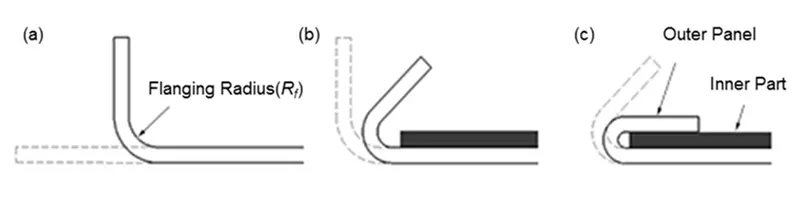
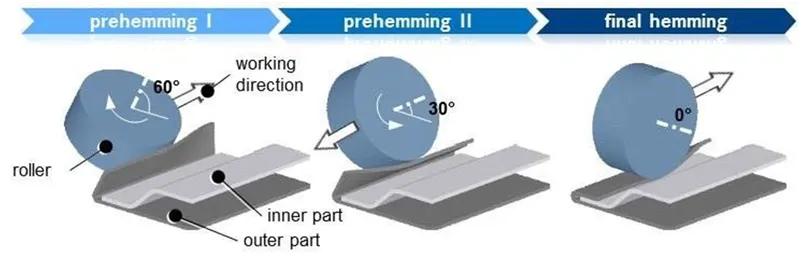
Above figure illustrate Hemming operations
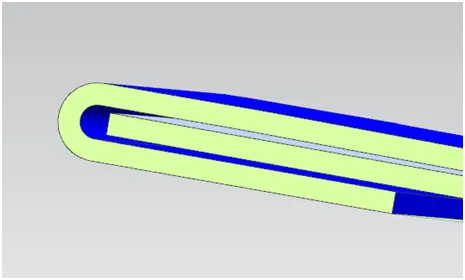
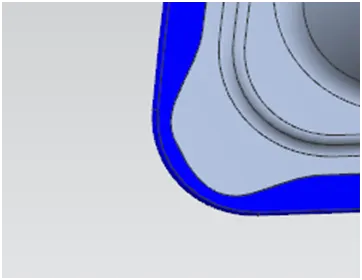
Hemming Corner relief
Conclusion
The Hood design challenge has been completed considering the design parameters and manufacturing feasibility as per the given design standards.