Section Modulus calculation and optimization
Objective
Use the Section from your Hood design and calculate the Section Modulus using the formula
S = I/y
Where,
S = Section Modulus
I = Moment of Inertia
y = distance between the neutral axis and the extreme end of the object
Come up with a new section that has an improved Section Modulus compared to the previous one and mention what changes you made which resulted in the increased strength.
Introduction
SECTION MODULUS
- Ratio of total moment resisted by the section to the stress in the extreme fiber
- Section modulus is a direct measure of strength of any sectional area of an object about a reference axis (neutral axis).
- It gives us an idea about how much of load the given structure can take.
- If the section modulus increases the moment of resistance increases.
- This strength can measure directly from Section modulus formula, and defined by below formula.
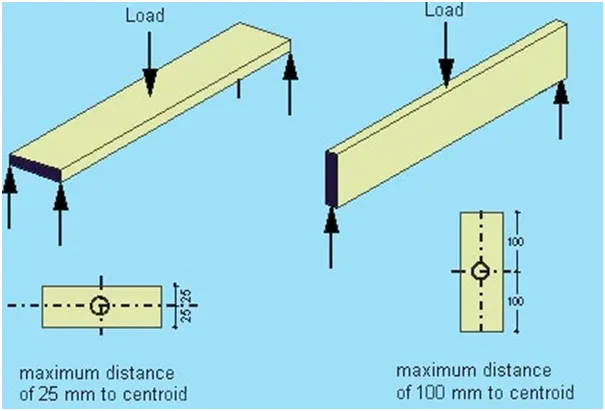
- Section modulus represented with a symbol of 'S'.
S=I/Y
- The Unit of a “section modulus” is (mm3
Where 'I ‘- Moment of inertia
Definition of Moment of inertia –'I'
It is a measure of an object’s resistance to changes to its rotation.
- Also defined as the capacity of a cross-section to resist bending.
- It must be specified with respect to a chosen axis of rotation.
- It is usually quantified in m4 or kgm2
'Y' is the distance from the reference line (neutral axis) to one of the extreme end of an object
By using the same principle, here we have to calculate the strength of a hood panel.
Case study: 1
Before optimization
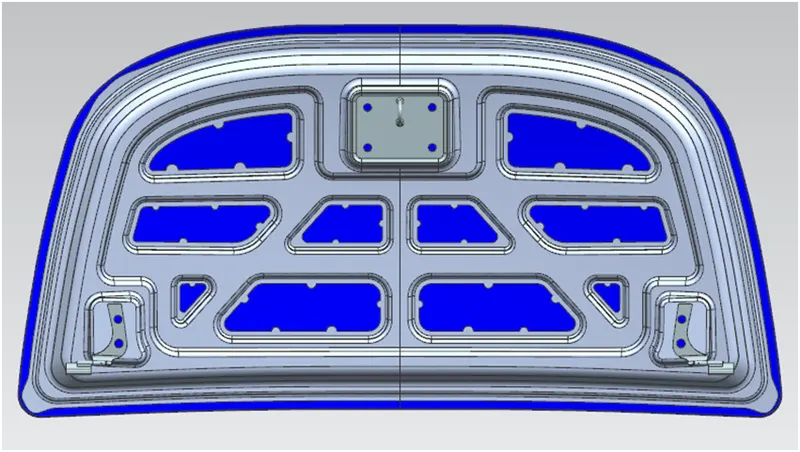
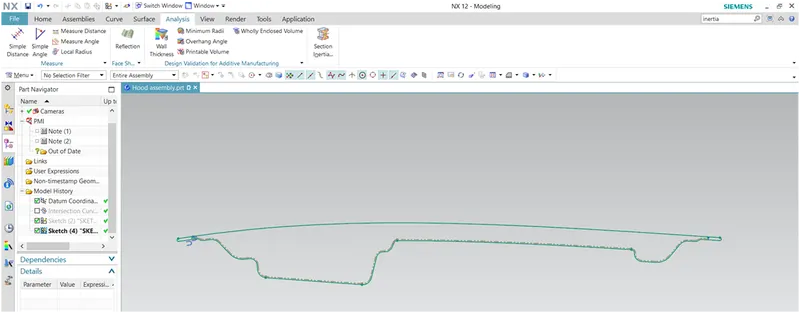
Create an intersection Curve with the help of the plane consider both the Outer & Inner panels of the hood.

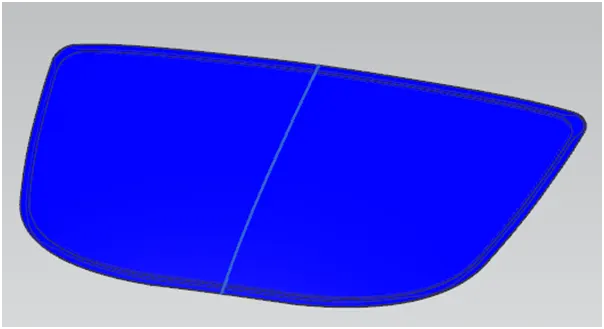
- After that create a sketch with respect to the datum plane created and project the curve into the sketch
- After finishing the sketch. Click Analysis- section inertia to calculate the principal moment of inertia, Area, Circumference and center of gravity of sections.
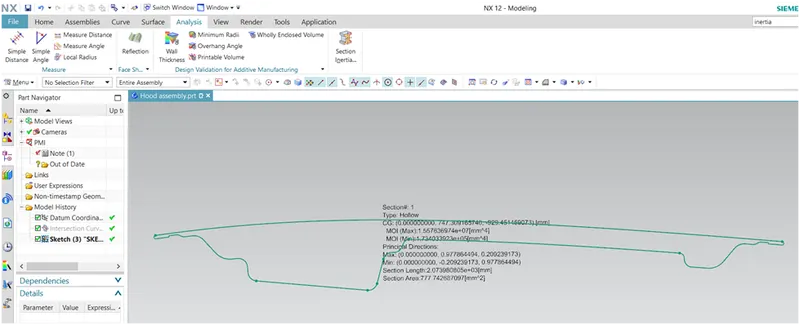
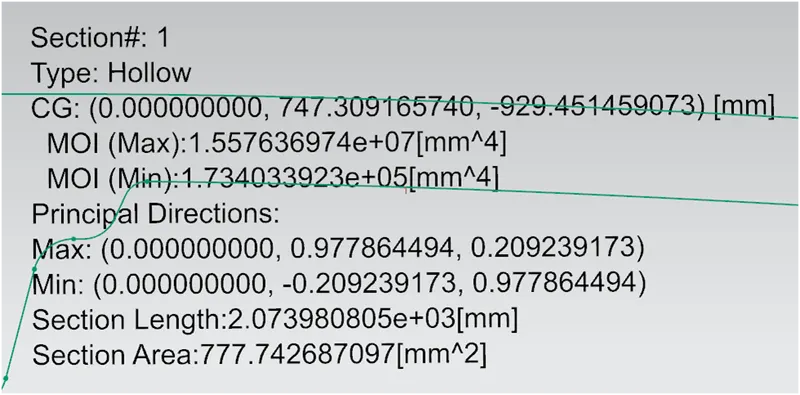
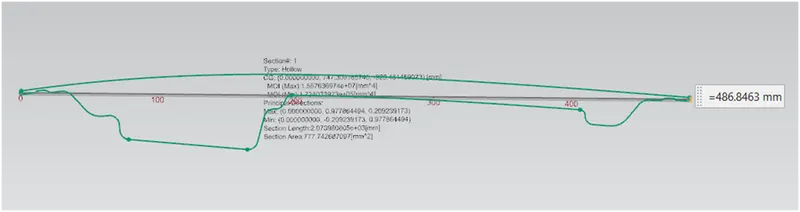
- Measure the maximum length of the object to find the value of ‘Y’
Moment of inertia (max) = 1.557636974e+07[mm^4)
Moment of inertia (min) = 1.734033923e+05[mm^4)
So, at neutral axis we need 'Y' value
Y=486.8463/2=243.4231 mm
As per the section modulus equation,
S = I / Y
- Minimum value of MOI is considered, as the body should withstand under any condition.
- So if we consider the minimum value of MOI, it will stand under any condition above that MOI value of that particular section.
S=I/Y
S=1.734033923×10^5/242.87
S=173403.3923/243.4231
S=712.35383 mm^3
Therefore
S=712.353 mm^3
Case study: 2
After Optimization
By increasing the depth of the inner panel by 1 mm.
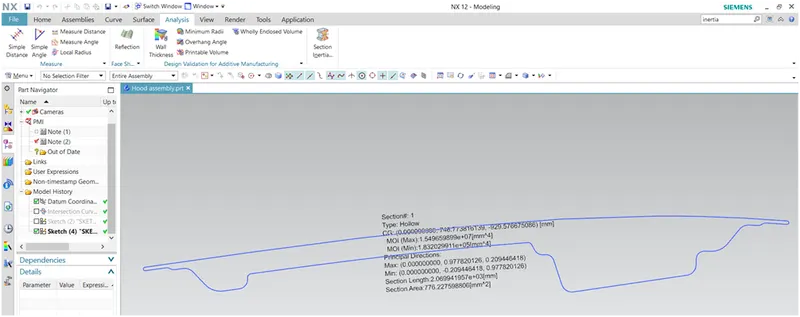
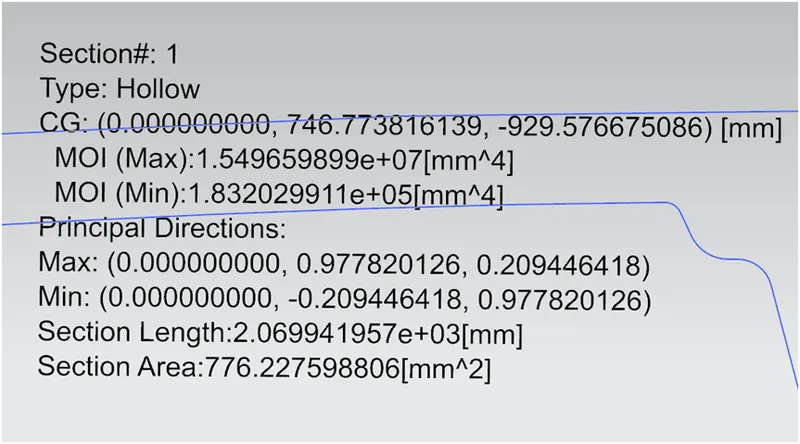
MOI (Max):1.549659899e+07[mm^4]
MOI (Min):1.832029911e+05[mm^4]
So, at neutral axis we need 'Y' without changing
Y=486.8463/2=243.4231
S=I/Y
S=1.832029911×10^5/243.4231
S=183202.9911/243.4231
S=752.611 mm^3
Therefore
S=752.611 mm^3
Conclusion report:
- When comparing cases 1 result S=712.353 mm^3 and cases 2 result 752.611 mm^3, it is notable that If the section modulus increases the moment of resistance increases.
- The section modulus of the design increases together with the moment of inertia.
- Therefore, increasing the area enhances the design's strength.