Underbody Coating
Underbody coating means a coating that is used in the automobile industry for the coating facility, which is applied to the underneath body to prevent it from mainly rust and corrosion.
By such coating, we are able to prevent the automobile body from dust, moisture, corrosion, rust, and the poor road condition too.
The coating cycle which is generally followed in the automobile industry is started with the pre-treatment process where generally the body surface is generally cleaned using degreasing and detergent solutions. After that, the electro-deposition method was used where an anti-rust layer has been created. After that, a coating of PVC and urethane was used. And after that, the primer has been used which increases the adhesiveness property, and finally, the final top coat has been applied.
Types:
- Wax or paraffin based: it is one of the cheapest coatings, but the disadvantage for such is that it lasts for one year only.
- Rubberized based: it offers good resistance against dust, moisture, and dent.
- Asphalt based: it is the advanced version of the rubberized based coating; it is mainly used for heavy commercial vehicles.
- Polyurethane based: it is one of the quickest types, but the only drawback is that the surface must be thoroughly cleaned before using such a coat.
The pictorial examples of undercoating effect are as follows:
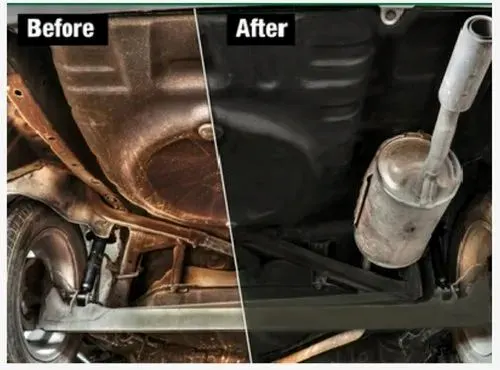
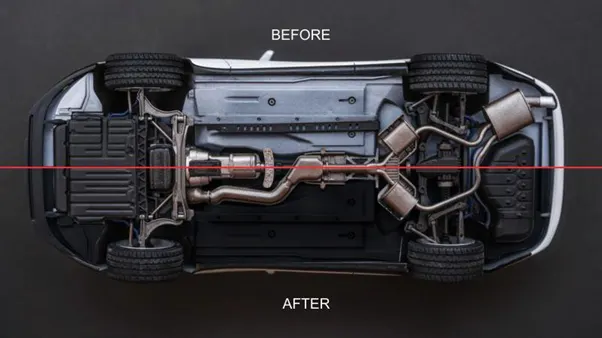
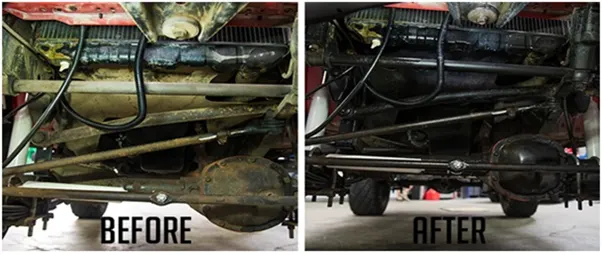
Pros:
- Offer resistance against rust, corrosion and dust dirt.
- Act as resistance against the rocky particles
- Also offered good sound cushioning
- Having anti-chipping property
- It offers great resistance to low-frequency heat waves.
Cons:
- The long-lasting was not indefinite
- Some coatings are costly to be applied