Underbody Coating
Introduction
Underbody coating is the coating done in the car where some of the parts are physically difficult or not possible to reach but are prone to corrosion. Examples: Internal body panels, frame rails, etc.
Importance
It is done in order to prevent corrosion. Since these parts are difficult to reach and often these parts are exposed to mud and dirt, it is needed to provide a coating to prevent corrosion while it is manufactured itself.
It must be done properly if not it will increase the overall weight of the part and may also cause trouble in the assembly since it can reduce the hole size, messing up the tolerance levels.
The Process of Coating
After the major panels are welded to form BiW, the BiW undergoes 5 stages which give the final body that is ready for assembly. The 5 stages are listed below. (In this the third stage is UnderBody Coating).
- Pre-treatment
At this stage, the surface of the BiW is prepared and conditioned for the Electric Deposition. Initially, the surface is cleaned to get rid of grease and a phosphate treatment is given to provide an inert metal phosphate layer that provides corrosion resistance. A conditioner is also given to activate the phosphate crystals. This stage helps the primer stick to the metallic surface
- Electrodeposition
This stage provides a metallic coating on the Zinc plating (GI material) that is coated onto the metallic surface of the body.
- Underbody Coating and Seam Sealing
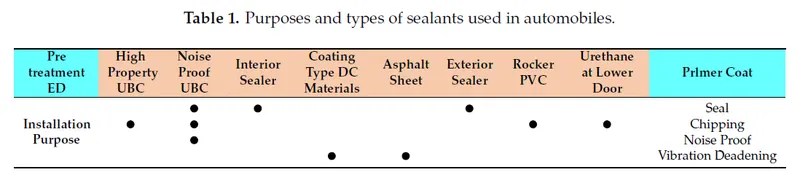
In this stage PVC (Polyvinyl Chloride) and urethane. These coatings are used to prevent corrosion, imparts anti-chipping properties and by a process called Dampening Coating, it helps to absorb noise from various parts of the car and during its interaction with the road. It is generally done using robots equipped with airless sprayers.
- Primer
This stage helps the paint to stick to the car surface. It also helps to smoothen the surface of the car in case of any scratches or imperfections from the previous stages, helps to improve stone chipping resistance and adds additional corrosion resistance properties to the paint. It is off three types
- Water borne – soluble in water
- Solvent borne– needs VOC for dissolving
- Powder– solid particles sprayed onto the surface.
- Topcoat
This is the final coating where the colour and glossiness of the paint are displayed. It can be divided into two parts.
- Basecoat-This is the coating where the colour of the painting is displayed
- Clearcoat- This is the coating where the paint gets some gloss and helps in finishing touch to the style of the vehicle. The main purpose of this is to protect the paint and retain its characteristics in the midst of UV rays, chipping, rain etc.
Types of UnderBody Coating.
The types of underBody coating are given in the list below.
Rubberized Undercoating
Rubberized vehicle undercoating is easy to apply and offers sound-cushioning as well as protection from dust, moisture, and dings or dents.
In addition to undercarriage, rubberized undercoating is also safe to use on wheel wells and quarter panels, and dries to a soft rubbery finish that prevents further rust, damage, or moisture seeps. The coating can be painted over and, if necessary for bodywork, can be easily removed with an undercoating removal spray.
Polyurethane Undercoating
This type of vehicle undercoating is a little bit quicker and easier to apply.
Oftentimes, polyurethane undercoating will come in canisters ready to preload into an application gun. This type of sealant works by seeping into all cracks and seams, displacing salt and moisture and oozing around rusty areas to bond with and protect unoxidized metal. It also sands quickly in case of a need to perform bodywork and can be painted over.
On the flipside, this type of car undercoating generally requires a little bit more surface prep work before applying (sanding and applying an etching primer to bare metals) before using are generally recommended.
Wax or Paraffin-Based Undercoatings
A paraffin-based undercoating protects the undercarriage of your vehicle. but it can wear off quicker than other types of undercoating and will need to be stripped and reapplied at least once every year.
Wax-based undercoatings never truly harden. During application, they drip or flow into seams and cracks to provide protective properties. They are usually available in a spray gun canister or in an aerosol can and offer at least a base protection in moderately humid climates.
Asphalt-Based Undercoating
For standard vehicles, any of the aforementioned types of undercoating will provide sufficient protection. For large trucks and heavy machinery, asphalt-based undercoating provides a bit of extra durability against rocks, chips, and moisture.
Asphalt-based undercoating generally contains a little bit of rubberized material that sets up firmly and also helps soften noise. Generally sold in five-gallon containers, this type of undercoating also needs more cure time than the other three, and is not paintable, making it best to use only for undercarriages.
Places the need UnderBody Coating
The UnderBody Coating is needed in the following areas.
around and inside the doors, hood, trunk, and front dash, and onto the exterior and interior of metal joints and outer area of the back wheel well.
Benefits of UnderBody Coating
- Fights Rust
- Absorbs Noise
- Reinforcement
- Prolong Car’s Life
Disadvantages of underbody Coating
- It is less helpful if corrosion is already present.
- It works best on new cars.
- Most vehicles make it five years before corrosion begins to show.
- It adds weight to the vehicle.
- An undercoating is not impervious to damage.