Underbody Coating
Aim Of The Challange :
Underbody coating is to prevent rusting and corrosion. This is not only required during the monsoon season but also in hot and humid climatic conditions. The coating is also a must if you tend to live in coastal regions where the humidity in these areas speeds up the process of corrosion. This can be eliminated by asking your car service professional to apply a rubberised anti-rusting coat on your car’s underbelly.
AUTOMOTIVE COATING PROCESSES:
The current trends in automotive coating process are motivated by lowering manufacturing costs, delivering customer satisfaction via aesthetic features and corrosion protection, and mitigating environmental concerns. A tremendous amount of consideration has been put into current automotive coating systems, and they have a level ofsophistication that satisfies most customers around the world.
STEPS IN COATING PROCESS:
1. POWDER COATING:
One solution to the emission of VOCs has been the replacements of liquid coatings with coatings in the form of dry, particulate solids, commonly called ‘powder coatings’. Their compositions contain very low concentrations of volatile solvents, on the order of 2% substanstially less than any other paint system. Currently, the automotive industry uses powder coating on wheels, bumpers, hubcaps, dorr handles, decorative trim & accent parts, truck beds, radiators, & numerous engine parts. A clear powder topcoat has been developed; BMW & Volvo are using it on their new model cars, & GM, Ford, & Chrysler have formed a consortium to test it on their production lines.
Now a day the insdustry are goind into morden coating process.
1) PRETREATMENT
The first sequence in preparing the BIW for subsequent coating is pretreatment sees Fig.2. Preatrament removes & clean excess metal & forms an appropriate surface structure enabling bonding of a corrosion protection layer. It consists of cleaning the body surface to remove remaining oils from the staming process & welding residues through three primary liquid dip processes of degreasing, conditioning, & phosphating. Pretreament helps the primer to bond onto the metal. A phosphate treatment applies an inert layer of metal phosphate, providing resistance to corrosion spread. The degreasing solution is composed of alkaline salts & surfactants & can include caustic soda, sodium carbonate. The surfactants are types of detergents for emulsifying oils & lubricants on the BIW. In surface conditioner which creates nucleation sites for phosphate crystal growth. It increases the number of crystallization nuclei on the metal surface that enchance bonding mechanism for the subsequent phosphate sequence. Finally, the liquid dip phosphate ions, nitrate ions, zinc & hydrogen ions. The free acid etches the steel surface, causing hydrogen to be released while metal phosphate ions are precipitated onto the surface in a crystalline form.
2) ELETRODEPOSITION
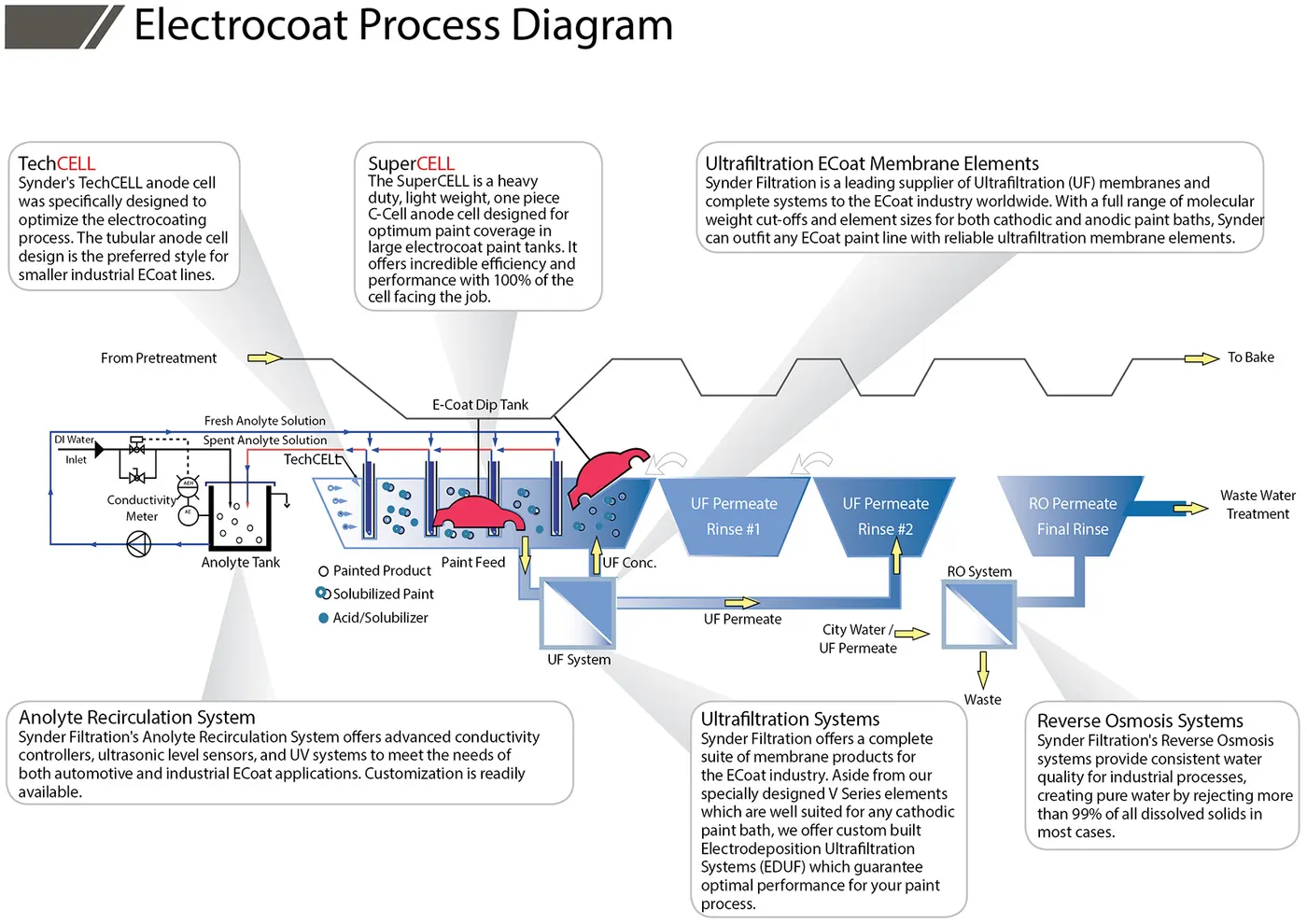
E-coating involves dipping automobile bodies into the coating solution & passing an electric current through the body & the liquid ED paint solution. Because of the charged nature of this coating process, the ED paint penetrates into places a spray would not reach. During operation, a mixture of resin, binder, & a paste containing the pigments is fed into the ED tank. The automobile body is lowered into the tank, & an electriccurrent applied; the solution in the tank consists of 80-90% deionised water & 10-20% paint solids.The resin is the backbone of the final paint film & provides corrosionprotection, durability, & toughness. Pigments are used to provide color & gloss.
3) RUST-PROOF MATERIALS: SEALER/PVC:
The third step is underbody coating & seam sealing using PVC. Fig.4 displays the lower door sections & rocker panel locations where PVC or urethanes are applied as an anti-chipping protection, & shows the cross section of this layer with respect to the other coatings on the body parts. During this third step, it is also typical to apply soft tip primer coat that improves the chipping resistance . This layer is applied to the front edge of the hood , which is an area prone to chipping shock, using a high elastic resin that resides between the ED & primer coats
4) PRIMER
The fourth coating step is the primer. It can be water-borne, solvent-borne, or a powder. The primer fills & smoothes minor imperfections & scratches that may be created during prior steps & by the intermediate sanding or grinding used to remove small imperfections. It also provides additional protection against corrosion & maximizes adhesion between it & the E-coat & basecoat; thereby, the primer incrases paint durability. Primer coating operations in an automobile assembly plant are usually implemented in three stages: Interior coating, Exterior coating, & then cutting in an oven. Manual spray painting is used for the interior coating of the doors, engine compartment, & luggage or trunk space. Some of the areas are not sprayed with basecoat. It is important that are primer color matches the basecoat to be able to impart uniform coating appearances between interior & exterior coats.
5) TOPCOAT:
The final step in the body coating process is to apply the topcoat, which consists of two layers the basecoat & clearcoat.
AUTOMOTIVE COATING PERFORMANCE :
The performance of an automotive coating can be accessed from different views, e.g., the durability of the exterior & interior paint finishes or the aesthetic features. However, limitations exist on the paint properties, process capabilities, & most importantly, the amount of money that can be spent to improve the finish. Consequently, each automotive company define its color & appearancestandards, which are to meet or exceed the levels reached by competitors & customers expectations. For checking ofcoating performance we consider some features like
a) Coating Quality:
It can be judged on three main criteria: protection against harsh environment; durability; & appearance quality.
b) Color:
Uniform & consistent color is essential to achieve the impression of a high-quality finish & avoid customer complaints. This issue is important not only at the time of purchase but also at the time of purchase but also throughout the lifetime of a vehicle. Factors that influence color tone are pigment orientation & concentration.
c) Corrosion Protection:
Automobile coatings are subjected to a number of different environments & situations during their service life. Degradation of the coating depends on three main factors: coating formula, the intensities of the environments or situation, & their duration. Exposure to UV from the sun, heat, & humidity has a long term deleterious effect with different degrees of intensity depending on the climate & weather conditions.