To Study the Recent Trends and Economy of Battery
AIM : To Study the Recent Trends and Economy of Battery.
Battery-Powered EV (BEV) :
A battery electric vehicle (BEV), pure electric vehicle, only-electric vehicle, or all-electric vehicle is a type of electric vehicle (EV) that exclusively uses chemical energy stored in rechargeable battery packs, with no secondary source of propulsion (e.g. hydrogen fuel cell, internal combustion engine, etc.). BEVs use electric motors and motor controllers instead of internal combustion engines (ICEs) for propulsion. They derive all power from battery packs and thus have no internal combustion engine, fuel cell, or fuel tank. BEVs include – but are not limited to – motorcycles, bicycles, scooters, skateboards, railcars, watercraft, forklifts, buses, trucks, and cars.
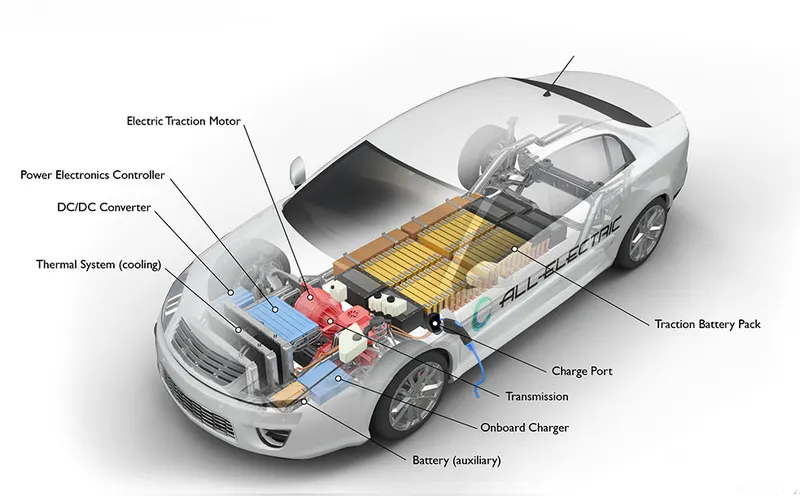
In 2016, there were 210 million electric bikes worldwide used daily. Cumulative global sales of highway-capable light-duty pure electric car vehicles passed the one million unit milestone in September 2016. As of October 2020, the world's top-selling all-electric car in history is the Tesla Model 3, with an estimated 645,000 sales, followed by the Nissan Leaf with over 500,000 sales as of September 2020.
OBJECTIVES :
Compare the battery capacity and related performance of any three recent Battery-powered EV (BEV).
(Hint: figures,model name ,capacity,future scope)
STUDY - 1 :
Comparing the battery capacity and related performance of any three recent Battery-Powered EV (BEV) :
Hyundai Ioniq 5 :
The Hyundai Ioniq 5 is an electric compact crossover SUV produced by Hyundai. It is the first product to be marketed under the electric cars-focused Ioniq sub-brand, and the first model developed on the Hyundai Electric Global Modular Platform (E-GMP). It was revealed globally on 23 February 2021.
Overview -
The design was previewed by the Hyundai 45 EV Concept which was presented at the Frankfurt Motor Show in September 2019. Both the concept car and the production version are inspired by the original Hyundai Pony and feature the Parametric Pixel design that is applied to the headlights, taillights, and wheels. The vehicle’s clamshell hood spans the entire width to make a sleek look with the 20-inch aerodynamic wheels.
Developed under the project code NE, it is the first vehicle to be based on the E-GMP platform. The dedicated electric vehicle platform enables the vehicle to adopt a fully flat interior floor with a 3-meter long wheelbase. The flat floor allows Hyundai engineers to develop a sliding front central console, which is able to slide backwards by 140 mm (5.5 in). It has a cargo capacity of 531 L (18.8 cu ft) behind the rear seats that can be increased to nearly 1,600 L (56.5 cu ft) with the second row seats folded.
The dashboard is dominated by two 300 mm (12 in) screens, one for the instrument cluster display and the other for the infotainment system under one piece of glass. It is equipped with a head-up display with augmented reality support. Many of the interior parts are made from recycled materials, including PET bottles. The roof consists of a single large glass panel without any support beams.
The Ioniq 5 also features a front trunk, which has a 57 L (2.01 cu ft) capacity for the RWD version and all North American versions, while the AWD model (except North America) has a 24 L (0.848 cu ft) capacity, due to the extra mechanical components underneath to support the front electric motor.
It has the ability to charge electrical equipment through the built-in V2L (Vehicle to Load) function. It can supply up to 3.6 kW of power from the port mounted under the rear seats and from another port installed outside. The exterior port is able to supply power even if the vehicle is turned off.
|
Overview |
|
|
Manufacturer |
Hyundai |
|
Production |
March 2021 – present |
|
Model years |
2022 |
|
Assembly |
South Korea: Ulsan (Ulsan Plant 1) |
|
Body and chassis |
|
|
Class |
Compact crossover SUV |
|
Body Style |
5-door SUV |
|
Layout |
|
|
Platform |
Hyundai E-GMP |
|
Related |
|
|
Powertrain |
|
|
Electric motor |
Permanent Magnet Synchronous Reluctance Motor |
|
Battery |
58–77.4 kWh |
|
Electric rage |
Up to 480 km (298 mi) |
|
Plug-in charging |
350 kW at 800V |
|
Dimensions |
|
|
Wheelbase |
3,000 mm (118.1 in) |
|
Length |
4,635 mm (182.5 in) |
|
Width |
1,890 mm (74.4 in) |
|
Height |
1,605 mm (63.2 in) |
|
Curb weight |
|
Powertrain -
The vehicle is available with 58 kWh or 72.6 kWh battery capacity options, while the North American version will only be available with the 58 kWh or 77.4 kWh batteries. Every Ioniq 5 has a top speed of 185 km/h (115 mph).
The battery can recharge 86 kilometers of range in 5 minutes, or from 10 to 80% in 18 minutes, or 375 kilometers in half an hour with its 800 V charging capabilities by using a 350 kW charger. The 800 V inverter is sourced from Vitesco Technologies, a subsidiary of the Continental group. A five minutes charge will add 100 km (62 mi) to its range by WLTP standards.
|
Specifications - |
||||||
|
Battery |
Layout |
Power |
Torque |
0–100 km/h |
Range (claimed) |
Top speed |
|
58 kWh |
RWD |
125 kW (168 hp) |
350 N⋅m (258 lb⋅ft) |
8.5 s |
N/A |
185 km/h (115 mph) |
|
AWD |
53 kW (71 hp) (front motor) |
255 N⋅m (188 lb⋅ft) (front motor) |
6.1 s |
N/A |
||
|
72.6 kWh |
RWD |
160 kW (215 hp) |
350 N⋅m (258 lb⋅ft) |
7.4 s |
480 km (298 mi) (WLTP) |
|
|
AWD |
70 kW (94 hp) (front motor) |
255 N⋅m (188 lb⋅ft) (front motor) |
5.2 s |
N/A |
||
|
77.4 kWh |
RWD |
168 kW (225 hp) |
350 N⋅m (258 lb⋅ft) |
N/A |
up to 480 km (300 mi) |
|
|
AWD |
74 kW (front motor) 165 kW (rear motor) 239 kw (320 hp) (combined) |
605 N⋅m (446 lb⋅ft) (combined) |
< 5 s |
433 km (269 mi) (SE & SEL models) 393 km (244 mi) (Limited model) |
||
Kia EV6 :
The Kia EV6 is an electric compact crossover SUV produced by Kia. Introduced in March 2021, it is the first Kia dedicated electric vehicle, and the first model developed on the Electric Global Modular Platform (E-GMP) similar to the Hyundai Ioniq 5. It is also the first model to be named under the new nomenclature designated for a line of Kia electric cars, which will range from EV1 to EV9.
Overview -
After a set of pictures were revealed on March 15, 2021, the EV6 was finally released on August 2, 2021. Developed under the codename CV, it is the first Kia model based on the E-GMP electric car platform.
Main features include quick acceleration with the time for getting from zero to hundred km/h (GT model) taking 3.5 seconds, rapid 800V charging capability, and vehicle-to-load function.
It features a panoramic curved display panel inside, which opens up more space while a controller for transition between infotainment and HVAC below the navigation screen and touch buttons for using heated seat as well as steering wheel further enhance driver usability. The EV6’s boot space is 520 L (VDA standard) and it can be increased up to 1,300 L when the rear seats are folded. The crossover is claimed to be furnished with sustainable materials for its door pocket, crash pad, mood lighting, garnish and Nappa leather seats. It also has augmented reality head-up display, 360 camera option, remote controlled parking, along with safety technologies including Lane Follow Assist, Highway Driving Assist 2 (semi-autonomous adaptive cruise control) including auto lane changing, AEB collision avoidance, remote smart parking assist and Safe Exit Assist. as well as Smart Cruise Control with Machine Learning (SSC-ML), 360 camera eyc.
For the first time in the automotive industry in Korea, it obtained the Product Carbon Footprint certificate from United Kingdom's The Carbon Trust.
|
Overview |
|
|
Manufacturer |
Kia |
|
Production |
2021–present |
|
Model years |
2022– (North America) |
|
Assembly |
South Korea: Hwasung (Hwasung Plant) |
|
Body and chassis |
|
|
Class |
Compact crossover SUV |
|
Body style |
5-door SUV |
|
Layout |
|
|
Platform |
Hyundai E-GMP |
|
Related |
|
|
Powertrain |
|
|
Electric motor |
Permanent Magnet Synchronous Reluctance Motor electric, rear-wheel drive:
electric, all-wheel drive:
|
|
Transmission |
Direct drive reduction gear |
|
Battery |
58-kWh or 77.4-kWh lithium-ion Polymer |
|
Electric range |
Up to 510 km (317 mi) |
|
Dimensions |
|
|
Wheelbase |
2,900 mm (114.2 in) |
|
Length |
4,680–4,695 mm (184.3–184.8 in) |
|
Width |
1,880 mm (74.0 in) |
|
Height |
1,550 mm (61.0 in) |
Specifications -
|
Battery |
Layout |
Power |
Torque |
Multi fast charging |
|
58 kWh |
2WD |
125 kW |
350 N·m |
400 V / 800 V |
|
4WD |
173 kW |
605 N·m |
||
|
77.4 kWh |
2WD |
168 kW |
350 N·m |
|
|
4WD |
239 kW |
605 N·m |
Nissan Ariya :
The Nissan Ariya is an electric compact crossover SUV produced by the Japanese automobile manufacturer Nissan at its Tochigi plant in Japan starting in July 2020. The US launch of the Ariya was planned for the second half of 2021 but has been delayed to 2022.
Overview -
The Nissan Ariya concept car was presented on 24 October 2019 at the 2019 Tokyo Motor Show. It is a 100% electric coupe SUV concept car of 4.6 m (15 ft), which places it between the Qashqai and X-Trail in the range of the Japanese manufacturer.
The concept car was fitted with 21 inch rims, LED headlamps and an illuminated logo on its grille, which itself takes the form of a large "V" characteristic of Nissan design. Inside, the dashboard is equipped with two 12.3 inch screens assembled to form a large screen, from which ProPilot 2.0 autonomous driving is controlled.
The manufacturer has not distributed information on the capacity of the battery to be used in the production Ariya, but indicated that it will be recharged by direct current (DC) compatible with standard CHAdeMO. It will go from zero to 60 miles per hour in 5.1 seconds. The Ariya will support the CCS standard in the US and Europe.
|
Overview |
|
|
Manufacturer |
Nissan |
|
Production |
July 2020 – present |
|
Model years |
2022– (North America) |
|
Assembly |
Japan: Kaminokawa, Tochigi (Tochigi plant) |
|
Designer |
Takashi Utsunomiya and Kazuki Aoyama |
|
Body and chassis |
|
|
Class |
Compact crossover SUV |
|
Body style |
5-door SUV |
|
Layout |
Front-wheel drive with optional Dual-motors all-wheel drive (E-4ORCE) |
|
platform |
Nissan CMF-EV platform |
|
Powertrain |
|
|
Electric motor |
Front and rear motor combined output, 3-phase AC induction motor |
|
Transmission |
1-speed fixed gear |
|
Battery |
65, 90 kWh lithium-ion |
|
Electric |
|
|
Plug-in charging |
Onboard charger
Offboard charger
|
|
Dimensions |
|
|
Wheelbase |
2,775 mm (109.3 in) |
|
Length |
4,595 mm (180.9 in) |
|
Width |
1,850 mm (72.8 in) |
|
Height |
1,665 mm (65.6 in) |
Production -
Originally slated to hit the market in 2021 at a starting price of $40,000, the Ariya production version was unveiled in July 2020. Due to chip shortage caused by the COVID-19 pandemic, the Ariya's launch was delayed to 2022 from its original 2021 launch.
Specifications -
|
Model |
Standard Range |
Extended Range |
|||
|
Powertrain |
FWD |
AWD |
FWD |
AWD |
AWD Performance |
|
Availability |
2021– |
||||
|
Battery capacity (useable) |
65 kWh (63 kWh) |
90 kWh (87 kWh) |
|||
|
Range (WLTP) |
360 kilometers (224 mi) |
340 kilometers (211 mi) |
500 kilometers (311 mi) |
460 kilometers (286 mi) |
400 kilometers (249 mi) |
|
Power |
160 kW (218 PS; 215 hp) |
205 kW (279 PS; 275 hp) |
178 kW (242 PS; 239 hp) |
225 kW (306 PS; 302 hp) |
290 kW (394 PS; 389 hp) |
|
Torque |
300 N⋅m (221 lb⋅ft) |
560 N⋅m (413 lb⋅ft) |
300 N⋅m (221 lb⋅ft) |
600 N⋅m (443 lb⋅ft) |
|
|
Acceleration 0–60 mph (0–97 km/h) |
7.5 s |
5.9 s |
7.6 s |
5.7 s |
5.1 s |
|
Top Speed |
160 km/h (99 mph) |
200 km/h (124 mph) |
160 km/h (99 mph) |
200 km/h (124 mph) |
|
|
DC Fast Charge (DCFC) Speed |
Up to 130 kW |
||||
|
On-board Charge Speed |
7.4 kW |
22 kW |
|||
|
Trunk Space |
468 L (17 cu ft) |
415 L (15 cu ft) |
468 L (17 cu ft) |
415 L (15 cu ft) |
|
CONCLUSION :
Comparing the battery capacity and related performance of any three recent Battery powered EV (BEV).
REFERENCES :
https://en.wikipedia.org/wiki/Battery_electric_vehicle
https://en.wikipedia.org/wiki/Hyundai_Ioniq_5