To Study the Mathematical Modeling of lead-acid Battery.
AIM : To Study the Mathematical Modeling of lead-acid battery.
Lead-Acid Battery :
-
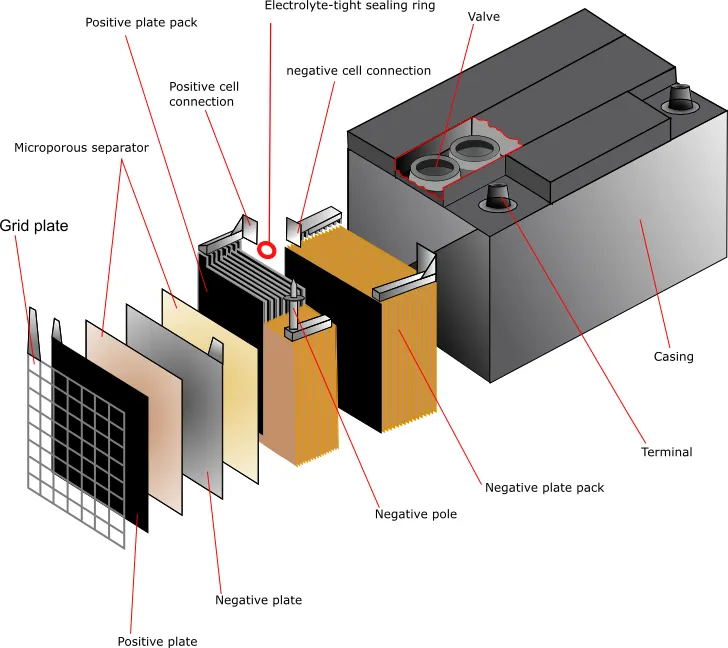
The lead-acid battery is a type of rechargeable battery first invented in 1859 by French physicist Gaston Planté. It is the first type of rechargeable battery ever created. Compared to modern rechargeable batteries, lead-acid batteries have relatively low energy density. Despite this, its ability to supply high surge currents means that the cells have a relatively large power-to-weight ratio. These features, along with their low cost, make them attractive for use in motor vehicles to provide the high current required by starter motors.
-
As they are inexpensive compared to newer technologies, lead-acid batteries are widely used even when surge current is not important and other designs could provide higher energy densities. In 1999 lead-acid battery sales accounted for 40–50% of the value from batteries sold worldwide (excluding China and Russia), equivalent to a manufacturing market value of about $15 billion. Large-format lead-acid designs are widely used for storage in backup power supplies in cell phone towers, high-availability settings like hospitals, and stand-alone power systems. For these roles, modified versions of the standard cell may be used to improve storage times and reduce maintenance requirements. Gel-cells and absorbed glass-mat batteries are common in these roles, collectively known as VRLA (valve-regulated lead-acid) batteries.
-
In the charged state, the chemical energy of the battery is stored in the potential difference between the pure lead at the negative side and the PbO2 on the positive side, plus the aqueous sulfuric acid. The electrical energy produced by a discharging lead–acid battery can be attributed to the energy released when the strong chemical bonds of water (H2O) molecules are formed from H+ ions of the acid and O2− ions of PbO2. Conversely, during charging, the battery acts as a water-splitting device.
Working of Lead-Acid Battery :
-
The storage battery or secondary battery is such a battery where electrical energy can be stored as chemical energy and this chemical energy is then converted to electrical energy as and when required. The conversion of electrical energy into chemical energy by applying an external electrical source is known as charging of a battery. Whereas conversion of chemical energy into electrical energy for supplying the external load is known as discharging of secondary battery.
-
During charging of battery, current is passed through it which causes some chemical changes inside the battery. These chemical changes absorb energy during their formation.
-
When the battery is connected to the external load, the chemical changes take place in reverse direction, during which the absorbed energy is released as electrical energy and supplied to the load.
Chemical Action During Recharging -
- For recharging, the anode and cathode are connected to the positive and the negative terminal of the DC supply mains. The molecules of the sulfuric acid break up into ions of 2H+ and SO4−. The hydrogen ions being positively charged move towards the cathodes and receive two electrons from there and form a hydrogen atom. The hydrogen atom reacts with lead sulphate cathode forming lead and sulfuric acid according to the chemical equation.
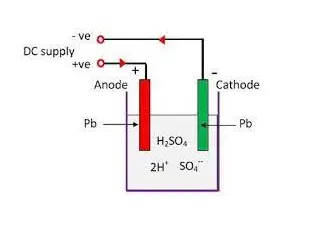
- SO4−ion moves to the anode, gives up its two additional electrons becomes radical SO4, react with the lead sulphate anode and form leads peroxide and lead sulphuric acid according to the chemical equation.
Chemical Action During Discharging -
- When the cell is full discharge, then the anode is of lead peroxide (PbO2) and a cathode is of metallic sponge lead (Pb). When the electrodes are connected through a resistance, the cell discharge and electrons flow in a direction opposite to that during charging.
- The hydrogen ions move to the anode and reaching the anodes receive one electron from the anode and become hydrogen atom. The hydrogen atom comes in contact with a PbO2, so it attacks and forms lead sulphate (PbSO4), whitish in colour and water according to the chemical equation.
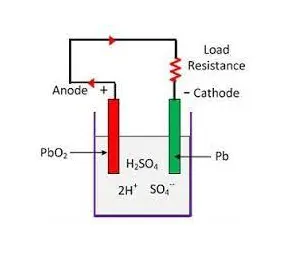
- Here each sulphate ion (SO4−) moves towards the cathode and reaching there gives up two electrons becomes radical SO4, attack the metallic lead cathode and form lead sulphate whitish in colour according to the chemical equation.
OBJECTIVES :
Run a MATLAB script for the mathematical model of lead-acid battery and comment on it -
STUDY :
THEORY :
Important Terminologies for mathematical battery model -
Open Circuit Voltage (E) :
Open circuit voltage is the maximum theoretical voltage that an ideal battery can achieve. This voltage is not possible to achieve in actual conditions because of losses and internal resistance of the battery. OCV can be approximated by discharging the battery at a very low discharge rate i.e. around C/20.
V = E - I × R
State of Charge (SOC) :
The state of charge of battery is defined as ratio of its current capacity(Qt) to its nominal capacity(Qn). State of charge shows how much charge/energy will be available in battery for a given instant of time. State of charge ranges from 0 to 100%.
SoC value depends on the previous behaviour(Hysteresis) of the battery and be calculated as,
SOC = ( Qt / Qn ) × 100
where Q is the capacity.
Depth of Discharge (DOD) :
It shows the amount of energy removed from a battery at a given instant of time.
DOD = Charge removed/ Peukert's Capacity
also, DOD = 1- SOC
Peukert's Law :
Peukert's law expresses the battery capacity with respect to the rate of discharge. The law states that the discharge capacity of the battery decreases with the
increase in the rate of discharge current.
For a one-ampere discharge rate, Peukert's law is often stated as -

Where,
 is the capacity at a one-ampere discharge rate, which must be expressed in ampere-hours,
 is the actual discharge current (i.e. current drawn from a load) in amperes,
 is the actual time to discharge the battery, which must be expressed in hours.
 is the Peukert constant (dimensionless).
Charge Removed :
Charge removes is the amount of energy removed from the total stored energy in the battery. The amount of energy removed is higher than the actual amount of energy supplied to the system. The charge removed also depends on the behaviour of the battery in an earlier time step.
The total charge removed from the battery for the nth step of the simulation is 𝐶𝑅 𝑛 and δt is in seconds, the time step between calculations.
𝐶𝑅 𝑛+1 = 𝐶𝑅 𝑛 + 𝛿𝑡 /3600×𝐼𝑘 ...Ah
Charge Supplied :
Charge supplied is the actual amount of energy or charge supplied to the system from the battery. The charge supplied is always less than the charge removed and depends on the earlier time step behaviour.
𝐶𝑆 𝑛+1 = 𝐶𝑆 𝑛 + 𝛿𝑡 /3600×𝐼 ...Ah
MATLAB Script for the Mathematical Model of Lead-Acid Battery :
clc
clear all
close all
% Defining time step variables with T %
% Total time 10001 steps with time space of 50 sec %
T=(0:50:500000)
% Defined Input Variables %
CR=zeros(1,length(T));  % charge removes
DOD=zeros(1,length(T)); % Depth of discharge
V=zeros(1,length(T));   % Voltage
CS=zeros(1,length(T));  % Cahrge supplied
E=zeros(1,length(T));   % Open Circuit voltage
I=[10,50,100,150,200];  % Current In Amphers
n=1;     % No of cells
C=50;    % Capacity in Amp.hrs
k=1.045; % 0.045 Represents loss of capacity due to discharge
dt=(T(2)-T(1))*ones(1,length(T)); % Time step
R_in=(0.06/C)*n; % Internal Resistance
E(1)=2.15;

for i= 1:length(I)
   V(i)= n*(2.15-I(i)*R_in);

% Defining the voltage equation for OCV %
for n=2:length(T)
   dt(n)= T(n)-T(1);
   Cp=(I(i)^k)*(dt(n)); % Peukert's Capacity
   CR(n)=(CR(n-1)+(dt(n)*(I(i)^k))/3600);
   DOD(n)=(CR(n)/Cp);
   E(n)= 2.15-DOD(n)*(2.15-1.75);
   V(n)= E(n)-I(i)*R_in;

   if DOD(n)>0.99
      E(n)=0;
      V(n)=0;
   end

   if DOD(n)>1
   E(n)=1;
   end

   if E(n)>0
   CS(n)=CS(n-1)+((I(i)*dt(n))/3600);

   else
   CS(n)=CS(n-1);
  end
end

figure(1)
hold on
plot(DOD,V)
xlabel('DOD')
ylabel('Voltage')
end
plot(DOD,E)
legend('E - OCV','V - volatge','I = 10A','I = 150A','I = 200A')
grid on

figure(2)
plot(DOD,E)
hold on
plot(DOD,V)
legend('E - OCV','V - volatge')
xlabel('DOD')
ylabel('Voltage')
grid on

figure(3)
plot(CR,E)
hold on
plot(CR,V)
legend('E - OCV','V - volatge')
xlabel('CR')
ylabel('Voltage')
grid on

figure(4)
plot(CS,E)
hold on
plot (CS,V)
legend('E - OCV','V - volatge')
xlabel('CS')
ylabel('Voltage')
grid on
Explanation of Code :
- Firstly, Defined total time & time steps. (10001 steps are defined with each time step of 50 sec)
- The variables secondly define for the mathematical model of CR, CS, DOD, V, Cp, E, n, I, C, k for improving the performance of the simulation.
- The discharge current 'I' is taken as 10, 50, 100,150, 200. This are the diffenent discharge rates as C/5, 1C, 2C, 3C, and 4C.
- Used 'for' loops use to calculate different variables. The first 'for' loop is used to calculate the inner commands for each value of I. Second 'for' loop used to calculate CS, CR, E, V, SOC & DOD repeats the simulation till the end of the defined time.
- 'If' loop is used such that voltage & OCV will drop as soon as DOD reaches above 0.99 & further the value is considered as 1which shows battery is completely discharged.
- Finally, Results are plotted with the Plot command.
Output Plots :
(OCV & V) Vs DOD Plot at Different Rates :
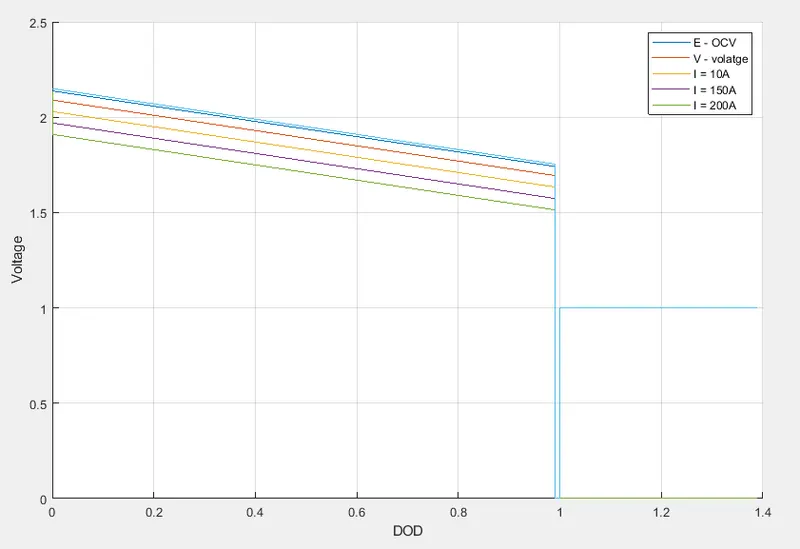
From this plot, We can observe that discharge capacity of the battery decreases with an increase in discharge rate. The topmost line is the open-circuit voltage and is the maximum possible voltage that a battery can attain ideally. We can reach near to OCV by decreasing discharge rate.
(OCV & V) Vs DOD Plot :
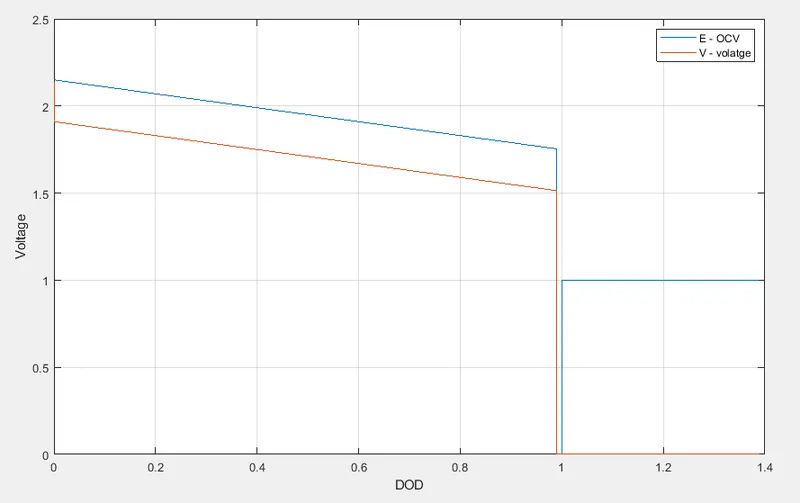
This plot shows the variation of open-circuit voltage and battery discharge voltage with respect to DOD. The difference between both the voltages is occurred due to the internal resistance of the battery and other loose (temperature, chemistry etc).
(OCV & V) Vs CR Plot :
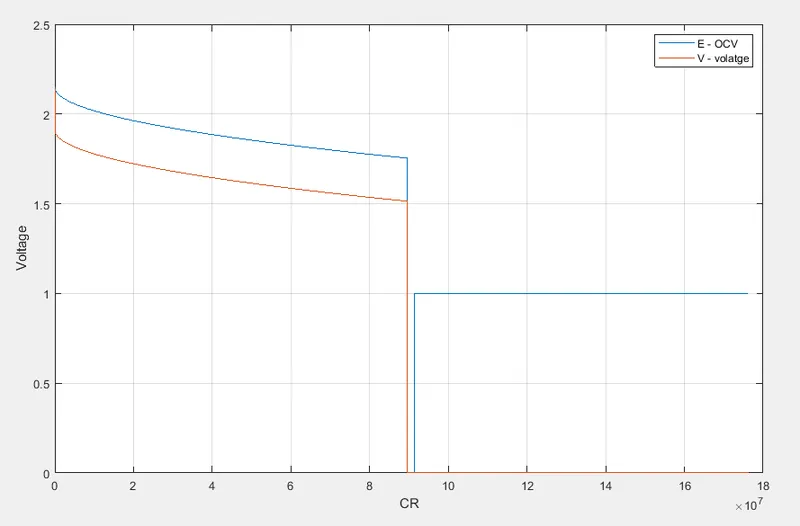
This plot shows Open circuit voltage (E) & Battery discharge voltage (V) with respect to Charge removed. It can see that the charge removed is higher than the charge supplied.
(OCV & V) Vs CS Plot :
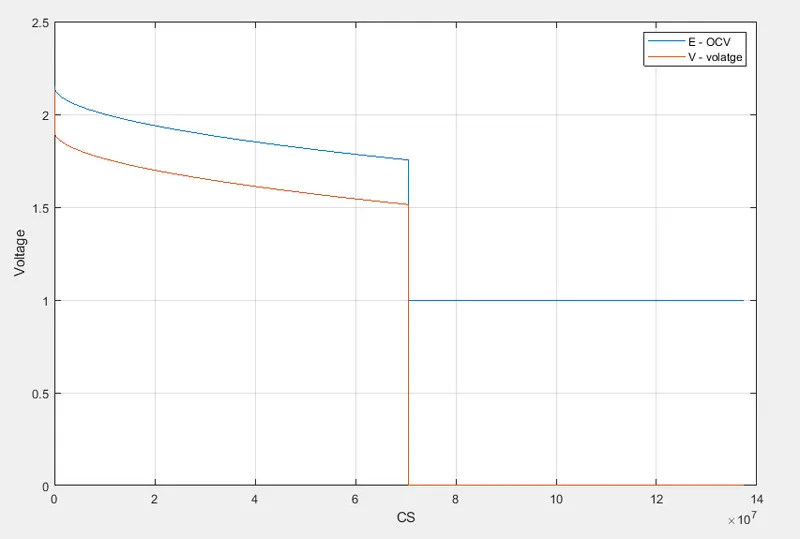
This plot shows that the Open circuit voltage (E) & Battery discharge voltage (V) with respect to Charge Supplies (CS). Both the voltages of the battery decreases with an increase in charge supplied.
CONCLUSION :
Thus, We created a Mathematical model of a Lead-acid battery with Matlab script.
REFERENCES :
https://en.wikipedia.org/wiki/Lead%E2%80%93acid_battery
https://www.electrical4u.com/working-of-lead-acid-battery-lead-acid-secondary-storage-battery/