To Study the Specifications of Lithium-Ion Cell.
AIM : To Study the Specifications of Lithium-Ion Cell.
Lithium-Ion Cell :
- Lithium-ion batteries power the lives of millions of people each day. From laptops and cell phones to hybrid and electric cars, this technology is gaining in popularity due to its lightweight.
- A battery is made up of anode, cathode, separator, electrolyte and two current collectors (positive and negative). The anode and cathode store lithium. Carries positive lithium ions from the anode to the cathode and vice versa via electrolyte positive.
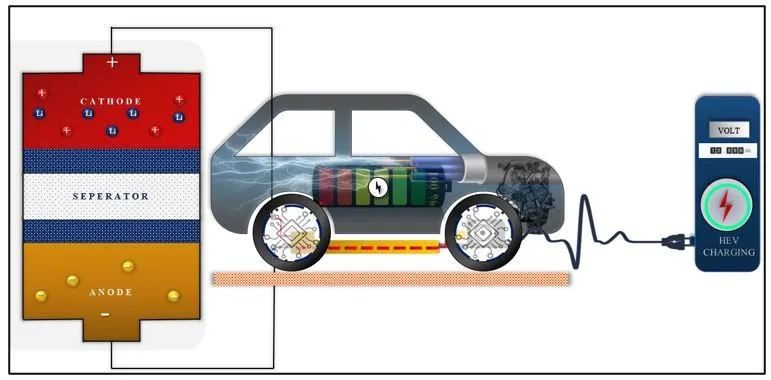
- The motion of lithium ions forms free electrons in the anode which creates a charge in the positive current collector. The electric current then flows from the current collector through the device to the negative current collector. The separator blocks the flow of electrons inside the batteries, high energy density and the ability to recharge.
OBJECTIVES :
Read a lithium ion cell datasheet. Comment on the following : -
-
What is the difference between nominal voltage and maximum voltage ?
-
Under which situation we observe the changes in dimensions and weight of a cell.
-
List out various mechanical testing and standards.
-
What is the discard procedure suggested generally for used Li+ion batteries ?
STUDY - 1 :
The Difference Between Nominal Voltage and Maximum Voltage :
Nominal Voltage :
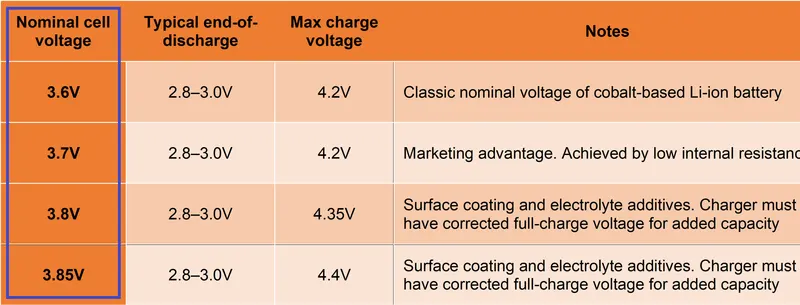
- A Li-ion cell is an electrochemical device that produces a voltage potential when placing metals of different affinities into an electrolyte. However Manufacturers rate a cell by assigning a nominal voltage, and with a few exceptions, these voltages follow an agreed convention. Here are the nominal voltages of the most common cells in brief.
- The nominal voltage of a lithium-ion cell is 3.6V. Some cell manufacturers mark it as 3.7V or higher. This offers a marketing advantage because the higher voltage boosts the watt-hours on paper.
- The 3.7V rating also creates unfamiliar references of 11.1V and 14.8V when connecting three and four cells in series rather than the more familiar 10.80V and 14.40V for 3.6V respectively. Equipment manufacturers follow the nominal cell voltage of 3.6V for most Li-ion systems as a power source.
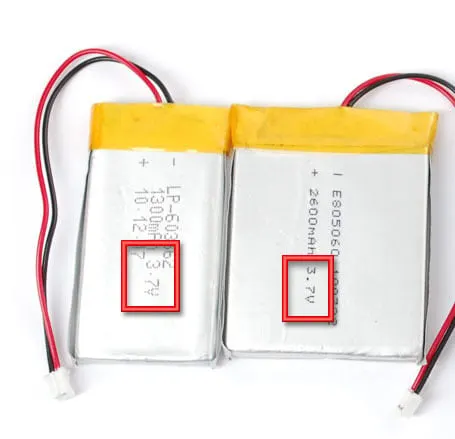
- The nominal voltage is a function of anode and cathode materials, as well as impedance. Voltage calculations include measuring the mid-way point from a full-charge of cell 4.20V to the 3.0V cutoff with a 0.5C load. For Li-cobalt the mid-way point is about 3.6V.
- Similarly on Li-manganese with a lower internal resistance gives an average voltage of 3.7V. It should be noted that the higher voltage is often set arbitrarily and does not affect the operation of portable devices or the setting of the chargers. But there are exceptions.
- Some Li-ion cells with LCO architecture feature a surface coating and electrolyte additives that increase the nominal cell voltage and permit higher charge voltages. To get full capacity, the charge cut-off voltage for these batteries must be set accordingly.
Figure shows the typical voltage settings -
- Users want to know if Li-ion cells with higher charge voltages compromise longevity and safety. There is limited information available but what is known is that, yes, these batteries have a shorter cycle life than a regular Li-ion; the calendar life can also be less.
- Since these cells are mostly used in consumer products, the longevity can be harmonized with obsolescence, making a shorter battery life acceptable. The benefit is longer a runtime because of the gained Wh (Ah x V). All cells must meet regulatory standards and are safe.
- The phosphate-based lithium-ion has a nominal cell voltage of 3.2V and 3.3V; lithium-titanate is 2.4V. This voltage difference makes these chemistries incompatible with regular Li-ion in terms of cell count and charging algorithm.
- The lithium battery output voltage varies during discharging. The nominal voltage is measured at the mid point between full charged and fully discharged based on a 0.2C discharge (where C is the rated capacity of the cell in mAh). A single lithium battery cell nominal voltage is usually shown as either 3.6V, 3.7V or 3.8V.
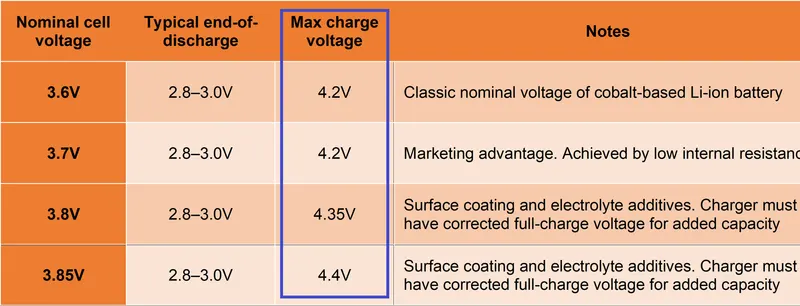
- The actual voltage profile during discharge depends on the cell chemistry being used, the discharge rate, the temperature and the age of the cells or battery being discharged. A single cell lithium battery cell maximum voltage is 4.2V, cut off voltage will be 2.5V ~ 3V.
Maximum Voltage :
-
Maximum voltage of Vmax - usually 4.2V or less. Say 4.2V for now. As for current, the maximum Voltage applied will affect cell longevity (and capacity on a given charge). Charging at a terminal voltage of much above 4.2V will shorten you cell life, may lead to metallic lithium plating out and can lead to the exciting and equipment eating "vent with flame" battery meltdown phenomenon.
-
The maximum voltage AT the battery (1 cell) under maximum constant current CCmax is Vmax = 4.2V in this case.
-
BUT the maximum voltage AT the battery (1 cell) under ANY current is also Vmax.
If the battery will not accept Imax when Vmax is applied then CC mode is no longer appropriate. Charging should be CV (or terminated if Icharge at Vmax is <= Icv_min - see below) - An important point here is where you measure what you call "the charging voltage". This is properly measured at the cell electrodes as close to the cell internals as possible. In practice anywhere on the (usually) weld-attached tabs should be OK as at the max allowed current the voltage drop across the tabs should be minimal. As long as the voltage at the actual cell is <= Vmax then the voltage at other points in the charger may be > Vmax if the charger design requires it.
Figure shows the typical voltage settings -
Consider : Apply a "true" constant current source to a discharged LiIon cell.
- There will be lead resistance external to the cell so the voltage elsewhere to the system may be higher than at the battery terminals. Ignore that for now - comment on this at end.
For a discharged LiIon battery the terminal voltage will be somewhere around 3V and will slowly rise as CC is applied. - After about 40 to 50 minutes of charging a LiIon cell at 1C (= CCmax in this case) from fully discharged the TERMINAL voltage will reach 4.2V. This is where you stop applying CC and apply a CV of Vamx (= 4.2V in this case) at whatever current it takes to keep the voltage at 4.2V (up to a maximum of CCmax.)
Charging voltage is removed when Icharge falls below Icv_min to prevent potentially irreversible electrochemical reactions and to prevent Lithium metal "plating out".
- If Vmax is set at 4.15V then charge capacity is reduced noticeably but cycle life is extended.
- If Vmax is set at 4.1V charge capacity is significantly reduced and cycle life is significantly extended.
The loss of capacity per cycle that occurs when Vmax is reduced leads to an overall INCREASE in total lifetime capacity as the extension in life cycles rises faster than the per cycle capacity falls. If you care mainly about highest capacity per charge set Vmax as high as allowed and accept low cycle life.
If you can tolerate say 80% to 90% of max possible capacity per cycle, set Vmax lower and get more overall energy storage before replacement.
The graph below from Battery University article shows what happens when Vmax is increased above 4.2V -
- At the end are 3 tables from the same battery University page which show the effects on cycle life from varying various parameters (depth of discharge, temperature, Vmax).
STUDY - 2 :
The Changes in Dimensions and Weight of a Cell :
Dimensions Changes in Cell :
- The battery changes may occur at some condition depending upon the positive and negative terminal where it is affected by deep scratch, crack, rust, discolouration and leakage. Physical appearance should also check before when we use the cell.
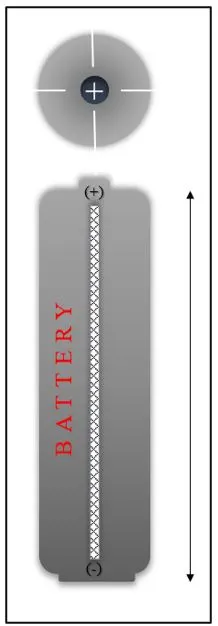
During cycles, the battery thickness changes for the three reasons -
- Expansion and contraction of host materials due to lithium intercalation.
- Electrode volume increase caused by irreversible reaction deposits.
- Dead volume and pressure changes within the cell case depending on battery structure and construction.
Weight Changes in Cell :
There will be minor changes in weight between fully charged and empty battery, this occurs because of (Einstein's) m = E/c^2 but this weight will be negligible. Energy is equivalent to mass and c2, the squared speed of light, is the conversion factor.
- The total mass of a battery increases when the battery is charged and decreases when it is discharged.
- Lead-acid batteries, used in internal combustion automobiles and in many electric vehicles like electric forklifts, golf carts, etc. are heavy because they use lead, which is very dense.
- The battery is filled with a water-acid mix, which is also rather heavy.
- Increase in temperature may affect the battery weight.
- Deep charging may affect battery weight because the total mass of a battery increases when the battery is charged and decreases when it is discharged.
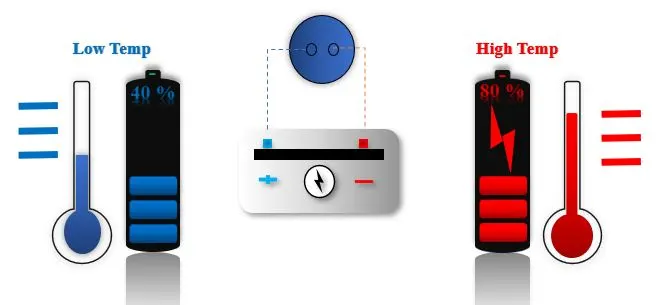
Also, the following Points are Responsible for that Situation -
Manufacturing Defects -
- Flaws in production can cause metallic particles (impurities) to seep into the lithium-ion cell during the manufacturing process. Battery manufacturers need to ensure stringently controlled cleanrooms for manufacturing batteries.
- Another defect could be the thinning of separators which could prove detrimental in actual use. Cells should undergo strict quality-control tests and validation before being sold.
Design Flaws -
- Car companies want to design their cars as sleek and slim while giving the maximum range and performance. These requirements push battery pack manufacturers to come up with compact designs by packing high-capacity cells into a smaller body, messing with an otherwise well-built battery.
- Compromising on the design can cause damage to the electrodes or the separator. Either of which could result in a short circuit. Further, the absence of a proper cooling system or vent can cause battery temperatures to rise as the flammable electrolyte heats up.
- If uncontrolled, it could result in a chain reaction of cell failures, causing the battery to heat up even more and spiral out of control.
Abnormal or Improper Usage -
- External factors like keeping the battery very close to a heat source or near a fire can cause it to explode. Penetrating the battery pack either deliberately or through an accident is bound to cause a short circuit and the battery to catch fire. That’s why unauthorized disassembly of the battery pack in electric vehicles leads to the lapse of warranty.
- Users are advised to only get the batteries checked and repaired from the car maker’s authorized service centers. Even high-voltage charging or excessive discharging of the battery could damage it.
Charger Issues -
- Using poorly insulated chargers can damage the battery. If the charger shorts or generates heat near the battery, it can do enough damage to cause failure.
- While lithium-ion batteries have built-in protections to stop them from overcharging, using unofficial chargers can damage the battery in the long term.
Low-quality components -
- In addition to manufacturing defects, using low-quality components is one of the highest causes of battery failures. Increasing competition is driving the prices of batteries down, causing battery manufacturers to cut corners where they shouldn’t. By skimping on poor quality electronics like the battery management system, the risk of battery failure increases.
- The battery management system is critical to battery safety and performance. It protects the battery pack from operating outside of its safe operating area.
- As batteries form a high-value component of an electric vehicle or energy storage system, it’s essential to invest in a smart battery management system that can detect cell failures immediately and prevent the battery from exploding.
STUDY - 3 :
The Various Mechanical Testing and Standards :
Mechanical Testing of Battery :
Typical tests are included in the safety standards below. They include simple tests for dimensional accuracy to dynamic testing to verify that the product can survive any static and dynamic mechanical stresses to which it may be subject.
Mechanical tests at different states of charge and environmental conditions depend upon -
- Crush Tests
- Nail Penetration Tests
- Shock Test
- Vibration Test
- Impact Test
- Drop Test
Crush Tests :
- Battery crush tester simulation of several types of power lithium batteries in the procedure of use, the battery suffered compression.
- The battery crush tester machine is used to simulate the squeezing situation of numerous power batteries. Individually battery sample cell is subjected to pressure only in one direction.
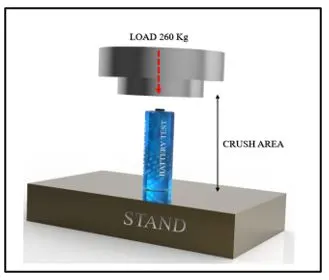
- A cylindrical or prismatic cell should have its longitudinal axis parallel to the plane of the extrusion device and be subjected to extrusion. Squeeze the battery between two flat plates. Extrusion pressure is applied by the hydraulic head of the piston.
Nail Penetration Tests :
- Nail penetration testing is a type of safety testing done to simulate internal short-circuiting.
- The sample battery is penetrated with a nail to simulate an internal short-circuit and verify that the battery does not catch fire or burst.
Shock Test :
- Shock tests are used to measure the impact of sudden acceleration caused by a collision, drop, or explosion to simulate the conditions a product can face in its lifetime.
Vibration Test :
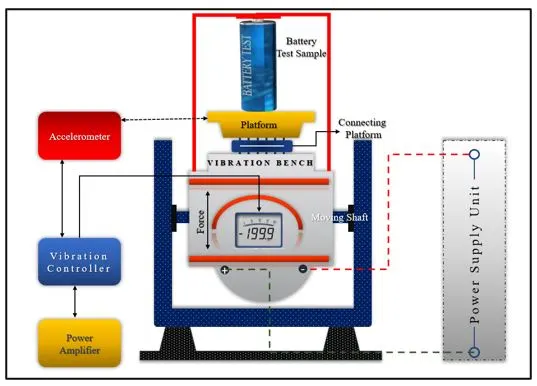
- The vibration test of batteries can also be performed as a random test or as a sinusoidal test. The random vibration test is matching to the test described in SAE J2380.
- The sinusoidal test starts with excitation with 2000 cycles at a fixed frequency between 10 and 30Hz. Vibration testing is essential during product development.
Impact Test :
- An impact test is a mechanical stress test to observe the response of a Li-ion cell after a sudden and measured force. The purpose of impact testing is to determine the safe prevention of fire or explosion after an object disrupts the cell.
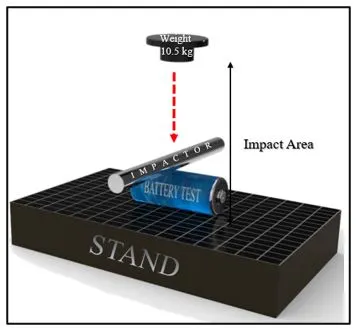
- An impact test is a mechanical stress test in which a rigid object, such as a steel rod, is placed on a test specimen and a load is dropped on the steel rod.
Drop Test :
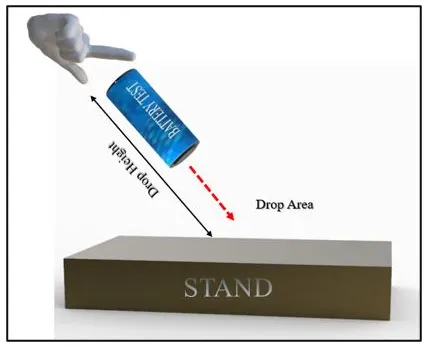
- Drop test of battery (with the flat, negative end down) is done from some height to check its charge life.
- If the battery is charged, it should make a solid knock and most likely stay standing. If the battery is dead, then it will bounce and fall over immediately.
Lithium-Ion Battery Standards :
- Many organizations have established standards that address lithium-ion battery safety, performance, testing, and maintenance.
- Standards are norms or requirements that establish a basis for the common understanding and judgment of materials, products, and processes.
- Standards are an invaluable tool in industry and business, because they streamline business practices and provide a level playing field for businesses to develop products and services. They are also critical to ensuring that products and services are safe for consumers and the environment.
- A number of standards have been developed for the design, testing, and installation of lithium-ion batteries.
- The internationally recognized standards listed in this section have been created by the International Electrotechnical Commission (IEC), Underwriters Laboratories (UL), the Japanese Standards Association (JSA), and others.
- These standards have been selected because they pertain to lithium-ion Batteries and Battery Management in stationary applications, including uninterruptible power supply (UPS), rural electrification, and solar photovoltaic (PV) systems. These standards should be referenced when procuring and evaluating equipment and professional services.
International Electrotechnical Commission (IEC) :
Performance -
- IEC 61960 : Secondary cells and batteries containing alkaline or other non-acid electrolytes - Secondary lithium cells and batteries for portable applications - Part 3: Prismatic and cylindrical lithium secondary cells and batteries made from them.
Safety -
- IEC 62133-2:2017 : Secondary cells and batteries containing alkaline or other non-acid electrolytes - Safety requirements for portable sealed secondary lithium cells, and for batteries made from them, for use in portable applications - Part 2: Lithium systems.
- IEC 62281:2019 : Safety of primary and secondary lithium cells and batteries during transport.
Testing -
- IEC 61959:2004 : Secondary cells and batteries containing alkaline or other non-acid electrolytes - Mechanical tests for sealed portable secondary cells and batteries.
Underwriters Laboratories (UL) :
Safety -
- UL-1642, 5th Edition : Standard for Lithium Batteries.
- UL-9540, 2nd Edition : ANSI/CAN/UL Standard for Energy Storage Systems and Equipment.
Testing -
- UL-9540A, 4th Edition : ANSI/CAN/UL Standard for Test Method for Evaluating Thermal Runaway Fire Propagation in Battery Energy Storage Systems.
- UL-1973, 2nd Edition : ANSI/CAN/UL Standard for Batteries for Use in Stationary, Vehicle Auxiliary Power and Light Electric Rail (LER) Applications.
- UL-1974, 1st Edition : ANSI/CAN/UL Standard for Evaluation for Repurposing Batteries.
Japanese Standards Association (JSA) :
- JIS C 8715-2 : Secondary Lithium Cells and Batteries for Use in Industrial Applications - Part 2: Tests and requirements of safety.
STUDY - 4 :
The Discard Procedure Suggested Generally for used Lithium-Ion Batteries :
- The superior performance characteristics of lithium-ion batteries enhance the performance of our electronic devices. However, the handling of lithium-ion (li-ion) batteries during the end-of-life phase of electronic products requires additional attention. If batteries are handled incorrectly, there is a higher risk of fire, pollution and other negative effects.
- Every lithium-ion battery has li-ion as an identification mark on it. This can be inscribed in the material or placed on the battery as a sticker.
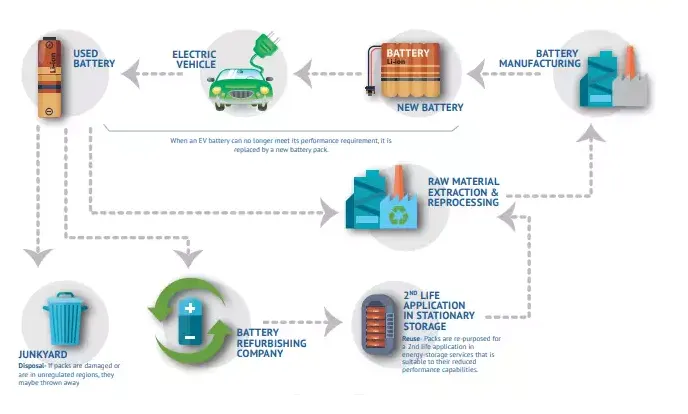
- Lithium-ion batteries are recyclable, but they don’t go in the recycling bin. The purpose of recycling lithium-ion batteries is to avoid toxic electronic waste from clogging the landfills and to use the retrieved materials in the fabrication of new products.
- Lithium-ion batteries used in electric vehicles have a shelf life of less than ten years. After a 5 to 8 year usage period, the power generated by the batteries is not enough for an EV to achieve the desired range.
- Once the drop-in capacity is below 70-80 percent; they could still be used in other applications such as in households or energy backups while on the other hand, recycling of lithium-ion batteries helps to recover the metals - cobalt, lithium, nickel, and others.
- According to JMK Research estimates, the lithium-ion battery market in India is expected to increase from 2.9 GWh in 2018 to about 132 GWh by 2030 at a CAGR of 35.5 percent. The increasing volume of lithium-ion batteries, would in turn lead to a growing capacity of ‘spent’ batteries in the ecosystem. The annual recycling market is expected to be around 22 - 23 GWh, which is a $1,000 million opportunity.
- The research estimates that the recycling market in India will start picking up from the year 2022 onwards when batteries presently in use in electric vehicles would reach their end of life.
- The heavy reliance on imports of battery metals is one of the main reasons why India is still not a scale manufacturer of lithium-ion batteries. To bring down the imports and make battery manufacturing sustainable it is necessary to invest early in large scale recycling infrastructure.
- Further, the changing international and political relations with countries owning natural reserves of these key metals and raw materials and fluctuating prices of raw material in global markets could also impact the battery prices in India. An increase in the price of batteries could increase the already high cost of electric vehicles and be a hindrance to the sale of EVs.
- Many Indian companies have already started looking at this lucrative opportunity and have either already established or announced plans to set up recycling operations.
- MG Motor and Hyundai which have launched their electric cars- ZS EV and Kona Electric in the Indian market already have institutional partners for battery waste disposal. MG partnered with Umicore, a lithium battery recycling solutions provider, for effective life cycle management of the batteries used in the e-ZS electric vehicle.
- In August 2019, Tata Chemicals launched its lithium-ion battery recycling operations in Mumbai. The operations, launched at the pilot-scale, could recycle the spent batteries successfully. Mahindra Electric also had expressed its plans to enableEV battery recycling, in a method similar to the recycling of cell phone batteries, with the help of a supply partner.
How to Properly Recycle lithium-ion Batteries :
- Remove the battery from the device if possible.
- Store batteries in a cool, dry place such as a plastic container.
- If the batteries are physically damaged, store them in an insulated plastic bag to avoid any short-circuiting.
- Recycle your batteries in a local battery drop-off bin or at a recycling centre.
What to Avoid when Recycling lithium-ion Batteries :
- Do not throw out batteries in your regular household garbage or recycling bin.
- Do not burn batteries in a fire, they may explode.
- Don’t mix damaged, and non-damaged batteries.
- Avoid storing batteries in metal containers.
- Don’t store batteries for a long period of time.
CONCLUSION :
- Successfully differentiated between nominal voltage and maximum voltage.
- Discussed Under which situation we observe the changes in dimensions and weight of a cell.
- Listed out various mechanical testing and standards.
- Discussed about the discard procedure suggested generally for used Li-Ion batteries.
REFERENCES :
https://www.ineltro.ch/media/downloads/SAAItem/45/45958/36e3e7f3-2049-4adb-a2a7-79c654d92915.pdf
https://electronics.stackexchange.com/questions/93892/maximum-charging-voltage-for-li-ion-battery
https://www.sciencedirect.com/science/article/abs/pii/S0378775303002817
https://www.ionenergy.co/resources/blogs/battery-safety/
https://www.mpoweruk.com/testing.htm
https://www.usaid.gov/energy/powering-health/technical-standards/lithium-ion-batteries
https://cleanriver.com/how-to-safely-dispose-recycle-lithium-ion-batteries/