To plan a structural layout and to create grids using TSD
- Summarize the user interface in TSD
AIM:-Summarize the user interface in TSD with the for the following items:-
-
Project Workspace
-
Scene Content
-
Create Two scene views
-
Loading drop list
- Properties window
INTRODUCTION:- User interface in TEKLA STRUCTURAL DESIGN consist of:-
- Quick Access Toolbal which includes access to various tools like save, open a certain file, redo, undo and even delate a certain element.
- Ribbon Tools which various tools for modelling, analyzing and designing of steel, concrete and composite structures. It also includes tools for BIM integration and report development.
- Project Workspace
- Scene Content
- Property Window
- Load list
PROCEDURE:-
- Project Workspace- how to access and usage :-
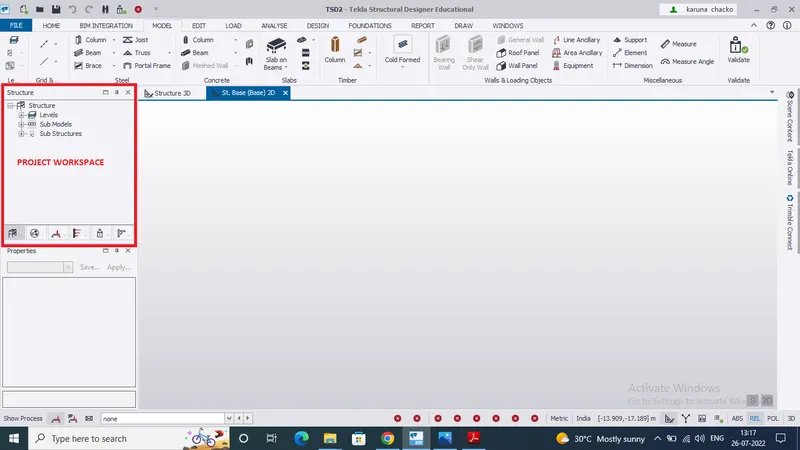
- Open the TEKLA STRUCTURAL DESIGN 2022 software from desktop.
- The one thatis highlighted in red in the picture above is the Project Workspace
- It is a space on the scene which gives all the information on the model about the number of construction levels, loading, winding and status.
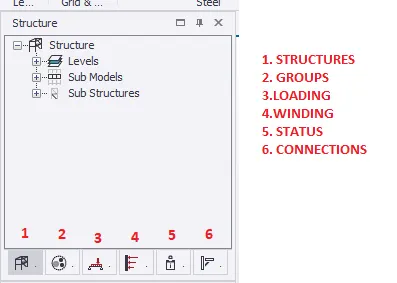
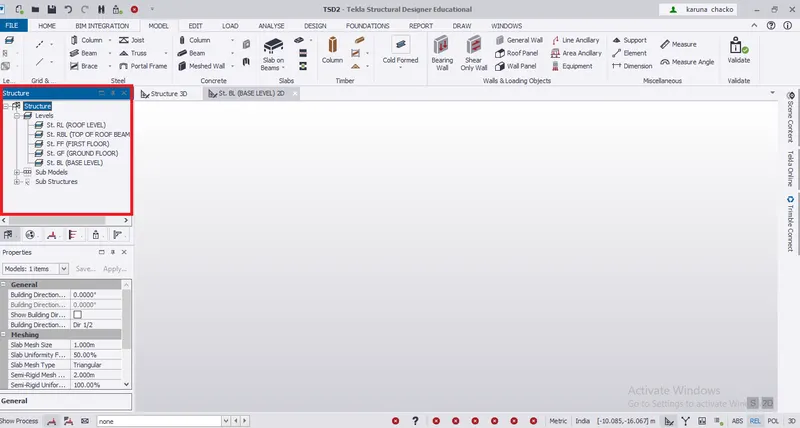
- On clicking Structure icon, it gives information of each construction levels from base level to roof level and also on architectural grid lines and sub-structures.
- In Loading icon, it provides information on total load cases and reaction summary of load combinations.
- In Wind icon, the list gives the wind direction, load cases including wind load,and pressure zone.
- Status gives status on modelling, analysis and design of the structure.
B. Scene Content
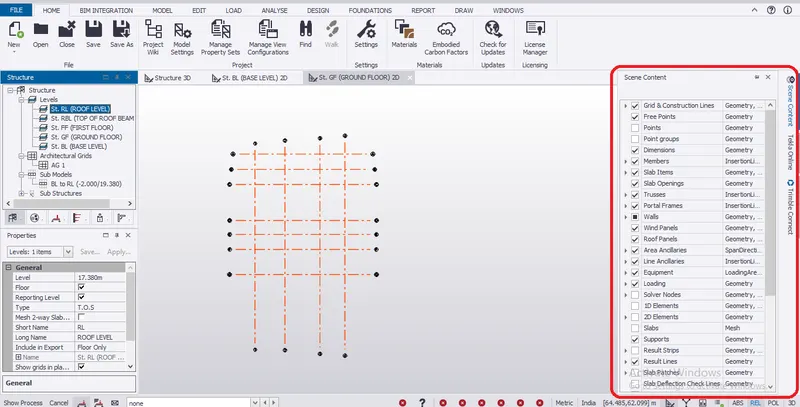
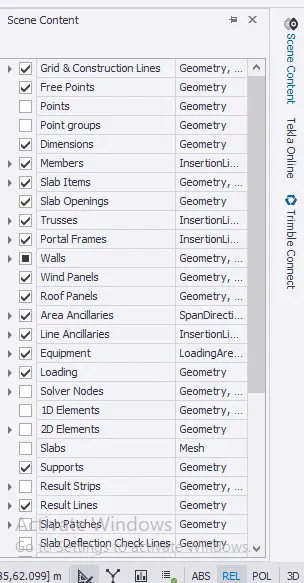
Scene content displays the model in use, that is, it diplays each member of structure on selecting the particular member. For example, on unticking the grid and construction line in the scene content, we can observe that the grid and constructin lines are hidden.
Similarly, to hide beams or columns of the complex structure, we need to untick the option and just to highlight any particular member just tick the option required.
C. CREATE TWO SCENE VIEWS
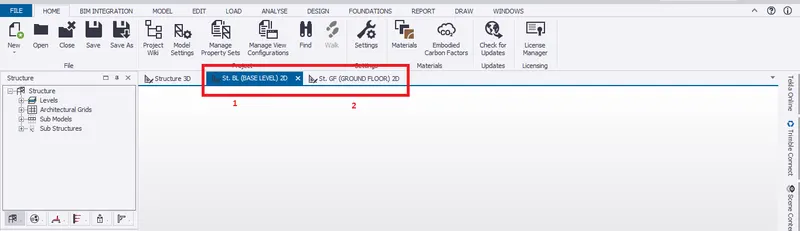
To create two scene view, we must first specify the construction level and its level difference in the Model tool. Thereby creating two levels in scene view. in picture below, we can view two scene view:- one is base level and other is ground floor level.
D. LOADING DROP LIST
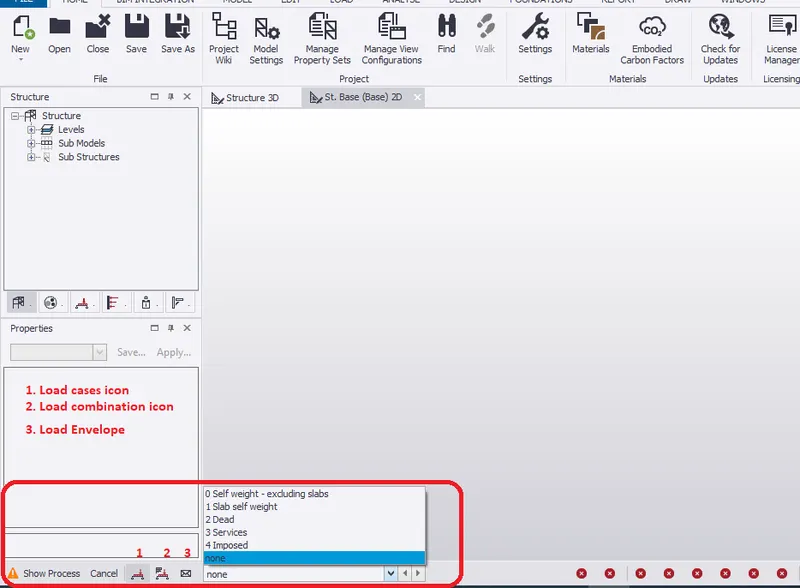
This loading list shows list of all primary loads (ie, self weight, dead load, live load, seismic load and wind load), combination of load cases and load envelope.
E. PROPERTIES WINDOW
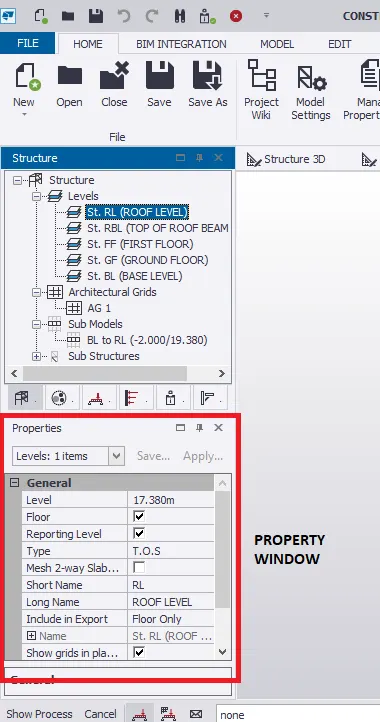
It shows the various properties on selecting each member. For example, on selecting a beam its varoius properties like size, material used , grade of the material, reinforcement details etc are been described in this window
RESULT:- Hence, following user interface in TSD is summarised:-(i) Project Workspace; (ii) Scene Content; (iii) Create Two scene views; (iv) Loading drop list; (v) Properties window
II. CREATE A NEW FILE IN TSD AND SET UP THE SETTINGS FOR A STEEL BUILDING TO HAVE MEMBER GRADE FE 410 AND CONCRETE GRADE OF M30 AS PER IS CODES. THE COVERS FOR THE MEMBERS TO BE AS PER THE FOLLOWING INPUT:-
|
MEMBERS |
IN CONTACT WITH GROUND |
ABOVE GROUND |
|
Column |
50mm |
40mm |
|
Slab |
30mm |
25mm |
|
Pile cap |
75mm |
|
|
Foundation |
50mm |
AIM:- To create a new file in TSD and set up th settings for a steel building to have member grade Fe 410 and concrete grade of M30 as per IS codes.
INTRODUCTION:-TEKLA STRUCTURAL DESIGN software is used for modelling, analyzing and designing of structural building which could be steel, concrete or composite structure. before modelling any structure, as we open a new file we need to set the Settings which includes general information like country name in which the structure is to be constructed, standard codes to be adopted for design requirements, standard unit, information on steel, concrete and reinforcements, loading and analysis, etc.
PROCEDURE:-
- Open the TEKLA STRUCTURAL DESIGN 2022 software on the desktop. A workspace appears on the screen.
- Create a new file by clicking the icon NEW.
- Under HOME tab, go to SETTINGS a table appears on the screen as shown in the picture below.
- Choose India settings (active) to follow Indian Standards for the required steel structure.
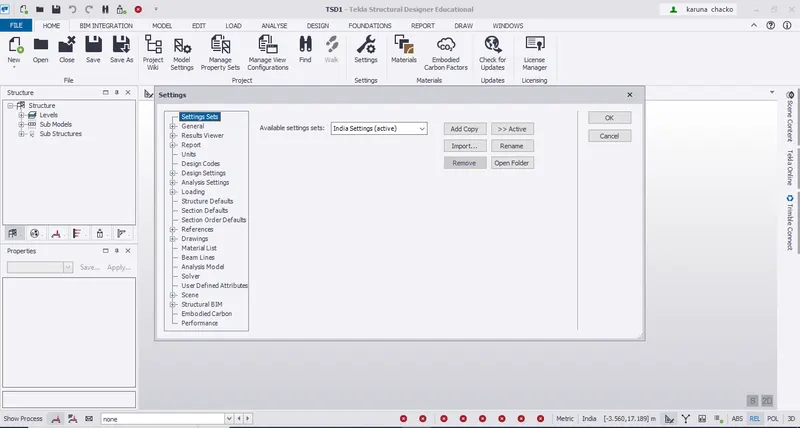
- Check IS codes as per requirement in Design Codes. Click OK.
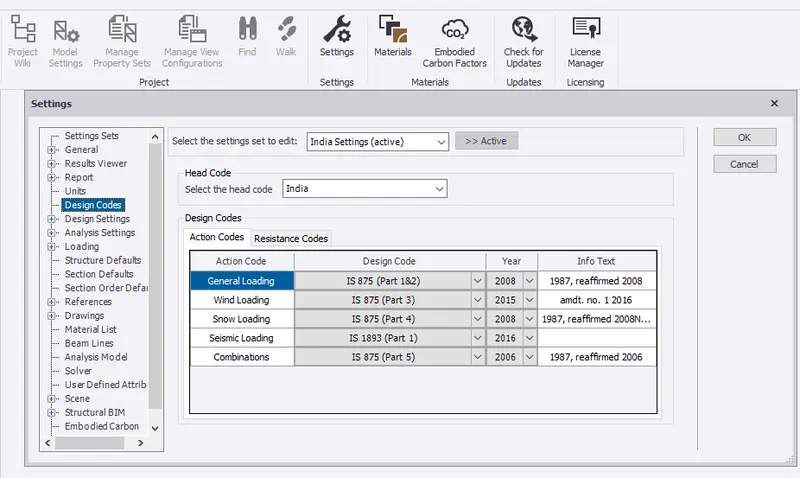
Set Fe 410 grade Steel for the Steel Structure
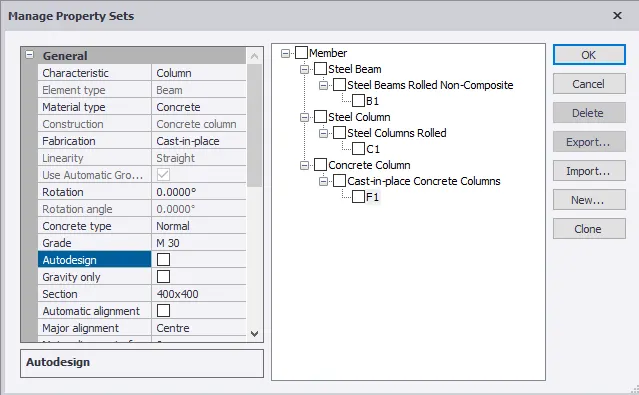
- Under HOME, go to Manage Properties Sets.
- Click NEW on the right hand side of the window appeared.
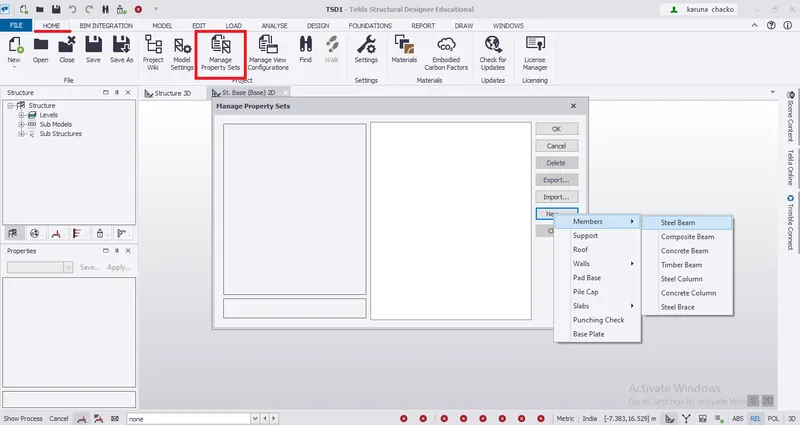
- Select Members, choose steel beams
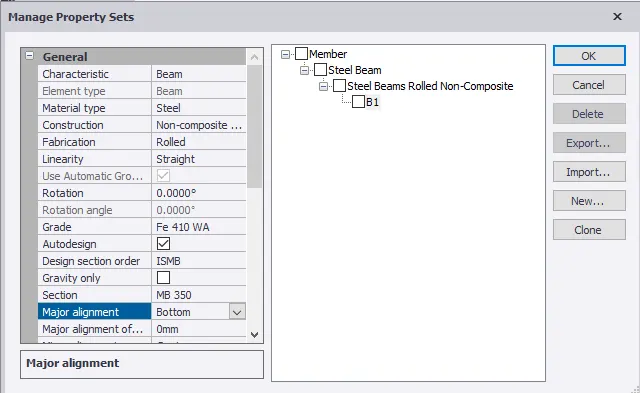
- Rename STEEL BEAM ROLLED NON COMPOSITE member to B1.
- Set grade of steel as Fe 410 WA. Turn off Auto design.
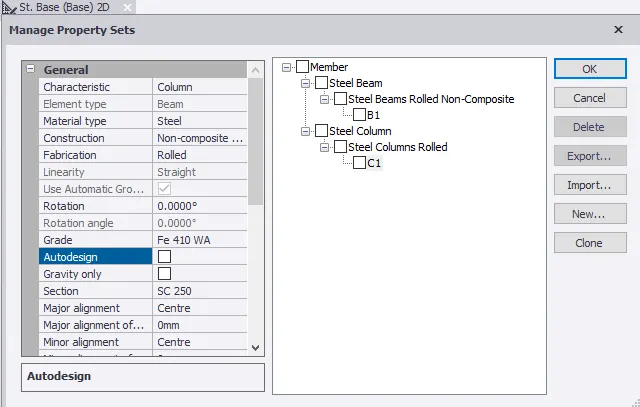
- Similarily, to set properties for steel column for the steel building.
- Rename STEEL COLUMN ROLLED as C1 and set grade of steel as Fe 410 WA. Turn off AUTO DESIGN.
Set M30 grade concrete for Foundation
- Similarily, to set M30 grade of concrete for design of foundation/pile/ padestal footing.
- Go to MANAGE PROPERTY SETS, click on NEW.
- Select MEMBERS and choose concrete column. Rename to F1.
- Select grade of concrete as M30.
- Turn off Auto Design.
- Scroll down to set noimnal cover to 50mm
- Specify section size as per the requirement.
- Click on OK.
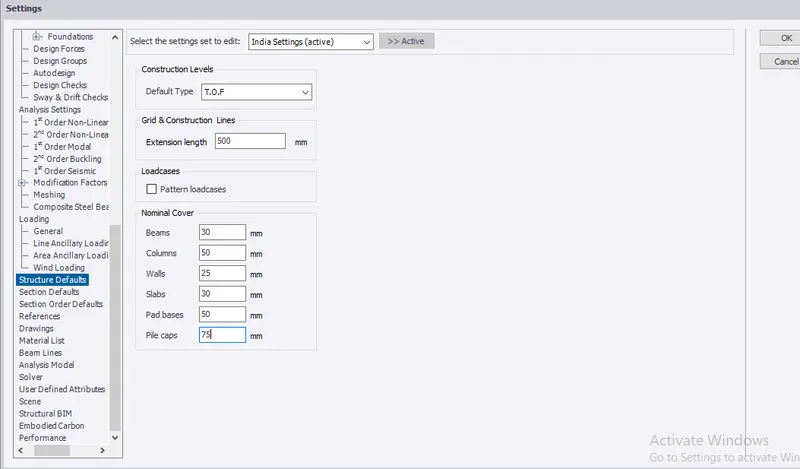
To set Covers for the Member In contact with Ground
- In HOME, go to SETTINGS
- Select Structural default.
- Choose TOF as default type in Construction Level.
- Set nominal cover as 50 mm for columns, 30 mm for slabs, 75 mm for pile caps.
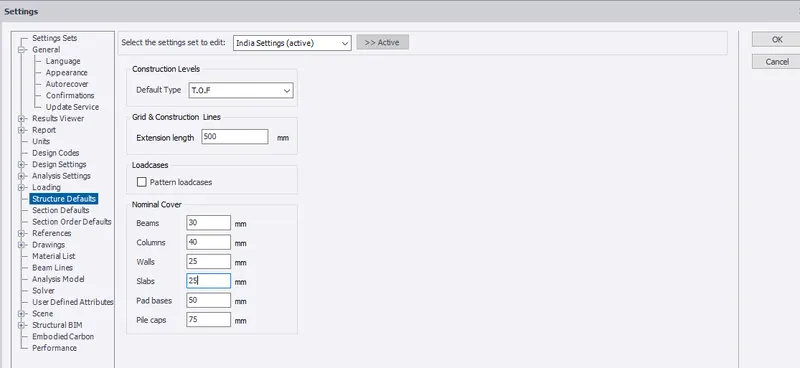
To set Covers for the Member above the Ground
- To set nominal cover as 40 mm for columns, 25 mm for slabs
- Go to HOME, select SETTINGS
- Select Structural default.
- Choose TOF as default type in Construction Level.
- Set nominal cover as 40 mm for columns, 25 mm for slabs, 75 mm for pile caps.
RESULT:-
- Properties of the Steel structure is set to steel grade of Fe 410 and concrete grade of M30 as per IS codes.
- Various members in contact with ground such as column, slab and pile cap is provided with cover of 50 mm, 30mm and 75mm respectively.
- Also, various members above ground such as column, slab and pile cap is provided with nominal cover of 40 mm, 25mm and 75mm respectively.
III. With reference to the input drawing as per Attachment 1, 1.1, and 1.2 and study the steel building plan and summarize your understanding of the plan. Based on your study assume and explain the location of columns and beam and develop a hand sketch for each plan
AIM:- To summarize the understanding of the plan given in the input drawing as per Attachment 1, 1.1, and 1.2. Also, to assume and explain the location of columns and beam and develop a hand sketch for each plan.
INTRODUCTION:- Every structure consist of slabs, beams, columns and foundation where the beams supports the slab either one- way or two way depending on slab length. Thereby, the either sides of the beam are supported by column where the column load is taken the foundation.
PROCEDURE:-
Summarize the understanding of the given plan in Attachment 1, 1.1, and 1.2.
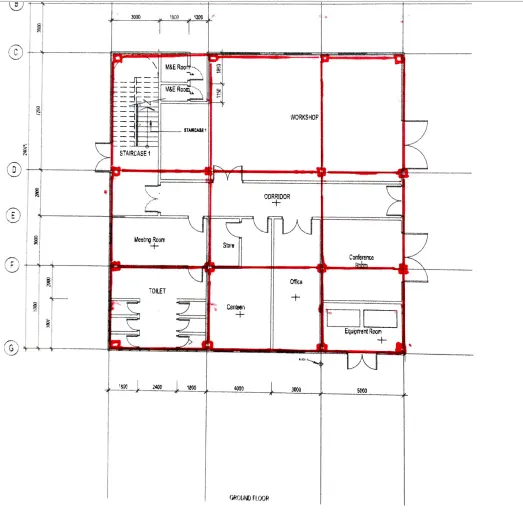
- Attachment 1(Ground Floor)
- Attechment 1 is the ground floor of the steel building with grid lines provided from A to G along Y direction and 1 to 4 along X direction.
- Position of Columns are provided from C to G and from 1 to 4 as shown in the attachment below/ picture below.
- Secondary beams can provided because of larger span length of the slab. By providing secondary beams, the slabs can be considered as one- way slab (ie, ly/lx>2). In picture, secondary beams are provided the middle of grid line 1-2 which supports the staircase slab as well.
- Similarly, secondary beams can provided between grid line 2-3 at a distance 4m from grid 2.
- On the grid F-5, there is a hinderence of door, which is needed to be arranged.
B. Attachment 1.1 (First floor)
- Level difference from ground floor to first floor is 5.2m
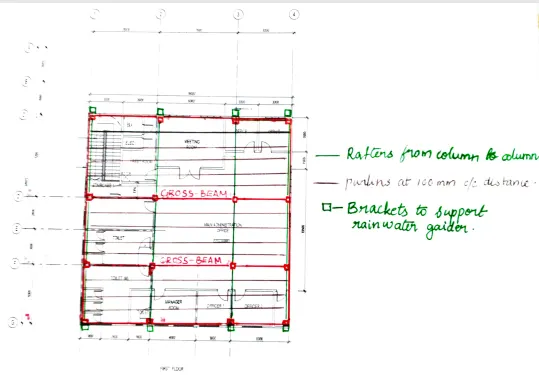
- Position of column and beam are provided in the pdf attachment below/ picture below.
- Rafters are provide from column to column along grid line 1,2,3 and 4 parallel to sloping roof.
- Brackets are provided beneath rainwater collector to collect the rainwater from the sloping roof.
- Purlins can be provided at 100mm intervals to support the rafters.
- Tie beams are provided above the colums.
C. Attachment 1.2 (Section)
- Total height of the steel building is 16.88m where level difference from ground floor to first floor is 5.2m and that from first floor to top of roof beam is 6.8m. The height difference from top of the roof beam to top of the roof is 4.88m.
- Metal cladding loads are used for construction of steel building.
- Bracing can be provided along the sides of the metal cladding to resist lateral forces.
RESULT:- Studied the steel building plan From the Attachment 1, 1.1, and 1.2 and summarized and explained the location of columns and beam and therefore, developed a hand sketch for each plan with is attached in pdf format below/ above picture.
IV. Model grid lines and construction levels as per Attachment 1. 1.1 and 1.2.
AIM:- To model grid line and construction level as per the Attachment 1,1.1 and 1.2 requirement.
INTRODUCTION:- Construction level gives an information on number of levels that we need to constuct in the structural design, whereas, grid line gives an easy way to arrange beams and columns in each level.
PROCEDURE:-
CONSTRUCTION LEVELS
- Create a new file by clicking NEW.
- Go to MODEL from ribbon tool.
- Click on CONSTRUCTION LEVELS

- Following tab appears on the screen.
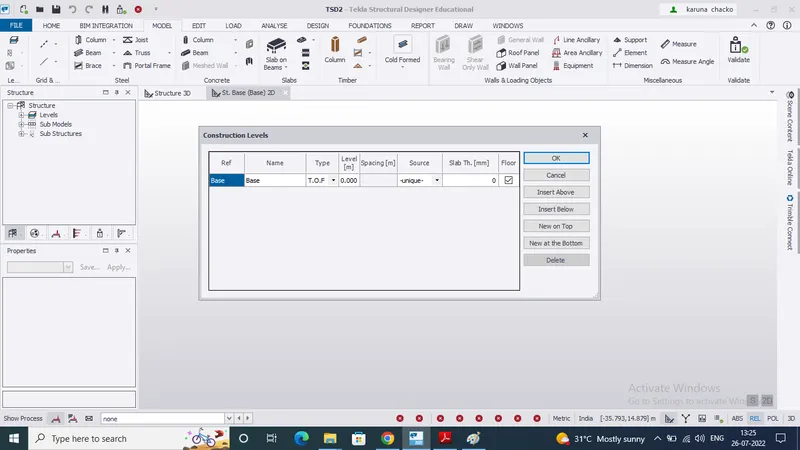
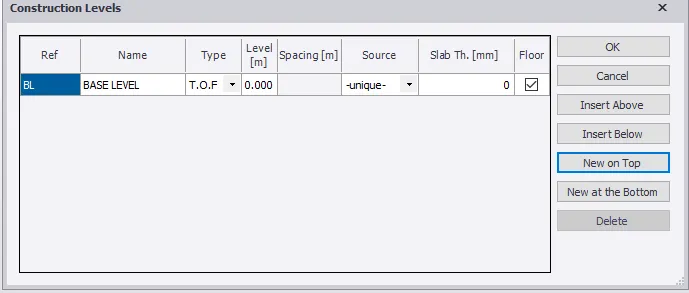
- Rename base as base level with reference as BL
- Set BL type as Top of Foundation (TOF) at 0.00m level.
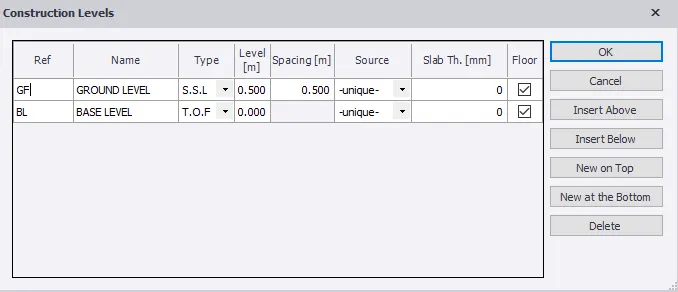
- To create a ground floor above foundation.
- To insert ground level, click on Insert Above of the tab to add an another level.
- Rename from 1 to ground floor and refer it as GF.
- Since ground floor is above foundation, set GF as Structural Slab Level (SSL) at level 0.5m.
- Similarily, click on insert above of the tab to create a first floor level above the ground floor as per the Attachment 1.2.
- Set level type as SSL at a spacing of 5.2m from the ground floor.
- Similarily, click on insert above to create top of beam level at a level of 6.8m above first floor and top of roof level at a spacing of 4.88m from the top of beam level as per the Attachment 1.2.
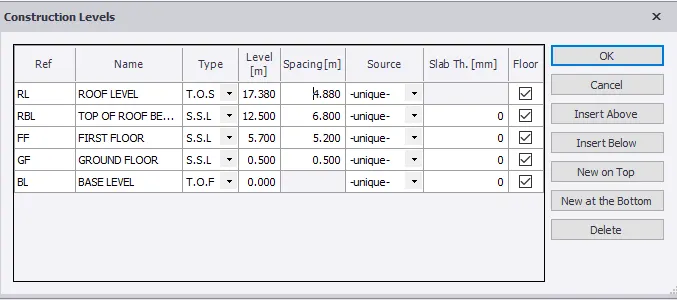
- Click on OK to get Construction Levels on the project workspace as shown below.
GRID LINES
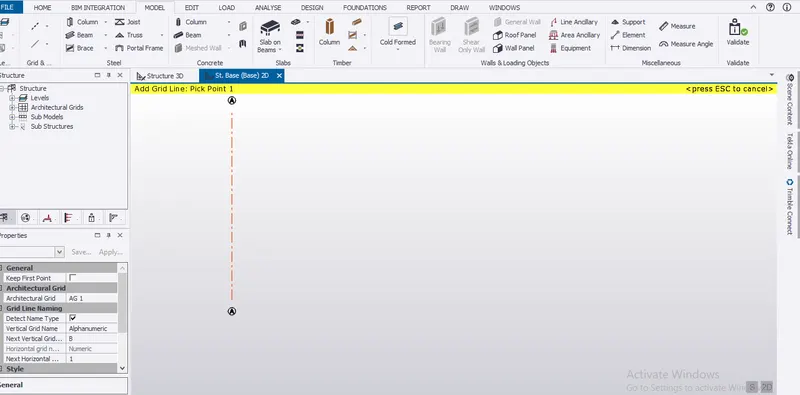
- Go to MODEL, click on the GRID LINE icon from the ribbion tools.

- Add a grid line by picking a point on the scene view on the screen. Drag from the point and pick an another point on the view screen.
- To form parallel grid line, select the drop arrow of the grid line.
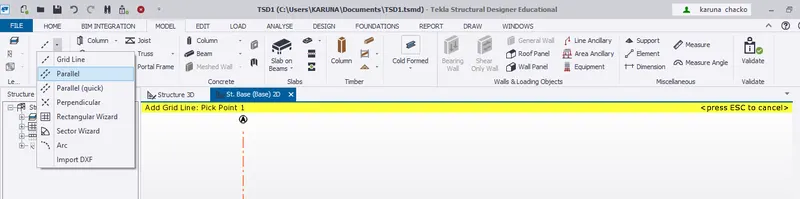
- Select the referance grid line in the scene view. Specify the distance,that is 6m from the referance grid line.
- Similarily, specify the third and fourth parallel line by 7m and 5m from second and third line in the scene view.
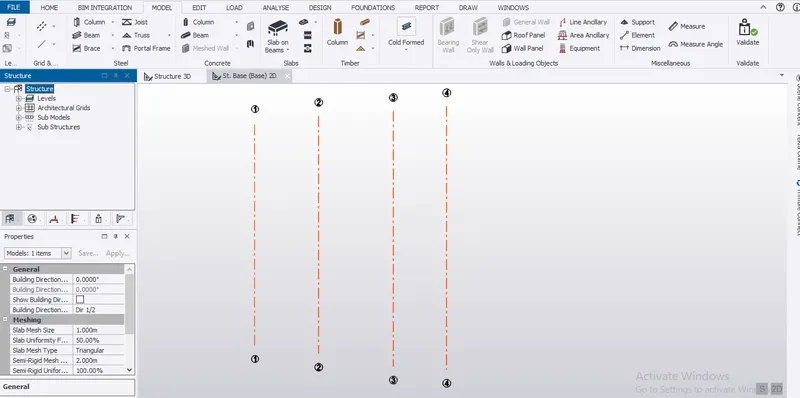
- From the grid line icon, choose the perpendicular grid line.
- Select the referance grid line 1-1, pick a point perpendicular to grid line 1-1.
- Pick the start point of the line and the end point which passes the the four grid line.
- Rename this grid line as A-A
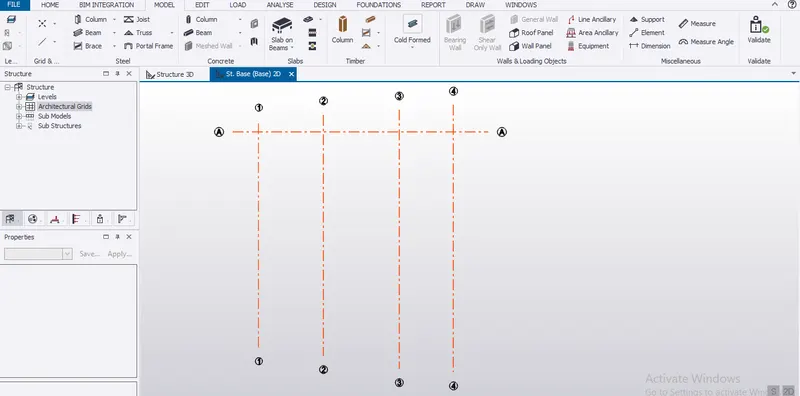
- Similarly, construct gridline parallel to gridline A-A by selecting parallel gridline icon.
RESULT:- As per the requirement, modelling of Grid line and construction line is completed for all the floor levels.
GRID LINE FOR FLOUNDATION LEVEL
GRID LINE FOR GROUND FLOOR LEVEL