Supervised Learning - Classification Week 9 Challenge
Supervised Learning - Classification Week 9 Challenge
1.What is a Neural Network?
Neural networks, also known as artificial neural networks (ANNs) or simulated neural networks (SNNs), are a subset of machine learning and are at the heart of deep learning algorithms. A neural network is a method in artificial intelligence that teaches computers to process data in a way that is inspired by the human brain. It is a type of machine learning process, called deep learning, that uses interconnected nodes or neurons in a layered structure that resembles the human brain. It creates an adaptive system that computers use to learn from their mistakes and improve continuously. Thus, artificial neural networks attempt to solve complicated problems, like summarizing documents or recognizing faces, with greater accuracy.Neural networks can help computers make intelligent decisions with limited human assistance. This is because they can learn and model the relationships between input and output data that are nonlinear and complex.
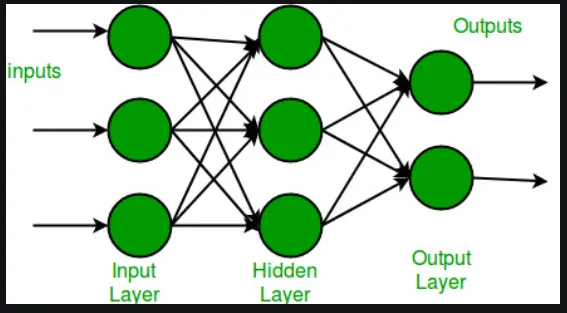
Artificial Neural Network (ANN) has only three layers – the input layer, the output layer, and a hidden layer.
Neurons take input, process it, and pass it on to other neurons present in the multiple hidden layers of the network, till the processed output reaches the Output Layer.
2.What is deep learning?
Deep learning, also known as hierarchical learning, is a subset of machine learning in artificial intelligence that can mimic the computing capabilities of the human brain and create patterns similar to those used by the brain for making decisions. In contrast to task-based algorithms, deep learning systems learn from data representations. It can learn from unstructured or unlabeled data.
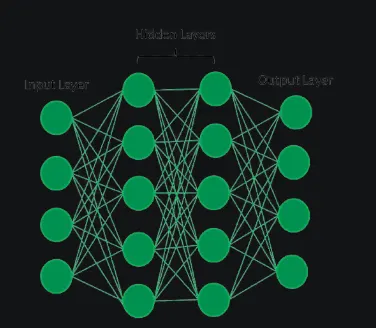
A neural network with multiple hidden layers and multiple nodes in each hidden layer is known as a deep learning system or a deep neural network. Deep learning is the development of deep learning algorithms that can be used to train and predict output from complex data.
The word “deep” in Deep Learning refers to the number of hidden layers i.e. depth of the neural network. Essentially, every neural network with more than three layers, that is, including the Input Layer and Output Layer can be considered a Deep Learning Model.
3.What is the role of the activation function?
An Activation Function decides whether a neuron should be activated or not. This means that it will decide whether the neuron’s input to the network is important or not in the process of prediction using simpler mathematical operations. The purpose of the activation function is to introduce non-linearity into the output of a neuron. The neural network has neurons that work in correspondence with weight, bias, and their respective activation function. In a neural network, we would update the weights and biases of the neurons on the basis of the error at the output. This process is known as back-propagation. Activation functions make the back-propagation possible since the gradients are supplied along with the error to update the weights and biases.
A neural network without an activation function is essentially just a linear regression model. The activation function does the non-linear transformation to the input making it capable to learn and perform more complex tasks.
4. What are the different types of activation functions?
The different types of activation fuctions are;
- Regression - Linear Activation Function
- Binary Classification—Sigmoid/Logistic Activation Function
- Multiclass Classification—Softmax
- Multilabel Classification—Sigmoid
- Convolutional Neural Network (CNN): ReLU activation function.
- Recurrent Neural Network: Tanh and/or Sigmoid activation function.
1. Linear Activation Function:
The linear activation function, also known as "no activation," or "identity function" (multiplied x1.0), is where the activation is proportional to the input.The function doesn't do anything to the weighted sum of the input, it simply spits out the value it was given.
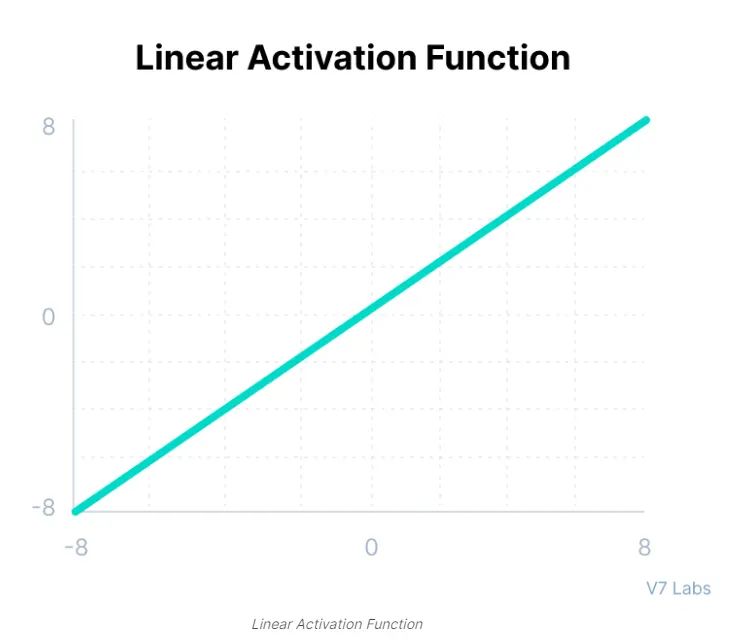
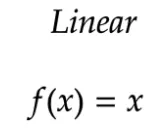
Linear activation function has two major problems :
- It’s not possible to use backpropagation as the derivative of the function is a constant and has no relation to the input x.
- All layers of the neural network will collapse into one if a linear activation function is used. No matter the number of layers in the neural network, the last layer will still be a linear function of the first layer. So, essentially, a linear activation function turns the neural network into just one layer.
2. Binary Step Function:
Binary step function depends on a threshold value that decides whether a neuron should be activated or not. The input fed to the activation function is compared to a certain threshold; if the input is greater than it, then the neuron is activated, else it is deactivated, meaning that its output is not passed on to the next hidden layer.
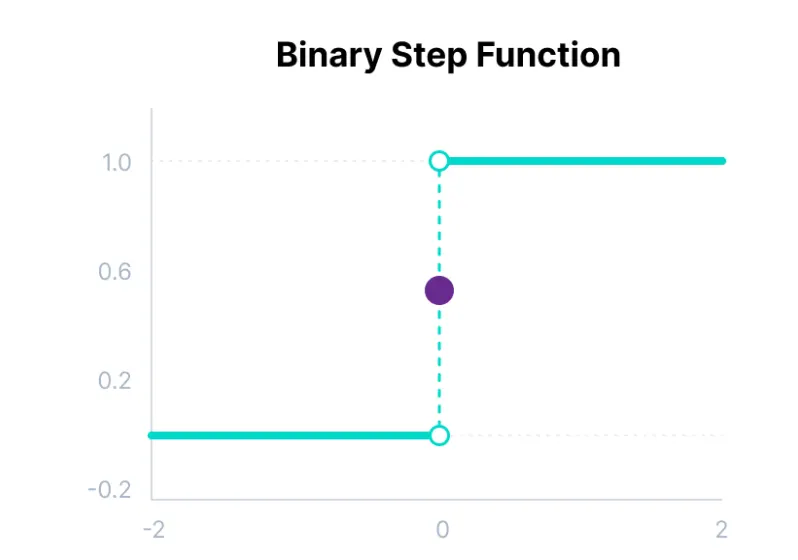
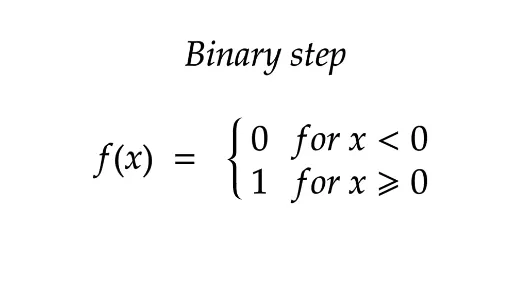
The limitations of binary step function:
- It cannot provide multi-value outputs—for example, it cannot be used for multi-class classification problems.
- The gradient of the step function is zero, which causes a hindrance in the backpropagation process.
3. Non-Linear Activation Functions:
The Nonlinear Activation Functions are the most used activation functions.It makes it easy for the model to generalize or adapt with variety of data and to differentiate between the output.
Non-linear activation functions solve the following limitations of linear activation functions:
- They allow backpropagation because now the derivative function would be related to the input, and it’s possible to go back and understand which weights in the input neurons can provide a better prediction.
- They allow the stacking of multiple layers of neurons as the output would now be a non-linear combination of input passed through multiple layers. Any output can be represented as a functional computation in a neural network.
4. Sigmoid / Logistic Activation Function:
This function takes any real value as input and outputs values in the range of 0 to 1.The larger the input (more positive), the closer the output value will be to 1.0, whereas the smaller the input (more negative), the closer the output will be to 0.0, as shown below.
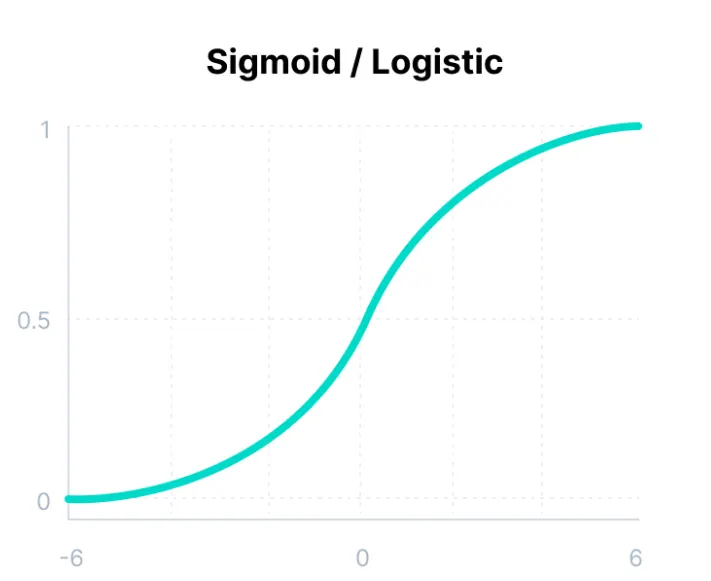
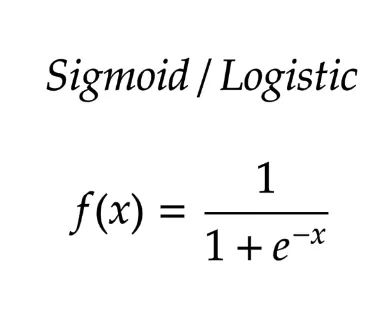
Sigmoid/logistic activation function is one of the most widely used functions:
- It is commonly used for models where we have to predict the probability as an output. Since probability of anything exists only between the range of 0 and 1, sigmoid is the right choice because of its range.
- The function is differentiable and provides a smooth gradient, i.e., preventing jumps in output values. This is represented by an S-shape of the sigmoid activation function.
The limitations of sigmoid function are discussed below:
- The derivative of the function is f'(x) = sigmoid(x)*(1-sigmoid(x)).
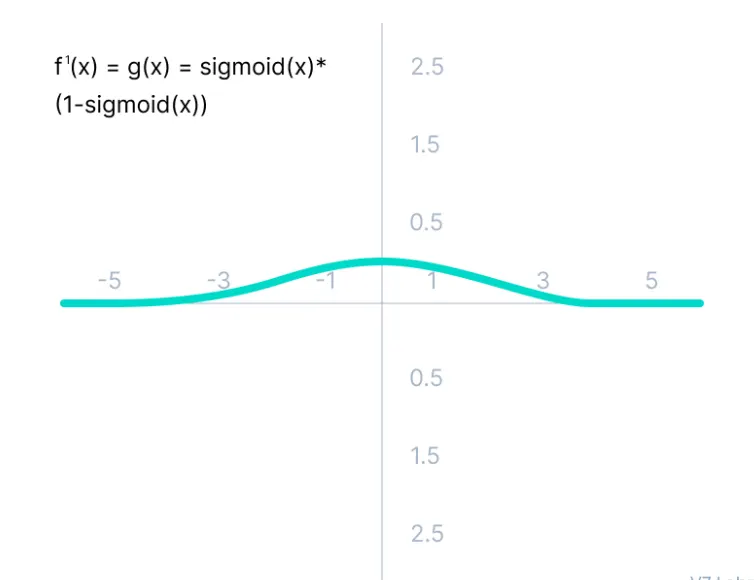
As we can see from the above Figure, the gradient values are only significant for range -3 to 3, and the graph gets much flatter in other regions.It implies that for values greater than 3 or less than -3, the function will have very small gradients. As the gradient value approaches zero, the network ceases to learn and suffers from the Vanishing gradient problem.The output of the logistic function is not symmetric around zero. So the output of all the neurons will be of the same sign. This makes the training of the neural network more difficult and unstable.
5. Tanh Function (Hyperbolic Tangent):
Tanh function is very similar to the sigmoid/logistic activation function, and even has the same S-shape with the difference in output range of -1 to 1. In Tanh, the larger the input (more positive), the closer the output value will be to 1.0, whereas the smaller the input (more negative), the closer the output will be to -1.0.
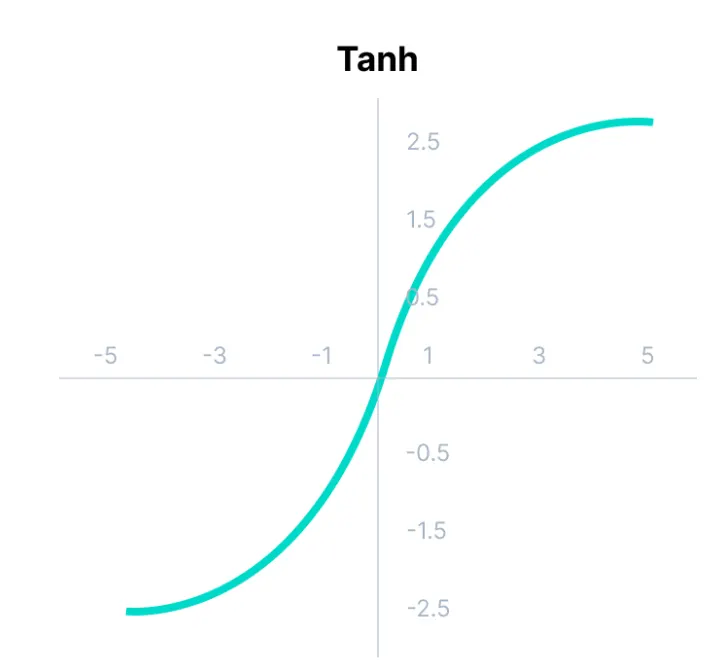
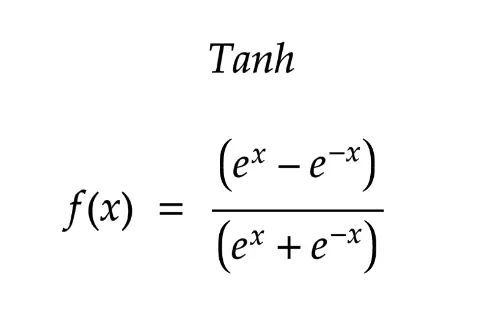
Advantages of using this activation function are:
- The output of the tanh activation function is Zero centered; hence we can easily map the output values as strongly negative, neutral, or strongly positive.
- Usually used in hidden layers of a neural network as its values lie between -1 to; therefore, the mean for the hidden layer comes out to be 0 or very close to it. It helps in centering the data and makes learning for the next layer much easier.
Both sigmoid and tanh face vanishing gradient issue, tanh is zero centered, and the gradients are not restricted to move in a certain direction. Therefore, in practice, tanh nonlinearity is always preferred to sigmoid nonlinearity.
6. ReLU activation function:
ReLU stands for Rectified Linear Unit.Although it gives an impression of a linear function, ReLU has a derivative function and allows for backpropagation while simultaneously making it computationally efficient.The main catch here is that the ReLU function does not activate all the neurons at the same time. The neurons will only be deactivated if the output of the linear transformation is less than 0.
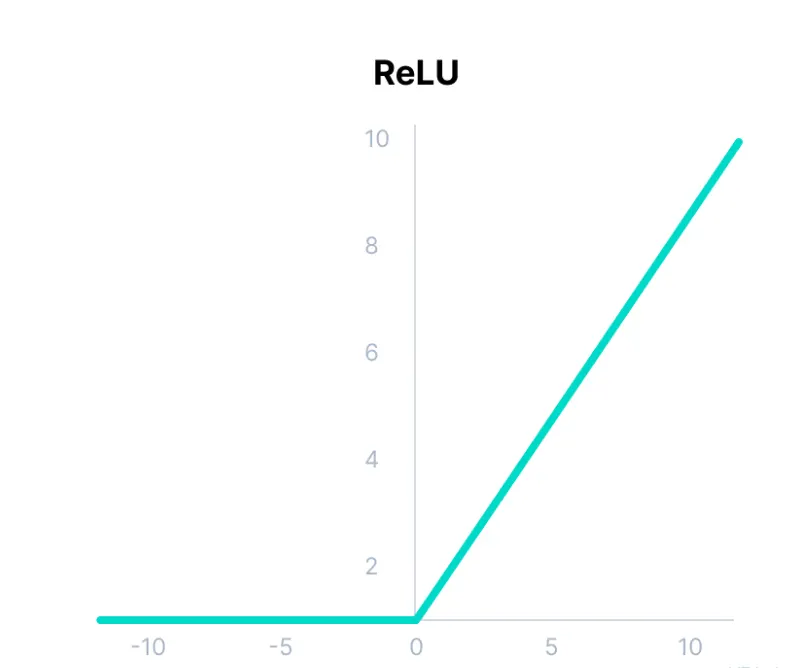
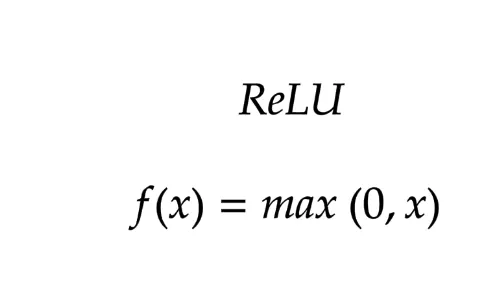
The advantages of using ReLU as an activation function are as follows:
- Since only a certain number of neurons are activated, the ReLU function is far more computationally efficient when compared to the sigmoid and tanh functions.
- ReLU accelerates the convergence of gradient descent towards the global minimum of the loss function due to its linear, non-saturating property.
The limitations faced by this function are:
The negative side of the graph makes the gradient value zero. Due to this reason, during the backpropagation process, the weights and biases for some neurons are not updated. This can create dead neurons which never get activated.
All the negative input values become zero immediately, which decreases the model’s ability to fit or train from the data properly.
6. Softmax:
The softmax function is also a type of sigmoid function but it is very useful to handle classification problems having multiple classes .
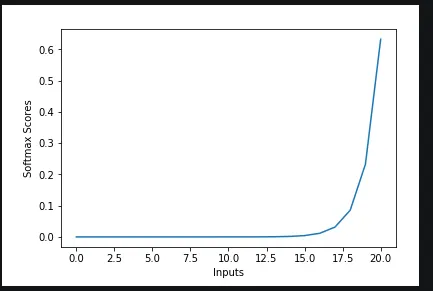
Usually used when trying to handle multiple classes. the softmax function was commonly found in the output layer of image classification problems.The softmax function would squeeze the outputs for each class between 0 and 1 and would also divide by the sum of the outputs. The softmax function is ideally used in the output layer of the classifier where we are actually trying to attain the probabilities to define the class of each input.
5.What do you understand by backpropagation?
Backpropagation, or backward propagation of errors, is an algorithm that is designed to test for errors working back from output nodes to input nodes. It is an important mathematical tool for improving the accuracy of predictions in data mining and machine learning.
Backpropagation is the essence of neural network training. It is the method of fine-tuning the weights of a neural network based on the error rate obtained in the previous epoch (i.e., iteration). Proper tuning of the weights allows you to reduce error rates and make the model reliable by increasing its generalization.Backpropagation in neural network is a short form for “backward propagation of errors.” It is a standard method of training artificial neural networks. This method helps calculate the gradient of a loss function with respect to all the weights in the network.