Supervised Learning - Classification Week 7 Challenge
1.
|
PROS |
CONS |
|
It is highly accurate |
Its speed is low |
|
It can handle many features |
It requires more time to process |
|
Works well even in small sets |
Separates only 2 classes |
2. Applying SVM
from sklearn import datasets, linear_model
import numpy as np
import pandas as pd
import seaborn as sns
import matplotlib.pyplot as plt
import warnings
warnings.filterwarnings("ignore")
# Read the dataset
df = pd.read_csv('faults.csv')
df.drop('TypeOfSteel_A400', axis='columns', inplace=True)
df.head()
print(df.info())
print(df.head(5))
# Seperating the values seperatly of the faulty ones from the good ones
X = df.iloc[:, :26].values
y = df.iloc[:, -1].values
#Fault columns
y1 = df.iloc[:, 26].values
y2 = df.iloc[:, 27].values
y3 = df.iloc[:, 28].values
y4 = df.iloc[:, 29].values
y5 = df.iloc[:, 30].values
y6 = df.iloc[:, 31].values
y7 = df.iloc[:, 32].values


# Assigning output for returning for the faulty ones
for n in range(len(y)):
  if y1[n] == 1:
    y[n] = 1
  elif y2[n] == 1:
    y[n] = 2
  elif y3[n] == 1:
    y[n] = 3
  elif y4[n] == 1:
    y[n] = 4
  elif y5[n] == 1:
    y[n] = 5
  elif y6[n] == 1:
    y[n] = 6
  elif y7[n] == 1:
    y[n] = 7
  else :
    y[n] = 0

    print(y)

from sklearn.model_selection import train_test_split
X_train, X_test, y_train, y_test = train_test_split(X, y, test_size = 0.3, random_state = 4)

from sklearn.preprocessing import StandardScaler
sc = StandardScaler()
X_train = sc.fit_transform(X_train)
X_test = sc.transform(X_test)

from sklearn.svm import SVC
classifier = SVC(kernel = 'rbf', gamma='auto', random_state = 4)
classifier.fit(X_train, y_train)
y_pred = classifier.predict(X_test)
print("The score is: ", classifier.score(X_test, y_test))

from sklearn.metrics import confusion_matrix, accuracy_score
cm = confusion_matrix(y_test, y_pred)
print(cm)
accuracy_score(y_test, y_pred)

import seaborn as sn
plt.figure(figsize=(10,7))
sn.heatmap(cm, annot = True)
plt.xlabel('predicted')
plt.ylabel('actual')
plt.show()
print("The score is: ", classifier.score(x_test, y_test))
print('accuracy_score')
Output
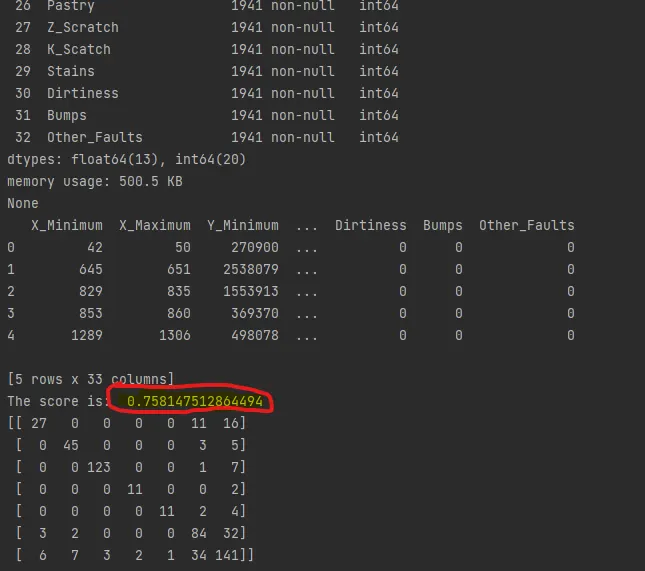
The training and test dataset was solved with 75.81% accuracy
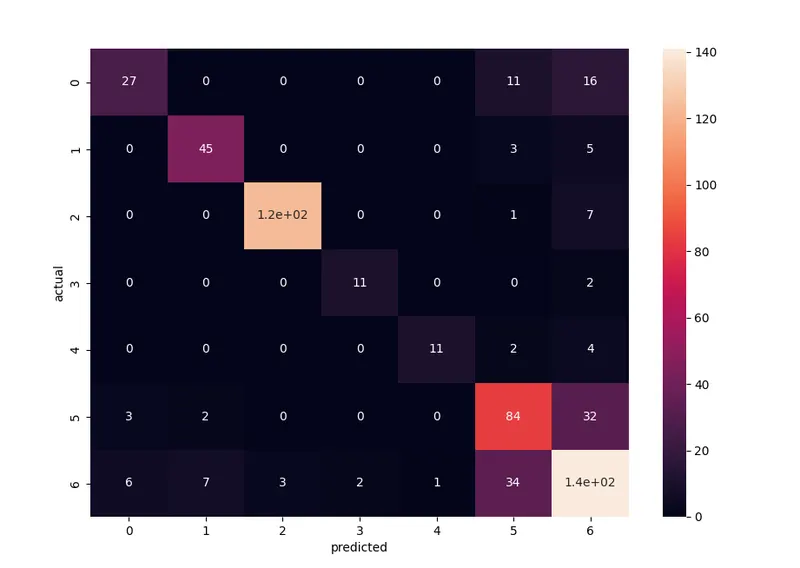
This plot shows the distribution of the actual and predicted values in the dataset