Supervised Learning - Classification Week 7 Challenge
Supervised Learning - Classification Week 7 Challenge
1. Pros and cons of SVM.
Advantages of Support Vector Machine:
- SVM works relatively well when there is a clear margin of separation between classes.
- SVM is more effective in high dimensional spaces.
- SVM is effective in cases where the number of dimensions is greater than the number of samples.
- SVM is relatively memory efficient
Disadvantages of Support Vector Machine:
- SVM algorithm is not suitable for large data sets.
- SVM does not perform very well when the data set has more noise i.e. target classes are overlapping.
- In cases where the number of features for each data point exceeds the number of training data samples, the SVM will underperform.
- As the support vector classifier works by putting data points, above and below the classifying hyperplane there is no probabilistic explanation for the classification.
2.Apply SVM to the “Surface defects in stainless steel plates” dataset and evaluate it
Support Vector Machine(SVM) is a supervised machine learning algorithm used for both classification and regression. Though we say regression problems as well it’s best suited for classification. The objective of the SVM algorithm is to find a hyperplane in an N-dimensional space that distinctly classifies the data points. The dimension of the hyperplane depends upon the number of features. If the number of input features is two, then the hyperplane is just a line. If the number of input features is three, then the hyperplane becomes a 2-D plane. It becomes difficult to imagine when the number of features exceeds three.
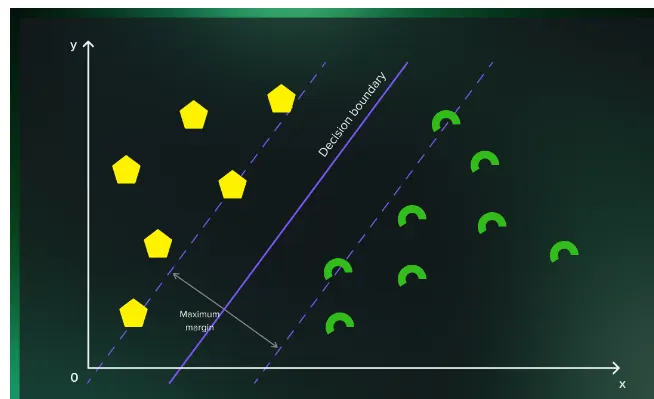
A support vector machine (SVM) is a supervised ML algorithm that performs classification or regression tasks by constructing a divider that separates data in two categories. The optimal divider is the one which is in equal distance from the boundaries of each group.
Applied svm to Stainless steel plate got the score of 71% of Accuracy ,attached the Ipynb file below.