Structural dynamics
Question No.1.
Differences between Static analysis and Dynamic analysis are as below:
Static Analysis
1. Load do not varies with time and effect of time on the application of load is neglected as the load is applied slowly such slow that it is not comparable with natural vibration freequency of the structure.
2. Motion of the building/structure is neglected in static analysis
3. Material is assumed to be behave in elastic manner i.e., material regains its shape and size after the removal of applied force.
4. Effect of Inertia and damping is not accounted but Elastic force should be accounted in the equation of motion
5. Effect of inertia of the building is not considered in the static analysis
Dynamic Analysis
1. Load varies with the time i.e., load is applied rapidly
2. Motion of the building/structure is considered in dynamic analysis
3. Material is assumed to be behave not necessarily in elastic manner but also in plastic manner (i.e. strain hardening)
4.Effect of Inertia, Damping and Elastic force is accounted in the equation of motion
5. Effect of inertia of the building is considered in the dynamic analysis.
Question No.2.
a. Elastic Behaviour
A material is said to behave like a elastic when it regains its original shape and size when the applied causing deformation is removed. From the force - displacment graph, it can be observed that upto certain point from the origin, the line is linear which shows elastic property.
c. Inelastic behaviour
Inelastic behavior is the property of the material when the material do not retain it's previous size and shape after a certain deformation. The material loses its load bearing ability. In force - displacement graph inelastic behavior can be observed in the upper shape of the curve upto point "a".
c. Plastic Behaviour
When the applied load exceeds the elastic limit (yield point) of the material, it behaves like plastic. i.e., the material will not regain its size and shape after the removal of applied load. But the material is still able to sustain further loads due to strain hardening. From the force - displacment graph, it can be observed that the plastic behaviour occurs after the point a during unloading.
d. Non-linear Inelastic behaviour
It can be observed that Non-linear inelastic behavior occurs after the line from "O" tends to bend towards point "a".
Question No.3.
The Single Degree of Freedom System is a combination of 3 pure independent systems such as the stiffness, the damping and the mass (inertia) component.
The Stiffness Component – the frame without damping or mass. The external force fs on the stiffness component is related to displacement u by fs = ku, if the system is linearly elastic, k is the stiffness co-efficient, u is the displacement.
The Damping Component – the frame with its damping property with no stiffness or mass. The external force on the damping component is related to velocity by fd = ců, where fd is damping force, c is the viscous damping coefficient and ů is the velocity.
The Mass Component – the roof mass without the stiffness or damping of the frame. The external force fi on the mass component is related to the acceleration by fi = mű. where ű is the acceleration and m is the mass.
Then, mű + fd + fs = p(t)
mű + ců+ ku = p(t)
Question No.4.
Relationship between Natural period (Tn) & Natural frequency (f) is as follows:
f = 1/Tn
Natural period (Tn): It is the time required for the undamped system to complete one cycle of free vibration. Unit of Tn is Seconds
Tn = 2 * pi() / Wn, where Wn is natural freequency of vibration. Unit of Wn is radians per second
Natural Freequency (f): Number of cycles (one complete revolution) executed by system in one second. Unit of f is Hertz.
Question No.5.
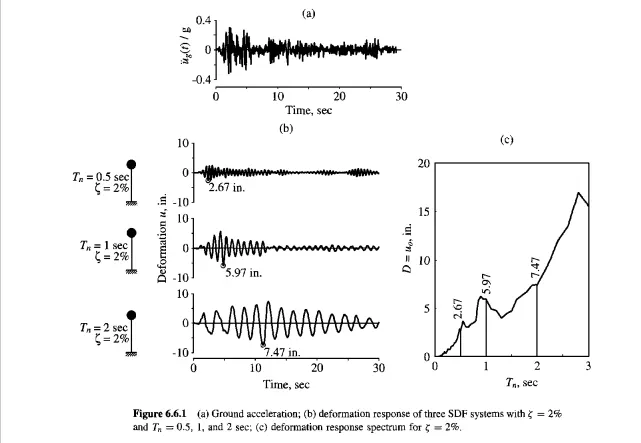
Response spectrum concept is a practical means of characterising ground motions and their effects on structures. Response spectrum provides a convenient means to summarise the peak response of all possible linear SDF systems to a particular component of ground motion. It also provides a practical approach to apply the knowledge structural dynamics to the design of structures.
A plot of the peak value of a response quantity (u, v and a) as a function of the natural vibration period Tn of the system, is called the response spectrum for that quantity.
A variety of response spectra can be defined depending on the response quantity that is plotted. Consider the following peak responses:
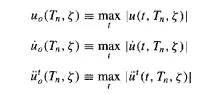
The deformation response spectrum is a plot of peak u, against Tn for fixed ζ (damping) . A similar plot for peak v, is the relative velocity response spectrum, and for peak "a", is the accelaration response spectrum.