Structural dynamics
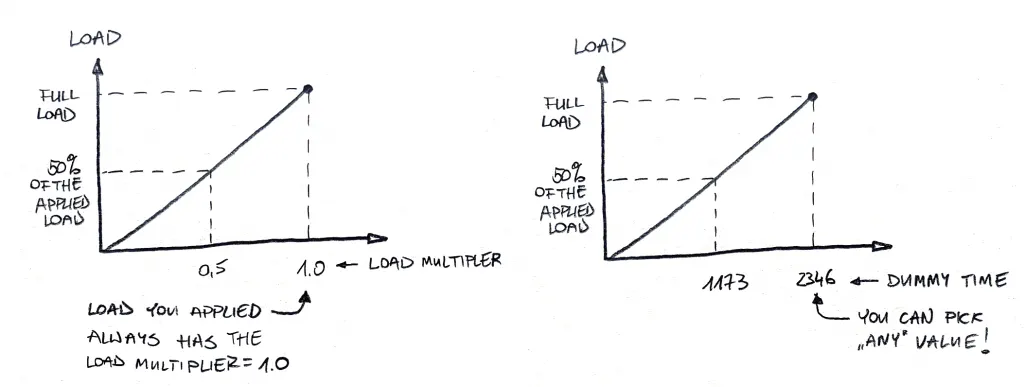
1) Differentiate Static analysis and Dynamic analysis with proper representing pictures :-
| NO | static analysis | Dnamic analysis |
| 1) | A static analysis can only be performed if the system being simulated does not depend on time, and if the loads being applied are constant. | In a dynamic analysis, the system itself, the load application, or both might change with time. |
| 2) | Static analyses don’t consider inertia. | In a dynamic analysis, the inertial loads developed by the system due to acceleration are taken into account. |
| 3) | In a static analysis, only the stiffness matrix of the FEA model is solved. | In a dynamic analysis, in addition to the stiffness matrix, the mass matrix (and damping matrix, if not zero) is solved |
| 4) | the loads which varies very slowly (the acceleration of load is very very less than the natural frequency of the structure) | The loads which changes with time fairly quickly in comparison to the structure's natural frequency. |
Q.2. Explain the following with relevant force-displacement graph.
- Elastic behavior
- Inelastic behavior
- Plastic behavior
- Non-linear Inelastic behavior
Elastic behavior:-
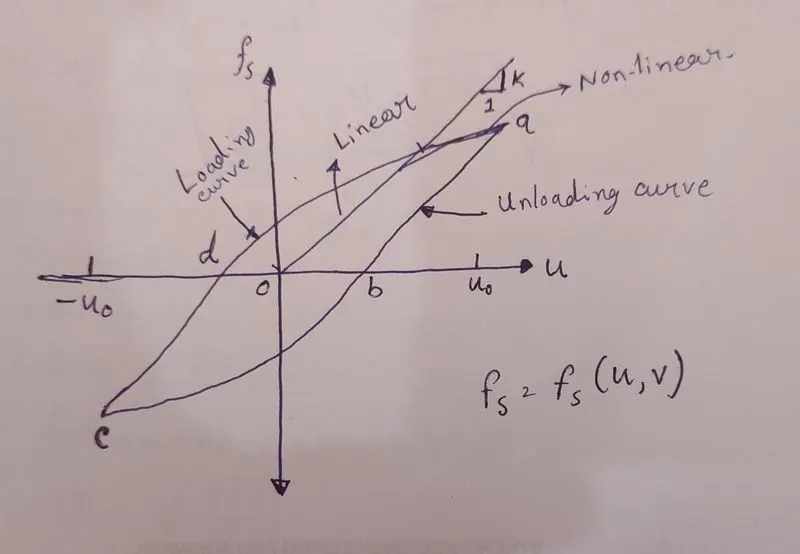
Elasticity is the tendency of solid objects and materials to return to their original shape after the external forces (load) causing a deformation are removed. An object is elastic when it comes back to its original size and shape when the load is no longer present. In graph it is clearly mentioned that upto a certain point from "O" the graph is linear and shown its elastic properties.
Inelastic behavior:-
Inelastic behavior is the property of the material when the material can't retain it's original size & shape after a certain deformation. In the aforementioned graph inelastic behavior has been shown in the upper shape of the curve upto point "a".
Plastic Behavior:-
For stresses beyond the elastic limit, a material exhibits plastic behavior. This means the material deforms irreversibly and does not return to its original shape and size, even when the load is removed. When stress is gradually increased beyond the elastic limit, the material undergoes plastic deformation.
Plastic behavior occurs when the material completely lost it's ductility. In the aforementioned graph plastic behavior occurs during unloading after point "a".
Non-linear Inelastic behavior:-
Materials have elastic behaviour usually only up to a certain load, which is called the 'yield point'. After that, the deformations are plastic. Rubber, for instance, has an elastic stress–strain curve, but the relation is not linear − in such cases nonlinear elastic models are required.
3. Explain Mass, Stiffness & Damping components in the equation of motion (30 marks)
The single degree of freedom system can be viewed as a combination of 3 pure independent system
- The stiffness component
- The damping component
- The mass component
The stiffness component:-
- The term stiffness is used in earthquake engineering to designate how well a building will endure large lateral displacements imposed by ground shaking.
- Stiffness is a measure of how much force is required to displace a building by a certain amount.The frame without damping or mass.
- The external force fs on the stiffness component is related to displacement u by fs=ku
- If the system is linearly elastic.
The Damping component:-
- Damping is the dissipation of vibratory energy in solid mediums and structures over time and distance.
- Similar to the absorption of sound in air, damping occurs whenever there is any type of friction that diminishes movement and disperses the energy.
- The frame with its damping property but no stiffness or mass .
- The external force on the damping component is related to velocity by fd=cv.
The mass component:-
- The vertical irregularities in structures are Stiffness irregularity, Mass irregular, Vertical geometric irregularity, Discontinuity in capacity. A. Centre of Mass.
- The centre of mass is a position defined as the average position of all the parts of the system, weighted according to their masses.
- The roof mass without the stiffness or damping of the frame.
- The external force f1 on the mass component is related to acceleration by fi=mu¨
mu¨+ fd + fs = p(t) that is mu¨ + cu˙ + ku = p(t)
Now, the external force p(t) is appilied to the complete system. They may therefore visualized among the 3 components of the structure. That is inertial, stiffness and damp
4. Provide relationship between Natural period (Tn) & Natural frequency (f) and provide their definitions
Natural Period(Tn):-
- The natural period of a building is simply a time taken by it to undergo one complete cycle of oscillation.
- The natural period is one of the properties or building which is controlled by mass and stiffness.
- Formula to find out natural period is,
Tn = 2π/ωn or ωn = 2π/Tn
- Tn is a natural period of building.
- m is mass
- ω is stiffness
Natural Frequency (f):-
A natural frequency is defined as that frequency at which a body will vibrate if excited by an external force.
Natural frequencies are generated by impacts of the internal parts of a rolling-element bearing. These impacts are normally the result of slight variations in load and imperfections in the machined bearing surfaces. As their name implies, these are natural frequencies and are present in a new bearing that is in perfect operating condition.
The natural frequencies of rolling-element bearings are normally well above the maximum frequency range, FMAX, used for routine machine-train monitoring. As a result, they are rarely observed by predictive-maintenance analysts. Generally, these frequencies are between 20 KHz and 1 MHz. Therefore, some vibration-monitoring programs use special high-frequency or ultrasonic monitoring techniques such as high-frequency domain (HFD). Note, however, that little is gained from monitoring natural frequencies. Even in cases of severe bearing damage, these high-frequency components add little to the analyst's ability to detect and isolate bad bearings.
- The number of cycle (or one complete revolution) executed by system in one second with units in hertz. Where, fn=1/Tn
- Natural vibration properties ωn, Tn and f depends only on mass and stiffness of the structure.
- Tn, ωn, fn (Natural vibration pproperties) depends only on two quantities that is mass and stiffness.
- ωn = sqrt(k/m), the stiffer of single degree of freedom having the same mass will have higher natural frequency and the shorter natural period.
- Natural frequency and Natural time period is inversely proportional to each other.
- Similary, the heavier of 2 structures (or) one with more mass and if both structure have the same stiffness. The one with the heavier mass will have the lower frequency and lower frequency and longer natural period.
- ωn, n is natural (indicates to emphasize the natural properties of system and when it is allowed freely without any natural excitation).
- It is important to remember that earthquake last for few seconds. The Ground motion subsides freely vibrates the structure based on the velocity, displacement impacted to it. Because, the system is linear these vibration properties are independent of displacement and velocity.
- These properties are related to its mass and stiffness,
- The natural vibration properties ωn, Tn and fn depends only on the mass and stiffness of the structure. That is k=mw2.
- The stiffer of 2 single degree of freedom system having the same mass will have the shorter natural period (less time to comlete one cycle) and higher natural frequency.
- Similarly the heavier mass of two structures having the same stiffness will have the longer natural period and the lower natural frequency. That is ωn = sqrt(k/m).
5.Explain in detail about Response spectrum & its Graph
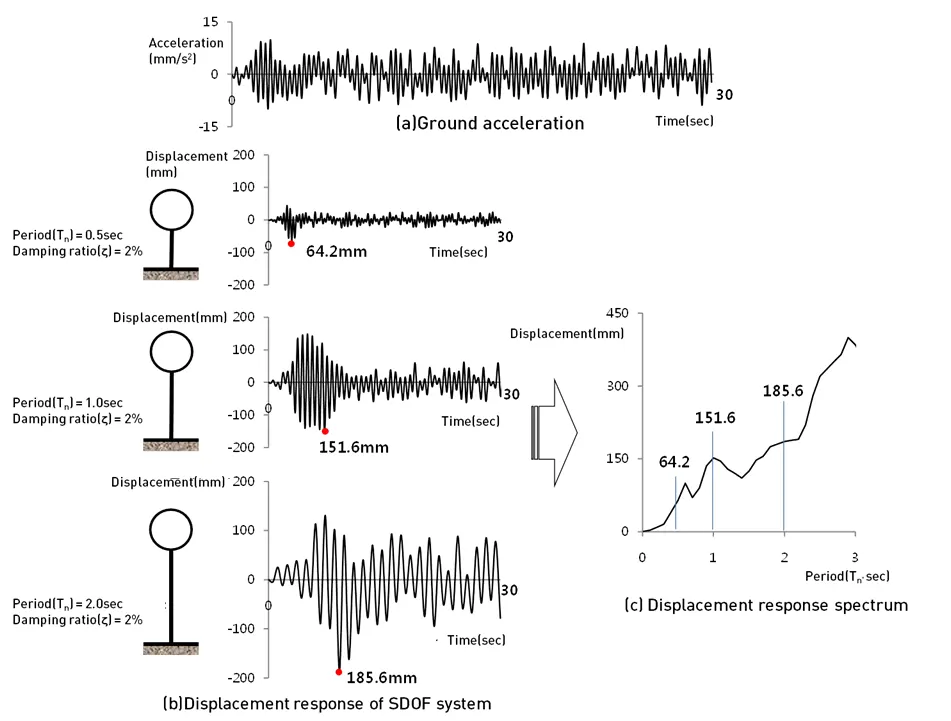
A response spectrum is a graphical plot of the frequency of an oscillator and its damping. The response spectrum plot represents the peak or steady-state response (velocity, displacement, or acceleration) of a series of oscillators of varying natural frequency.
Pseudo-Acceleration Response Spectrum:-
- Pseudo acceleration for an single degree od freedom system with naturak frequency ωn is related to its peak deformation D = uo, due to earthquake ground motion: A = (ωn^2) * D = ((2π/Tn)^2) * D.
- The quantity A has units of acceleration and is related to the peak value of base shear Vbo (just another name for the peak value of the equivalent static force fso): Vbo = fso = mA (or) Vbo = (A/g)*ω.