Structural dynamics
- Differentiate Static analysis and Dynamic analysis with proper representing pictures.
Aim: To differentiate. Between static analysis and dynamic analysis.
Explanation:
|
SNo. |
Static analysis. |
Dynamic analysis. |
|
1. |
Static analysis is. Is the analysis of. For sales like stress, strain and displacement etc. and it is independent of time. |
Dynamic analysis is depend on the time. |
|
2. |
The static load will be applied on the structure slowly. Example Dead load, Live load. |
The dynamic load apply on the structure is suddenly. Example. Earthquake load, wind load. |
|
3. |
The static analysis is done with the minimum three degree of freedom. |
Dynamic analysis of structure is done with the single degree of freedom. |
|
4. |
Static analysis done where the structure deformation behaves linearly. |
Dynamic analysis is done where structure behaves non-linear deformations. |
|
5. |
The results are a consequence of the applied constraints and loads, for example bearing, gravity, forces, etc. |
In this inertia and damping forces are considered. |
|
6. |
Structural analysis is mainly concerned with finding out the behaviour of a physical structure when subjected to force. |
Dynamic analysis for simple structures can be carried out manually. |
- Explain the following with relevant force-displacement graph.
- Elastic behaviour.
- Inelastic behaviour.
- Plastic behaviour.
- Non-linear Inelastic behaviour.
Aim: To understand and. Provide the sufficient definitions for the given abbreviation with images.
Explanation:
a. Elastic behaviour.
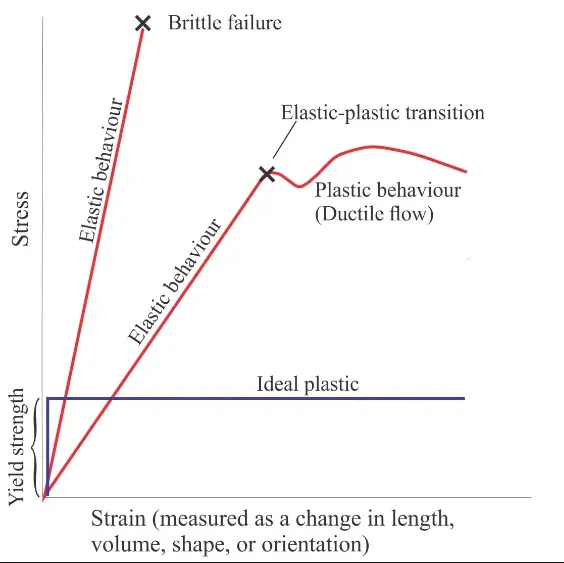
- Elasticity is the ability of a body to resist any permanent change to it when stress is applied. When stress application ceases, the body regains its original shape and size.
- Different materials show different elastic behaviour.
- The study of the elastic behaviour of a material is of much importance. Almost every engineering design requires knowledge of the elastic behaviour of materials. In the construction of various structures like bridges, columns, pillars, beams, etc. knowledge of the strength of the materials used in the construction.
- Strain is linearly proportional to Stress.
σ=Ee
b. Inelastic behaviour.
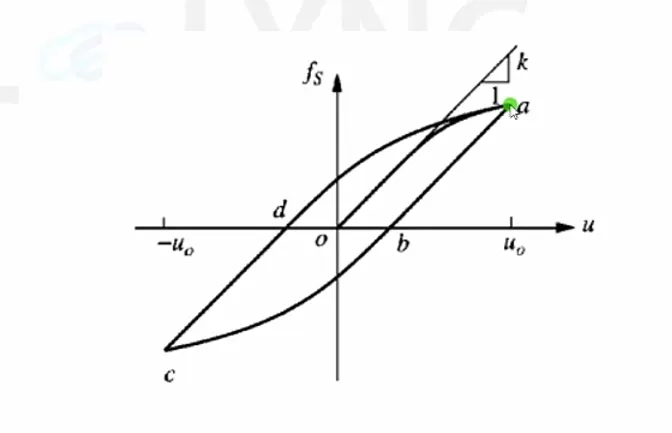
- Inelastic behaviour deformation of a material that does not disappear on removal of the force that produced it. Determined by experiments, the force deformation relation for a structural steel component undergoing cyclic deformations expected during earthquakes.
- The initial loading curve is a nonlinear at a large amplitudes of deformation and the run. Unloading and reloading curves differ from the initial loading branch; Such a system is said to be inelastic. This implies that the for the deformation relation is path dependent.
- It depends on whether the deformation is increasing.
c. Plastic behaviour.
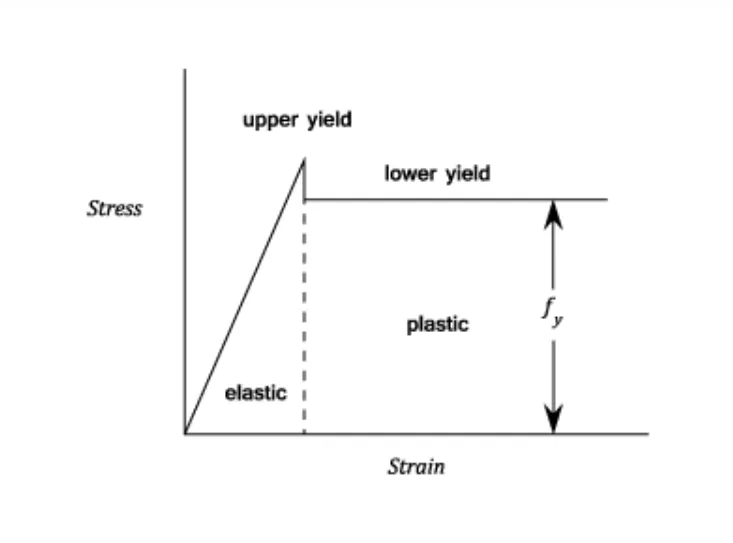
- A plastic material is one that shows little or no deformation up to a certain level of stress. Above this yield stress the material flows readily.
- Plastic behaviour known as permanent deformation. After that member cannot attains its original shape or position of deformation or displacement.
Plastic deformation occurs when:
- Stress and strain are not proportional.
- The defamation is not reversible.
- Deformation occurs by breaking and rearrangement of atomic bonds.
d. Non-linear Inelastic behaviour.
Forced displacement relationship becomes non-linear and inelastic at large deformations.
Force corresponding to deformation is not single valued and depends on history of deformation and whether deformations is increasing or decreasing. Does the resisting force can be expressed as.
fs=fs(u,v)
- Explain Mass, Stiffness & Damping components in the equation of motion.
Aim: Explaining about mass comm are and damping components in the equation of motion.
The mass component:
The roof mass without the stiffness or damping of the frame the external force on the mass component is related to the acceleration by
fi=mu
The stiffness component:
The frame without damping or mass , the external forces fs on the stiffness component is related to the displacement u by:
fs=ku if the system is linearly elastic.
The Damping component:
The frame with its damping property but no stiffness or m ass the external force on the damping component is related to velocity by
fd=cv
- Provide relationship between Natural period (Tn) & Natural frequency (f) and provide their definitions.
Aim: To provide the relationship between natural period and natural frequency and providing their sufficient definitions.
Explanation:
Relationship between Natural period (Tn) & Natural frequency (f)
The equation gives the relation between the frequency and the period: The relation between the frequency and the period is given by the equation: f=1/T
Natural Period:
- The fundamental natural period was calculated on the basis of mass and stiffness of the building.
- The natural period of a building is simply a time taken by it to undergo one complete cycle of oscillation.
- The natural period is one of the properties or building which is controlled by mass and stiffness.
- Formula to find out natural period is,
Tn =2π√(m/k)
where,
Tn is a natural period of building, m is mass, k is stiffness.
Natural Frequency:
- A building’s natural frequency (n) is simply the inverse of the fundamental period (T), and, for flexible and dynamically sensitive buildings and other structures.
- Natural frequency, is the frequency at which a system tends to oscillate in the absence of any driving force.
Natural frequency (f) =√stiffness/√Mass of structure.
- Explain in detail about Response spectrum & its Graph.
Aim: To understanding about the response spectrum and Analysis its graph.
Explanation:
Response Spectrum:
- A response spectrum is a function of frequency or period, showing the peak response of a simple harmonic oscillator that is subjected to a transient event. The response spectrum is a function of the natural frequency of the oscillator and of its damping.
- It provides a convenient means to summarise the peak response of all possible linear SDF systems to a particular component of ground motion.
- It also provides a practical approach to apply the knowledge of structural dynamics to the design of structure and development of lateral force requirements in building codes.
The equation of motion for the mass can, if there are no external forces, be written as:

Dividing by the mass, and using customary notation,

Here, the undamped natural (angular) frequency is.

and the damping ratio is

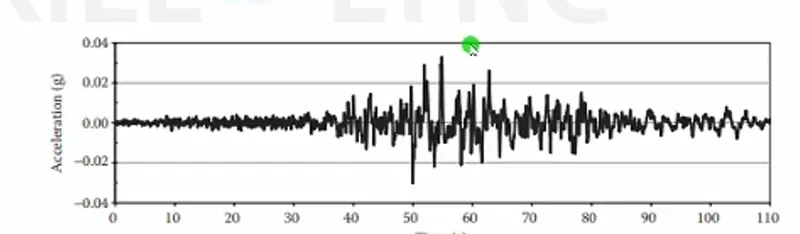
Graph of response spectrum:
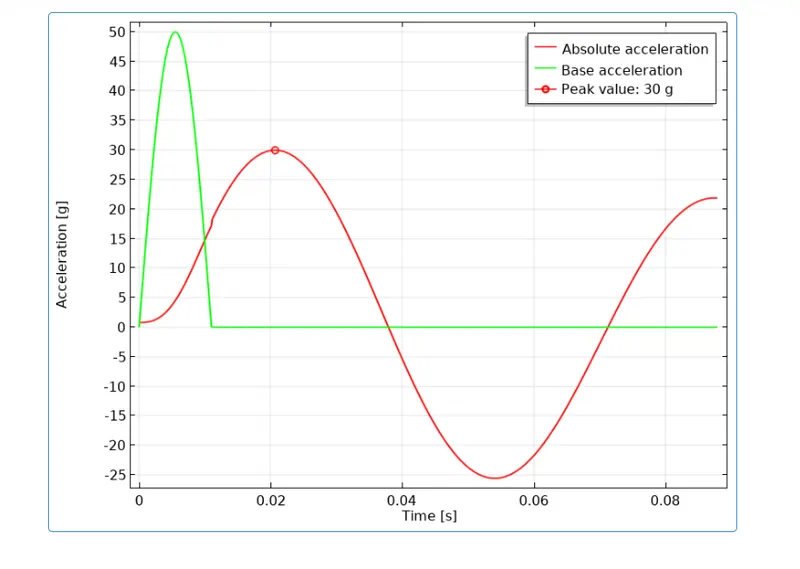
Fig: Showing the Absolute acceleration at a natural frequency of 15 Hz and damping of 5%.
Record of the 1985 Michoacan Guerrero earthquake in Mexico City