Structural dynamics
ANSWERS
1. a) Static Analysis
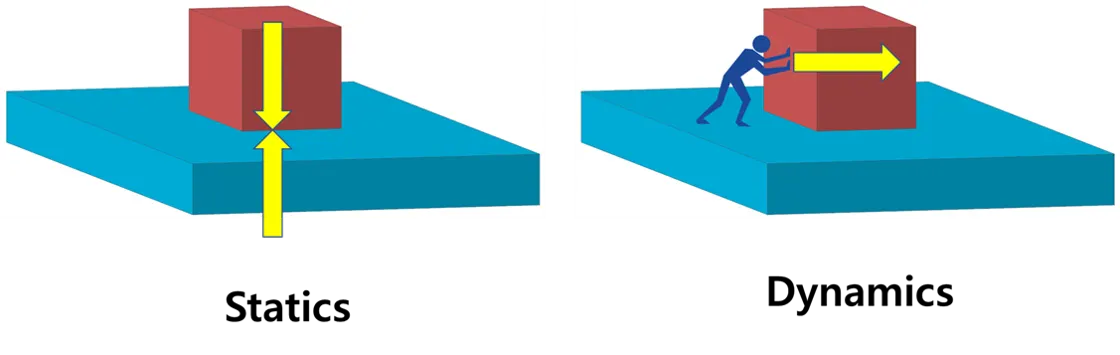
The static analysis analyzes the steady state in which forces are balanced in an object or system. This is a state where there is no change no matter how much time passes. Therefore, changes in time are not considered.
- It doesn’t matter how you apply the load. This is happening extremely slowly. The way you apply the load has no impact on structural behavior.
- The load isn't changing with time.
b) Dynamic Analysis
Dynamic analysis analyzes the moving state of an object or system. At this point, time or frequency is considered to express motion. The dynamic analysis is generally more complicated because it has more variables to consider than the static analysis. This is why the dynamic analysis requires more analysis time than the static analysis.
- It studies the behavior of a structure subjected to dynamic (actions having high acceleration) loading.
- Dynamic loads are the time-varying loads. But Structural dead loads and live loads have the same magnitude and direction throughout their application and are thus static loads.
- Dynamic analysis is the testing and evaluation of data in real time.
2. a) Elastic behaviour
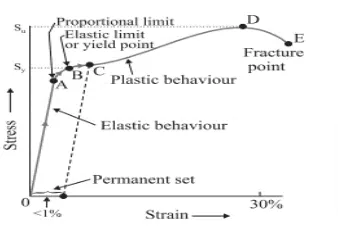
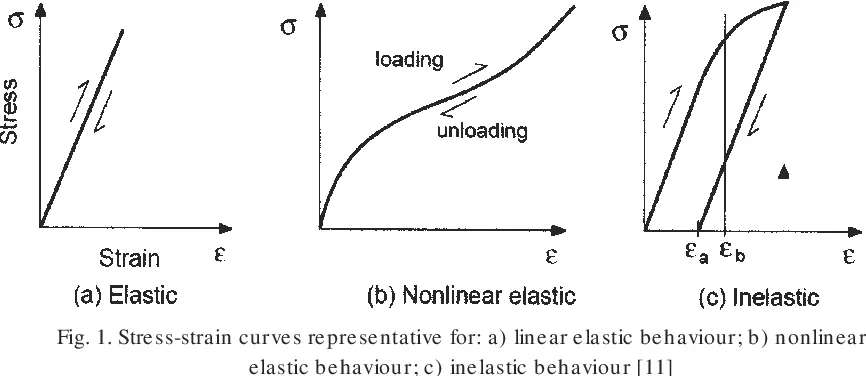
Elasticity is the tendency of solid objects and materials to return to their original shape after the external forces (load) causing a deformation are removed. The Elastic limit is the stress value beyond which the material no longer behaves elastically but becomes permanently deformed.
b) Inelastic behaviour
Simply they're Non-elastic materials. They undergo permanent deformation when a force is applied. Inelastic deformation typically involves a change in the material's internal structure or composition leadding to permanent changes in its properties.
c) Plastic behaviour
For stresses beyond the elastic limit, a material exhibits Plastic behaviour. This means the material deforms irreversibly and does not return to its original shape and size, even when the load is removed.
d) Non- Linear Inelastic behaviour
Materials that have elastic behaviour usually only upon a certain point after their deformation are Plastic and relation in this isn't linear.
3. From the considerations of conservation of energy, any vibrating system will, in general, have three constituents:
(i) a mechanism to store the kinetic energy, which is also responsible for the generation of inertia force;
(ii) a mechanism for energy dissipation/loss;
(iii) a mechanism to store the potential energy, responsible for the elastic restoring force in the vibrating system.
In the simplest possible idealisation of a vibrating system, these three mechanisms may be considered to be lumped into discrete elements as shown in Figure below.
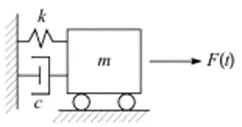
The mass/inertia element(m) stores the kinetic energy, the spring element (k) stores the potential energy, the dashpot (c) represents the viscous damper for dissipation/loss of energy, and F(t) is an external time varying force.
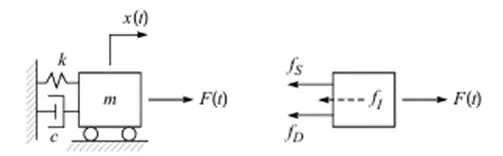
The system shown in Fig. above is a Single Degree of Freedom (SDOF) system because it is only required to monitor a single quantity, viz., the movement of the mass (m), to completely describe the vibration of the system. In general, the number of independent displacements required to define the displaced positions of all the masses relative to their original position is called the number of degrees of freedom for vibration analysis. A single degree of freedom (SDOF) system is the simplest possible mathematical model in structural dynamics.
In order to derive the governing equation of motion, let us consider the various forces acting on the mass m as shown in the accompanying Free Body Diagram (FBD). The forces fS and fD represent the elastic restoring force and the force developed in the damper, respectively. These forces, along with the external force F(t) act on the mass (m), which then cause the change in momentum of the mass by Newton’s second law as,
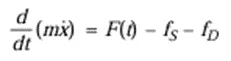
where x(t) denotes the displacement of mass m from its original position of rest.
The rate of change of momentum can be considered to have the same effect as that of applying a fictitious inertia force fI directed opposite to the direction of motion for considering the instantaneous equilibrium of forces acting on the mass. Therefore,
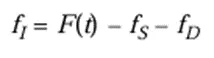
Thus,
Inertia force, fI = mx (Mass x Acceleration),
Spring force, fS = kx (Spring constant x Spring deformation) and
Damping force, fD = cx (Coefficient of viscous damping x Relative velocity between the two ends of the dashpot).
By substituting these relations in the above Equation, we get,

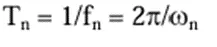
4. The system vibrates indefinitely with the same amplitude at a frequency of n radian/sec. Here, n is the angular rotation (radians) traversed by a dynamic system in unit time (one second). It is called the natural frequency of the system (in radians/sec). Natural Frequency is the frequency at which a system tends to oscillate in the absence of any driving force. Alternatively, the number of cycles completed by a dynamic system in one second is also called its natural frequency (in cycles/sec or Hertz). It is often denoted by fn.
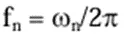
The time taken by a dynamic system to complete one cycle of revolution is called its natural period (Tn). It is the inverse of natural frequency.
5. Response Spectrum
Earthquake engineers prefer to report interaction between ground acceleration and structural systems through the Response spectrum, first proposed by Biot and later popularised by Housner. Response spectrum is a set of ordinates that describes the maximum response of a set of Single Degree Freedom Systems (SDOF) subjected to a prescribed ground motion. Often a response spectrum is presented as a plot of the maximum response of a set of SDOF systems subjected to a support (ground) motion as ordinate and corresponding natural frequencies (or, periods) of the SDOF system as abscissa.
The response spectrum is a function of the natural frequency of the oscillator and its damping. Thus, it is not a direct representation of the frequency content of the excitation, but rather of the effect that the signal has on a postulated system with a single degree of freedom (SDOF).
Eg.
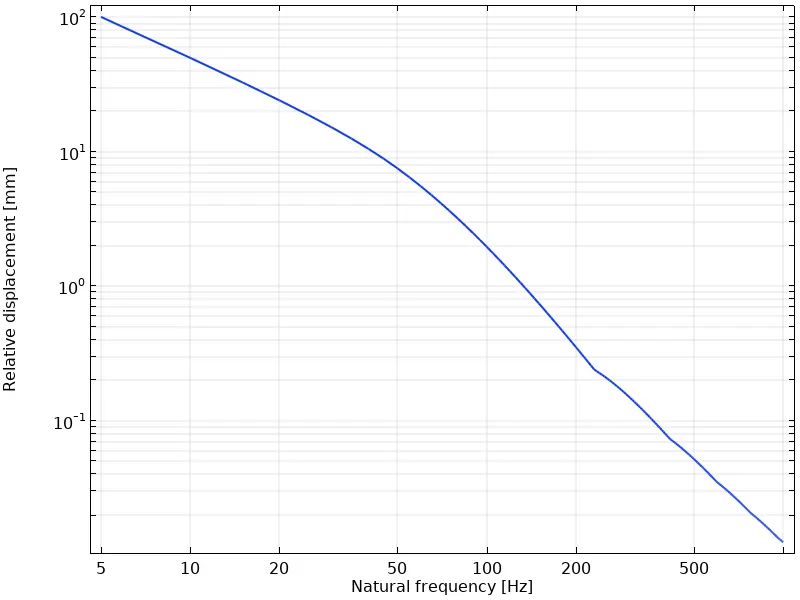
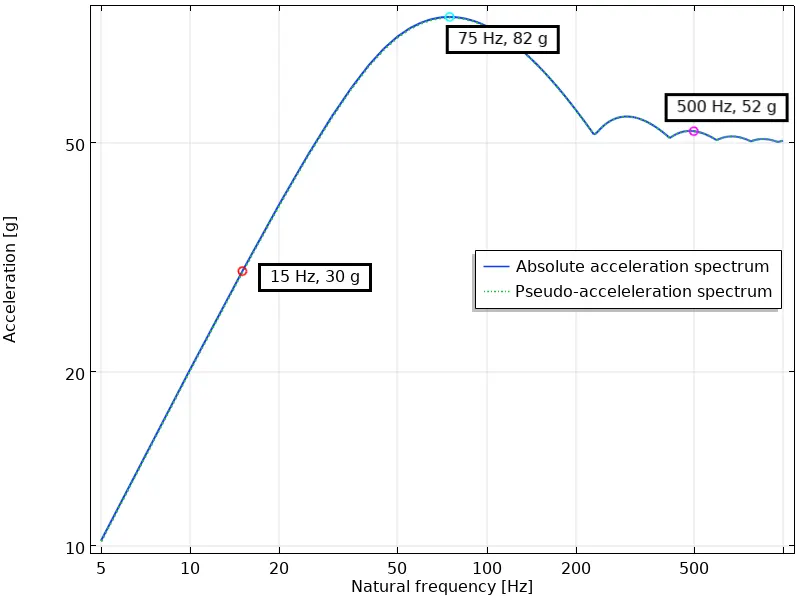
Relative displacement Response spectrum Absolute Acceleration Response spectrum