Structural dynamics
Week 2 Challenge
1Q.
Answer:
Static Analysis
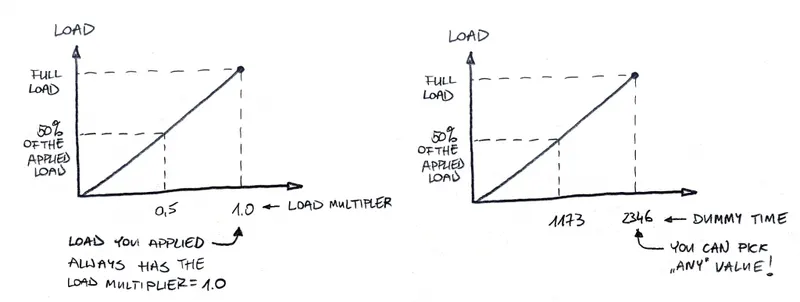
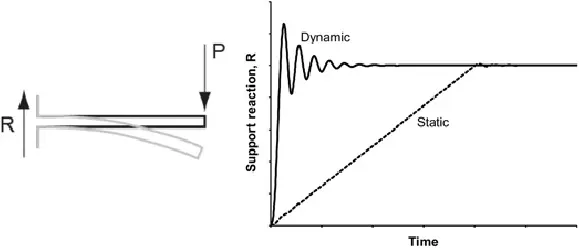
- Static analysis can only be carried out if the simulated system is not time-dependent and if the loads are constant.
- Inertia is not accounted for in static analysis.
- The force that is constant in size, position, and direction on or inside of a structure is referred to as static.
- In the case of static analysis, it is not necessary to account for inertia and damping forces, but the elastic force should be.
Dynamic Analysis
- The system itself, the load application, or both may change over time when performing a dynamic analysis.
- The system's inertial force as a result of accelaration is taken into consideration.
- A force that alters a structure's size, position, or direction is referred to as dynamic.
- In order to account for inertia and damping force in the equilibrium equation, which can be ignored in static analysis, two additional forces are needed for dynamic analysis.
2Q.
Answer:
1. Elasric Behavior:
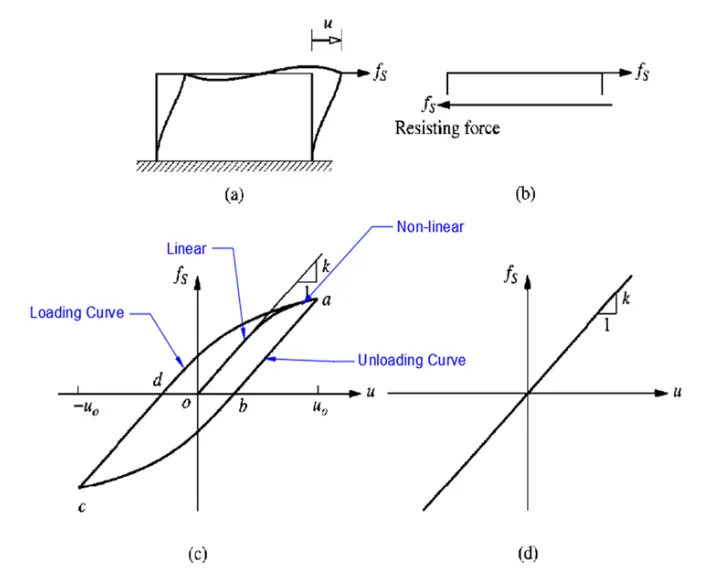
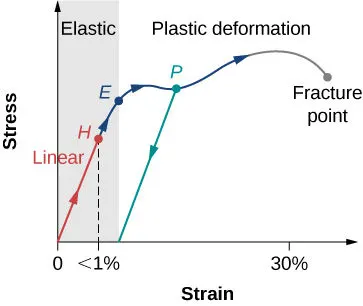
- When a material body that has been deformed can return to its original size and shape after the forces that caused the deformations have been removed, this property is known as elasticity.
- In order to make life more convenient, safe and stable man-made structures like skyscrapers and overbridges are designed.
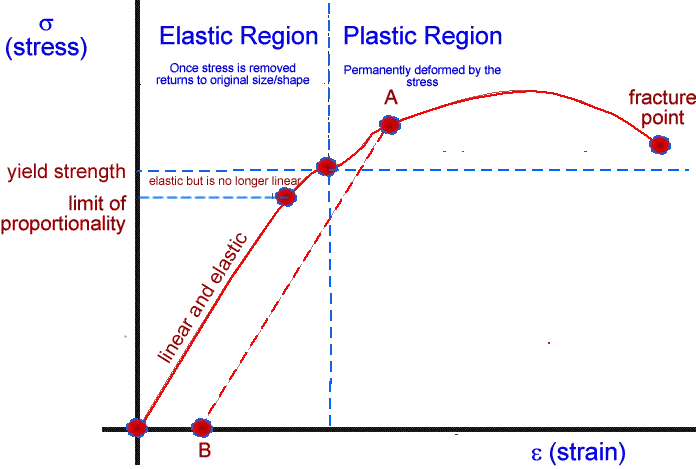
- From the graph, it is evident that the graph is linear and exhibits elastic properties up until a certain point from "O."
2. Inelastic Behavior:
- Materials with deformation that persist after the removal of the force it produces
- When an inelastic material reaches its maximum strength, it will simply rupture suddenly through a shear break without experiencing any elongation or deflection.
- For instance, wood, fabric, etc.
- In the graph, the upper shape of the curve up to point "a" exhibits inelastic behavior.
3. Plastic Behavior:
- A material displays plastic behavior under stresses greater than the elastic limit.
- This means that even after the load is removed, the material continues to deform irreversibly and does not take on its original form or size.
- Plastic deformation occurs when stress is gradually increased past the elastic limit.
- An illustration of plasticity is plastic wrap.
- After point "a" in the graph, the plastic behavior happens during unloading.
4. Non-linear Inelastic Behavior:
- Materials typically exhibit elastic behavior only up to a certain point, after which deformation is plastic. This is nonlinear elastic behavior.
- This is nonlinear elastic behavior.
- After the line from "o" begins to bend toward point "a," non-linear elastic behavior appears.
3Q.
Answer:
1. Mass Components:
Only the frame's mass is taken into account by the equation of motion's mass component; stiffness and damping are neglected. The equation fi=mu relates the force to the mass component.
2. Stiffness Components:
The term "stiffness" refers to a material's ability to resist deformation, and in this component, only stiffness is taken into account in the frame, leaving out other mass and damping components. Equation fs=ku relates the force to the stiffness component.
3. Damping Components:
The dissipation of energy brought on by vibrations over time and space is known as damping. The clash between structural and non-structural elements is the cause of it.
Equation fd=cu relates the force to the damping component.
As a result, the equation for motion can be expressed as
It is mu + cu + ku = p(t)
where p(t) is the external force.
Mu + fd + fs = p(t)
4Q.
Answer:
Natural period:
The term "natural period of vibration" refers to the amount of time it takes an undamped system to complete one cycle of free vibration.
It is expressed by the formula Tn = 2/n and is measured in seconds.
Natural frequency:
One complete cycle of free vibration is completed in one second, which is the definition of the natural frequency.
It is expressed in radians per second.
Natural frequency and period are related in such a way that the former is inversely proportional to the latter.
fn=1/Tn.
5Q.
Answer:
Response Spectrum:
It is a concept for describing the effects of ground motion on structures over a range of time Tn.
The term "response spectra" refers to a plot of the peak value of a response activity (u, v, a) as a function of the system's natural vibration period Tn.
Response spectra plots can be used to calculate the peak response of all linear systems with a single degree of freedom.
The three types of plots are typically u and Tn as the relative velocity spectrum, u* as the acceleration response spectrum, and u** as the deformation response spectrum.
For the range of damping values encountered in the data, several of these plots with different damping ratios are created for each plot.
Deformation Response Spectrum:
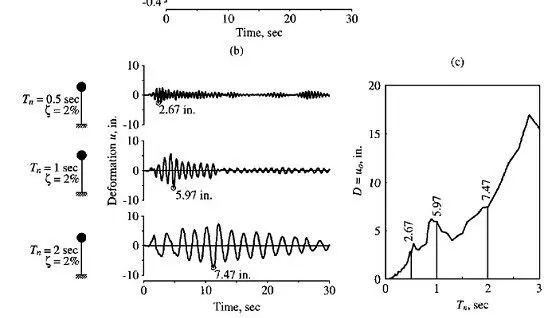
The plot has been deformed with respect to time in the image up top.
An earthquake's recorded ground acceleration is shown in the first plot (a).
The deformation response plots for three separate SDF systems are shown in the second plot (b).
The corresponding deformations with respect to time are obtained in each plot of b when the natural time period is varied by 0.5, 1 or 2 seconds and the damping ratio is fixed at 2.
The peak responses are then recorded using a plot of the recorded dimensions and Tn.So, based on the duration of the vibration, the system's deformation can be calculated.
Pseudo Acceleration Response Spectrum:
The peak deformation D = uo of a freedom system with natural frequency n is related to the ground motion caused by earthquakes:
A is equal to (n2) * D or ((2/Tn)*2) * D. The acceleration obtained is relative, making the term "pseudo acceleration" appropriate.
The D in this case denotes relative deformation rather than total deformation.
A has units for acceleration and is related to Vbo for base shear. Vbo = (A/g)* or Vbo = fso = mA.
A/g, the base shear coefficient in this equation, is calculated by dividing the acceleration by the gravitational force.
Therefore, the total base shear or equivalent static force can be used to analyze the structure by multiplying this by the total mass of the structure.
This deformation can then be multiplied by the stiffness to produce an equivalent static force, which can then be applied to the structure's analysis.
--------------------------------------Thank You--------------------------------------------------------