Structural dynamics
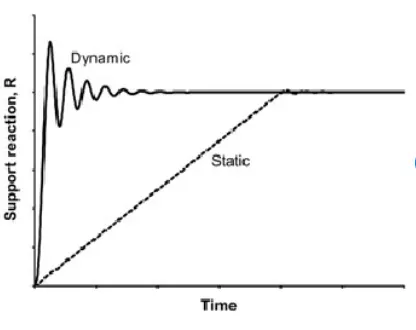
1ANS:The difference between the static and dynamic analyisis
| S.No. | Static Analysis | Dynamic Analysis |
| 1 | It is used for calculate the stress,strain deformation at constant loads(Dead load,liveload) | It is used for calculate the stress,strain deformation at varying loads with time(Earth quake load,wind load,snow load etc) |
| 2 | It is easier when compare to Dynamic analysis | It is accurate when compare to static analysis |
| 3 | Interial is irrelevent & stiffeess is relevent | Interia & stiffness is relevent |
| 4 | Loads applied slowly | Loads changing by time so it quickly applied. |
| 5 | Structure motion is not considerd | Structure motion is consider. |
Static analyisis Static analyisis Vs Dynamic analysis
2ANS:
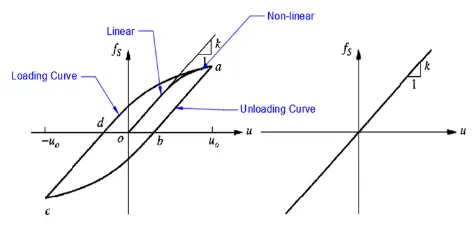
Elastic behaviour: It can be defined as the ability of component to regain its orginal shape after removing the external applied laod.The component under loading like compression and tension loses its original shape and tend to act according to the load and when the load is removed the components its regain the original shape .For linear force system, the relation between the lateral forces(fs) and the resulting deformation(u) is linear .
Fs=Ku 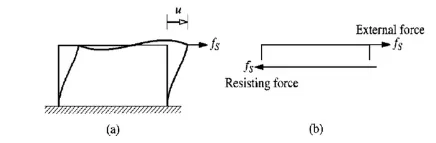
Inelastic behaviour: It can be defined as the ability of component it doesnot regain its orginal shape after removing the external applied laod. It is opposite of elastic behavoiur0
Plastic behaviour: The property of material which have deformed shape and permanent strain after removal the external load is called as plastic behaviour.The plastic behaviour of the structures occurs the beyond yield point and the deformation is irreversible when it load is removed.
Non-linear Inelastic behaviour: When large deformation occur at the material,The force and displacement relation becomes the non linear. For force displacement ,force coressponding to displacement is not a single valued in non linaer behaviour it depends upon the history of deformation of material,fs=fs(u,v).
3ANS:
Mass component: In equation of motion the mass component consider the only mass remaing stiffness and damping component are negeleted.The force is related to mass component eqaution fi=mu.
Stiffness component: The regidity of material to resist from deformation is called as Stifness.In stiffness component only stiffness is considerd remaing mass and damping components are neglected. fs=ku.
Damping component: It is the dissipiation of energy due to vibration over time and distance.In this component damping only consider remaing mass and stiffness are not considerd.It occurs due to friction between the structural and non structural elements.fd=cu
The equation of motion p(t)=mu+fs+fd
p(t)=mu+ku+cu.
4ANS:
Natural period: The time required for the undamped system for complete the one cycle of free vibration.
Tn =2pi/Wn units -sec
Natural frequency: The number of cycles or one complete revoluation excuted by system in one second. units radian/sec (hertz)
The relation between the natural period(Tn) and natural frequency(fn)
fn=1/Tn
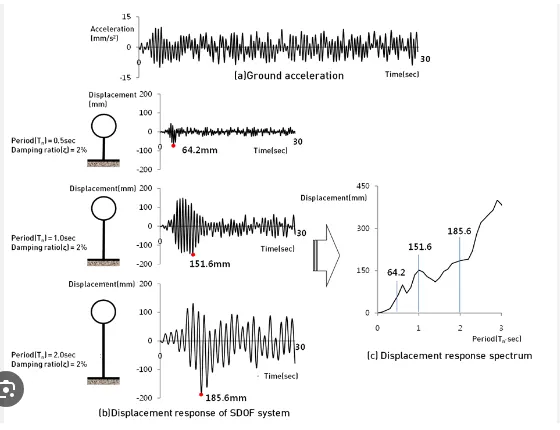
5ANS:Response spectrum factor
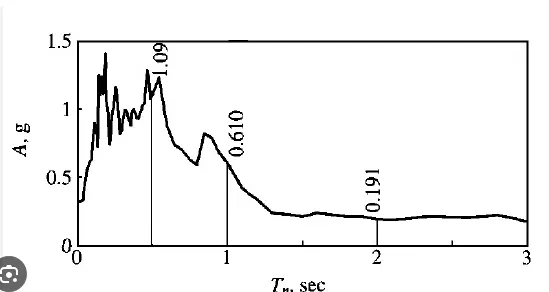
- It is central concept of sesmic engineering,it is partical means of charctering ground motion and their effects on structures of different time period(Tn)
- It provides the convient means to summarize the peak response of all possible linear single degree fresdom system to particular component of ground shake.
- It also provide a praticular approach to apply the knowledge of structural dynamics to the design of structures & developmnet of lateral forces requiremnt in building codes.
- Aplot of a peak value response quantity like displacement(u) response spectrum, Velocity (v) response spectrum and acceleration (a) response spectrum as function of the natural time period (Tn) of the system is called as the response spectrum for the quantity.
- Each such plot is for single degree freedom system having a fixed damping ratio for several such plots for different values of damping ratio are included to cover the range of damping values encountered in actual structures.
Pseudo acceleration response spectrum
It is for single degree freedom with natural frequency(Wn) is related to peak deformation(D0) due to earth quake ground motion.
A=(Wn*Wn)*D =(Wn*Wn)*(2pi/Tn)2
The quantity A has no units of acceleration and is related to the peak value of base shearVbo
Vbo=fso=mA
Vbo=(A/g)W