Structural dynamics
CHALLENGE 2
1.Different static analysis and dynamic analysis with proper representing picture?
Answer:
Static analysis:
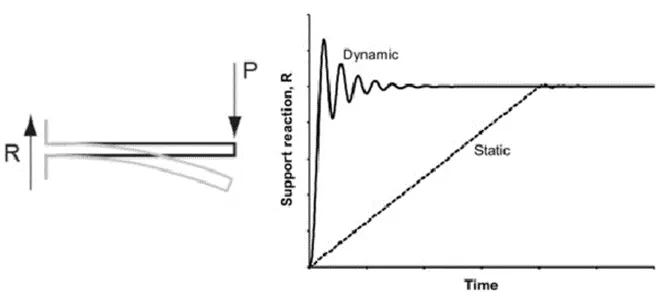
Static analysis is an essential procedure to design a structure. Using static analysis, the structure's response to the applied external forces is obtained. Moreover, the static analysis is performed when the structure is subjected to external displacements, such as differential support settlements. Static analysis can only be performed if the system being simulate not depend on time, and if the loads being applied are constant. In static analysis does not consider inertia force. In this analysis no necessity to count inertia and damping forces in case of static analysis, but the elastic force should be accounted.
Dynamic analysis:
Structural dynamics which are covers the behaviour of a structure subjected to dynamic loading. Dynamic loads include people, wind, waves, traffic, earthquakes, and blasts. Any structure can be subjected to dynamic loading. In dynamic analysis, the load application or both might change with time. The inertial force developed by the system due to acceleration are taken into account. Dynamic refers to the force on the structure that changes size, position or direction. In the dynamic, two additional forces must be accounted such as inertia and damping force in equilibrium equation it can be disregarded in static analysis
2.Explain the following with relevant force displacement graph?
Answer:
Elastic behavior: An elastic analysis is performed by the applying design loads and required internal forces on the structural elements are determining and adequate design strength is provided. Elasticity , ability is a deformed material body to return its original shape and size when the forces causing the deformations are removed. A body is said to behave elastically. The theory of elasticity is used to design safe and stable man-made structures such as skyscrapers and overbridges to make life convenient.
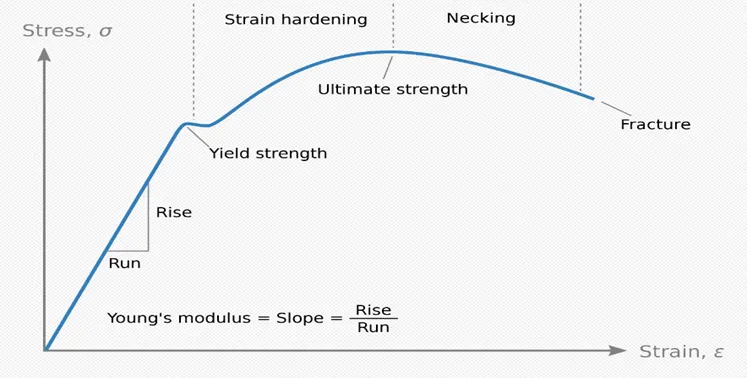
Inelastic behavior: The inelastic behavior of the buildings is characterized in terms of ductility capacity and demands. Deformation material does not disappear on the removal of force produced by it. Inelastic material will experience no elongation or deflection and up to its ultimate strength is reached will just rupture suddenly usually through shear.
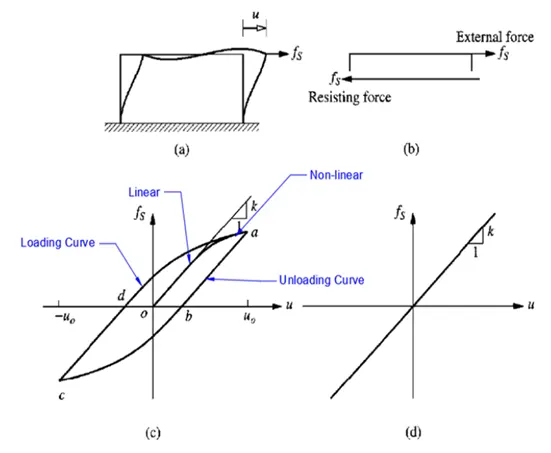
Plastic behavior: Plastic analysis has been used traditionally to assess the collapse behavior of structures on the basis of yielding of cross sections under proportionally increasing loading. For the stresses beyond the elastic limit the material exhibits plastic behavior. That means the material deforms by irreversibly and does not return to its original shape and size, even when the load is removed. When stress is gradually increased beyond the elastic limit by the material undergoes plastic deformation
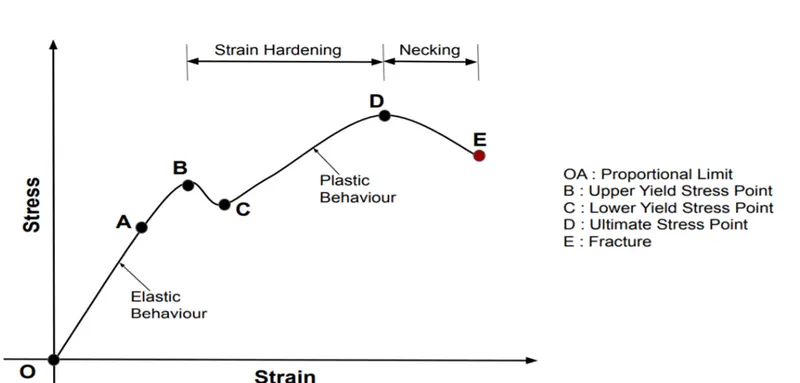
Nonlinear inelastic behavior: Nonlinear elasticity is the subject that deals with materials that are capable of large, reversible deformations. The materials have elastic behavior usually only up to the certain point after that deformation are plastic and the relation in this is not linear, that is nonlinear elastic behavior.
3.Explain Mass, Stiffness & Damping components in the equation of motion?
Answer:
Stiffness component: The term stiffness is used in earthquake engineering to denoted how well a building will endure large lateral displacements imposed by ground shaking. Stiffness is a measure of how much force required to displace in a building by a certain amount. The frame without damping or mass. The external force fs on the stiffness component is related to displacement u by fs=Ku. If the system is linearly elastic.
Damping component: It is the dissipation of vibratory energy in solid mediums and structures over time and distance. Similar to absorption of sound in air, damping occurs whenever there is any type of friction that diminishes movement and disperses the energy. The frame with its damping property but no stiffness or mass. The external force on the damping component is related to velocity by fd=cv.
Mass component: The vertical irregularities in structures are Stiffness irregularity, Mass irregular, Vertical geometric irregularity, Discontinuity in capacity. A. Centre of Mass. The center of mass is a position defined as the average position of all the parts of the system, weighted according to their masses. The roof mass without the stiffness or damping of the frame. The external force f1 on the mass component is related to acceleration by fi=mu¨
mu¨+ fd + fs = p(t) that is mu¨ + cu˙ + Ku = p(t)
Now, the external force p(t) is applied to the complete system. They may therefore visualize among the 3 components of the structure. That is inertial, stiffness and damping force.
4.Provide relationship between Natural period (Tn) & Natural frequency (f) and provide their definitions?
Answer:
Natural period (Tn): The natural period of the building is simply to time taken by its to undergo one complete cycle of oscillation. The natural period it is one of the properties of building which is controlled by mass and stiffness. Formula to find out natural period is
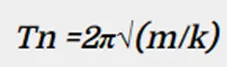
Where, k is the total stiffness and m is the total mass.
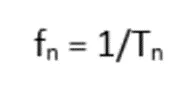
Natural frequency (f): The frequency is nothing but the number of vibrations in a second and is the inverse of the time period. Reciprocal of the natural period of a building its nothing but the natural frequency and unit is Hertz (Hz)
5.Explain in detail about Response spectrum & its Graph?
Answer:
A response spectrum it is a graphical plot of the frequency of an oscillator and it is damping. The response spectrum plot represents the peak or steady-state response of a series of oscillators of varying natural frequencies. In the vibration analysis of any system, the response spectrum is very useful as the resulting plot can provide the response of any linear system with respect to its natural frequency. Response Spectrum Analysis is a scientific method for estimating the structural response of dynamic vibration events.
It’s a central concept in the earthquake engineering, response spectrum is a practical means of characterizing ground motions and their effects on structures of different Tn
It provides a convenient means to summarize the peak response of all possible linear SDF systems to a particular component of ground motion
It also provides a particular approach to apply the knowledge of structural dynamics to the design structures and development of lateral force requirements in building codes
A plot of the peak value of a response quantity (u,v and a) as a function of the natural vibration period Tn of the system, is called the response spectrum for that quantity
Each such plot is for SDF systems having a fixed damping ratio ζ and several such plots for different values ζ are included to cover the range of damping values encountered in actual structures
The response spectrum can be of three types, the deformation response spectrum is a plot of peak u, against Tn for fixed ζ. A similar plot for peak ú, is the relative velocity response spectrum, and for peak üT, is the acceleration response spectrum
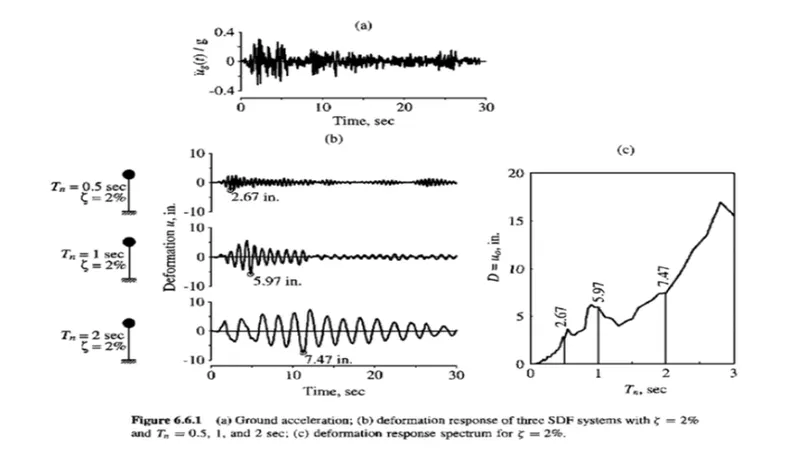
The First Peak deformation we obtain is 2.67 inch for Tn=0.5sec and Շ = 2%
Second Peak deformation we obtain is 5.97 inches for Tn=1sec and Շ = 2%
The third Peak deformation we obtain is 7.47 inches for Tn=2sec and Շ = 2%
In x-axis, it shows the natural period of vibration and y-axis peak displacement.