Structural dynamics
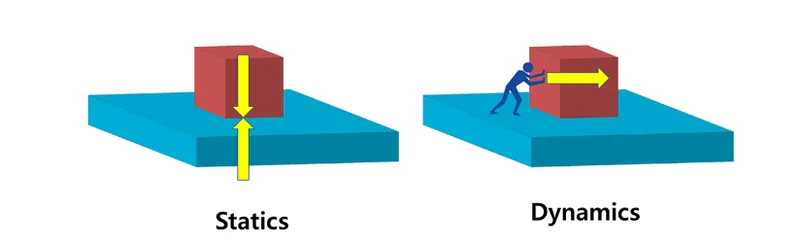
1. Differentiate Static analysis and Dynamic analysis with proper representing pictures.
Ans:
Static Analysis:
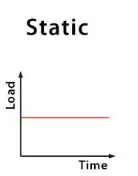
- Static analysis of structures considers static loads acting on the structure such as dead,live load which does not vary with time.
- In Static analysis the structure considered doesn't depend on time.
- In this case loads are constant and not any kind of inertia forces is considered.
- In static analysis the the structure is taken as constant & dynamic forces is not considered only elastic force is taken in to account.
Dynamic Analysis:
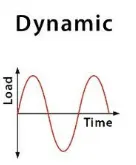
- Dynamic analysis of structure consideres dynamic loads acting on structure such as seismic load, wind load etc which varies wrt time.
- In dynamic analysis the loadings on the structure considered depends on time.
- In this case loads are not constant, inertia force generated due to accelaration is considered.
- Motion of the structure is considered in dyna mic analysis.
2. Explain the following with relevant force-displacement graph.
- Elastic behavior
- Inelastic behavior
- Plastic behavior
- Non-linear Inelastic behavior
Ans:
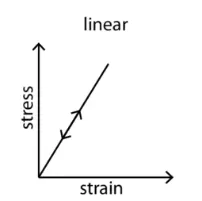
- Elastic behavior
- Elasticity, ability of a deformed material body to return to its original shape and size when the forces causing the deformation are removed. A body with this ability is said to behave (or respond) elastically.
- Stresses beyond the elastic limit cause a material to yield or flow.
- For such materials the elastic limit marks the end of elastic behaviour and the beginning of plastic behaviour.
b. Inelastic behavior
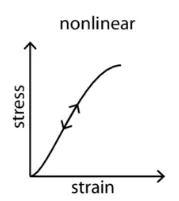
- Inelasticity, Deformation of a material that does not disappear on removal of the force that produced in it.
- The material undergone deformation acts opposite to elastic behaviour.
- In inelastic material the material undergoes with no deflection and rupture will suddenly occure when the material reaches its ultimate strength.
c. Plastic behavior
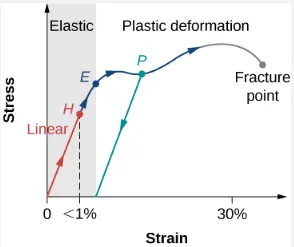
- The characterstics of material by which it undergoes inelastic strain beyond those at the elastic limit is known as plasticity or plastic behaviour of material.
- This property is particularly useful in operatin of prestressing and forging.
- When large deformation occurs in a ductile material loaded in plastic region the material is said to undergo plastic flow.
d. Non-linear Inelastic behavior
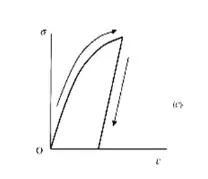
- When the material goes under very large & significant deformation, after the propertional limit of the material the relationship between stress and strain is not linear & that is non linear elastic behavior.
- Nonlinear elasticity is the subject that deals with materials that are capable of large, reversible deformations. Of specific importance are deformations of polymeric composites, elastomers and soft tissues.
3. Explain Mass, Stiffness & Damping components in the equation of motion.
Ans:
- Mass component: The mass componenet in equation of motion considers only the mass of the frame and stiffness and damping is neglected. The force is related with mass component with the following equation.
- f(i)=mu.
- Stiffness component: The rigidity of the material to resist deformation is called as the stiffness and in this component only stiffness is considered in the frame and other mass and damping components are neglected. The force is related with stiffness componet with the following equation
- f(s)=ku.
- Damping component: Damping is the dissipiation of energy due to vibrations over time and distances. It occurs due to the friction between structural and non stuctural elements. The force is related with damping component with the following equation.
- f(d)=cu˙
- Hence the equation of motion can be written as
- mu¨+ fd + fs = p(t)
- => mu¨ + cu˙ + ku = p(t)
where p(t) is the external force.
4. Provide relationship between Natural period (Tn) & Natural frequency (f) and provide their definitions.
Ans:
Natural period:
- The natural period of a building is simply a time taken by it to undergo one complete cycle of oscillation.
- The natural period is one of the properties or building which is controlled by mass and stiffness.
- Formula to find out natural period is,
- Tn =2π√(m/k)
-
where,
- Tn is a natural period of building.
- m is mass
- k is stiffness
-
- Tn =2π√(m/k)
Natural frequency (f)
- The natural frequency is defined as the number of cycles i.e, one full cycle of free vibration completed in one second. It is denoted in radians/sec.
- The relation between and natural period and natural frequency is that frequency is inversely propotional to the period of vibration.
- fn=1/Tn
5.Explain in detail about Response spectrum & its Graph.
Ans:
Response Spectrum:
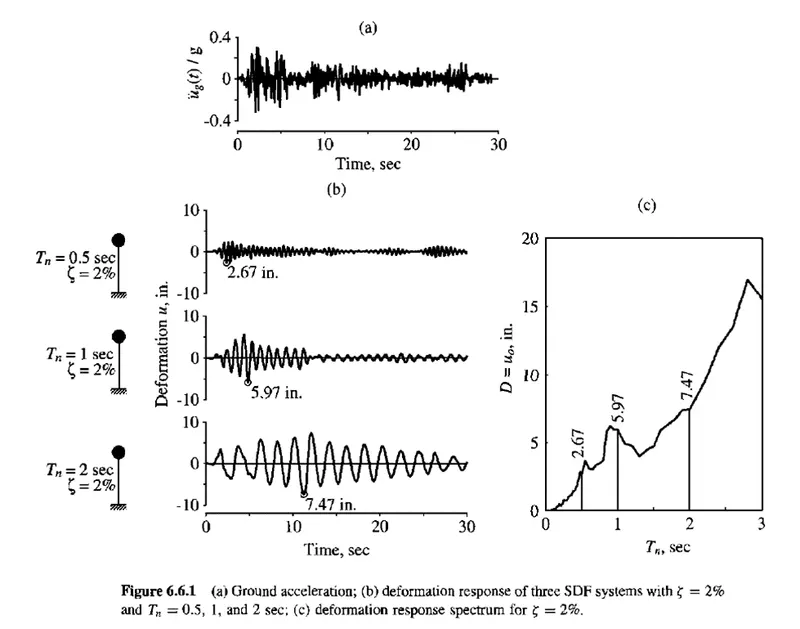
- Response-spectrum analysis (RSA) is a linear-dynamic statistical analysis method which measures the contribution from each natural mode of vibration to indicate the likely maximum seismic response of an essentially elastic structure. Response-spectrum analysis provides insight into dynamic behavior by measuring pseudo-spectral acceleration, velocity, or displacement as a function of structural period for a given time history and level of damping. It is practical to envelope response spectra such that a smooth curve represents the peak response for each realization of structural period.
- A response spectrum is a function of frequency or period, showing the peak response of a simple harmonic oscillator that is subjected to a transient event. The response spectrum is a function of the natural frequency of the oscillator and of its damping. Thus, it is not a direct representation of the frequency content of the excitation, but rather of the effect that the signal has on a postulated system with a single degree of freedom (SDOF).
- A plot of the peak value of a response quantity (u,v and a) as a function of the natural vibration period Tn of the system,is called the response spectrum for that quantity
- Each such plot is for SDF systems having a fixed damping ratio ζ and several such plots for different values ζ are included to cover the range of damping values encountered in actual structures
- The response spectrum can be of 3 types , the deformation response spectrum is a plot of peak u, against Tn for fixed ζ . A similar plot for peak ú, is the relative velocity response spectrum, and for peak üT ,is the accelaration response spectrum