Structural dynamics
1. Differentiate Static analysis and Dynamic analysis with proper representing pictures (30 marks)
Ans:-
Aim: To differenciate about Static analysis and dynamic analysis with proper representing pictures.
| SrNo. | Static Analysis | Dynamic Analysis | ||
| 1. |
|
|
||
| 2. |
|
|
||
| 3. |
|
|
||
| 4. |
|
|
||
| 5. |
|
|
||
| 6. |
|
|
||
| 7. |
|
|
- This image is represented by Static analysis and Dynamic analysis.
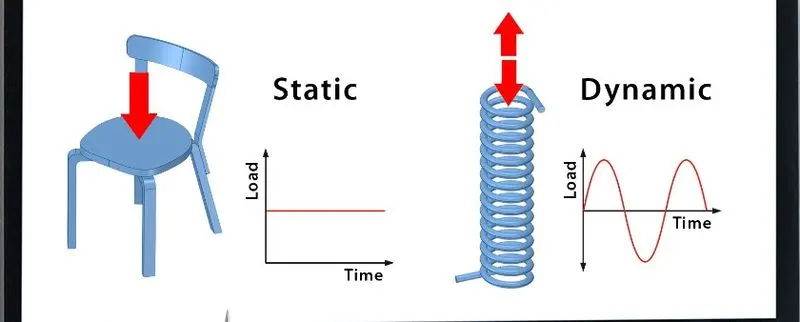
- The distinction is made between the dynamic and the static analysis on the basis of whether the applied action has enough acceleration in comparison to the structure's natural frequency.
- The equation of equilibrium for a structure under static loading is:f=ku, where u is the displacement.
- Unlike static loading's which remain constant or act in such a manner so that there is no substantial variation in structural response with time, dynamic loading's vary substantially with time, thus the structural response needs to be calculated at every time instant.
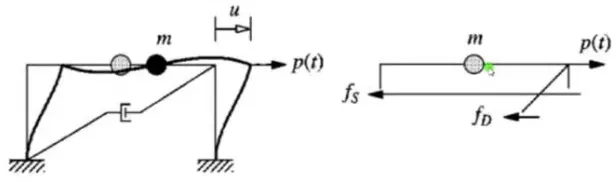
- The equation of equilibrium for a structure under dynamic loading is:mu¨(t)+cu˙(t)+ku(t)
where, u¨ is the acceleration (the double derivative of the displacement) and is the velocity(the single derivative of the displacement).
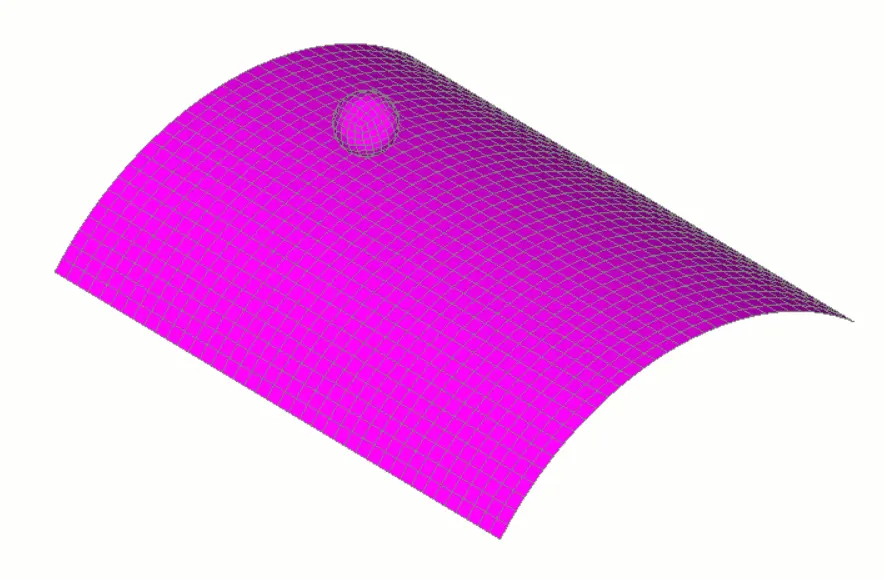
Inertia effects-
2. Explain the following with relevant force-displacement graph (40 marks)
- Elastic behavior
- Inelastic behavior
- Plastic behavior
- Non-linear Inelastic behavior
Ans:-
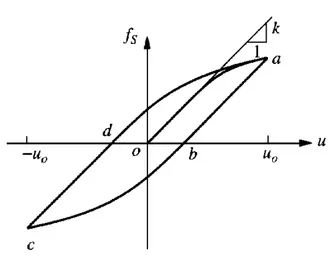
- Under cyclic deformation due to earthquake, the intial loading curve is non - linear with larger amplitude of formation.
- After initial loading there are unloading and reloading curves. Both differ from initial loading branch.
- We see that at certain point in cyclic loading it becomes non linear until the point (a).
- Then there is unloading then load moves in negative direction and then there is reloading then it doesnot follow intial unloading path. It will follow a new path.
- This implies the fs coressponding an inbuilt direction (lateral deformation) is not a single value. It depends on the history of deformation
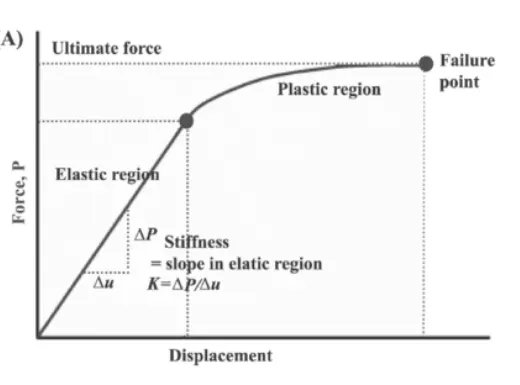
Force displacement fraph on Elastic behavior:-
- Elasticity, ability of a deformed material body to return to its original shape and size when the forces causing the deformation are removed.
- For a linear elastic system the relationship between the lateral force fs and resulting deformation u is linear that is, fs=ku; where k is the lateral stiffness of the system; its unit are force/length.
- In linear deformation k is constant
- This deformation would be linear at smaller displacement. But would become non linear at larger deformations.
- Elastic behavior is the property of the material upto which the material can retain it's shape. From the aforementioned graph it is clearly mentioned that upto a certain point from "O" the graph is linear and shown its elastic properties.
Force-displacement graph of Inelastic behavior:-
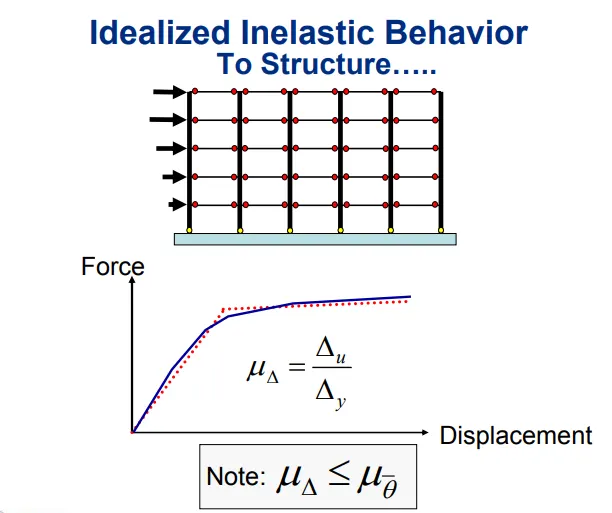
- For extreme loadings, the structure is allowed to experience a limited amount of deformation beyond the elastic limit.
- This deformation is called “inelastic” since in contrast to elastic deformation, when the loading is removed, the structure does not return to its original position.
- Inelastic behavior is the property of the material when the material can't retain it's previous shape after a certain deformation. In the aforementioned graph inelastic behavior has been shown in the upper shape of the curve upto point "a".
Force-displacement graph of Plastic behavior:-
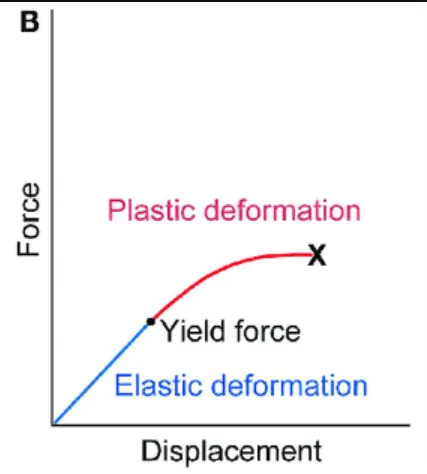
- For stresses beyond the elastic limit, a material exhibits plastic behavior.
- This means the material deforms irreversibly and does not return to its original shape and size, even when the load is removed.
- When stress is gradually increased beyond the elastic limit, the material undergoes plastic deformation.
- Plastic behavior occurs when the material completely lost it's ductility. In the above mentioned graph plastic behavior occurs during unloading after point "a".
Force-displacement graph of Non-linear Inelastic behavior:-
- Force displacement relationship becomes non-linear and inelastic at large deformations
- Force fs corresponding to deformation is not single valued and depends on history of deformations and whether deformations is increasing or decreasing. Thus the resisting force can be expressed as: fs=fs(u,v).
- Non-linear inelastic behavior occurs after the line from "O" tends to bend towards point"a".
3. Explain Mass, Stiffness & Damping components in the equation of motion (30 marks)
Ans:-
The single degree of freedom system can be viewed as a combination of 3 pure independent system
- The stiffness component
- The damping component
- The mass component
1.Stiffness:
- Stiffness relates to how a component bends under load while still returning to its original shape once the load is removed. Since the component dimensions are unchanged after load is removed, stiffness is associated with elastic deformation. A material can have high strength and low stiffness.
The stiffness component:-
- The term stiffness is used in earthquake engineering to designate how well a building will endure large lateral displacements imposed by ground shaking.
- Stiffness is a measure of how much force is required to displace a building by a certain amount.The frame without damping or mass.
- The external force fs on the stiffness component is related to displacement u by fs=ku
- If the system is linearly elastic.
2.Damping:
- Damping is a reduction in vibration over a period of time. Damping will eventually bring a vibrating object to rest. A damping mechanism suppresses vibrations of the structure.
The Damping component:-
- Damping is the dissipation of vibratory energy in solid mediums and structures over time and distance.
- Similar to the absorption of sound in air, damping occurs whenever there is any type of friction that diminishes movement and disperses the energy.
- The frame with its damping property but no stiffness or mass .
- The external force on the damping component is related to velocity by fd=cv.
3.Mass:
- Newton's second law, which states that the force F acting on a body is equal to the mass m of the body multiplied by the acceleration a of its Centre of mass, F = ma, is the basic equation of motion in classical mechanics.
- Mass is always constant for a body. One way to calculate mass: Mass = volume × density. Weight is the measure of the gravitational force acting on a mass.
The mass component:-
- The vertical irregularities in structures are Stiffness irregularity, Mass irregular, Vertical geometric irregularity, Discontinuity in capacity. A. Centre of Mass.
- The centre of mass is a position defined as the average position of all the parts of the system, weighted according to their masses.
- The roof mass without the stiffness or damping of the frame.
- The external force f1 on the mass component is related to acceleration by fi=mu¨
mu¨+ fd + fs = p(t) that is mu¨ + cu˙ + ku = p(t)
- Now, the external force p(t) is appilied to the complete system. They may therefore visualized among the 3 components of the structure. That is inertial, stiffness and damping force.
4. Provide relationship between Natural period (Tn) & Natural frequency (f) and provide their definitions (25 marks)
Ans:-
Aim:- Relationship between Natural period (Tn) & Natural frequency (f) and provide their definitions
Natural period (Tn):-
- The natural vibration of the system (Tn) is the time required for the undamped system to complete one cycle of free vibration (unit is seconds).
- It is related to the natural circular frequency of vibration, ωn, in units of radians per second. With, Tn = 2π/ωn or ωn = 2π/Tn
Natural frequency (f):-
- The number of cycle (or one complete revolution) executed by system in one second with units in hertz. Where, fn=1/Tn
- Natural vibration properties ωn, Tn and f depends only on mass and stiffness of the structure.
- Tn, ωn, fn (Natural vibration pproperties) depends only on two quantities that is mass and stiffness.
- ωn = sqrt(k/m), the stiffer of single degree of freedom having the same mass will have higher natural frequency and the shorter natural period.
- Natural frequency and Natural time period is inversely proportional to each other.
- Similary, the heavier of 2 structures (or) one with more mass and if both structure have the same stiffness. The one with the heavier mass will have the lower frequency and lower frequency and longer natural period.
- ωn, n is natural (indicates to emphasize the natural properties of system and when it is allowed freely without any natural excitation).
- It is important to remember that earthquake last for few seconds. The Ground motion subsides freely vibrates the structure based on the velocity, displacement impacted to it. Because, the system is linear these vibration properties are independent of displacement and velocity.
- These properties are related to its mass and stiffness,
- The natural vibration properties ωn, Tn and fn depends only on the mass and stiffness of the structure. That is k=mw2.
- The stiffer of 2 single degree of freedom system having the same mass will have the shorter natural period (less time to comlete one cycle) and higher natural frequency.
- Similarly the heavier mass of two structures having the same stiffness will have the longer natural period and the lower natural frequency. That is ωn = sqrt(k/m).
- Frequency and time periods is inversely proportional the number of vibrations per second is frequency.
f=1/t or t=1/f
5. Explain in detail about Response spectrum & its Graph (25 marks)
Ans:-
- A central concept in earthquake engineering, response spectrum is a pratical means of characterizing ground motion and their effects on structures of different Tn.
- It provides a convenient means to summarize the peak response of all possible linear single degree of freedom systems to a particular component of ground motion.
- It also provides a practical approach to apply the knowledge of structural dynamics to the design structures and development of lateral force requirements in building codes.
- A plot of the peak value of a response quantity (u, v and a) as a function of the natural vibration period Tn of the system, or a related parameter such as circular frequency ωn or cyclic frequency fn, is called the response spectrum for that quantity.
- Each such plot is for Single Degree of Freedom systems having a fixed damping ratio Շ, and several such plots for different values of Շ are included to cover the range of damping values encountered in actual structures.
- A variety of response spectra can be defines depending on the response quantity is plotted. Consider the following peak responses.
- The response spectrum can be of 2 types. The deformation response spectrum is a plot of peak u, against Tn for fixed Շ.
- A similar plot for peak u˙, is the realtive velocity response spectrum, for the peak u¨, is the acceleration response spectrum.
Deformation Response Spectrum:-
- Here is the paticular ground motion that is L-centro earthquake.
- The response developed for L-centro earthquake as shown.
- Now, the time variation of the deformation induced in the ground motion in 2 different single degree of freedom system is presented.
- Each single degree of freedom as its own period of vibrations that is Tn=1sec and Tn=2sec. And the damping ratio kept constant.
- Each of the single degre freedom system subjected this earthquake. That is the displacement history that we obtain.
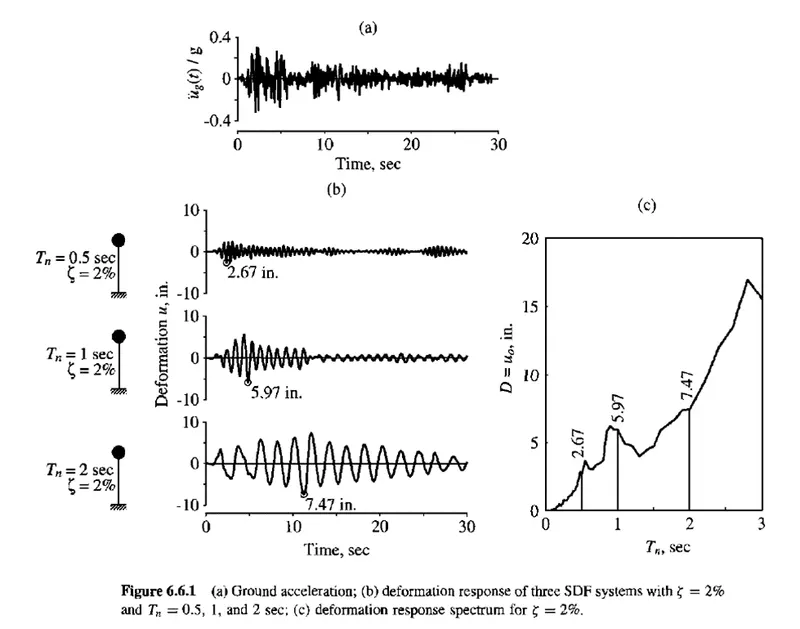
- First Peak deformation we obtain is 2.67 inch for Tn=0.5sec and Շ = 2%
- Second Peak deformation we obtain is 5.97 inch for Tn=1sec and Շ = 2%
- Third Peak deformation we obtain is 7.47 inch for Tn=2sec and Շ = 2%
- In x-axis it shows the natural period of vibration and y-axis peak displacement.
- Now, to determine the peak deformation value, repeat the process again and compute displacement for natural period vibration.
- For a range of single degree of freedom system with different period of vibration keep the damping ratio as constant.
- For getting the peak period of vibration that is displacement from response spectrum curve. That deformation can be multiplied by stiffness to get equivalent static force.
- From there we can do simple structural analysis to obtain the bending moment and shear force in the structure.
Pseudo-Acceleration Response Spectrum:-
- Pseudo acceleration for an single degree od freedom system with naturak frequency ωn is related to its peak deformation D = uo, due to earthquake ground motion: A = (ωn^2) * D = ((2π/Tn)^2) * D.
- The quantity A has units of acceleration and is related to the peak value of base shear Vbo (just another name for the peak value of the equivalent static force fso): Vbo = fso = mA (or) Vbo = (A/g)*ω.
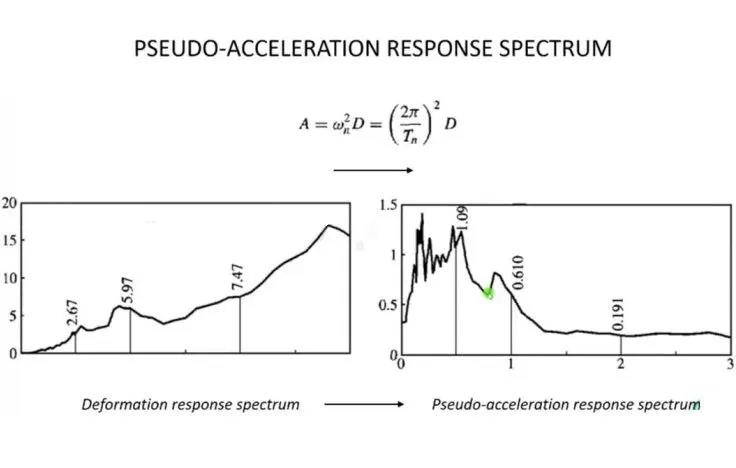
- A(t) is called pseudo acceleration and can be easily obtained by multiplying deformation at each instant of time with ωn^2 = ((2π/Tn)^2).
- Most codes world wide are force based values related to peak acceleration are mentioned in the code and those values can be easily multiply by mass of the structure to obtain the equivalent static force.
- When equivalent static force expressed in the form of deformation.
- The stiffness of the system as to be calculated and it can be leborious task.