Structural dynamics
STRUCTURAL DYNAMICS
Q1. Differentiate static analysis and dynamic analysis with proper representing pictures.
STATIC ANALYSIS:
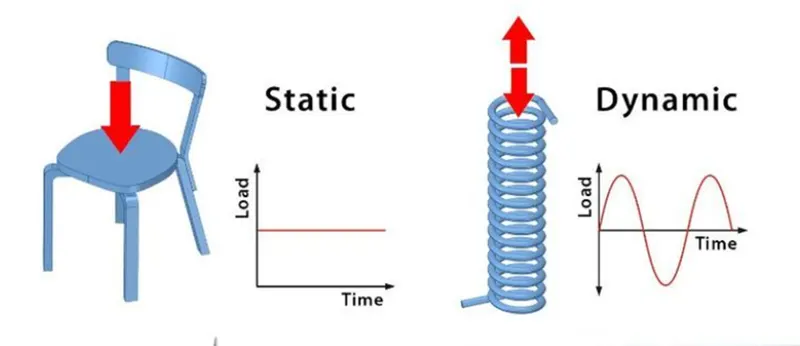
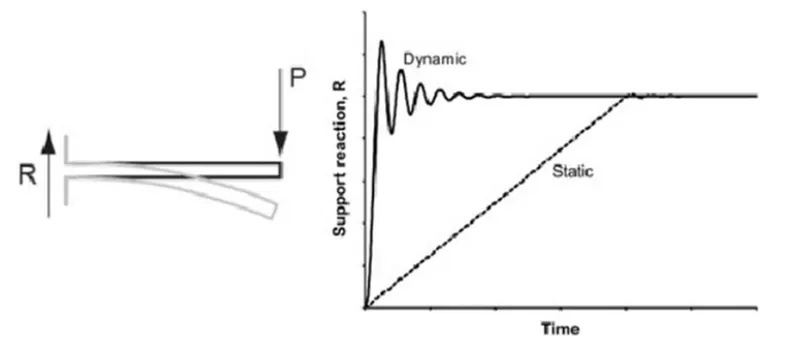
Static analysis of structures considers static loads acting on the structure such as dead, live load which does not vary with time and are not considered to be sudden. In static analysis stiffness matrix alone is considered and the inertial forces are not considered. Motion of the structure is not considered.
DYNAMIC ANALYSIS:
Dynamic analysis of structure considers dynamic loads acting on the structure such as wind, earthquake which varies with time. These loads are sudden and does not follow a constant pattern and vary with time. In dynamic analysis along with stiffness matrix, mass matrix and damping matrix is also included. Motion of the structure is considered.
So the basic difference between static and dynamic analysis is that the loads considered in static analysis does not vary with time whereas, the loads considered in dynamic analysis vary with time.
Q2. Explain the following with relevant force-displacement graph
- Elastic behaviour
- Inelastic behaviour
- Plastic behaviour
- Non-linear inelastic behaviour
ELASTIC BEHAVIOUR:
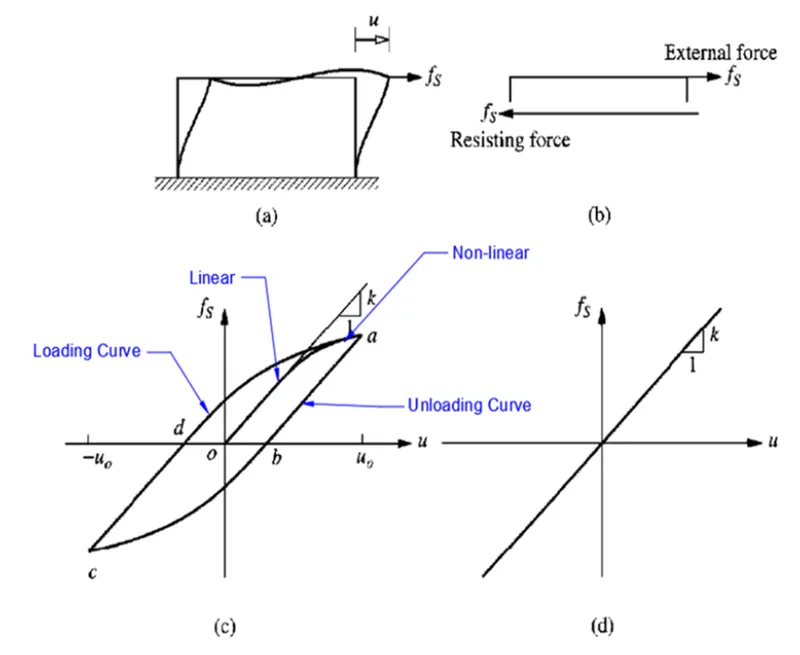
Elastic behaviour can be defined as the ability of a component to return to its original shape when an application of external loading is removed. The explanation is that any component under loading like compression or tension loses its original shape and tends act according to the load and when the load is removed the component restores to its original shape when the loading is removed. For linear system force can be expressed as fs=ku where k is lateral stiffness constant.
INELASTIC BEHAVIOUR:
Inelastic behaviour of materials is defined as the inability of the material to return to its original shape when the load is removed and tend to be in the deformed shape. The material undergone deformation acts opposite to elastic behaviour hence, called as inelastic behaviour.
PLASTIC BEHAVIOUR:
The property of the material which has the deformed shape and permanent strain in it when the loading is removed is called the plastic behaviour of structure. The plastic behaviour of the structure occurs beyond the yield point of the structure and the deformation is irreversible even when the loading is removed. It occurs beyond point ‘a’ after unloading as represented in the curve.
NON-LINEAR INELASTIC BEHAVIOUR:
When large deformation occurs at the material, the force displacement relationship of the material becomes non-linear. Force corresponding to displacement is not single valued in non-linear behaviour and depends on the history of deformations of the material. For non-linear system force can be expressed as fs=fs(u,v).
Q3. Explain mass, stiffness & damping components in the equation of motion.
The equation of motion in single degree of freedom system consists of three independent system components acting on the frame.
MASS COMPONENT:
The mass component in equation of motion considers only the mass of the frame and stiffness and damping are considered to neglected. The force is related with mass components with the equation of fi = mu
STIFFNESS COMPONENT:
The rigidity of the material to resist deformation is called as the stiffness and in this component only stiffness is considered in the frame and other mass and damping components are neglected. The force is related with stiffness component with the equation of fs = ku.
DAMPING COMPONENT:
Damping is the dissipation of energy due to vibrations over time and distances. It occur due to the friction between structural and non-structural elements. The force is related with damping component with the equation of fd = cu.
Hence the equation of motion can be written as
mu + fd + fs = p(t) that is mu + cu + ku = p(t) where p(t) is the external force.
Q4. Provide relationship between natural period (Tn) & natural frequency (f) and provide their definitions.
NATURAL PERIOD:
The time taken for undamped system to complete one cycle of free vibration is called as the natural period of vibration and it is denoted by the formula Tn = 2π/ωn and the unit is seconds.
NATURAL FREQUENCY:
The natural frequency is defined as the number of cycles i.e., one full cycle of free vibration completed in one second. It is denoted in radians/sec.
The relation between and natural period and natural frequency is that frequency is inversely proportional to the period of vibration.
fn = 1/Tn
Q5. Explain in detail about response spectrum & its graph.
RESPONSE SPECTRUM:
It is a concept of characterizing the ground motion and their effects on structure of different time period Tn. A plot of the peak value of a response activity (u, v, a) as a function of natural vibration period Tn of the system is called the response spectra. The peak response of all linear single degree of freedom systems can be computed by response spectra plot. Three types of plot are generally plotted with u and Tn as deformation response spectra and a similar plot is done with u* as relative velocity spectrum and with u** as acceleration response spectrum. Each plot is done with fixed damping ratio and several such plots with different damping ratio are created for the range of damping values encountered in the structures.
DEFORMATION RESPONSE SPECTRUM:
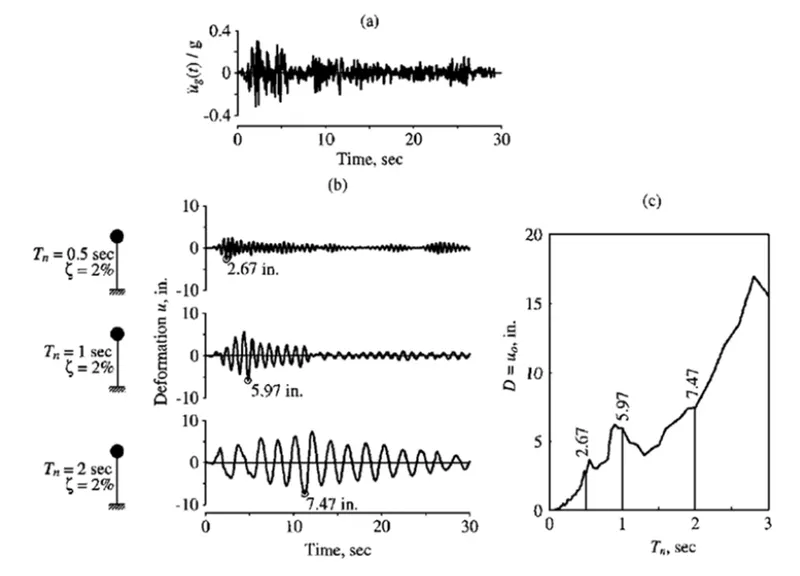
The above image contains the plot with deformation with respect to time. The 1st plot (a) represents the ground acceleration recorded during a earthquake. The second plot (b) represents the plots of deformation response of three independent SDF systems. In each plot of b has been done within fixed damping ratio as 2% and variation in natural time period as 0.5s, 1s, 2s and the corresponding deformations are obtained with respect to time. Finally a plot of recorded dimensions and Tn is done to record the peak responses. So based on the time period of vibration the deformation of the system can be obtained which can be multiplied with stiffness to obtain equivalent static force which can be further used for the analysis of the structure.
PSEUDO ACCELERATION RESPONSE SPECTRUM:
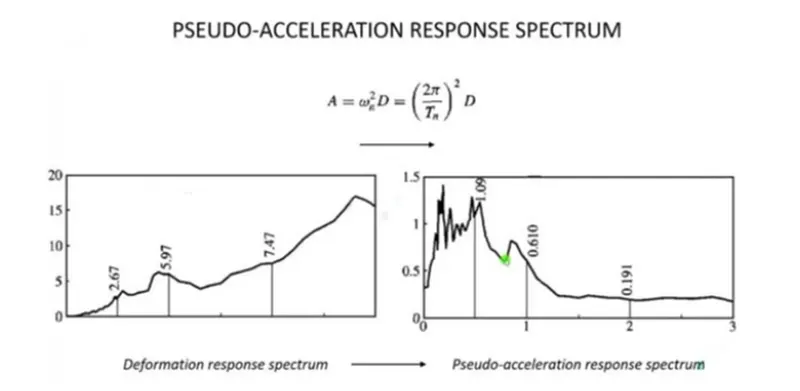
Pseudo acceleration for a single degree of freedom system with natural frequency ωn is related to its deformation D = uo, due to earthquake ground motion: A = (ωn^2)*D = ((2π/Tn)^2)*D. The D here represents relative deformation and not total deformation hence, the acceleration obtained is relative so, it is called as pseudo acceleration. The quantity A has units of acceleration and it is related with base shear Vbo. Vbo = fso = mA (or) Vbo = (A/g)*ω. In this formula A/g is base shear coefficient which is acceleration divided by gravitational force. So, multiplying this with total mass of the structure provides total base shear or equivalent static force which can be used for analysis of the structure. Pseudo- acceleration can be calculated by multiplying deformation with natural circular frequency of vibration at any instant of time.