Sketch a G+1 residential plan according to Vaastu Shastra and Calculation of Loads as per IS code
G+1 residential plan
Aim:
The main objective of this project is to plan a G+1 residential plan according to Vaastu shastra and calculation of loads as per IS code.
Introduction:
Vaastu shastra is the ancient Indian science of architecture and acts as a guideline to design your home in the way that enhances positive energy. Our nature is abundant with powerhouse of energy sources like the sun, wind, moon, water, earth and fire. A good home needs to radiate the right kind of energy.
Structural loads are forces applied to the structure components. Structural loads are important consideration in the design of buildings. Assessment of their effects is carried out by structural analysis. Excess loads may cause structural failure. The different types of loads acting on a structure are broadly classified into two types:
- Vertical load
- Dead load
- Live load
- Snow load
- Horizontal load
- Wind load
- Seismic load
- Temperature load
Procedure:
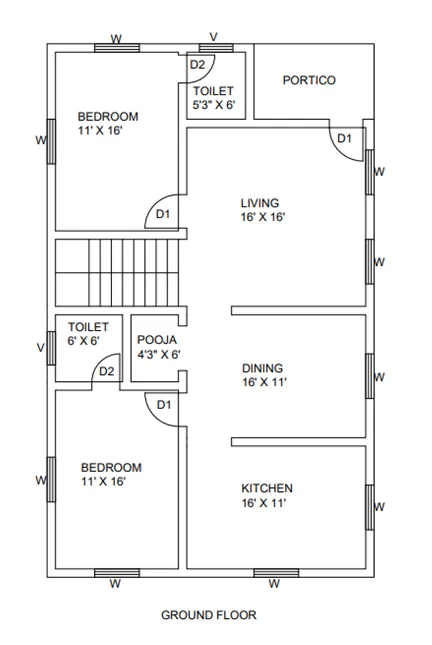
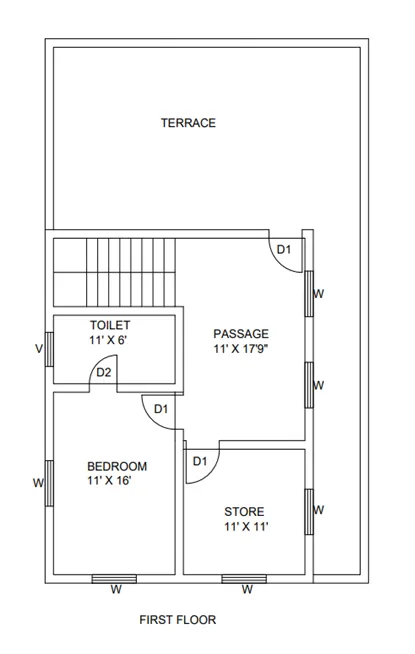
The important structural drawings required to be provided to the site for construction are:
- Centre line drawing
- Footing and column layout with reinforcement details
- Column schedule with reinforcement details
- Plinth beam layout with reinforcement details
- First floor beam layout with reinforcement details
- First floor beam slab layout with reinforcement details
- Lift pit and headroom reinforcement details
G+1 residential plan is considered as above with ground floor and first floor
Here,
D1 is a door with width 3 feet and height 7 feet
D2 is a door with width 2.5 feet and height 7 feet
W is a window with width 4 feet and height 4 feet
V is ventilation with width 3 feet and height 3 feet
Height of each floor is considered as 11 feet
Columns are considered at all corners of a room, so there will be 18 columns in ground floor and 11 columns in first floor
All Column size is considered as 0.75 feet x 1 feet
All Beam size is considered as 0.75 feet x 1.25 feet
Size of each room is considered as above
Wall in terrace area is considered as 3 feet
Slab thickness is considered as 0.5 feet
- Dead load:
- For column:
Volume of column = 0.75*1*11 = 8.25 feet^3 = 0.233 m^3
Unit weight of concrete = 25 KN/m^3
Dead weight of all columns at ground floor = 18*25*0.233 = 104.85 KN
Dead weight of all columns at first floor = 11*25*0.233 = 64.075 KN
Total dead weight of all columns = 168.925 KN
- For beam:
Cross-section area for beam = 0.75*1.25 = 0.9375 feet^2
At plinth beam,
Length of all beam = 280.25 feet
Volume of plinth beam = 280.25*0.9375 = 262.734 feet^3 = 7.439 m^3
Unit weight of concrete = 25 KN/m^3
Dead weight of plinth beam = 25*7.439 = 185.975 KN
At lintel beam of ground floor and ground floor roof,
Dead weight of lintel beam and ground floor roof is same as plinth beam = 3*185.975 = 557.925 KN
At lintel beam of first floor and first floor roof,
Length of all beam = 156.5 feet
Volume of lintel beam = 156.5*0.9375 = 146.718 feet^3 = 4.154 m^3
Unit weight of concrete = 25 KN/m^3
Dead weight of lintel beam = 25*4.154 = 103.85 KN
Dead weight of lintel beam and first floor roof = 2*103.85 = 207.7 KN
Total dead weight of all beam = 557.925+207.7 = 765.625 KN
- Wall load
Unit weight of brick wall = 20 KN/m^3
Between ground level and lintel level,
Height of wall = 7 feet
Cross-section of wall = 0.75*7 = 5.25 feet^2
Length of wall excluding few areas where wall is not constructed = 258.25 feet
Volume of wall = 258.25*5.25 = 1355.812 feet^3 = 38.392 m^3
Volume of Door, window, ventilation and openings in ground floor = 47.25+108+13.5+63+31.5+26.25 = 289.5 feet^3 = 8.197 m^3
Dead weight of wall = 20*(38.392-8.197) = 603.9 KN
Between lintel and ground floor rood,
Height of wall = 10-0.5-7-1.25 = 2.25 feet
Length of wall = 280.25 feet
Volume of wall = 280.25*2.25*0.75 = 472.921 feet^3 = 13.391 m^3
Dead weight of wall = 20*13.391 = 267.82 KN
Between ground floor roof and first floor lintel excluding terrace area,
Height of wall = 7 feet
Length of wall = 156.5 feet
Volume of wall = 156.5*7*0.75 = 821.625 feet^3 = 23.265 m^3
Volume of door, window, ventilation and opening in first floor = 47.25+13.125+31.5+72+6.75 = 170.625 feet^3 = 4.831 m^3
Dead weight of wall = 20*(23.265-4.831) = 368.68 KN
Between lintel and ground floor rood,
Height of wall = 10-0.5-7-1.25 = 2.25 feet
Length of wall = 156.5 feet
Volume of wall = 156.5*2.25*0.75 = 264.093 feet^3 = 7.478 m^3
Dead weight of wall = 20*7.478 = 149.56 KN
Terrace area,
Height of wall = 3 feet
Length of wall = 94.25 feet
Volume of wall = 94.25*3*0.75 = 212.062 feet^3 = 6.004
Dead weight of wall = 20*6.004 = 120.08 KN
Total dead load of wall = 1510.04 KN
- Slab load
Thickness of slab = 0.5 feet
Unit weight of concrete = 25 KN/m^3
At ground floor roof,
Volume of ground floor roof slab = 0.5*(1179) = 589.5 feet^3 = 16.692 m^3
Dead load of ground floor roof = 25*16.692 = 417.3 KN
At first floor roof,
Volume of first floor roof slab = 0.5*(558.25) = 279.125 feet^3 = 7.903 m^3
Dead load of first floor roof = 25*7.903 = 197.575 KN
Total dead load of slab = 614.875 KN
Total dead load = 3059.465 KN
- Live load:
At ground floor,
Live load = 2 KN/m^2
Live load = 2*1113 = 2226 KN
At first floor,
Live load = 2 KN/m^2
Live load = 2*624.25 = 1248.5 KN
Total live load = 3474.5 KN
- Wind load:
Here, the height of building is 22 feet = 6.705 m
Wind load is applicable of building height greater than 10 m
So, here wind load = 0
- Load combination using limit state of collapse as per IS 456 (greater of all combination is considered for further design calculation):
- 5DL + 1.5 IL = 1.5*(3059.465+3474.5) = 9800.947 KN
- 2DL + 1.2IL + 1.2WL = 1.2*(3059.465+3474.5+0) = 7840.758 KN
- 5DL + 1.5WL = 1.5*(3059.465+0) = 4589.197 KN
- 9DL + 1.5WL = 0.9*3059.465 = 2753.518 KN
Greater of all is selected for further design calculation = 9800.947 KN
Result:
Here, in this project initially a G+1 is designed using Vaastu shastra to enhance the positive energy in the house. With the help of assumptions, the dead load, live load and wind load are calculated which helps to design the reinforcement for columns, beams, slabs, etc. here,
dead load = 3059.465 KN
live load = 3474.5 KN
wind load = 0 KN
as per IS 456 load combinations are calculated and greater of all is selected for further calculation. Here, seismic load and snow load is not considered since the height of the building is less than 10 m.