Structural dynamics
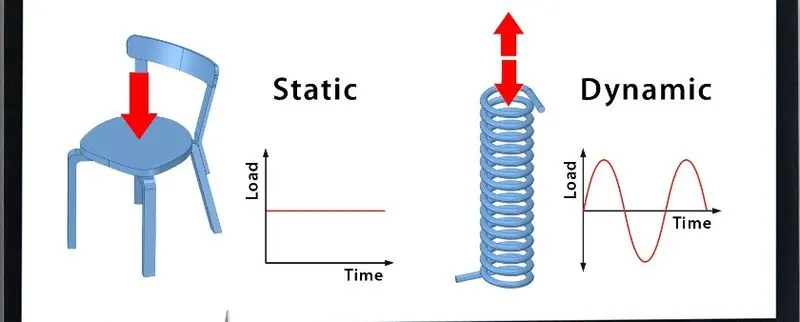
1. Differentiate Static analysis and Dynamic analysis with proper representing pictures
| Static Analysis | Dynamic Analysis |
| Static analysis time invariant analysis of forces like Stress, strain and displacement etc. | Dynamic analysis is time dependent analysis |
| The results are a consequence of the applied constraints and loads, for example, bearings, gravity, forces, etc. | Inertia and damping forces taken into account |
| Static loads applied on structure slowy | Dynamic Loads applied on the structures Suddenly |
| Example- Dead Load , Live load | Example- Earthquake load , Wind Load |
| Static analysis done with minimum three degree of freedom | Dynamic analysis of structure done with single degree of freedom |
| Static analysis done where the structure deformations behave linear | Dynamic analysis done where structure behaves non-linear deformations |
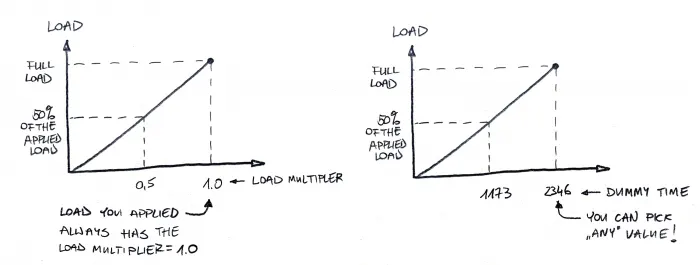
2. Explain the following with relevant force-displacement graph (40 marks)
- Elastic behavior
- Inelastic behavior
- Plastic behavior
- Non-linear Inelastic behavior
1.Elastic Behaviour-Ability of deformed matrrial body to return to its original shape and size when force causing the deformation are removed Ex. Rubber band. spring. etc.
2.Inelastic Behaviour-Deformatoion material that does not disappear on removal of force that produced it Ex. wood, fabric, etc.
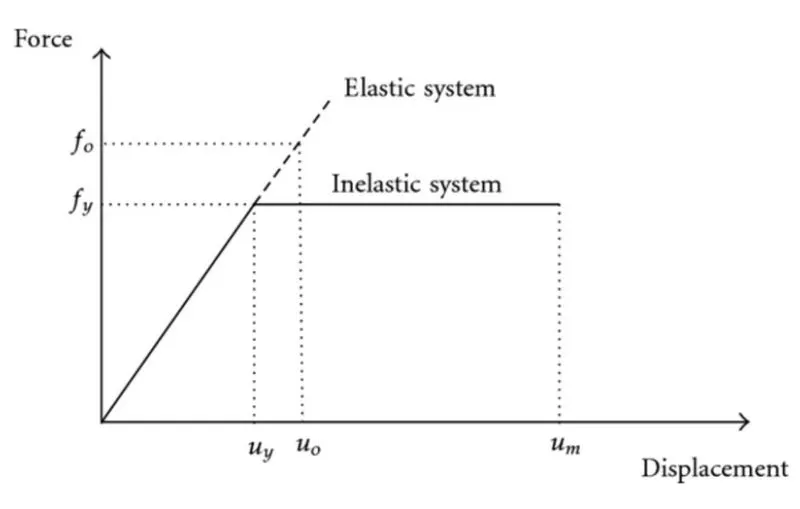
3.Plastic Behaviour-The material deforms irreversibly and does not return to its original shape and size even whe load is removed.
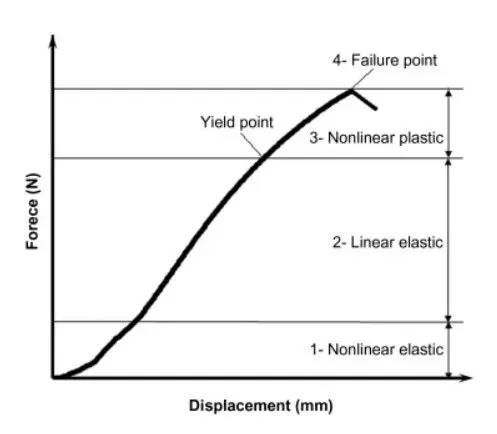
4.Non-linear elastic behaviour-Materials have elastic behaviour usually only upto a certain point after that deformation are plastic and relation in this is not linaer i.e. non linear elsatic behaviour.
3. Explain Mass, Stiffness & Damping components in the equation of motion
Mass:
Newton's second law, which states that the force F acting on a body is equal to the mass m of the body multiplied by the acceleration a of its Centre of mass, F = ma, is the basic equation of motion in classical mechanics.
Mass is always constant for a body. One way to calculate mass: Mass = volume × density. Weight is the measure of the gravitational force acting on a mass.
Stiffness component:
The frame without damping or mass. The external force fs on the stiffness component is related to displacement u by fs = ku, if the system is linearly elastic.
Damping component:
The frame with its damping property with no stiffness or mass. The external force on the damping component is related to velocity by
fd=cv
Where,
fD-Damping force
c-viscous damping coeff
u-velocity
4. Provide relationship between Natural period (Tn) & Natural frequency (f) and provide their definitions
Natural Period(Tn):-Time required for undamped system to complete one cycle of free vibration. Unit is in Seconds
Tn=2π/Wn
Natural Frequency(f):-Number of cycle (or one complete revolution) executed by system in one second. Unit is in hertz
f=1/Tn
Natural vibration properties Wn, Tn and f are depend only on mass and stiffness of structure.
5. Explain in detail about Response spectrum & its Graph
The typical earthquake ground motion response spectrum represents an envelope of the peak responses of many single-degree-of-freedom (SDOF) systems with different periods. The acceleration response spectrum of a ground motion is a relationship between the natural period of vibration of a sdof system and the maximum absolute acceleration that it experiences under the ground motion. Similarly, a displacement response spectrum typically represents the peak displacement, relative to the ground, of many sdof systems with different periods. Hence, the construction of a response spectrum involves the analysis of many different sdof systems. The value of each point on the spectrum is the peak response of a single degree of freedom system of a given period.