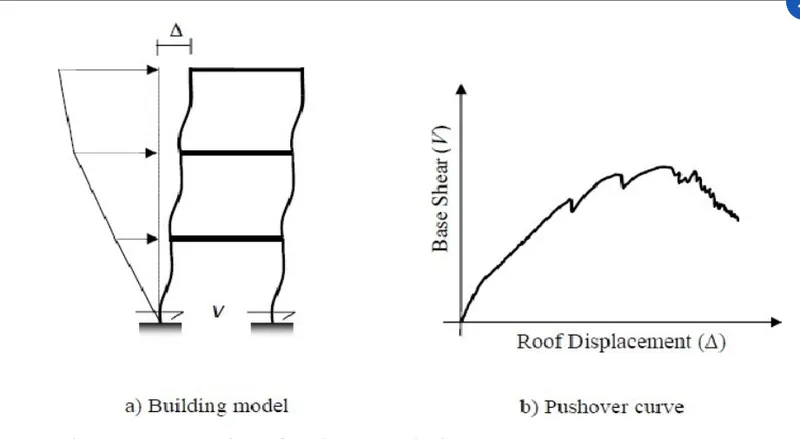
Structural dynamics
1)
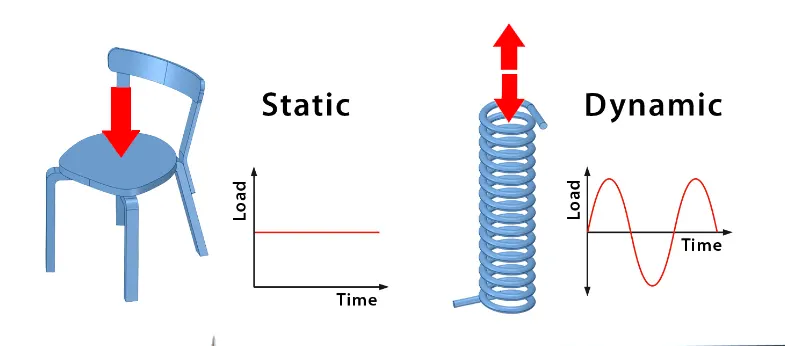
| STATIC | DYNAMICS | |
| Linear |
|
|
| Nonlinear |
|
|
2)
ELASTIC BEHAVIOR
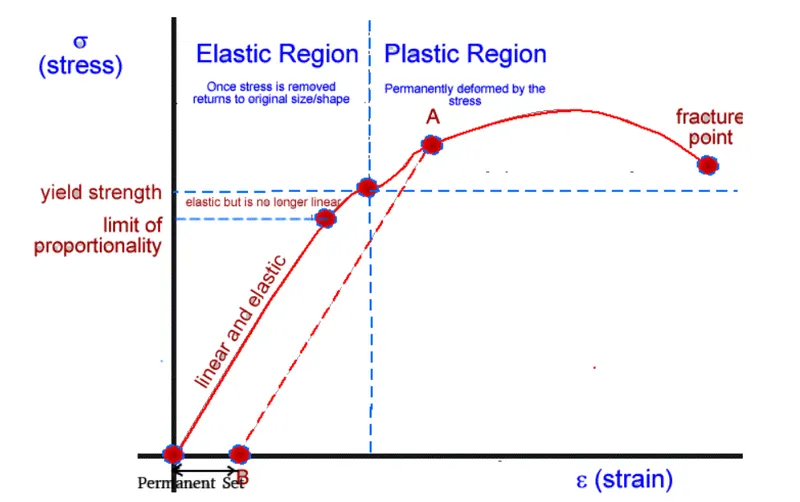
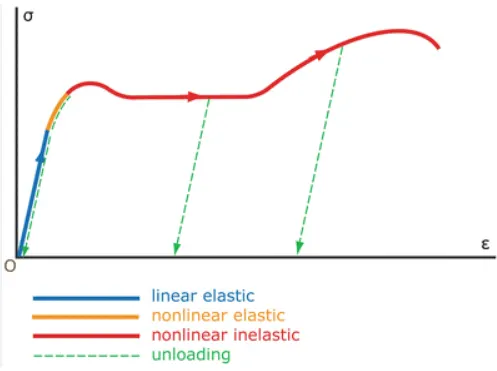
Elastic behaviour is the ability of a material to recover original shape after the force is removed. in a spring this occurs when the force is lower than the elastic limit. loading and unloading force extension curves can be different as long as it returns to its original shape.
INELASTIC BEHAVIOR
When an object is deformed, (stretched, bent or compressed), if it returns to its original shape once the forces are removed, it is an elastic deformation. If it does not return to its original shape it is an inelastic deformation.
PLASTIC BEHAVIOR
Plastic deformation is the permanent distortion that occurs when a material is subjected to tensile, compressive, bending, or torsion stresses that exceed its yield strength and cause it to elongate, compress, buckle, bend, or twist.
NON-LINEAR INELASTIC BEHAVIOR
Non-linear refers to behavior that is not directly proportional, as in the force required to deform something is not a constant multiple of the distance it is deformed.
3)
MASS
Mass is a measure of an object's resistance to acceleration when a force is applied. It is determined by applying a force to an object and measuring the acceleration that results from that force.
STIFFNESS
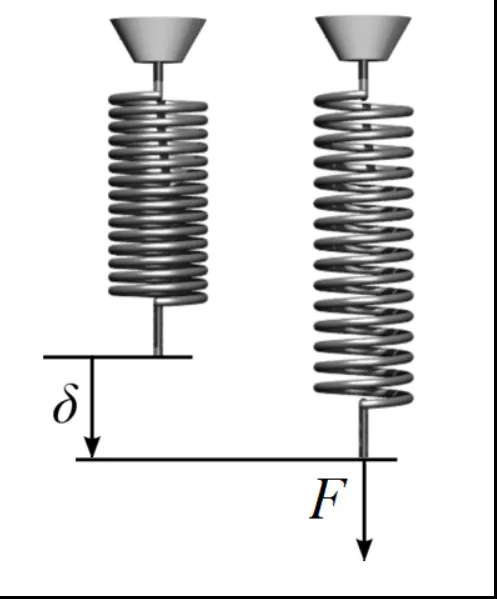
The stiffness K of a body is a measure of the resistance offered by an elastic body to deformation. For an elastic body with a single degree of freedom (DOF) (for example, stretching or compression of a rod), the stiffness is defined as

where,
 is the force on the body.
 is the displacement produced by the force along the same degree of freedom (for instance, the change in length of a stretched spring).
DAMPING
Damping forces are a special type of force that are used to slow down or stop a motion. The key point is that damping forces only work on vibratory motion or on systems that exhibit an oscillatory nature.
4)
NATURAL PERIOD(Tn)
The time taken for undamped system to complete one cycle of free vibration is called as the natural period of vibration and it is denoted by the formula Tn = 2π/ωn and the unit is seconds.
NATURAL FREQUENCY(f)
The natural frequency is defined as the number of cycles i.e, one full cycle of free vibration completed in one second. It is denoted in radians/sec.
The relation between and natural period and natural frequency is that frequency is inversely propotional to the period of vibration.fn=1/Tn.
5)
RESPONSE SPECTRUM
A response spectrum is a plot of the peak or steady-state response (displacement, velocity or acceleration) of a series of oscillators of varying natural frequncy, that are forced into motion by the same base vibration or shock. The resulting plot can then be used to pick off the response of any linear system, given its natural frequency of oscillation. One such use is in assessing the peak response of buildings to earthquake. The science of strong ground motion may use some values from the ground response spectrum (calculated from recordings of surface ground motion from seismographs) for correlation with seismic damage.
If the input used in calculating a response spectrum is steady-state periodic, then the steady-state result is recorded. Damping must be present, or else the response will be infinite. For transient input (such as seismic ground motion), the peak response is reported. Some level of damping is generally assumed, but a value will be obtained even with no damping.
Response spectra can also be used in assessing the response of linear systems with multiple modes of oscillation(multi-degree of freedom systems), although they are only accurate for low levels of damping. modal analysis is performed to identify the modes, and the response in that mode can be picked from the response spectrum. These peak responses are then combined to estimate a total response. A typical combination method is the square root of the sum of the squares (SRSS) if the modal frequencies are not close. The result is typically different from that which would be calculated directly from an input, since phase information is lost in the process of generating the response spectrum.
The main limitation of response spectra is that they are only universally applicable for linear systems. Response spectra can be generated for non linear systems, but are only applicable to systems with the same non-linearity, although attempts have been made to develop non-linear seismic design spectra with wider structural application. The results of this cannot be directly combined for multi-mode response.