Structural dynamics
AIM:
⦁ To get the better understanding of the following topics which are explained below.
1.STATIC AND DYNAMIC ANALYSIS:
STATIC ANALYSIS:
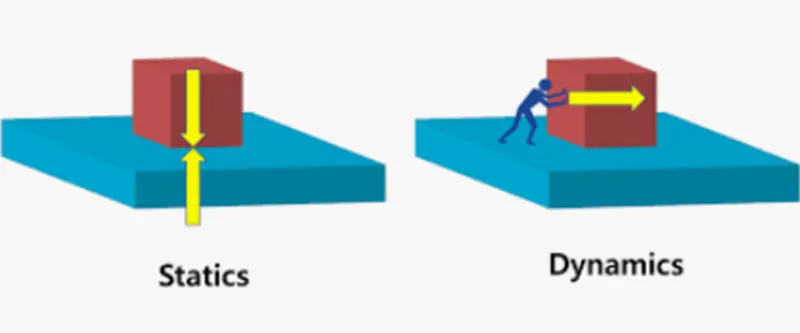
⦁ A static structural analysis calculates the effect of steady loading conditions on a structure.
⦁ it ignores the damping and inertia effects, such as those caused by time varying loads.
⦁ Static analysis is an essential procedure to design a structure.
⦁ Using static analysis, the structures response to the applied external force is obtained.
⦁ The static analysis is performed when the structure is subjected to external displacements support settlements.
DYNAMIC ANALYSIS:
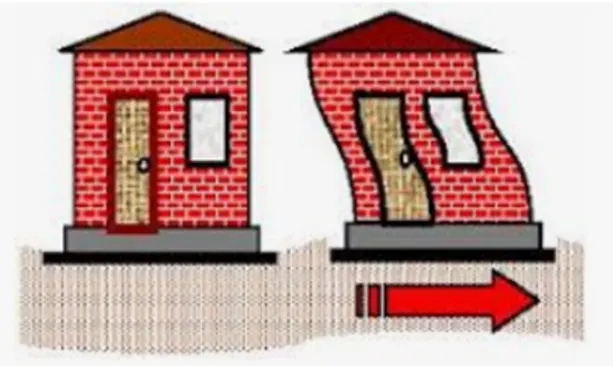
⦁ Dynamic analysis is a type of structural analysis which covers the behaviour of a structure subjected to dynamic (actions having high acceleration) loading.
⦁ A dynamic load is any load that changes overtime. these type of loads exert forces onto a structure that are often much greater than their static equivalents.
⦁ Dynamic analysis is the testing and evaluation of a program by executing data in real-time.
⦁ The objective is to find the errors in a program while it is runnig, rather than by repeatedly examinin the code offline.
2. ELASTIC BEHAVIOUR:
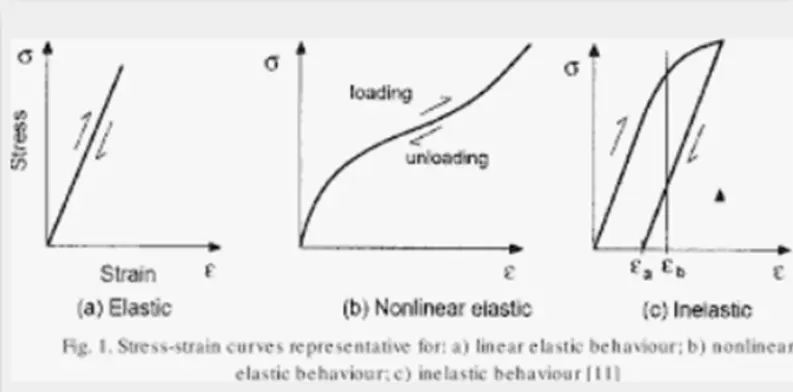
⦁ Ability of a deformed material body to return to its original shape and size when the forces causing the deformation are removed. A body with this ability is said to behave elastically.
INELASTIC BEHAVIOUR:
⦁ Material which does not return to its original shape after being deformed or when the external force is removed.
NON-LINEAR ELASTIC BEHAVIOUR:
⦁ Materials have elastic behaviour usually only upto a certain load, which is called the yield point. After that, the deformations are plastic.
⦁ Rubber has an elastic stress-strain curve, but the relation is not linear in such cases non linear elastic models are required.
PLASTIC BEHAVIOUR:
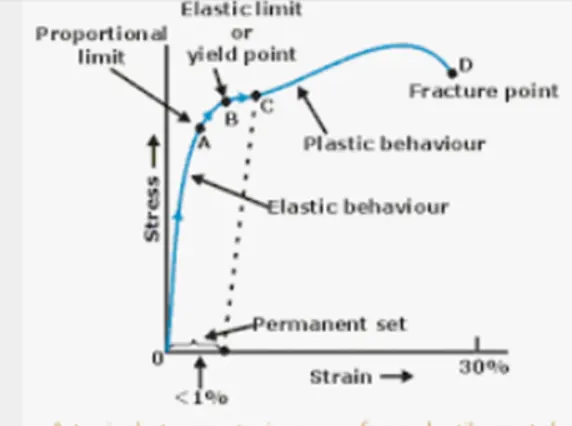
⦁ For stress beyond the elastic limit, a material exhibits plastic behaviour.
⦁ This means the material deforms irreversibly and does not return to its original shape and size, even when the load is removed.
⦁ When the stress is gradually increased beyond the elastic limit, the material undergoes plastic deformation
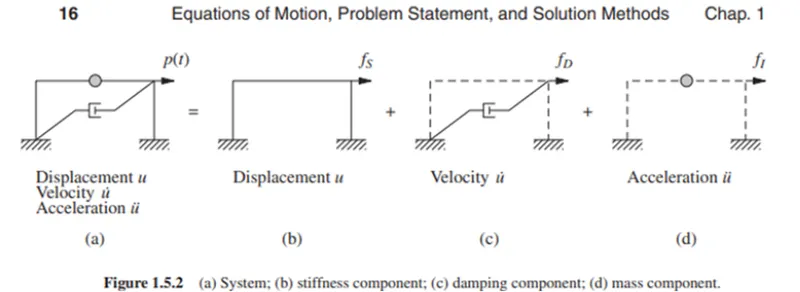
3. The equation of motion can be derived from the Newton's second law of motion is F=ma, or force is equal to mass times acceleration.
STIFFNESS COMPONENTS:
⦁ The frame without the damping or mass. the external force fs on the stiffness component is related to displacement 'u' by fs=ku: if the system is linear.
DAMPING COMPONENT:
⦁ The frame with its damping property but no stiffness or mass.
⦁ The external force on the damping component is related to velocity by fd=cv.
MASS COMPONENT:
⦁ The roof mass without stiffness or damping of the frame. The external force fi on the mass component is related to the acceleration by
fi =

⦁ hence it becomes,

4. NATURAL FREQUENCY:(f)
⦁ It is also known as Eigen frequency.
⦁ The frequency at which the system tends to oscillate in the absence of any driving force.
⦁ It is also referred as wn.
NATURAL PERIOD:
⦁ The period of one complete oscillation of a body or system.
RELATIONSHIP:
⦁ Both refers to quantities which are mass and stiffness.
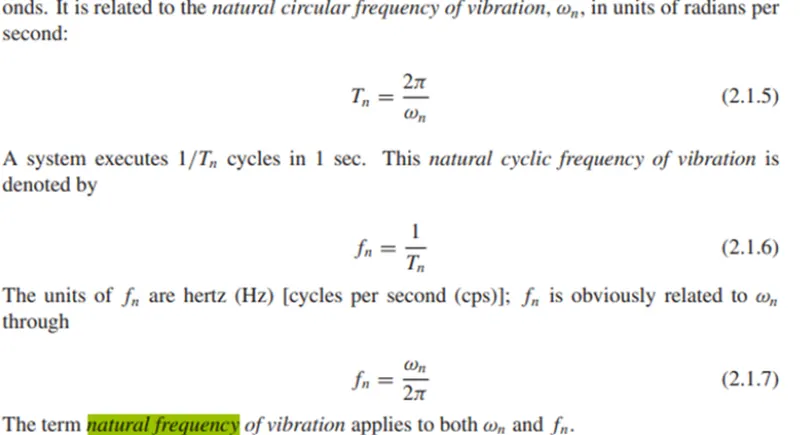
⦁ Natural frequency is inversely proportional to natural period.
⦁ The following formulas are taken from the book, dynamic or structure.
5. RESPONSE SPECTRUM:
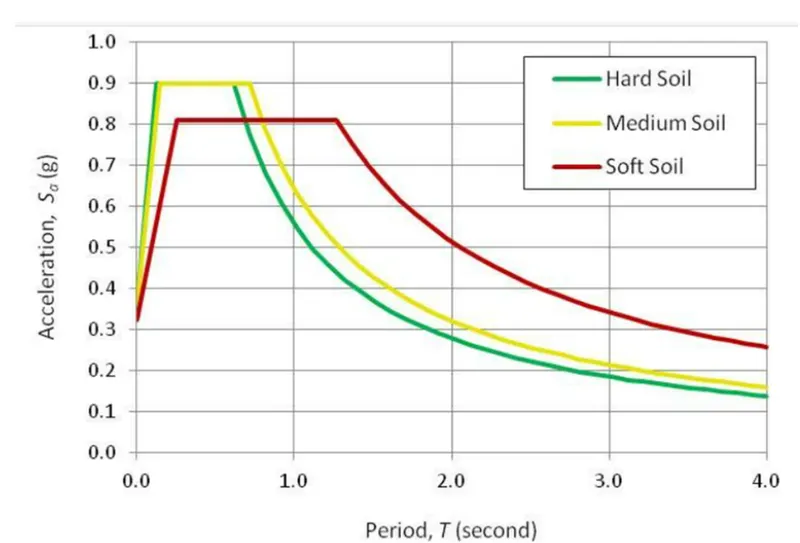
⦁ A response spectrum is a function of frequency or period, showing the peak response of a simple harmonic oscillator that is subjected to a trasient event.
⦁ The response spectrum is a function of the natural frequency of the oscillator and of its damping.
⦁ The support movement acts as a forcing term and that the solution depends only on the two parameters.

and

but not on individual values of m,c and k.
For given values of
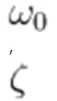
and
b(t)
this equation can be solved for a sufficiently long time. The displacement, velocity and acceleration response spectra are defined as the maximum values caused by the acceleration history
b(t)
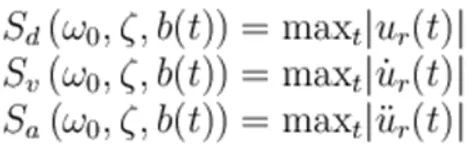
⦁ The response spectrum graph is given below,
RESULT:
⦁ Hence, the explanation and appropriate pictures are shown above.