Structural dynamics
Q.1
The main differences between Static & Dynamic Analysis are:
1- Acceleration: In Static Analysis, the load doesn't vary with time, hence no acceleration exists. Conversely, in Dynamic Analysis, the load does vary with time, and the acceleration is to be considered.
2- Motion: In Static Analysis, the motion doesn't exist, hence the static equilibrium equations are predominant. Conversely, in Dynamic Analysis, the motion should be considered, and the dynamic motion equations are to be applied.
3- Forces: In Static Analysis, the main acting forces are the static forces only. While in Dynamic Analysis, two additional dynamic forces should be additionally considered due to the acceleration (the Inertial Force & the Damping Force).
Q.2
The main types of material behavior from the force-displacement relationship viewpoint are:
a- Linear Elastic Behavior: During the loading phase, the relation between the force (P) & displacement (∆) is linear. That is P=k*∆ where k is the stiffness & the role is called Hooke’s law. During the unloading phase, the relation remains the same.
b- Non-linear Elastic Behavior: During the loading phase, the relation between the force (P) & displacement (∆) is not linear depending on the nature of the material. During the unloading phase, the relation remains the same (non-linear).
c- Linear Inelastic Behavior: During the loading phase, the relation between the force (P) & displacement (∆) is linear. That is P=k*∆ where k is the loading stiffness. During the unloading phase, the relation is also linear but follows another role P=k'*∆ where k' is the unloading stiffness. In other words, some residual strain remains due to the inelasticity of the material.
d- Non-linear Inelastic Behavior: During the loading phase, the relation between the force (P) & displacement (∆) is not linear depending on the nature of the material. During the unloading phase, the relation is also non-linear but follows another role. In other words, some residual strain remains due to the inelasticity of the material.
Material behavior also falls into two zones:
1- Elastic Zone: Where the strain is directly proportioned to the stress in any type of the above-mentioned 4 types.
2- Plastic Zone: Where the strain continues increasing without any increase in stress. Even if the stress is removed, the material exhibits an increasing strain. This behavior is considered a mode of failure.
Q.3
There are 3 internal force types in the dynamic equilibrium that resist external forces. These 4 force types (3 internals + 1 external) contribute together to form the equation of motion as follows:
1- Stiffness Force (Fs): This force is the elastic resisting force due to the rigidity of the building & could be calculated by the equation Fs=k.u where; k is the stiffness, and u is the displacement.
2- Damping Force (Fd): This force is the damping force that dissipates the energy in the forms of internal friction between steel joints & opening-closing cycles of concrete cracks as well as external friction between structural & non-structural elements. This force could be idealized as a viscous force & could be calculated by the equation Fd=c.u̇ where; c is the viscosity (damping), and u̇ is the first derivative of the displacement (the velocity).
3- Inertial Forces (Fi): This is the force of the mass & could be calculated by Newton's second law of motion Fi=m.ü where; m is the mass, and ü is the second derivative of the displacement (the acceleration)
And, the equation of motion becomes --> k.u + c.u̇ + m.ü = -müg(t) [or F(t)] where; -müg(t) is the external earthquake acceleration force, and F(t) is any other external force.
Q.4
Some of the most important dynamic characteristics of the building are:
1- Natural Period (Tn): The time period for a complete cycle of vibration. And could be calculated from the equation Tn=2π/sqrt(k/m) where; k is the stiffness, and m is the mass.
2- Natural Frequency (f): The number of complete cycles of vibration that occurs in a second. And could be calculated from the equation f=1/Tn where; Tn is the natural period.
3- Damping ratio (ζ): A dimensionless ratio that represents the portion of the energy dissipated in one cycle of vibration. And could be calculated from the equation ζ=c/ccr where; c is the actual damping, and ccr is the critical damping. Whenever ζ≥1 the building will not oscillate.
Q.5
The Response Spectrum function is a relationship between the Fundamental Periods (T - the Natural Periods) & the Spectral Response Accelerations (Sa - the Pseudo Accelerations) for a specific earthquake ground motion & a specific damping ratio (ζ).
The Response Spectrum function is used in earthquake engineering to characterize the ground motion and its effects on structures for any single degree of freedom (SDF), as well as to simplify the process of dynamic analysis & loads applications in a practical manner.
The Response Spectrum function could be represented as a graph with different values of T for the horizontal axis & corresponding Sa values for the vertical axis.
The fundamental Period (T) could be calculated from the equation T=2π/sqrt(k/m) where; k is the stiffness, and m is the mass.
The corresponding Pseudo Acceleration (Sa) could be calculated from the equation Sa=(2π/T)^2*up where; up is the peak displacement for that SDF during the whole earthquake duration for the specified T and ζ.
By repeating the previous step with different values of T and obtaining the corresponding values of Sa, the response spectrum graph could be plotted.
By repeating the whole process with different values of ζ, different graphs for the function could be generated for the specified earthquake.
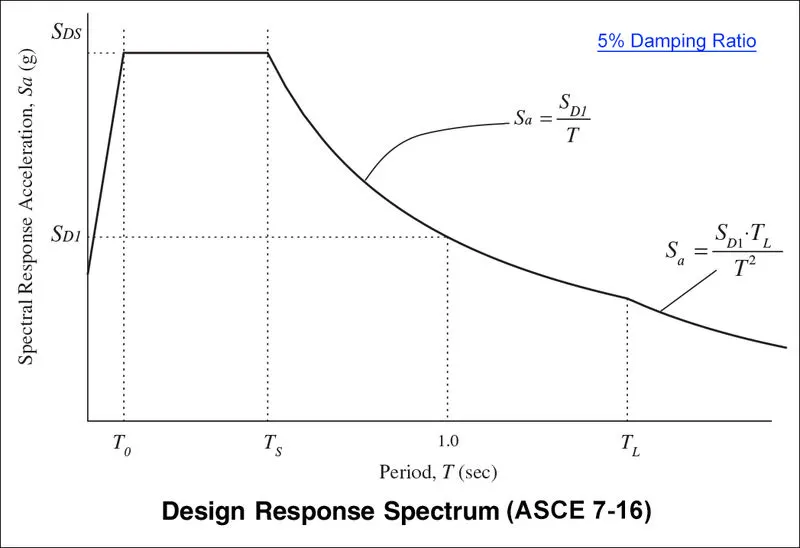
To use a graph for a specific value of ζ, provided the value of T, the corresponding value of Sa could be spotted.
With the value of Sa, the magnitude of the total base shear force could be calculated from the equation V=m*Sa=(W/g)*Sa where; W is the seismic weight, and g is the gravitational acceleration.
The last equation could be rearranged as V=(Sa/g)*W to bring the base shear as a portion of the seismic weight.
==============================================================================