Structural dynamics
AIM:-
1. Differentiate Static analysis and Dynamic analysis with proper representing pictures
Ans:-
Static Analysis Dynamic Analysis
- static analysis time invariant analysis of force Dynamic analysis is time dependent
like Stress, strain and displacement etc. analysis.
- Static loads applied on structure slowy Dynamic Loads applied on the structure
Example: Dead load,live Load . Suddenly.
- Loads is not Variable with time and neglected Load is Variable with time Due to Fast
Due to slow applying of load . Applying of load and vibrations.
- Static forces does not change in size position Dynamic forces Changes in Size, position,
or in direction. And direction.
- The displacement obtained by static analysis The displacement obtained by Dynamic analysis
is more. Are less.
- Static analysis complited where The structure Dynamic analysis complited where The structure
deformations behave linear . behave Non- linear deformations
- Static analysis done with minimum Three degree Dynamic analysis of structure done with
of freedom. singale degree of freedom.
- There is not inertia effect on Static analysis Inertia effect is considered in Dynamic analysis.
1.Static Load:-
RESULT:- 
2. Dynamic load:-
RESULT:-
AIM:-
2. Explain the following with relevant force-displacement graph
- Elastic behavior
- Inelastic behavior
- Plastic behavior
- Non-linear Inelastic behavior
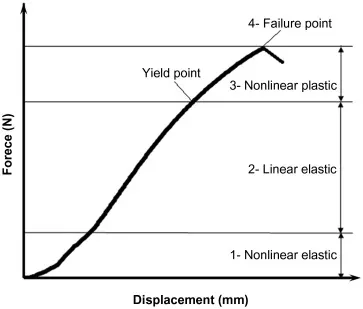
1.Elastic behavior:-
- The ability of a deformed material body to return to its original shape and size when the force cousing The deformation are removed.
- A body with this ability is said to behave / or respond elastically. From the force-desplacement graph at point O to a certain point,it shown a linear path, hence the body shown the elastic properties at a certain limit with the forces applied.
2.Inelastic behavior:-
- The deformation of the material That does not disappear on the removal of the force that produce it.
- From the force - displacement graph inelastic behavior corrosponds to the nonlinear path.
- Inelastic is experinced by the body as soon as the path goes out of the linear curve.
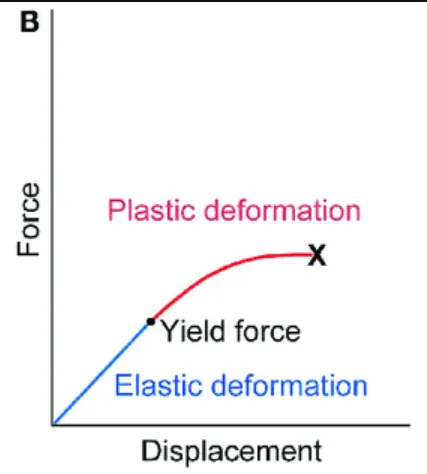
3.Plastic behavior:-
- The behavior of plastic structures beyond the bending collapse load is influenced by the changes in the geometry of a structure during the process of plastic deformation.
- In the present paper,an investigation of the load - deflection relationship for simply supported rectangular Rainforced concrete plates is presented.
4.Non-linear Inelastic behavior:-
- Material have elastic behavior usually only up to a certain load, which is called the 'yield point'.
- After that The deformation are plastic.
- From the force - displacement graph, is bihavior occurs when the line from point 'O' tends to bend to point "a"
RESULT:-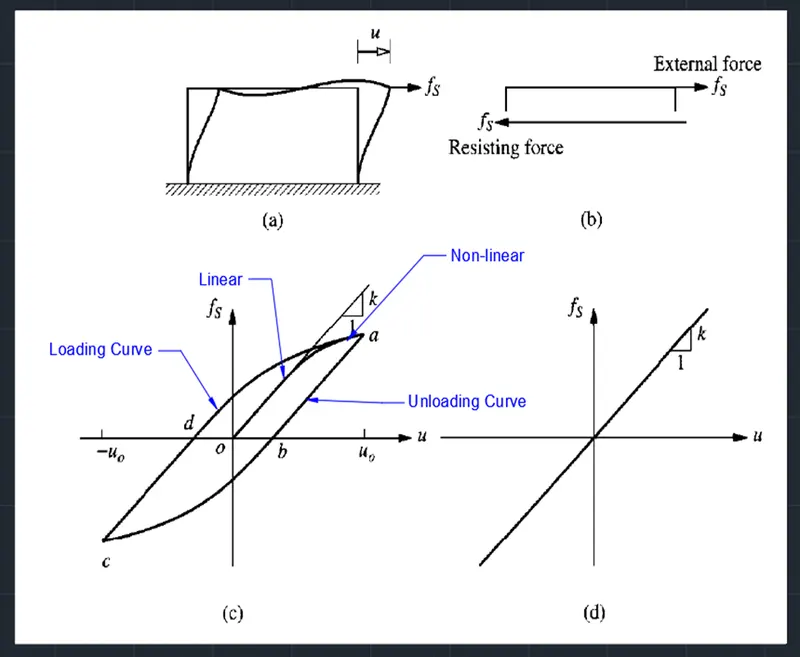
AIM:-
3. Explain Mass, Stiffness & Damping components in the equation of motion
Mass:-
- newton's second law, which states that the force F acting on a body is equal to the mass M of the body Multiplied by the acceleration a of its center of mass.
- F= ma, is the basic equation of motion in classical mechanics.
- Mass is always constant for a body.one way to calculate mass: Mass = volumn x density weight is the measure of the gravitational force acting on a mass.
Stiffness:-
- Stiffness relates to how a component bends unders load while still returning to its original shape once the load is removed.
- since the component dimensions are unchanged after loads is removed. stiffness is associated with elastic deformation. A material can have heigh strenght and low stiffness.
Damping:-
- Damping is a reduction in vibration over a period of time. Damping will eventually bring avibration object.
- A damping machanism suppresses vibration of the structure.
In the section the governing equation for the idealized one-story frame is formulaed based on an alternative viewpoint.
Under the action of external force p(t) the state of the system is described by
- Displacement u(t)
- Velocity u'(t)
- Acceleration u"(t)the system as the combination of three pure components:
1.Mass component :- The roof mass without the stiffness or damping of the frame
2.Stiffness component :- The frame without damping or mass
3.Damping component :- The frame with its damping property but no stiffness or mass
- The external force Fs; on the stiffness component is related to the displacement U By Eq. Fs= ku
- If the system is linearly elastic, the external force fd on the Damping component is related to the velocity u' by Eq. fd= cu'
- External force fi on the mass component is related to the acceleration by fi=mu'
- The external force p(t) applied to the completedSystem may there fore be visuolized as distributed among the thrde components of the structure and Fs+Fd+Fi must eqyual the appolied force p(t) loading to
- Eq. p(t)=Mu'+cu"+Ku
Result:-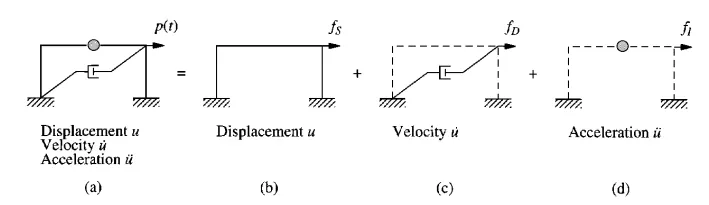
AIM:-
4. Provide relationship between Natural period (Tn) & Natural frequency (f) and provide their definitions
Natural period:-
- The natural vivration of the system (Tn) is the time required for the undamped system to complete one cycle of free vibration
- It is Related to the natural circular frequency of vivatarion ωn,unit of radiation/second
Formula for period:-
, Tn = 2π/ωn or ωn = 2π/Tn
Natural frequency (f):-
- The number of cycle (or one completerevolution ) executed by system in one second with unit in hertz. where,fn= 1/Tn
- Natural vivaration properties ωn, Tn and F depend only one mass and stiffness of the structure.
- Tn, ωn,Fn (Natural vivaration proparties) depend only on mass and stiffness of the structure
- ωn = sqrt(k/m), The stiffer of single degree of freedom having the same mass will have higher natural frequency and the shorter natural period.
- Natural frequency and natural time period is inversely proportional to each other .
Result:-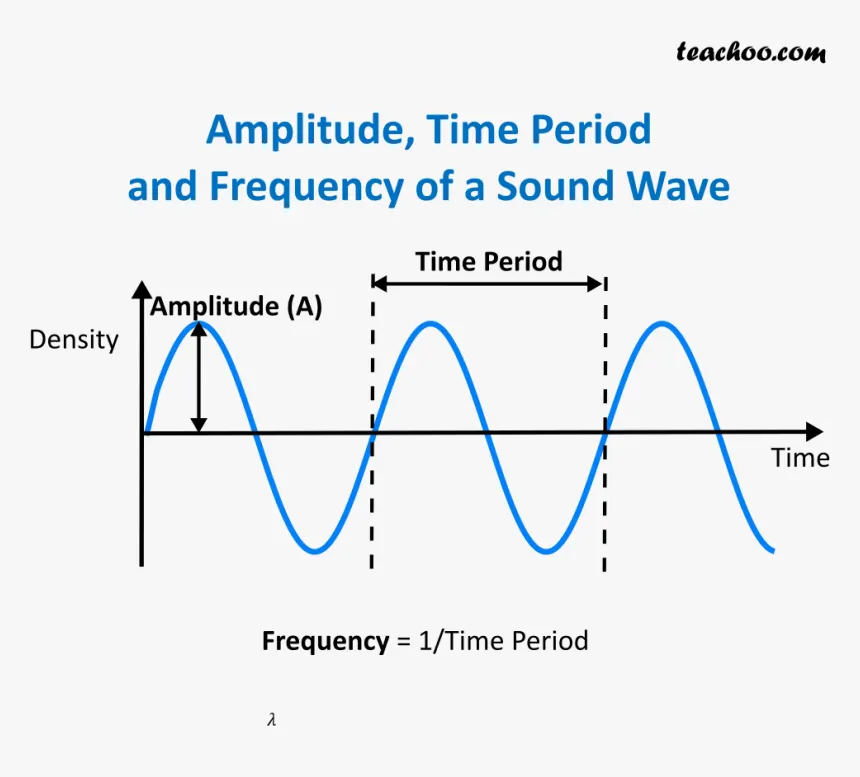
AIM:-
5. Explain in detail about Response spectrum & its Graph
- In general, several vibration modes contribute to the total structure response.the question is how to determine the peak value of the total response which is repesented by the combined contribution of all relevent vibration modes.
- In the analysis by means of responses spectra, only the maximum values of the response for individual modes are known, where the time at which these maximum occur is not know, however, it is highly imposibale that the maximums would occur simultaneously in all vivaration modes.
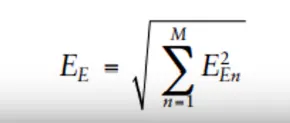
Square Root of the sum of Square
(SRSS)combination rule
- A centaral concept in earthquake engineering ,response spectrum is a practical means of Characterizing ground motion and thire effects on structures of different Tn.
- It also provides a practical approch to apply the knowledge of structural dynamic to the Designe structures and development of lateral force requirments in buildingcodes.
- Each such plot is for single degree of freedom system having a fixed Damping ratio and several such plots for different value of are includ to cover the range of damping value encountered in actual structure.
- A similar plot for peak u' is the relative velocity response spectrum, for the peak u", is the acceleration response spectrum.
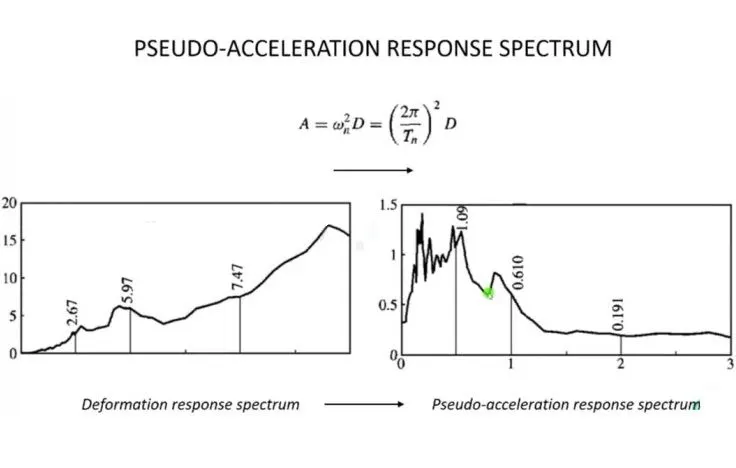
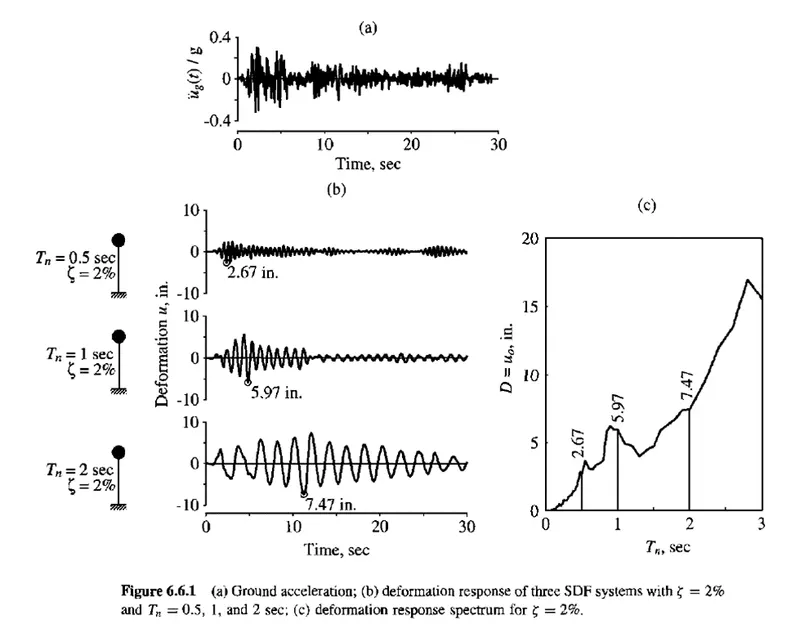
Deformation Response Spectrum:-
- Hearis the particular ground motion that is L- centro earthquake.
- The response developed for L-centro earthquake as shown.
- New the time viriation of the deformation induced in the ground motion two diffrent single dgree of freedom system is presented.
- Each of the single degree freedom system subjected this earthquake.that is the displacement history that we obtain.
Pseudo-Acceleration Response Spectrum:-
- pseudo acceleration for an single degree of freedom system with natural frequancy ωn is related to its peak deformation D=uo, due to earthquake ground motion:-
A = (ωn^2) * D = ((2π/Tn)^2) * D.
- The quantity a has unit of acceleration and is related to the peak value of base shear vbo
(just another name for the peack value of the equivalent static force Fso):-
Vbo = fso = mA (or) Vbo = (A/g)*ω.