Structural analysis of a buidling using Robot Structural Analysis
1)
HVAC STANDS FOR
H-HEATING
V-VENTILATION
AC-AIR CONDITIONING
HVAC is a system which is used to maintain the temperature ,circulate enough air and lighting to the building with the help of some units
HVAC is the important part of the building where safe and healthy conditions are regulated with respect to temperature and humidity ,using fresh air from out doors
Ventilatilating or ventilation is a process of exchanging or replacing air in any space to provide high indoor air quality.It also remove unpleasent smelland excessive moisture
Air conditioning system provides cooling and humidity control for all parts of a building ,Air conditioning and refregiration are provided through the removal of heat .
HVAC essential to modeling of building:
whenever we are working on a team project or in a real world we will e given a design requirements of HVAC
when we are working on a coordinate project it is necessary to have a basic knowledge of HVAC system which makes us to coordinate with a better judgement .
While we are modelling it is necessary to look after the comforts ,energy saving of the building .HVAC system are used fo cintrolling the overall climate in the building
To provide optimum lighting and aircirculation and control the temperature and humidity with in the building space .HVAC improves air quality in the building helping make it appropriate for human breathing .it reduces humidity so occupants can enjoy the better atmosphere.This is especially useful for buildings or underground spaces where ventilation is limited.
For sizing of systems .To check the mechanical performance of the ducts .to design them as per space required as per the space alloted to building provisons. This HVAC system place and an important role in the building modeling and they are essential .
2)
AIM: To desing the HVAC system for each floor for the building designed in the weel 7 assignment and to assign all the collectors, Duct, blower at appropriate groups tp com[lete the modeling of HVAC UNIT.
TOOLS USED:
- Mechanical template
- collobrate
- manage links
- manage tab
- systems
- airterminals
- Duct
- Layout connect
PROCEDURE:
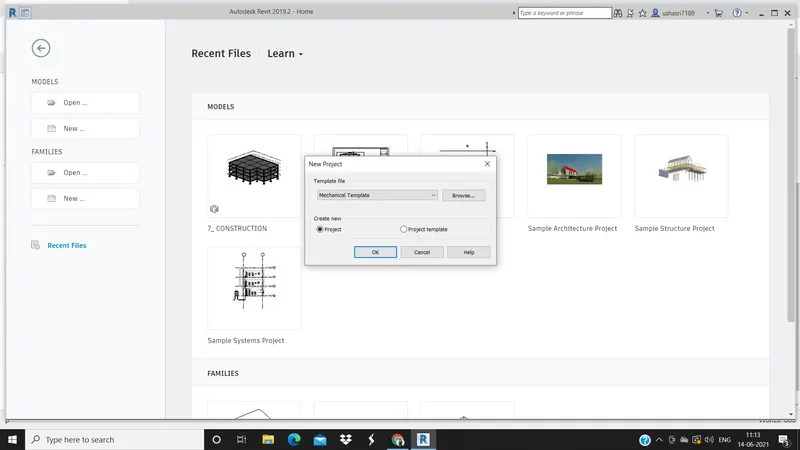
1) Open the Revit and go to new and select the Mechaical template and save the template with appropriate name.
2) Draw the grids and specify the coordinates as 0'0" in both the direction.
3) Then select the collobrate tab and collobrate the model .
4) Go to manage tab and select the manage link the Architectural model that we have created in week 7.
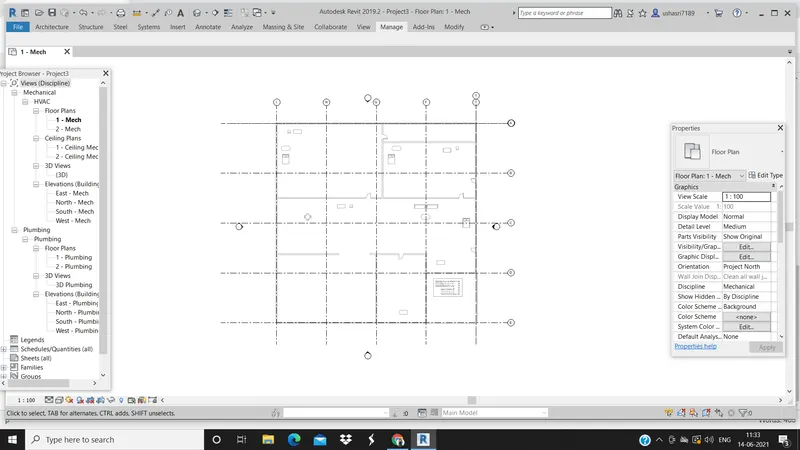
5)Relocate the cordinates and acquire coordinates
6)Select the system tab and select the air teminals and place the Return diffures and supplying diffuser in the rooms at appropriate place and place the Blowers and collectors
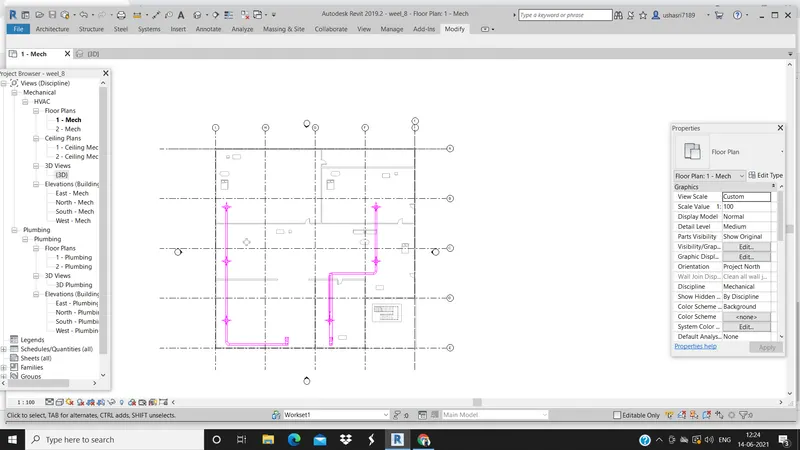
7) Select the elements in the room and click on duct option the dudcts are automatically created you choose in which direction you need.
8) look in 3D view wheather the ducts are clasihing with any wall and adjust by increasing the offset in the properties browser.
9)Similarly add all the HVAC Componets to the remaing floor.
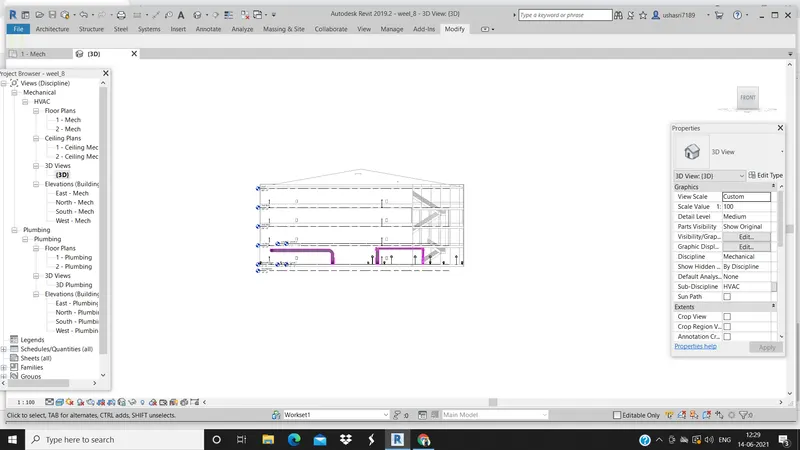
RESULT: The HVAC system componets like collecter, blowers are placed in the building successfully.
3)
These are the following steps to be followed to use add-ins tab to load plug-ins for robot structural analysis .
- Open the revit software , go to the Analysis tab and check whether the robot structural analysis is enableed in our software or not
- If not available we need to download if from autodesk store
- click on the shopping cart icon which is available at top right corner, the autodesk store will ne opened .
- In search tab enter the structural analysis tool kit, the software will apper
- select the respective version and click install
- The ROBOT STRUCTURAL get installed and will reflected in to our Revit software in analyse tab.
4)
We need to analyse the structure while modeling because the structure is the important component of the building . The main fuction of stucture is to bear all the loads and should be servicible through out the life span.
Structural analysis is nothing but determination of the loads on the physical structure and their components. Structures are generally subjected to different types of loads like dead loads, live loads, wind loads and sesmic load. The structure should capable to with stand all loads combinations. Strucutral aanalysis emlpoys the fields of applied mechanics. The result of the analysis are used to verify a structure fitness for use , often precluding physical tests.
Before modelling the elements the structural engineer should know the loads, forces, moments, deflections and the SFD, BMD, diagrams of the beams and how the structure behave when certain loads act on it. The strucutre should resist all the loads and should be sevicible unless we cannot design the model. The method we us efoe analysing the members and how it behave when loads act on it. The result of analysis helps us to know all the deformation and verifys the structure strength foe its use.
In Revite we use Robot structural analysis to design all the load and find the stregth of the structre and we can redesign the structure.
The design effects the modelling in many ways when we are modelling a structure we should take care that there should not be any overlaps which effects the design we have to do the modelling of the project again. Suppose if need to replace any column size in the strucure in the s per design we need to change in the modelling so the design effects the modelling.
5)
AIM: To export the complete analytical model prepared in the previous weel to the robot structural analysis and check what loads are to be placd and analyze the structural model.
a) A Boudary condition is placed on structure where either the exernal foces or the displacement are known at the stat of analysis. In this way , boudary conditions are where the tructural interacts with the environment either through the application of an external forces or though the some restraint that is imposing a displacement. For a structural analysis problem to be solvable , every loction on the boundary of our structural must have a known boundary condition, either a known forces or a known displacement . The known foces or displacement may have some magnitude or it may be zero. For example, we may know that there are loctions on our structure that have no external foces. This would be a zero foce boundary condition . A displacement boundary condition that is zero is equivalent to the structure being held in place at that loction . The list of parameter requierd are
- Degree of freedom
- Type of support
- Retraints.
b)According to the design standars the following load can be applied to the floor based on strucutre decide.
- Dead load
- live load
- wind load
- earthquake load
c) The load combinations for a my building that i considered are:
AIM: To include the load combinations to the analytical model.
TOOLS USED:
- Analyse
- load combination
- loads
- area loads
PROCEDURE:
1. First open the stuctural model which we have created in the last weel.
2. Then open the analytical model in the 3d view
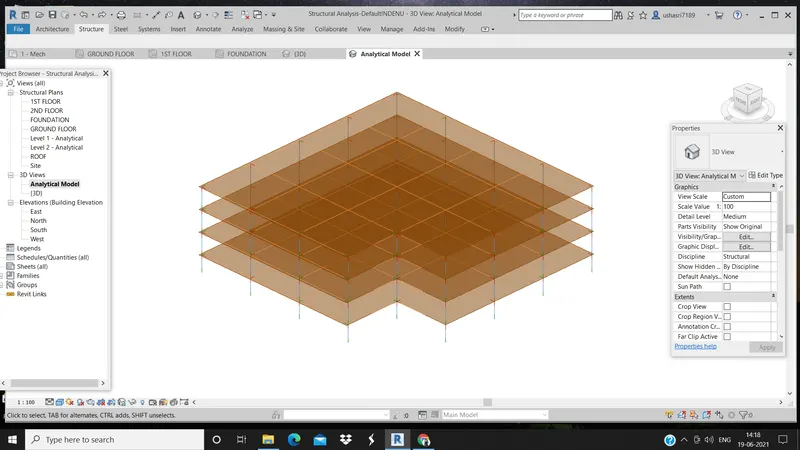
3. Now select manage then select structural settings
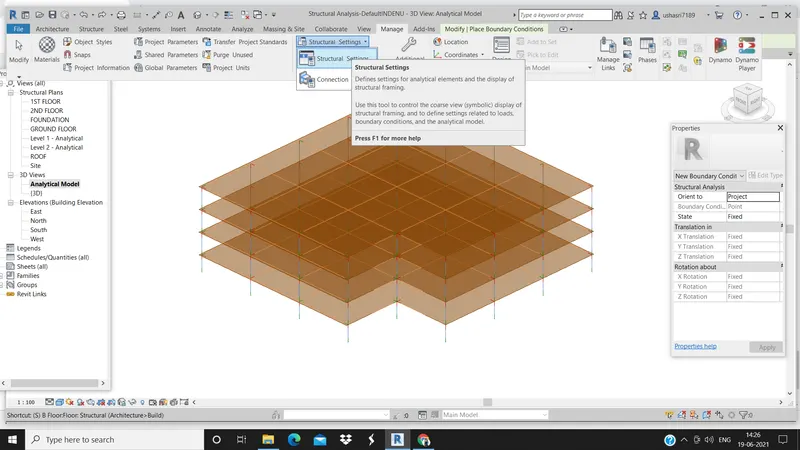
4. then select load combinations and then add loads and load factors.
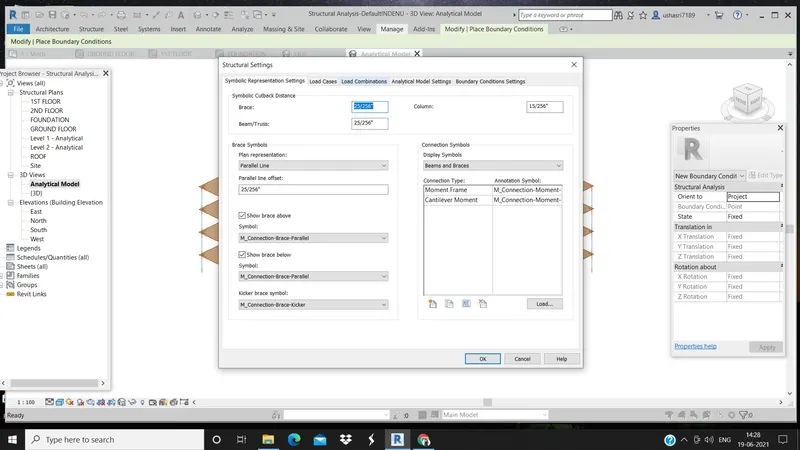
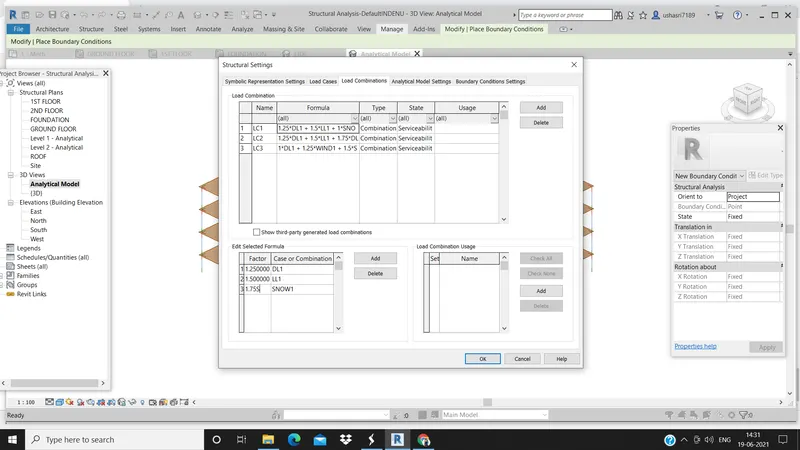
5. Select the analyse tab then select the boundary condition and select as fixed then select loads and picl the type of load you want to load
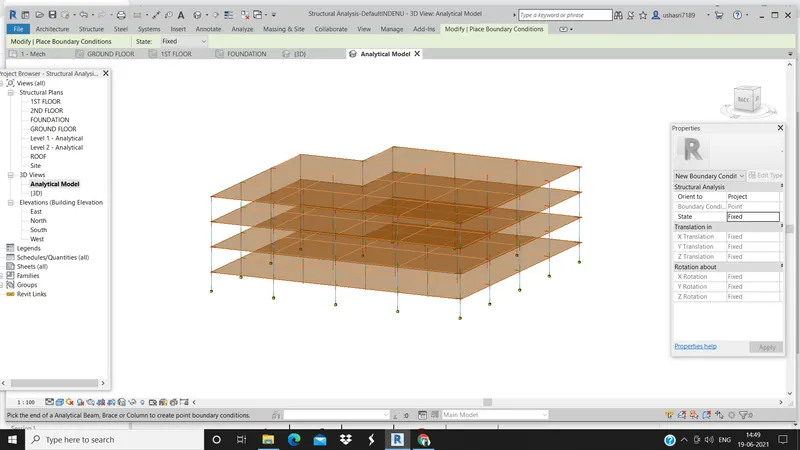
7. The loads are applied
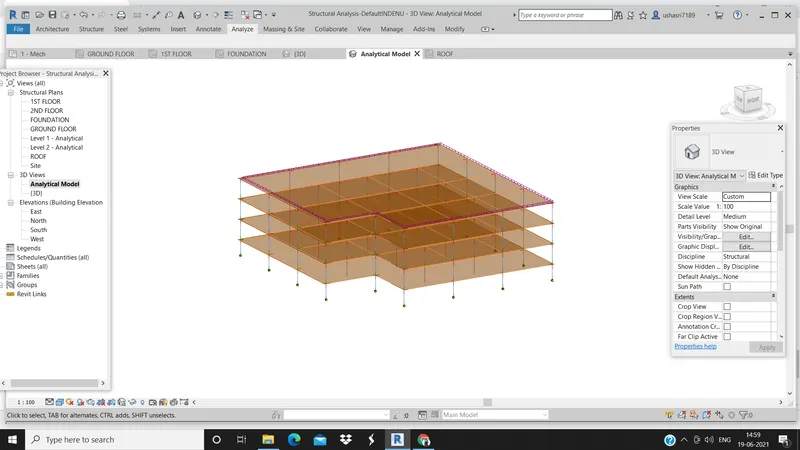
RESULT: All the loads are included.
d) AIM:To analyse the building and report all the details like maximum moment, displacement, lateral displacement, lateral loads in every floor and building.
TOOLS USED:
- Robot analysis
- Analyse tab
- prepare result
PROCEDURE:
1. Select the Analyse tab and select the Robot analysis
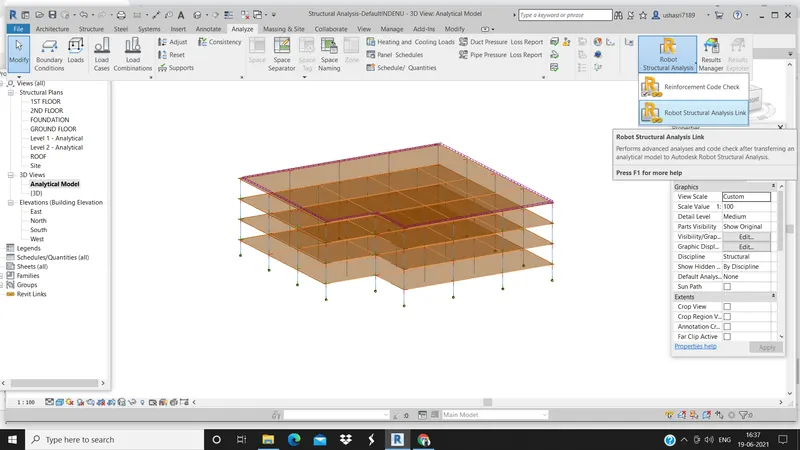
2.send the model to Robot analysis
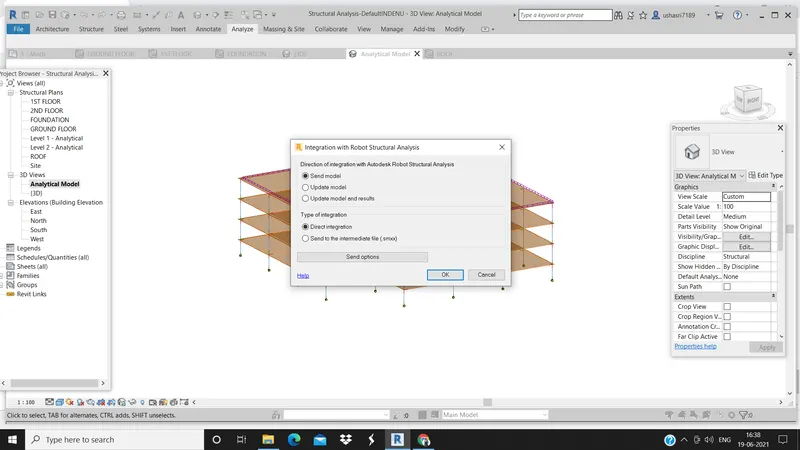
3. In Robot analysis click on analyse and prepare Result.
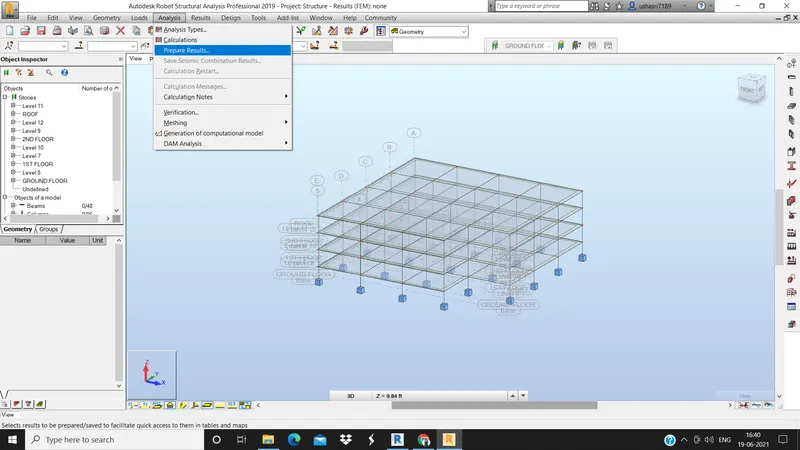
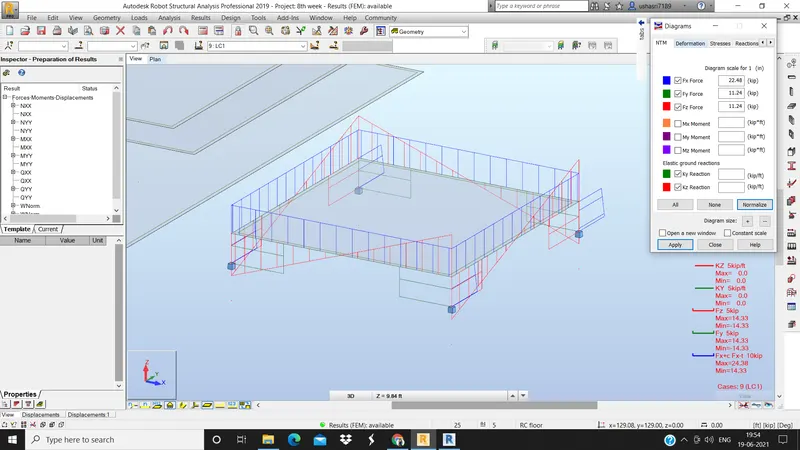
RESULT: The analysis of the model is done by using the robot analysis'
6)
Energy analysis is calculating the amount of enrgy. Energy analysis is the traditional method of assessing the way energy is used in an operation invovling the physical or chemical processing of material and the transfer and conversion of enegy.
Energy analysis is the virtual or computerizzed simulation of a building or complex that focuses on enegy consumptiom, utility bills and life cycle costs of various energy related items such as air conditioning, light and hot water. It is also used to evaluate the payback of green energy solutions like solar panels and photovoltaics, wind turbines and high efficicency appliances. To understan energy modeling, its important to undestand building simulation:
The main objective of energy analysis is to obtain insight into their techological performace for optimal decision making at the design, operations, and contro; levl.
With the help of energy analysi in and out volume of air through the openings and room. With this we can find the defects in our project and rectify the plan in which we dont haveany problem from environment point of view
Performing enegy analysis on the building design through all stages, from the earliest conceptual phase through detailed design, to ensure that you are constantly working towards the most energy efficient building possiblr .
These are the following steps to be considered to energy aanlyse the building
1. Set the loction of the model
2. Set a weather station for the analysis.
3. Verify enegy settings.
4. Create and analyze the enegy model.
5. Review the analysis on the insight dashboard.
To create a sustainable building which do not cause any harm to humans and living being we need to consider the energy analysis in modeling of Revit.
The factor of sustainablity improve the quality of design beacause sustainablity seeks to reduce the negative impacts on the environment, and the health and confornt of building occupants, there by improving the building performace. The basic objectivity of sustainablity are to reduce consumption of non renevable resouces , minimum waste, create healthy production environment .