Stoichiometric Combustion Calculator
The stoichiometric number is the value written in front of the atom, molecule or ion for balancing the number of elements on both sides, the reactant and product side of the equation. The given values can be in mass or moles. The combustion reaction is the reaction of any organic compound in presence of air/oxygen as a reactant, the product will always be CO2 and H2O for the case of complete combustion.
For a generic alkane fuel, the combustion process will following the below equation. Values in front of each molecule/compound are in moles.
Here
n = Number of moles of C
ar = Stoichiometric co-efficient
a = Number of moles of Carbon-dioxide
b = Number of moles of water
c = Number of moles of nitrogen
- The stoichiometric calculation for alkanes:-
`C_(2)H_(2n+2) + ar(O_2 +3.76N_2) = a CO_2 + bH_2O + cN_2`
where, n = Number of moles of C
ar = Stoichiometric co-efficient
a = Number of moles of Carbon-dioxide
b = Number of moles of water
c = Number of moles of nitrogen
For the stoichiometric combustion reaction for alkanes, we’re going to apply the mole balance to each of the elements:-
Number of moles of Carbon(C): n=a .............(1)
Number of moles of Hydrogen(H): `2n+2 = (2*b) rArr color(green)(\b = n+1)\ \ \ \ \ \ ........(2)`
Number of moles of Oxygen(O): `ar*2 = (a*2)+b\ \ \ \ \ \ \ \..................(3)`
Number of moles of Nitrigen(N): `ar*3.76=c \ \ \ \ ...........(4)`
substituting equation (1) and (2) in equation(3) will give us,
Stoichiometric coefficient, `ar=(3n+1)/2`
This equation shows the relationship between the stoichiometric coefficient (ar) and the number of carbon (n) moles for alkanes. - The stoichiometric calculation for alkenes:-
`C_nH_2n + ar(O_2+3.76N_2)=aCO_2 + bH_2O + cN_2`
where, n = Number of moles of Car = Stoichiometric co-efficient
a = Number of moles of Carbon-dioxide
b = Number of moles of water
c = Number of moles of nitrogen
substituting equation (1) and (2) in equation(3) will give us,
For the stoichiometric combustion reaction for alkenes, we’re going to apply the mole balance to each of the elements:-
Number of moles of Carbon(C): n=a .............(1)
Number of moles of Hydrogen(H): `2n = (2*b) rArr color(green)(\b = n)\ \ \ \ \ \ ........(2)`
Number of moles of Oxygen(O): `ar*2 = (a*2)+b\ \ \ \ \ \ \ \..................(3)`
Number of moles of Nitrigen(N): `ar*3.76=c \ \ \ \ ...........(4)`
Stoichiometric coefficient, `ar=(3n)/2`
This equation shows the relationship between the stoichiometric coefficient (ar) and the number of carbon (n) moles for alkenes. - The stoichiometric calculation for alkynes:-
`C_nH_(2n-2) + ar(O_2+3.76N_2)=aCO_2 + bH_2O + cN_2`
where, n = Number of moles of Car = Stoichiometric co-efficient
a = Number of moles of Carbon-dioxide
b = Number of moles of water
c = Number of moles of nitrogen
For the stoichiometric combustion reaction for alkenes, we’re going to apply the mole balance to each of the elements:-
Number of moles of Carbon(C): n=a .............(1)
Number of moles of Hydrogen(H): `2n-2 = (2*b) rArr color(green)(\b = n-1)\ \ \ \ \ \ ........(2)`
Number of moles of Oxygen(O): `ar*2 = (a*2)+b\ \ \ \ \ \ \ \..................(3)`
Number of moles of Nitrigen(N): `ar*3.76=c \ \ \ \ ...........(4)`
substituting equation (1) and (2) in equation(3) will give us,
Stoichiometric coefficient, `ar=(3n-1)/2`
This equation shows the relationship between the stoichiometric coefficient (ar) and the number of carbon (n) moles for alkynes.
# MATLAB CODE FOR THE STOICHIOMETRIC COMBUSTION CALCULATION:-
function [ar_alkane, ar_alkene, ar_alkyne]= Combustion_equation(n)
ar_alkane = (3*n+1)/2;
ar_alkene = (3*n)/2;
ar_alkyne = (3*n-1)/2;

%plotting
plot(n,ar_alkane,'m*-')
hold on
grid on
plot(n,ar_alkene,'y')
hold on
plot(n,ar_alkyne,'rd-')
title('Stoichiometric coefficient(ar) v/s. Number of moles(n)')
legend ('Alkane','Alkene','Alkyne')

%labelling
xlabel('Number of moles of carbon(n)')
ylabel('Stoichiometric coefficient(ar)')
end
Code explanation:
The above code is a function code that calculates the stoichiometric coefficient for alkane, alkenes and alkynes and shows them as output(refer to the image below). The formula used is coefficient in terms of moles of carbon. These values are calculated based on input values of "n" and then represented in graph format to observe the trends of different fuel.
MATLAB Output:
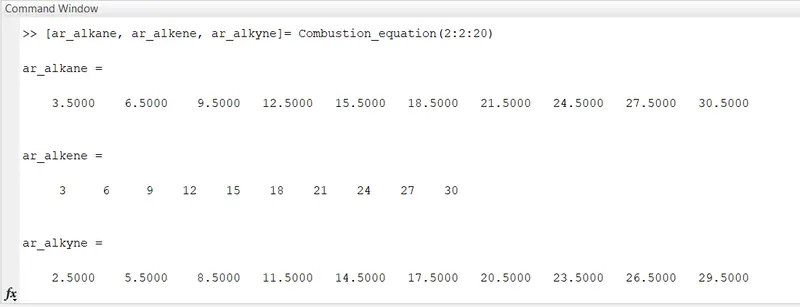
The above image shows the Stoichiometric coefficient values for 'n' values between 2 and 20 at an interval of 2.
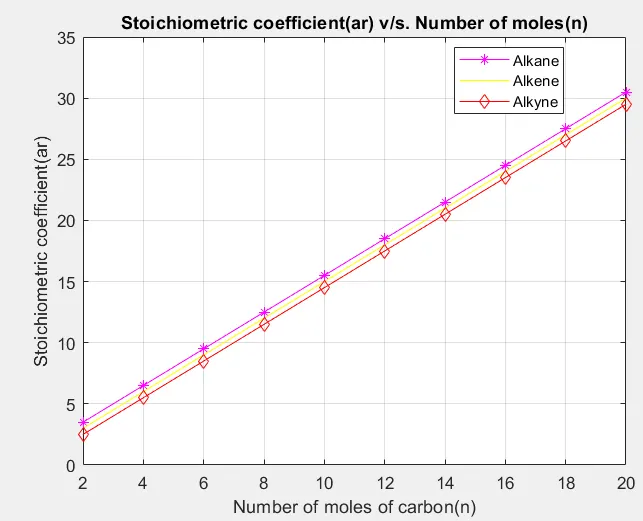
The graph shows the comparative data of all the calculated fuel types. It's a linear graph. As we can observe, all three types of fuel have the same slope and increase with the increase in moles of carbon. The only difference is at the coefficient value for the same 'n' value. They follow the order of alkane> alkene> alkynes for coefficient value at any value of carbon moles.
Thus, we can say that alkynes require the least amount of oxygen (air) while alkanes require the most amount of oxygen to get complete combustion.