Boundary and Initial Conditions of Differential Equations
A differential equation is a mathematical equation for an unknown function of one or several variables that relates the values of the function itself to its derivatives of various orders. Classified as: PDE(Partial differential equation) or ODE(Ordinary differential equation)
- The ordinary differential equation (ODE): contains differentials with respect to only one variable.
Example 1: `(d^2y)/(dx^2)+4xy(dy)/(dx)+5y=0`
It's a 2nd order ODE. Differentiation only with respect to 'x'.
- Partial differential equations (PDE): contain differentials with respect to several independent variables.
Example 2: `(delv)/(delt) - k(delv)/(delx^2)=v`
This is 1st order PDE. This equation is differentiated with respect to two different variables, ie. 't' and 'x'.
Initial and Boundary conditions in Differential equations :
As the name suggests, the initial condition is when all the conditions or values are defined for a variable only at the starting point of the equations. The number of initial conditions that are required for a given differential equation will depend upon the order of the differential equation.
Initial Conditions are generally of the form: `y(t0) = yunderset0` or `y ^(k) (t0) = yundersetk`
Similarly, the boundary condition is when you have a defined range for the dynamic variable in the differential equations. Starting and endpoint values/conditions are defined for the equation.
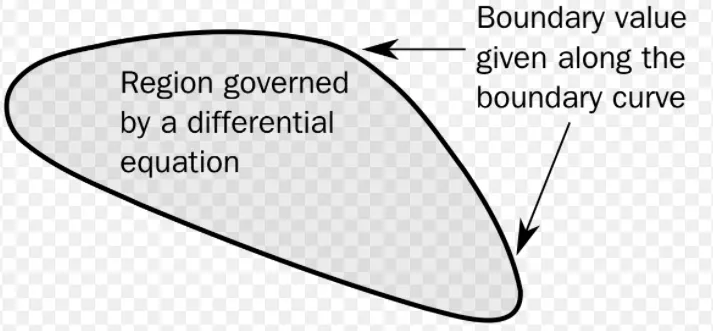
Both the conditions can be used on any differential equation, ie. PDE(Partial differential equation) or ODE(Ordinary differential equation). Generally, normal integration with upper and lower limits can also be under boundary conditions in the differential equation.
Example 3: `int_0^2 (d^2T)/(dx^2)+dotg/k=0` [steady-state equation]
`int_0^1 (del^2T)/(delx^2) = 1/alpha* (delT)/(delt)` [Transient state equation]
These equations are heat conduction equation, of 2nd order derivative. First equation being an ODE with boundary values of 0 and 2.
0 is the initial value and 2 is the final limit value.
The second equation is PDE with a boundary value of 0 and 1.
Example 4: `4x^2ddoty + 12xdoty + 3y = 0`, `y(x)=1/8` and `doty(4) = -3/64`
In this, we have a 2nd order differential equation with its two initial conditions. We use these conditions to find the solution of the given equation which satisfies both the initial conditions of variable function y, ie.
`y(x) = x^(-3/2)`
Types of boundary conditions:
There are five types of boundary conditions: Dirichlet, Neumann, Robin, Mixed, and Cauchy, within which Dirichlet and Neumann are predominant.
- Dirichlet: Specifies the values that a solution needs to take along the boundary of the domain. Defined for both PDE and ODE.
Example: Surfaces held at a fixed temperature. - Neumann: Specifies the values of the derivative applied at the boundary of the domain. Defined for both PDE and ODE.
Example: Represents heat flux across the boundaries. - Robin: It's a combination of the Dirichlet boundary condition and Neumann boundary condition. Also called Fourier type condition. Defined for both PDE and ODE.
- Mixed: Defined for PDE. The solution of the given equation needs to be satisfied by various boundary conditions on the disjoint parts of the boundary of the body/domain.
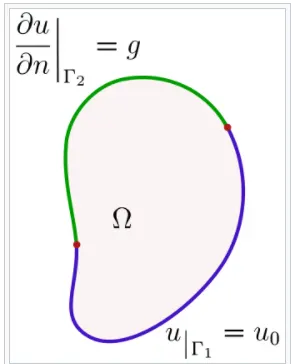
In this figure, the green part is the Neumann boundary condition and the purple is the Dirichlet boundary condition. - Cauchy: Defined for both PDE and ODE. It specifies both the function value and normal derivative on the boundary of the domain/body.
Importance:
These conditions are very important and are used to define the conditions in the physical boundary of a problem. Or to sometimes find a solution for any particular PDE or ODE. Can be used anywhere in any engineering field, irrespective of, if fluid dynamics, heat transfer, structures, or any other domain. Initial conditions are very important while solving calculus problems. Generally, initial condition problems are to be solved with respect to time.
Different classes of PDE:
- Order of PDE:
The order of a PDE is determined by the highest derivative in the equation.
Example: `((del u)/(delx1) )^2 + (delu)/(delx2) + u^6=0` is a first order PDE, cause differentiayion is done only once. - Linear and nonlinear PDE:
A linear PDE is one that is of first degree in all of its field variables and partial derivatives.
Example: `(delu)/(delx1) + (delu)/(delx2)=0` is linear PDE.
`(delu)/(delx1)+((delu)/(delx2))^3=0` is nonlinear PDE. - Homogeneous PDE:
If a function of multiple variables is equivalent to zero, it is termed homogeneous.
Example: `(delu)/(delt)+(delu)/(delx1)+(delu)/(delx2)=0` is homogeneous.
`(delu)/(delt)+(delu)/(delx1)+(delu)/(delx2)=x1+x2` is non-homogeneous. - PDE of 2nd order is classified into three types, ie. elliptical, hyperbolic, and parabolic.
The equations of elasticity (without inertial terms) are elliptic PDEs. Hyperbolic PDEs describe wave propagation phenomena and heat conduction equations are parabolic PDE.
Example: `(del^2u)/(delx1^2)+(del^2u)/(delxdely)+(del^2u)/(delx2^2)= x1(delu)/(delx1)`
The PDE is hyperbolic, if: `b^2-4ac>0`
elliptic, if: `b^2-4ac<0`
parabolic,if: `b^2-4ac=0`